
The Unsung Hero of Roof Protection: Why Apron Flashing Installation Matters
Apron flashing installation is the process of fitting an L-shaped metal strip at the base of any vertical surface — like a chimney, dormer, or wall — where it meets your sloped roof, sealing out water before it can cause damage. While it may seem like a minor detail in the grand scheme of a roofing project, its role is foundational to the structural integrity of your home.
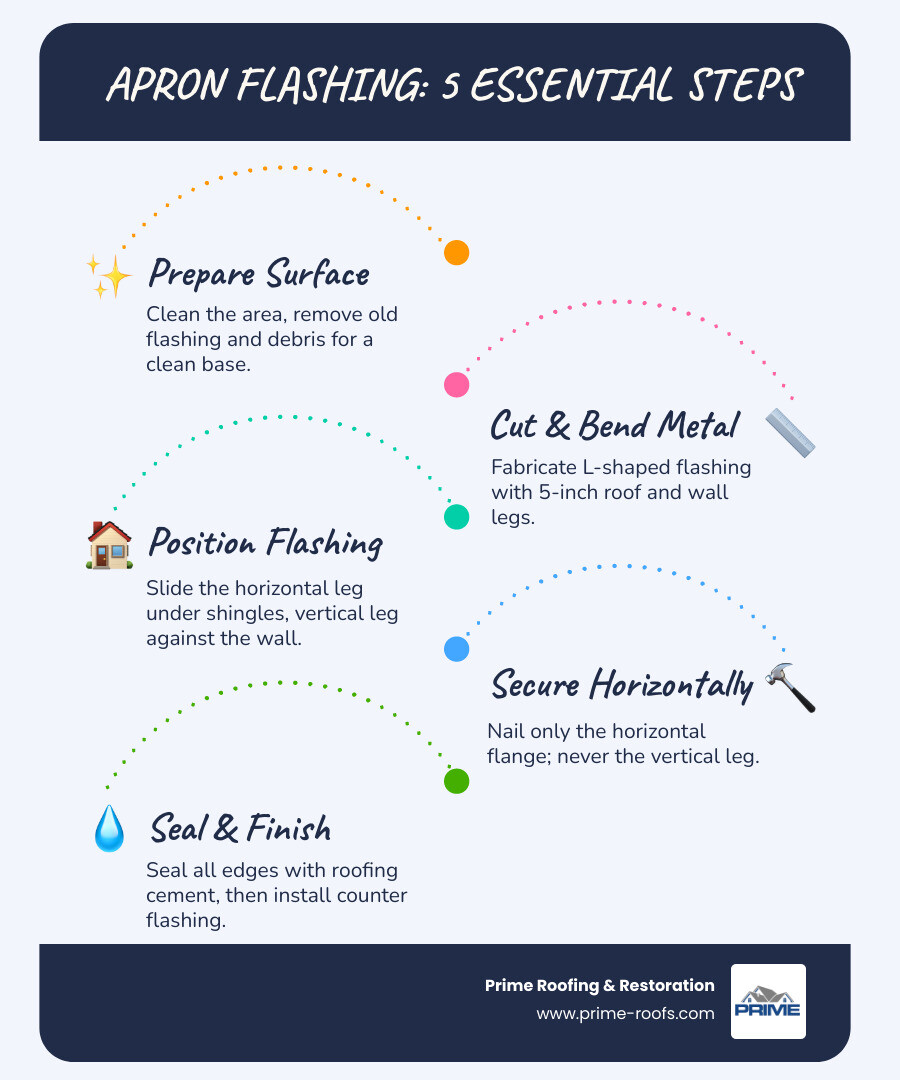
Here’s the quick version of how it works:
- Clean and prep the area — remove old flashing and debris, ensuring the substrate is dry and free of rot.
- Cut and bend metal to a 90-degree angle with a 5-inch roof leg and a 5-inch wall leg using a professional metal brake.
- Slide it into position with the horizontal leg under the shingles and the vertical leg against the wall, ensuring a tight fit.
- Nail only the horizontal flange — never the vertical leg — within 1 inch of the upper edge to allow for thermal expansion.
- Seal all edges with roofing cement or high-grade polyurethane sealant to prevent wind-driven rain from entering.
- Install counter flashing over the top for a complete, watertight system that utilizes gravity to shed water.
Poor flashing is one of the leading causes of roof leaks — and at Prime Roofing & Restoration, we see it every season. Improperly installed apron flashing ranks among the top five roofing failures in home additions and bump-outs, often because general contractors skip the monolithic through-wall metal and rely on caulk alone. In the humid and storm-prone climate of Central Alabama, where heavy downpours are a weekly occurrence, these shortcuts are a recipe for disaster.
That single shortcut leads to rot, mold, damaged insulation, and costly structural repairs — all of which could have been avoided with a proper installation. According to the National Roofing Contractors Association (NRCA), flashing is the most vulnerable part of any roof system, and apron flashing is the first line of defense at horizontal transitions.
I’m Bill Spencer, Owner and President of Prime Roofing & Restoration, serving Central Alabama with licensed, code-compliant roofing solutions. Over my years leading hands-on roof installations and repairs across the Gulf Coast region, apron flashing installation has proven to be one of the most misunderstood — and most critical — details in any roofing project. In this guide, I’ll walk you through everything you need to know to get it right the first time, ensuring your home remains a dry sanctuary for decades to come.
Apron flashing installation further reading:
Understanding Apron Flashing’s Critical Role in Preventing Roof Leaks
When we talk about a roof being “watertight,” most people think of shingles. However, shingles are designed to shed water down a flat plane; they aren’t great at stopping water where that plane hits a vertical wall. This is where apron flashing installation becomes your home’s best friend. Without it, water running down a wall or chimney would simply slip behind the shingles, soaking the roof deck and eventually the interior ceiling.
The Physics of Water Management: Shedding vs. Sealing
To understand why apron flashing is necessary, you have to understand how water behaves on a roof. Water follows the path of least resistance. When it hits a vertical wall, it flows downward. If there is a gap where the wall meets the roof, gravity pulls that water into the gap. Apron flashing acts as a bridge. By placing one leg of the metal under the shingles and the other up the wall, you create a continuous surface that water cannot penetrate. This is known as “positive drainage.”
Defining the Apron Component: Structure and Function
The “apron” gets its name because it drapes over the roof shingles just like a kitchen apron drapes over your clothes. It is a continuous, L-shaped metal profile. One “leg” sits flat on the roof deck (usually tucked under the shingles above it), while the other “leg” stands up against the vertical wall or chimney. This design creates a seamless transition that forces water to stay on top of the roofing material rather than slipping behind it. In professional circles, this is often referred to as “base flashing” when used at the bottom of a vertical surface.
Key Installation Locations: Where Apron Flashing is Indispensable
We typically install apron flashing in four high-stakes areas where the risk of water intrusion is highest:
- Chimney Bases: Specifically on the downslope side of the chimney. This is the most common failure point in older homes.
- Dormer Fronts: Where the front wall of a dormer meets the main roof slope. These areas catch a significant amount of runoff from the dormer roof.
- Skylight Edges: On the bottom edge of the skylight frame. Skylights are notorious for leaking if the flashing isn’t perfectly integrated.
- Roof-to-Wall Junctions: Any spot where a lower roof (like a porch or an addition) meets a taller house wall. This is a frequent site of rot in home additions.
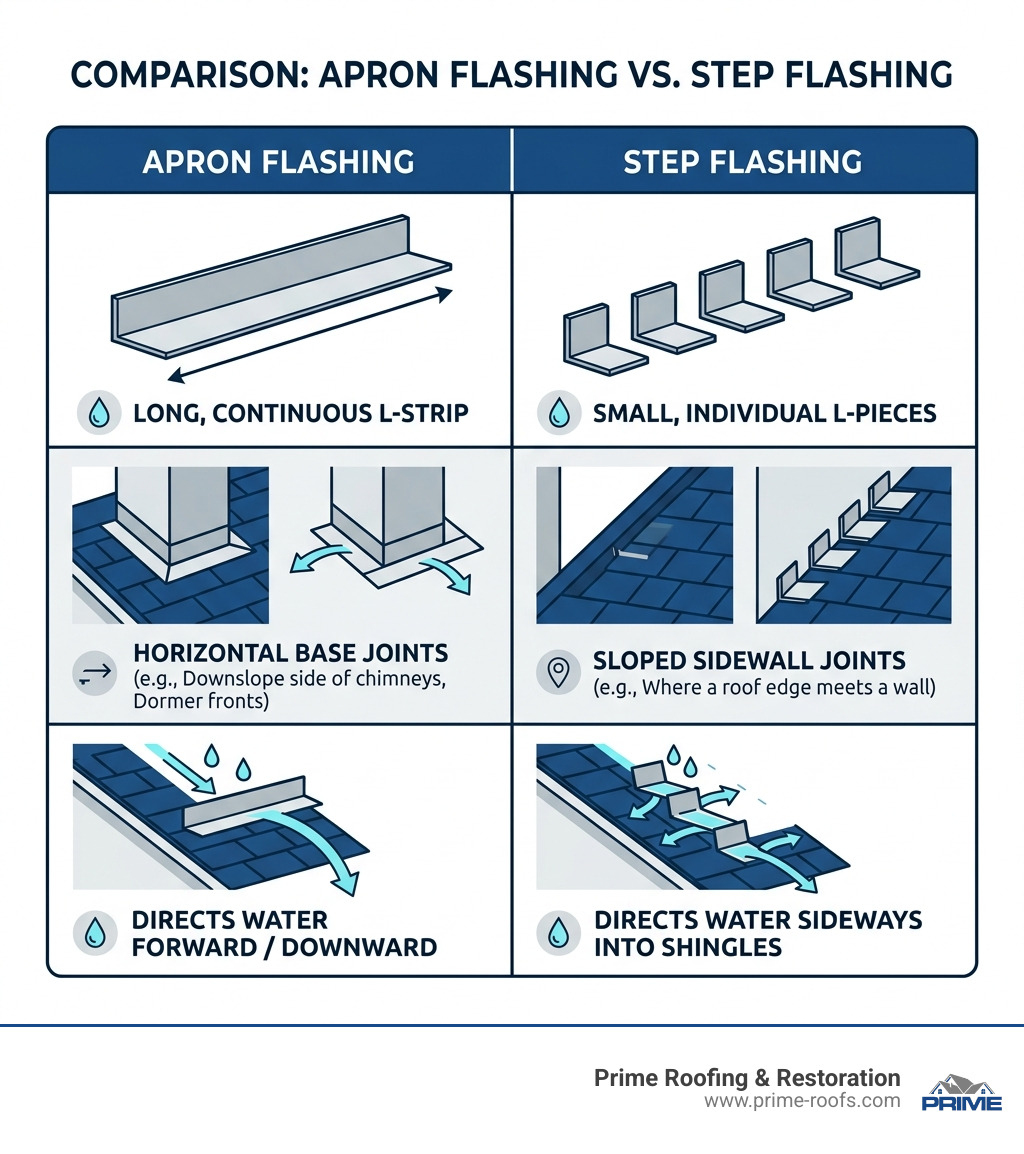
| Feature | Apron Flashing | Step Flashing |
|---|---|---|
| Shape | Long, continuous L-strip | Small, individual L-pieces |
| Location | Horizontal base joints | Sloped sidewall joints |
| Water Flow | Directs water forward/downward | Directs water sideways into shingles |
| Visual | Often visible at the base | Layered and mostly hidden |
| Installation | Installed in one long run | Installed piece-by-piece with shingles |
| Primary Risk | Improper sealing at ends | Missing pieces or improper overlap |
Essential Tools and Premium Materials for Durable Apron Flashing
You can’t achieve a professional apron flashing installation with a pair of kitchen scissors and some duct tape. Quality matters, especially in the humid, storm-prone climate of Alabama. The materials you choose will determine whether your roof lasts 10 years or 50 years.
Selecting the Optimal Metal: Durability and Performance
Not all metals are created equal. The choice of material often depends on the budget, the architectural style of the home, and the local environment.
- Galvanized Steel: The industry standard. Most building codes, including those in Alabaster and Hoover, require at least 26-gauge galvanized steel. It’s cost-effective, rigid, and holds its shape well during installation. However, it can eventually rust if the zinc coating is scratched or worn away.
- Aluminum: Great for coastal areas because it resists salt-air corrosion. It is more malleable than steel, making it easier to work with. However, you must never let raw aluminum touch wet concrete or masonry, as the alkaline nature of the mortar will cause rapid corrosion (pitting).
- 16-Ounce Copper: The gold standard. It’s incredibly durable (lasting 50+ years) and develops a beautiful patina over time. Copper can be soldered for a 100% watertight seal, which is why it’s often used on high-end historic homes. It is the most expensive option but offers the best ROI for long-term protection.
- Lead Sheeting: Used primarily around chimneys because it is highly malleable and can be “dressed” or molded to fit irregular masonry shapes. While less common today due to environmental concerns, it remains a favorite for complex restoration work.
Choosing the Right Sealants and Fasteners
We don’t just nail it and leave. The accessories are just as important as the metal itself.
- Polyurethane Sealant: Far superior to standard silicone or acrylic caulk. Polyurethane stays flexible as the house settles and has much higher UV resistance. We recommend brands like Vulkem or SolarSeal.
- Galvanized Nails: To prevent “bleeding” rust stains on your beautiful shingles. Always use 1.25-inch or 1.5-inch roofing nails with a wide head.
- Roofing Cement: Used sparingly to bond shingles to the flashing flange. Too much cement can trap water, so it must be applied with precision.
The Importance of Gauge and Thickness
In the roofing world, a lower gauge number means thicker metal. For apron flashing installation, we never use anything thinner than 26-gauge steel or 0.019-inch aluminum. Thinner metals are prone to “oil canning” (warping) and can be easily punctured by falling branches or hail. If you are dealing with water issues at the edge of your roof, you might also need to repair kickout flashing roof components to ensure water isn’t being funneled into your siding.
Step-by-Step Guide to Professional Apron Flashing Installation
Ready to get to work? Follow this professional process to ensure your installation stands up to the next Alabama thunderstorm. This process requires patience and precision; rushing through the flashing is the most common reason for call-backs in the roofing industry.
1. Preparation and Measurement
First, clear the area. If you’re doing a roof repair, remove the old, rusted flashing carefully with a pry bar. Inspect the underlayment and the wood decking beneath. If the wood is soft or discolored, it must be replaced before proceeding. We recommend installing a high-quality ice and water shield underlayment at least 3 to 4 inches up the vertical wall before the flashing goes on.
Pro Tip: Your flashing units should be at least 10 inches long and roughly 2 inches wider than your shingle exposure. For example, if your shingles show 5 inches, your flashing should be 7 inches wide to ensure proper coverage.
2. Bending and Positioning
Using a metal hand brake, bend your metal to a 90-degree angle. We aim for a 5-inch roof leg and a 5-inch wall leg.
- The “Under-Bend” Trick: Professionals often bend the metal slightly more than 90 degrees (about 95 degrees). This creates tension so that when you press it into the corner, it hugs the surfaces tightly without leaving a gap.
- The Kick-Out: At the very end of the run, ensure the flashing is bent slightly outward to direct water away from the wall and into the gutter system.
3. Securing the Flange
This is where most DIYers fail. Never nail the vertical flange to the wall. Houses are dynamic structures; they settle, expand, and contract with temperature changes. If you nail the flashing to both the roof and the wall, the metal will buckle and tear when the house shifts, creating a leak.
- Nail the horizontal flange only. Place nails within 1 inch of the top edge, spaced about 12 inches apart. This allows the vertical leg to “float” against the wall.
- The vertical leg should be held in place by the siding or counter flashing that overlaps it. This overlap should be at least 2 inches.
4. Overlapping and Seaming
If your wall is longer than a single piece of flashing (usually 10 feet), you must overlap the pieces.
- The 6-Inch Rule: Always overlap pieces by at least 4 to 6 inches.
- Direction Matters: Always install the lower piece first and overlap the upper piece on top of it. This ensures that water flowing down the flashing stays on the outside of the metal.
- Seal the Lap: Apply a bead of polyurethane sealant between the two pieces of metal at the overlap for extra security against wind-driven rain.
5. Final Sealing and Shingle Integration
Once the metal is secured, the shingles must be integrated. The shingles above the flashing should overlap the horizontal leg by at least 2 inches. Use a small amount of roofing cement to bond the shingle to the metal, but do not seal the very bottom edge of the shingle. This allows any moisture that gets behind the shingle to escape—a concept known as “weeping.”
Advanced Techniques: Integrating Apron Flashing with Complex Roof Structures
When dealing with chimneys or complex additions, apron flashing installation becomes a bit of an art form. It requires a deep understanding of how different materials interact and how water moves around obstacles.
Best Practices for Chimneys and Masonry
A chimney is a heavy masonry structure that settles differently than the rest of your wooden house frame. To handle this “differential movement,” we use a two-part system that is standard in high-end roofing:
- The Apron (Base Flashing): Secured to the roof deck and bent up against the chimney.
- The Counter Flashing (Cap Flashing): Tucked into a “reglet” (a groove cut into the mortar) and draped over the apron.
This “floating” system allows the chimney and the roof to move independently without breaking the watertight seal. According to the International Residential Code (IRC), if your chimney is wider than 30 inches, you are required to install a cricket — a small peaked roof structure behind the chimney — to divert water. We personally recommend a cricket for anything over 24 inches to be safe, especially in areas with high leaf debris which can clog the area behind a chimney. For more on this, check our guide on chimney flashing repair.
Handling Roof-to-Wall Transitions in Additions
In many Central Alabama homes, additions like sunrooms or master suite bump-outs are common. These often feature a lower roof meeting a taller wall. The mistake many contractors make is failing to remove the siding before installing the flashing.
- The Right Way: Remove the bottom two courses of siding. Install the apron flashing directly against the house wrap (sheathing). Then, reinstall the siding over the vertical leg of the flashing, leaving a 1-inch gap between the bottom of the siding and the roof surface. This prevents the siding from wicking up moisture and rotting.
Avoiding Common Mistakes
- Insufficient Overlap: If you are joining two pieces of flashing, you need a minimum of 4 inches of overlap. We prefer 6 inches in high-wind areas like the Gulf Coast or during Alabama’s tornado season.
- Nailing the Vertical Leg: As mentioned, this is a recipe for buckled metal and leaks. It is the #1 mistake we see in DIY projects.
- Ignoring the “Kick”: A small 5-degree outward bend at the very bottom of the apron helps “kick” water away from the wall and onto the shingles, preventing water from running down the face of the siding.
Maintenance, Cost Considerations, and Adherence to Building Codes
Even the best apron flashing installation needs a check-up. We suggest an annual inspection to look for signs of trouble, particularly after the heavy spring storm season in Alabama. Maintenance is the difference between a $500 repair and a $15,000 roof replacement.
Identifying Signs of Failure
- Rust Spots: Especially common on older galvanized steel. If you see orange streaks, the protective zinc coating has failed, and the metal is thinning.
- Sealant Gaps: Sun and heat can dry out old roofing cement or low-quality caulk, causing it to crack and pull away from the metal.
- Loose Shingles: If the shingles over the flashing are sliding, it’s a sign the bond has failed. See our tips on repairing loose shingles.
- Interior Water Stains: If you see brown spots on the ceiling near a wall or chimney, the flashing is likely the culprit.
Understanding the Investment
How much does this cost? While prices vary based on the complexity of the roof, here are some general guidelines:
- Materials: Galvanized steel is roughly $3–$5 per linear foot, while copper can jump to $15–$30. High-quality polyurethane sealant adds about $10–$15 per tube.
- Professional Labor: Expect to pay between $45 and $85 per hour. A complex chimney job may take 4-6 hours of meticulous work.
- Total Project: A standard apron flashing job for a chimney or dormer typically ranges from $350 to $850. While it might seem steep for a piece of metal, it is significantly cheaper than a $10,000 structural repair caused by a slow leak that rots your wall studs.
Navigating Building Codes and Insurance
In Alabama, we follow the International Residential Code (IRC). Key standards include:
- Use of corrosion-resistant materials (galvanized, copper, or aluminum).
- Minimum 26-gauge thickness for steel.
- Proper integration with the drainage plane (the house wrap or underlayment).
- Insurance companies often look at flashing during inspections. If your flashing is rusted or improperly installed, they may deny coverage for water damage or refuse to renew your policy until it is fixed. Proper documentation of a professional installation can help in these scenarios.
Frequently Asked Questions About Apron Flashing
What is the fundamental difference between apron and step flashing?
Think of it this way: Step flashing is for the “stairs” (the sloped sides of a wall), while apron flashing is for the “landing” (the flat horizontal base). Step flashing is installed piece-by-piece with each row of shingles, whereas apron flashing is one long, continuous run. Both are necessary for a complete water management system.
Is apron flashing a mandatory requirement by building codes?
Yes. The IRC and ARMA (Asphalt Roofing Manufacturers Association) both specify that flashing must be installed at all roof-to-wall intersections. Without it, your roof will not pass a professional home inspection, which can complicate the sale of your home.
Can apron flashing installation be a DIY project?
If you are comfortable on a ladder and have a metal brake, you can handle a small shed. However, for your primary residence, we strongly recommend professional installation. One small gap in the sealant or one misplaced nail can lead to a leak that stays hidden inside your walls for years, rotting your studs from the inside out. The risk-to-reward ratio for DIY flashing is generally poor.
How long does apron flashing typically last?
If installed correctly using galvanized steel, it should last 20-25 years, matching the lifespan of a standard asphalt shingle roof. Copper flashing can last 50-70 years. The sealant is usually the first thing to fail, typically needing replacement every 10-12 years.
Can I paint my apron flashing to match my roof?
Yes, but you must use the right primer. For galvanized steel, you need a DTM (Direct-To-Metal) primer that is compatible with zinc. Standard latex paint will peel off within a year. Painting can actually extend the life of the metal by providing an extra layer of UV protection.
Why is my new flashing “oil canning” or warping?
This usually happens if the metal was nailed too tightly or if the vertical leg was nailed to the wall. As the metal heats up in the Alabama sun, it expands. If it has nowhere to go, it buckles. This is why we only nail the horizontal flange.
Does apron flashing work with metal roofs?
Yes, but the profile is slightly different. Metal roofs use a specific “headwall flashing” that is designed to lock into the metal panels. The principle of shedding water remains the same, but the fastening method differs.
What should I do if I see rust on my flashing?
If the rust is surface-level, you can sand it down, apply a rust-inhibiting primer, and paint it. However, if the rust has created pits or holes, the entire section must be replaced. Patching holes with roofing cement is only a temporary fix and will eventually fail.
Conclusion: Secure Your Home with Expert Apron Flashing from Prime Roofing & Restoration
Your home is likely your biggest investment, and the details matter. At Prime Roofing & Restoration, we don’t just “slap on” some metal and call it a day. We pride ourselves on building lasting relationships through quality craftsmanship, transparent pricing, and code-compliant installations that stand the test of time.
Whether you’re in Alabaster, Hoover, Pelham, or anywhere across Central Alabama, our team of licensed experts is available to protect your home. Don’t let a minor flashing issue turn into a major restoration project. We use only the highest-grade materials and follow the strict guidelines set by the Asphalt Roofing Manufacturers Association (ARMA) to ensure your roof is bulletproof.
If you need a professional eye on your roof transitions, contact the best roofers in Alabaster, AL today. We offer comprehensive inspections and detailed estimates to give you peace of mind.
Contact Information
Prime Roofing & Restoration
1000 Corporate Dr, Suite 100, Alabaster, AL 35007
Phone: 205-555-0123
Hours: Monday – Friday: 7:00 AM – 6:00 PM | Saturday: 8:00 AM – 12:00 PM
Call us for a free, no-pressure consultation at 205-555-0123. Let’s make sure your roof is ready for whatever the Alabama sky throws at it!
(Map Placeholder: Interactive Google Map of Alabaster, AL Service Area)