
When Storms Hit, the Wrong Contractor Can Make Things Worse
How to find trustworthy contractors for storm damage repair is the most critical knowledge a homeowner can possess after severe weather impacts their property. When a storm tears through Central Alabama, the immediate aftermath is often a blur of fallen branches, missing shingles, and the sound of chainsaws. In this state of high stress, homeowners are at their most vulnerable. The urgency to protect your family and your investment can lead to hasty decisions that predatory “storm chasers” are waiting to exploit.
To ensure your property is restored to its pre-storm condition, you need professional roofing and restoration services that prioritize quality, transparency, and long-term accountability. A quick fix today can lead to a structural failure tomorrow if the underlying damage isn’t addressed by a professional who understands the nuances of storm-related structural stress.
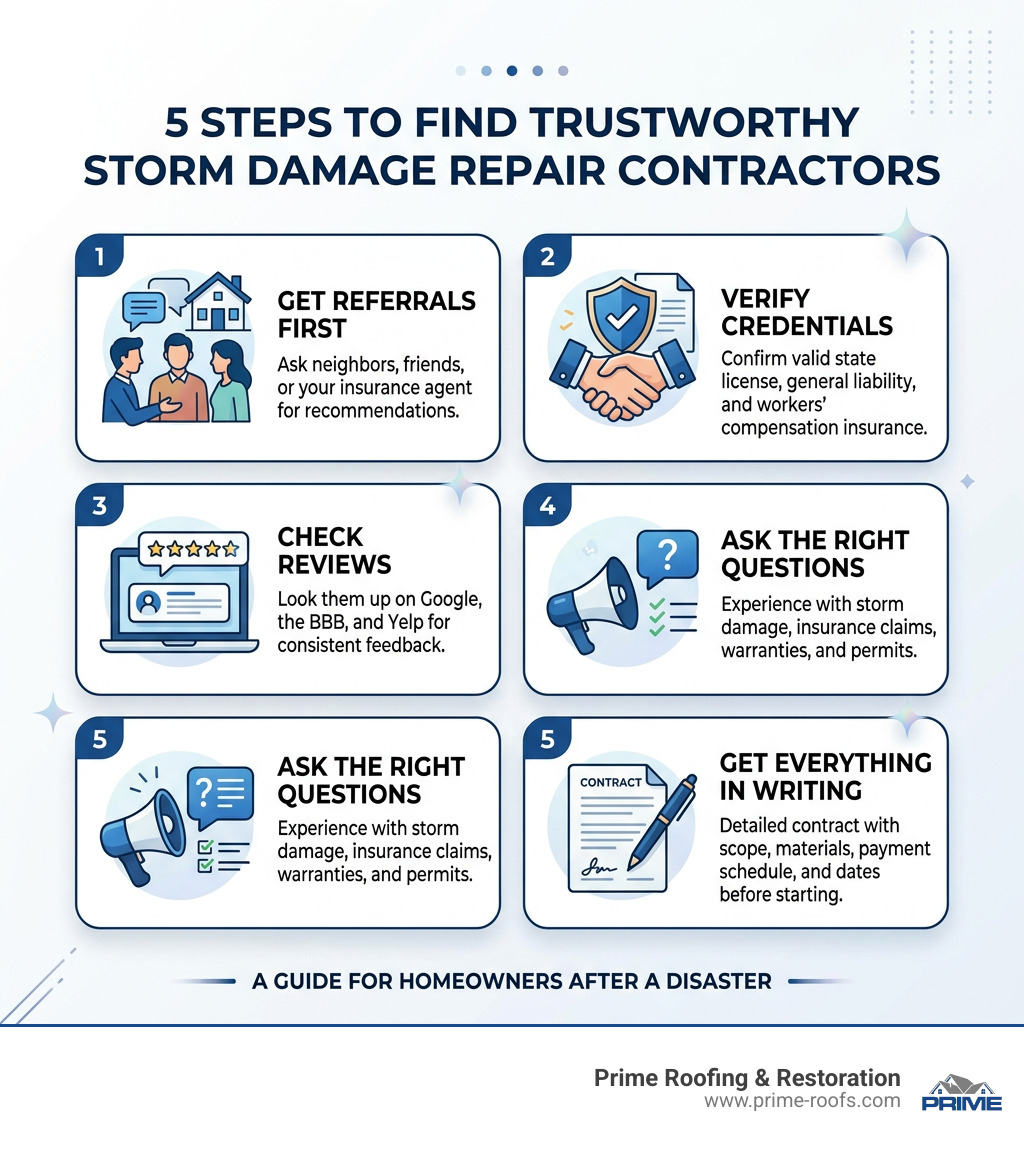
5 Comprehensive Steps to Find a Reliable Storm Damage Contractor:
- Prioritize Local Referrals – Start with your immediate circle. Ask neighbors, friends, or your insurance agent for recommendations. A contractor who has successfully completed work on your street is more likely to be invested in their local reputation.
- Rigorous Credential Verification – Don’t just ask if they are licensed; ask for the license number and verify it with the Alabama Licensing Board for General Contractors. Confirm they carry both general liability and workers’ compensation insurance to protect you from legal liability.
- Deep-Dive Review Analysis – Look beyond the star rating. Read reviews on Google, the BBB, and Yelp. Look for consistent, verified feedback over a period of years, not just a sudden influx of reviews following a recent storm.
- Strategic Interviewing – Ask the right questions regarding their specific experience with storm damage, their process for handling insurance claims, the specifics of their warranties, and how they handle local municipal permits.
- The Ironclad Written Agreement – Never allow work to begin without a detailed contract. This must include the full scope of work, specific materials to be used, a milestone-based payment schedule, and firm start and end dates.
A storm can leave your home exposed and your nerves frayed. That urgency is exactly what predatory contractors count on. Every year, after major weather events, neighborhoods across Alabama get flooded with door-knockers offering quick fixes. For those looking for reliable roofers in Alabaster, AL, taking a few extra hours to vet your contractor properly can be the difference between a lasting repair and a recurring nightmare.
Expert storm damage restoration requires licensed professionals who understand local building codes, insurance documentation, and the specific damage patterns caused by Alabama’s severe weather. Whether it’s the high-velocity winds of a tornado or the impact of large-scale hail, each type of damage requires a specific restoration approach.
I’m Bill Spencer, Owner and President of Prime Roofing & Restoration – a licensed Alabama contractor (License #30275) with an A+ BBB rating, and I’ve helped hundreds of Central Alabama homeowners navigate exactly how to find trustworthy contractors for storm damage repair after major weather events. In this guide, I’ll walk you through every step of the process so you can make a confident, informed decision.
Terms related to how to find trustworthy contractors for storm damage repair:
Spotting Red Flags: How to Avoid “Storm Chasers” and Scams

When a major hailstorm or high-wind event hits Alabaster or Hoover, a specific type of contractor often follows: the “storm chaser.” These are typically out-of-state companies that travel from county to county following weather maps provided by meteorological services. While not every traveling contractor is a scammer, many operate without local roots, meaning if your roof leaks a year from now, they will be long gone, and your “lifetime warranty” will be worth nothing more than the paper it’s printed on.
The first sign of a storm chaser is an unsolicited offer. If someone knocks on your door or leaves a flyer claiming they “noticed damage from the street,” be on high alert. Reputable local companies are usually busy responding to existing customers after a storm and rarely need to go door-to-door with high-pressure sales tactics. They rely on their reputation and established presence in the community.
Watch for these common warning signs:
- Unmarked Vehicles: Professional contractors invest in their brand. If they arrive in a plain white van or a truck with out-of-state plates, they likely lack a permanent local presence. A local pro will have branded vehicles that you’ve likely seen around town for years.
- Cash-Only Demands: Never pay in cash. Legitimate businesses use traceable payment methods like checks or credit cards. Cash payments are untraceable and often lead to the contractor disappearing before the work is finished.
- High-Pressure “Sign Now” Tactics: If they insist you sign a contract before they even get on the roof, or claim that a “special deal” expires today, walk away. You should always have time to review your options and consult with your insurance company.
For more protection, we recommend checking the State Attorney General’s guide on consumer protection to understand your rights during a declared disaster. Learning how to find trustworthy contractors for storm damage repair starts with saying “no” to the first person who knocks on your door.
Identifying Predatory “Deductible Eating” Schemes
One of the biggest red flags in the industry is a contractor offering to “cover,” “waive,” or “eat” your insurance deductible. While this sounds like a great deal, it is actually illegal in many states, including Alabama. This practice is often marketed as a “free roof,” but there is no such thing in the insurance world.
Insurance policies are legal contracts. When a contractor inflates an estimate to cover a deductible, they are committing insurance fraud. This puts you, the homeowner, at significant financial and legal risk. If a contractor is willing to cheat an insurance company, they will likely have no problem cutting corners on your roof installation to make up the difference. They might use lower-grade shingles, skip the replacement of flashing, or reuse old underlayment.
Warning Signs in Communication and Equipment
Trustworthy pros carry themselves with professionalism. This means wearing branded uniforms, carrying professional business cards, and using local phone numbers. If a contractor only provides a cell phone number with an out-of-state area code and has no physical office address in Alabama, they are likely a “fly-by-night” operation.
Always ask for verbal promises to be put in writing. A “handshake deal” offers zero protection when the clouds clear and the contractor disappears. Furthermore, check their equipment. Are their ladders in good repair? Do they have safety harnesses? A contractor who ignores safety regulations is likely to ignore quality standards on your roof as well.
The Verification Checklist: How to Find Trustworthy Contractors for Storm Damage Repair
Don’t take a contractor’s word for it—verify their credentials yourself. In Alabama, any project over $10,000 (which most storm repairs are) requires a state-licensed contractor. You can check a company’s standing through the Alabama Licensing Board for General Contractors.
Here is your essential verification list:
- General Liability Insurance: This protects your property if the contractor causes damage. For example, if a heavy bundle of shingles is dropped and cracks your driveway or a worker accidentally puts a foot through your ceiling, this insurance covers the repairs.
- Workers’ Compensation: This is critical. If a worker is injured on your roof and the contractor doesn’t have “workers’ comp,” you could be held liable for their medical bills and lost wages. Never hire a contractor who cannot provide a current Certificate of Insurance (COI) showing active workers’ comp coverage.
- Bonding: This provides a layer of financial protection if the contractor fails to complete the job or pay their suppliers. If a contractor doesn’t pay for the shingles they put on your house, the supplier can actually place a lien on your home. Bonding helps mitigate this risk.
Beyond basic legal requirements, look for manufacturer certifications. For example, GAF Master Elite status is only awarded to the top 2% of roofing contractors nationwide. These certifications ensure the team has undergone rigorous training and can offer enhanced warranties that are backed by the manufacturer itself. You can find more about licensed roof contractor requirements on our dedicated guide.
Leveraging Local Referrals: How to Find Trustworthy Contractors for Storm Damage Repair
The most reliable way to find a pro is through word-of-mouth. Talk to your neighbors who have already had work done. Ask them:
- Did the contractor show up on time and maintain a professional demeanor?
- Did they keep the job site clean and perform a thorough nail sweep with a magnet?
- Did the final price match the estimate, or were there “hidden fees” that appeared mid-project?
Another “insider” tip is to visit local supply stores or lumber yards. The people working the counters at these businesses know which contractors pay their bills on time and which ones do quality work. They see the professionals every morning and are often happy to provide a referral-based vetting of the local talent. If a contractor has a bad reputation with their suppliers, it’s a major red flag for you.
Vetting Online Reviews: How to Find Trustworthy Contractors for Storm Damage Repair
Online reviews are a goldmine of information, but you have to know how to read them. Don’t just look at the star rating; look for consistency. A company with 100 reviews over five years is generally more trustworthy than one with 50 reviews all posted in the last month (a common tactic for storm chasers trying to build a quick reputation after a disaster).
Check the Better Business Bureau (BBB) for any unresolved complaints. A trustworthy contractor will have a high rating and, more importantly, will have responded professionally to any criticism. Seeing how a company handles a mistake is often more telling than a string of perfect five-star reviews. Look for mentions of how they handled warranty claims or unexpected issues during the build.
Essential Questions to Ask Before Signing a Storm Repair Contract
Before you sign anything, you need to conduct a thorough interview. A reputable contractor will welcome these questions because they have nothing to hide. Use FEMA’s Checklist of Questions to Ask Your General Contractor as a starting point for your conversation.
Key questions include:
- How long have you been in business under this name? Many bad actors close one business and open another to escape a bad reputation or legal judgments. Look for a company with at least 5-10 years of local history.
- Do you have a local office nearby? A physical office indicates a commitment to the community. Avoid contractors who only operate out of a truck or a P.O. Box.
- Will you be using your own crews or subcontractors? If they use subcontractors, ask how long they have worked together and if the subcontractors are also insured.
- Who is my dedicated project manager? You need one point of contact who is responsible for the quality of the work and the safety of the site.
It is also vital to clarify who is responsible for permits. A trustworthy contractor will always pull the necessary permits and include the cost in their bid. If they ask you to pull the permit, it’s often because they aren’t licensed to do so or are trying to avoid municipal inspections. Check out our choosing a roofer guide for a full list of interview questions.
Experience with Specific Storm Damage Types
Storm damage isn’t always as obvious as a fallen tree. It takes a specialized eye to spot “hail bruising”—tiny indentations that compromise the shingle’s integrity by knocking off the protective granules—or “wind uplift,” where shingles are loosened but not blown off.
We specialize in hail damage roof repair, and we know that if these subtle issues aren’t documented correctly for your insurance company, you could face leaks years later when it’s too late to file a claim. Ask the contractor to show you photos of damage they’ve found on your roof and explain why it necessitates repair or replacement.
Understanding Workmanship and Material Warranties
There are two types of warranties: material and workmanship.
- Material Warranties: Provided by the manufacturer (like GAF or Owens Corning) against defects in the product. These can last 20, 30, or 50 years.
- Workmanship Warranties: Provided by the contractor against installation errors. This is where most issues arise.
The problem with storm chasers is that their workmanship warranty is only as good as their presence in town. If they leave the state, that warranty is effectively worthless. Local pros provide long-term protection and reciprocal relationships with manufacturers that ensure you are covered for decades. Ask if the workmanship warranty is transferable if you sell your home.
Navigating the Insurance Claims Process with a Professional Partner
The insurance process is often the most stressful part of storm recovery. This is where how to find trustworthy contractors for storm damage repair becomes truly critical. You need a partner who understands the language of insurance adjusters and the software they use to calculate costs.
A professional contractor will provide a detailed “Xactimate” estimate—the same software most insurance companies use—to ensure everyone is on the same page regarding costs. This minimizes the “gap” between what the contractor charges and what the insurance company pays. They should also be present when the insurance adjuster visits your home. This ensures that all damage is seen and accounted for in the initial report, preventing the need for multiple inspections.
For a deep dive into this process, see our insurance claims assistance guide.
The Role of the Contractor as Your Advocate
Your contractor should act as your advocate, not just a laborer. This includes:
- Evidence Collection: Taking high-resolution photos and videos of the damage immediately after the storm, including drone footage if necessary.
- Technical Explanations: Explaining to the adjuster why certain repairs are necessary to meet local building codes, such as the requirement for ice and water shield or specific flashing details.
- Supplement Filings: If additional damage is found during the repair (like rotted decking under the shingles), the contractor should handle the “supplement” process with the insurance company to ensure the extra costs are covered.
Getting a roof replaced on insurance shouldn’t feel like a battle. With the right pro, it’s a streamlined collaboration between you, the contractor, and the carrier.
Avoiding Common Insurance Claim Pitfalls
Time is of the essence. Most policies have a one-year window to file a claim, but waiting even a few months can make it harder to prove the damage was storm-related rather than just wear and tear.
Immediately after a storm, perform “temporary repairs” to prevent further damage—like tarping a leaking roof or boarding up broken windows. Keep all receipts for these emergency services, as they are usually reimbursable under the “Loss Mitigation” clause of your policy. Also, be aware that if you have a mortgage, the insurance check will likely be made out to both you and your mortgage company, requiring an extra step for endorsement before the contractor can be paid.
What Your Written Contract Must Include for Maximum Protection
Never rely on a verbal agreement, even with a contractor you like. A detailed written contract is your only legal protection if things go wrong.
| Feature | Vague Estimate (Avoid) | Detailed Contract (Required) |
|---|---|---|
| Scope of Work | “Repair roof damage” | Exact square footage, removal of old layers, replacement of flashing, and drip edge installation. |
| Materials | “New shingles” | Specific brand (e.g., GAF Timberline HDZ), color, and weight of shingles. |
| Timeline | “Starting soon” | Specific start date and estimated completion date, weather permitting. |
| Payment | “50% down” | Milestone-based payment schedule (e.g., 10% deposit, 40% on material delivery, 50% on completion). |
| Cleanup | Not mentioned | Daily debris removal, magnetic nail sweeping, and protection of landscaping. |
Your contract should also include “Lien Waivers.” These documents prove that the contractor has paid their material suppliers and subcontractors, protecting you from having a lien placed on your home if the contractor fails to pay their bills. For more details, consult our storm damage home repair complete guide.
Safe Payment Practices to Protect Your Investment
Standard practice is a small down payment (10-25%) to get on the schedule and cover initial administrative costs. Never pay the full amount upfront. If a contractor asks for the full payment before they’ve even delivered materials, they are likely using your money to finish a previous job.
Progress payments are acceptable for large projects, but the final 10-15% should always be withheld until:
- The work is 100% complete according to the contract.
- You have conducted a final walkthrough with the project manager and are satisfied.
- All debris, including small shingle scraps and nails, has been removed from your yard.
- You have received the final lien waivers from all major suppliers.
Ensuring Permit and Code Compliance
In Alabaster and Hoover, building codes are strictly enforced to ensure homes can withstand future storms. Your contractor must display the building permit prominently on-site. Once the job is finished, a municipal inspector will likely need to sign off on the work. This inspection is a vital safety net for you, ensuring the work meets legal standards and protects your property value. If a contractor tries to skip the permit process, they are putting your home’s safety and your future ability to sell the property at risk.
Why Local Expertise Matters for Alabama Storm Restoration
Alabama weather is unique and demanding. We deal with everything from intense summer heat that can blister shingles to sudden tornadic winds and heavy spring hailstorms. A local contractor understands these regional patterns and knows which materials perform best in our specific humidity and heat cycles. For instance, they might recommend shingles with higher algae resistance due to our humid climate.
Hiring local means you are supporting the Alabaster community. We are familiar with Alabaster storm damage resources and have established relationships with local adjusters and city officials. When you hire local roofing contractors, you aren’t just getting a repair; you’re getting a neighbor who will be here to stand behind their work for years to come. If a problem arises three years from now, you know exactly where our office is and how to reach us.
Furthermore, local contractors are familiar with the specific requirements of local Homeowners Associations (HOAs). We know which shingle colors are approved in neighborhoods like Wynlake or Weatherly, saving you the headache of a potential HOA violation after the roof is already installed.
Frequently Asked Questions about Storm Damage Contractors
How do I know if a contractor is truly “local”?
Verify their physical office address (not a P.O. Box), check for local area codes (like 205), and look for a long-standing history of permits pulled in your specific municipality. You can also ask for references from projects they completed in your neighborhood three or four years ago—storm chasers won’t have those. A truly local company will often have their logo on local little league jerseys or be members of the local Chamber of Commerce.
Is it safe to pay a contractor upfront for materials?
You should never pay the full amount upfront. A small down payment (typically 10-25%) is standard to secure your spot on the schedule. Reputable contractors usually have the credit lines with suppliers to secure materials and only require significant payment once materials are delivered to your driveway or work begins. If they claim they need your money to buy the shingles, it’s a sign of financial instability.
What should I do if my contractor disappears or does poor work?
Immediately contact your state or local agency that licenses or regulates contractors. In Alabama, this is the Licensing Board for General Contractors. You should also file a formal complaint with the State Attorney General’s office to initiate a dispute resolution process. If you suspect fraud, you can also contact the FEMA Disaster Fraud Hotline at 866-223-0814.
How long does a typical storm damage roof replacement take?
For a standard-sized home, the actual installation usually takes 1-2 days. However, the entire process—including the initial inspection, insurance adjustment, material ordering, and scheduling—can take anywhere from two weeks to two months depending on the severity of the storm and the backlog of the contractor.
Can I choose my own contractor if my insurance company recommends one?
Yes. You have the legal right to choose any contractor you want. While insurance companies often have “preferred providers,” these contractors may have agreements with the insurance company to keep costs low, which isn’t always in your best interest. You should choose the contractor you trust most to do the job correctly.
Conclusion
Finding the right professional is the most critical step in recovering from a disaster. By verifying licenses, asking the right questions, and insisting on a detailed contract, you protect your home from both the elements and unscrupulous actors. Don’t let the stress of a storm lead to a hasty decision. Take the time to vet, verify, and document every step of the process.
For homeowners in Alabaster, Hoover, and the surrounding areas, Prime Roofing & Restoration provides the licensed expertise and 24/7 emergency service needed to restore your peace of mind and your property. We are committed to quality, integrity, and our local community.
Need immediate help with storm damage? Contact our experts today for a free inspection.
Company Information
Prime Roofing & Restoration
1009 Guy St, Alabaster, AL 35007
Phone: 205-335-2419
Website: https://www.prime-roofs.com/
Find us on Google Maps:
View our Alabaster Location (Note: Replace with actual CID link if available)