
When a Storm Hits Your Business, Every Minute Counts
Commercial storm damage is any structural, water, or environmental harm caused to a business property by severe weather — including high winds, hail, heavy rain, tornadoes, and winter storms. For a business owner, this isn’t just a property issue; it is a threat to your livelihood, your employees’ safety, and your company’s reputation.
Here’s what you need to know right away:
- Most common types: Roof damage, water intrusion, wind damage, hail impact, structural compromise, and electrical disruption.
- First steps after a storm: Ensure safety, document all damage with photos, contact your insurer, and call a licensed restoration contractor.
- Biggest risk of waiting: Mold growth, structural failure, and potential insurance claim denial due to “failure to mitigate.”
- Who to call: A licensed commercial roofing and restoration contractor — not a general handyman or residential-only roofer.
Severe weather doesn’t send a warning. One storm can strip your roof, flood your interior, and halt operations — all before sunrise. The economic impact of downtime for a commercial entity can often exceed the cost of the physical repairs themselves. Every hour your doors are closed is an hour of lost revenue and potential customer churn.
The numbers make the physical risk clear. Normal thunderstorms produce winds between 22 and 55 MPH. However, the Gulf Coast and Central Alabama regions frequently experience hurricanes and tornadoes that push past 100 MPH. At around 90 MPH, no tree — regardless of size or species — can remain standing. For commercial buildings, which have larger surface areas and different aerodynamic profiles than homes, even winds over 50 MPH can cause serious structural damage, particularly to flat roofing systems like TPO or EPDM.
For Alabama business owners, that risk is real and recurring. The region faces a unique “double threat”: the spring tornado season and the late-summer hurricane season. When a storm hits, the speed and quality of your response directly determines how much it costs you — and how long you’re out of operation.
I’m Bill Spencer, Owner and President of Prime Roofing & Restoration, and I’ve spent more than five years leading storm response and commercial roofing services across Central Alabama and the Gulf Coast. Commercial storm damage is one of the most complex challenges a property owner can face. This guide is designed to be your comprehensive resource, walking you through exactly what to do — from the first hour after impact to the final insurance payout and reconstruction.
Commercial storm damage terms at a glance:
Identifying the Most Common Types of Commercial Storm Damage
When a storm rolls through Alabaster, Hoover, or Birmingham, it doesn’t just bring rain; it brings a cocktail of destructive forces. Understanding the specific nature of the damage is the first step in a successful recovery. We often see business owners confuse different types of damage, which can complicate insurance claims later. Each type of damage requires a specific restoration protocol to ensure the building’s long-term integrity.
| Damage Type | Primary Cause | Visible Signs | Long-Term Risk |
|---|---|---|---|
| Wind Damage | High-velocity gusts, tornadoes | Lifted shingles, torn TPO membranes, missing siding | Structural instability, secondary leaks |
| Hail Impact | Frozen precipitation | Dents in metal, “bruised” asphalt, cracked skylights | Accelerated roof aging, hidden leaks |
| Water Intrusion | Heavy rain, flash flooding | Ceiling stains, wet insulation, foundation cracks | Mold growth, electrical hazards |
| Impact Damage | Fallen trees, flying debris | Punctured roofs, broken windows, damaged HVAC | Immediate safety hazards, total exposure |
The Nuances of Wind and Impact Damage
Wind doesn’t just blow against a building; it creates “uplift.” On a flat commercial roof, wind can get under the edges of a membrane or flashing, peeling it back like a sardine can. This is particularly common in older buildings where the adhesive or mechanical fasteners have weakened over time. We also see significant damage from flying debris. In a severe storm, even a small branch becomes a projectile capable of puncturing a TPO or EPDM roof.
According to the National Weather Service, “high winds” are defined as sustained speeds of 40 mph or gusts of 58 mph—speeds that easily compromise commercial roofing systems. If you have trees near your property, remember the 90 mph rule: no tree can withstand sustained winds of that magnitude. When they fall, they don’t just damage the roof; they can compromise the entire structural skeleton of your building, leading to a total loss if not addressed immediately.
Hail Damage: The Silent Killer of Commercial Roofs
Hail damage is often the most misunderstood form of commercial storm damage. Unlike a fallen tree, hail damage isn’t always visible from the ground. On a flat roof, hail can cause “micro-fractures” in the membrane. While it might not leak today, these fractures allow moisture to seep into the insulation layer over time. This leads to “wet insulation,” which loses its R-value and eventually causes the roof deck to rot from the inside out. For metal roofs, hail can damage the protective coating, leading to premature rusting and failure. Identifying these issues early is why professional roof repair for wind and hail damage is essential.
Water and Flood Damage: Beyond the Surface
Water is the most persistent enemy of any commercial property. Once the exterior envelope is breached—whether by wind or hail—water finds the path of least resistance. This often leads to foundation cracks, saturated wall assemblies, and ruined inventory. Because commercial buildings often have complex HVAC and electrical systems located on the roof or in basements, water intrusion can lead to massive equipment failure.
It is crucial to understand the difference between wind and water damage as defined by FEMA. Wind damage is typically an exterior issue that leads to interior problems, while floodwater damage often involves rising water from the ground up. This distinction is vital because most standard commercial policies treat them as separate coverage events. If you are dealing with the aftermath of a deluge, our Storm Damage Cleanup Complete Guide offers deeper insights into the sanitation and drying process.
Immediate Steps and the Restoration Process

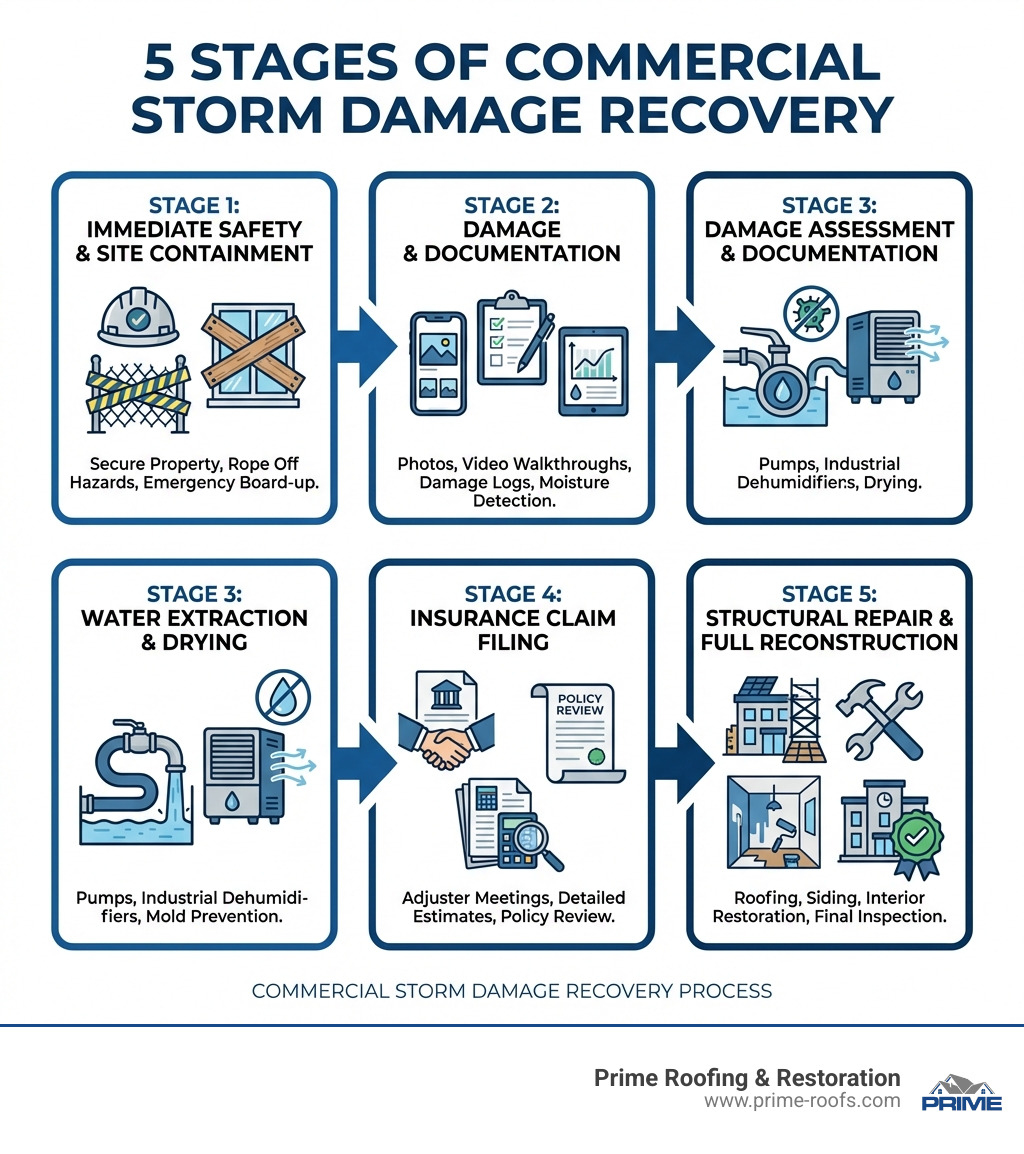
The first 24 to 48 hours after commercial storm damage occurs are the most critical. Your primary goal is “mitigation”—taking reasonable steps to prevent further damage. If you fail to mitigate, your insurance company may actually deny parts of your claim, arguing that the secondary damage (like mold or additional water rot) was preventable.
The 4-Step Emergency Protocol
- Safety First: Do not enter the building if there is standing water near electrical outlets or if you see sagging ceilings. Structural integrity can be compromised in ways that aren’t immediately obvious. Turn off the main power and gas if it is safe to reach the shut-off valves.
- Contact Professionals: Call a 24/7 restoration team to begin site containment. This includes boarding up broken windows and tarping roof breaches. At Prime Roofing & Restoration, we prioritize emergency calls to ensure your property is secured against the elements and vandals.
- Water Extraction: If there is standing water, industrial-grade pumps must be deployed immediately. Every hour water sits, it wicks further up into drywall and insulation.
- Dehumidification: Once the bulk water is gone, we use high-capacity dehumidifiers and air movers to pull moisture out of the air and building materials. This is a scientific process called psychrometrics, where we monitor temperature and relative humidity to ensure the environment is conducive to drying.
Knowing what to do after a storm damages your roof can save you tens of thousands of dollars in avoided interior repairs.
Documenting Commercial Storm Damage for Insurance
Before we move a single piece of debris or start the drying process, we document everything. Your insurance adjuster wasn’t there when the storm hit, so you need to provide photographic evidence that tells the story of the event.
- Photos and Video: Take wide shots of the entire property and close-ups of specific damage points (dented gutters, torn shingles, water stains). Don’t forget the roof and the perimeter fence.
- Asset Inventory: Create a detailed log of damaged office equipment, electronics, and inventory. Include model numbers and approximate purchase dates if possible.
- Moisture Mapping: Our team uses infrared cameras and moisture meters to find water hidden behind walls or under flooring that the naked eye can’t see. This documentation is vital for proving the full extent of the loss to the insurance company.
The Professional Restoration Timeline
How long does it take to get back to business? While every project is unique, here is a general breakdown of the phases:
- Phase 1: Emergency (Hours 1-24): Site stabilization, board-up, and water extraction.
- Phase 2: Drying (Days 2-5): Industrial dehumidification and moisture monitoring. We don’t stop until the moisture readings hit “dry standards.”
- Phase 3: Assessment (Days 5-10): Full damage report, line-item estimating, and insurance adjuster meetings.
- Phase 4: Reconstruction (Weeks 2-6+): Permanent roof repairs, drywall replacement, flooring, and painting. The duration depends on material availability and the scale of the structural damage.
For a more granular look at these phases, check out our Storm Damage Repair Complete Guide.
Navigating Insurance Claims and Recovery
Filing a commercial insurance claim is significantly more complex than a residential one. You aren’t just dealing with “replacement cost”; you’re dealing with “business interruption,” “extra expense coverage,” and “code upgrades.” A mistake in the filing process can result in a payout that doesn’t even cover the cost of materials.
The process of filing a claim starts with a phone call to your agent, but it shouldn’t end there. We strongly recommend having your restoration contractor present when the insurance adjuster arrives. Why? Because adjusters are often handling dozens of claims at once and may miss “collateral damage”—the small signs of hail on an HVAC unit or the micro-cracks in a roof membrane that will lead to leaks in six months.
Understanding Your Policy: ACV vs. RCV
One of the biggest shocks for business owners is the difference between Actual Cash Value (ACV) and Replacement Cost Value (RCV).
- ACV pays you what the item was worth at the time of the damage (depreciated value).
- RCV pays you what it actually costs to replace the item today. Most commercial policies are RCV, but they often pay out the ACV portion first and withhold the “depreciation” until you prove the work has been completed. Navigating this “recoverable depreciation” is a key part of our service.
If you’re feeling overwhelmed, our guide on navigating storm damage roofing services and insurance claims provides a step-by-step checklist to ensure you don’t leave money on the table.
Maximizing Your Claim Payout
To get a fair payout, you need a “line-item” estimate using industry-standard software like Xactimate. This isn’t just a lump sum; it’s a detailed breakdown of every nail, shingle, and hour of labor required.
We also look for “Code Upgrades.” If Alabaster building codes have changed since your roof was installed, your insurance may be required to pay for the extra cost to bring the new roof up to modern standards (e.g., increased insulation thickness or specific wind-rating fasteners). Our Storm Damage Repair Services team specializes in identifying these often-overlooked expenses.
Risks of Delaying Storm Repairs
We’ve seen it happen too often: a business owner sees a small leak, puts a bucket under it, and waits for “busy season” to end before calling us. By then, the damage has tripled.
- Mold Infestation: Mold can begin growing in as little as 24-48 hours in the humid Alabama climate. Once it’s in the HVAC system, the remediation costs skyrocket.
- Structural Failure: Wet wood rots, and wet metal rusts. Over time, this compromises the load-bearing capacity of your roof, leading to potential collapse under the weight of the next heavy rain.
- Claim Denial: Insurance policies usually have a “statute of limitations” (often one year). If you wait too long to report or repair damage, they may argue the damage was caused by “neglect” rather than the storm, giving them legal grounds to deny the claim.
Why Specialized Commercial Restoration Outperforms General Contractors
A commercial building is not just a “big house.” The materials are different, the codes are stricter, and the stakes are higher. While a general contractor might be great at remodeling a bathroom, they often lack the specialized equipment and knowledge needed for commercial storm damage.
Advanced Technology for Accurate Assessment
We use advanced technologies that most general contractors don’t even own:
- Infrared Thermography: This allows us to find “cold spots” that indicate moisture trapped in flat roof insulation. Without this, you might replace the membrane but leave wet insulation underneath, which will eventually fail.
- Industrial Dehumidifiers: We use LGR (Low Grain Refrigerant) dehumidifiers capable of removing 200+ pints of water per day, even in low-humidity environments.
- Moisture Meters: We use both invasive and non-invasive meters to ensure building materials are truly dry before we “seal” them with new drywall or flooring.
- Drone Inspections: For large-scale commercial roofs, drones provide high-resolution imagery of damage that might be missed during a manual walk-through.
Safety and Compliance
Commercial restoration sites are subject to strict OSHA regulations. From fall protection on high-slope roofs to hazardous material handling (like asbestos in older buildings), a specialized contractor ensures the project is compliant. This protects you, the business owner, from liability issues that could arise if an untrained worker is injured on your property.
Choosing a Licensed Expert in Alabama
In Alabama, roofing companies come and go. In fact, the average roofing company only stays in business for two to three years. Prime Roofing & Restoration is built on a foundation of longevity and local trust. When looking for a partner, always verify they have an Unlimited Home Builder’s License (if applicable to the structure) or the appropriate commercial credentials. This ensures they are legally authorized to handle large-scale structural repairs. If you’re in the Alabaster area, we’ve compiled a specific resource for Alabaster Storm Damage to help you find local, licensed help quickly.
Proactive Strategies to Minimize Future Commercial Storm Damage
While we can’t stop the wind from blowing, we can certainly make your building a harder target. Prevention is always cheaper than restoration. A proactive approach not only protects your physical assets but can also lead to lower insurance premiums over time.
The Importance of Maintenance
- Annual Roof Inspections: Catch small flashing issues, clogged drains, or loose fasteners before they become “blow-offs” during a storm. We recommend inspections in the spring and fall.
- Gutter and Drain Maintenance: On flat roofs, “ponding water” is a major cause of collapse during heavy rain. If your scuppers and drains are clogged with debris, the weight of the water can exceed the roof’s design capacity.
- Trim Overhanging Branches: Remember the 90 mph wind rule. Don’t let a tree be the reason your business closes. Keep branches at least 10 feet away from the building envelope.
- Invest in TPO: For many commercial properties, TPO roofing offers excellent wind and heat resistance. Modern TPO is engineered to withstand significant impact and high-velocity winds.
Documenting Your Maintenance History
A well-maintained roof is a resilient roof. We find that buildings with documented maintenance histories have a much easier time with insurance claims. It proves that the damage was caused by the “act of God” (the storm) and not “wear and tear” or “lack of maintenance.” For a deep dive into local maintenance standards, see our Alabaster Storm Damage Complete Guide.
Developing an Emergency Ready Plan (ERP)
Every business should have a “Go-Bag” for their property. This isn’t a physical bag, but a digital folder (stored in the cloud) containing:
- Site blueprints and utility shut-off locations.
- Off-site backups of all financial and client records.
- Contact lists for your insurance agent, key employees, and a preferred storm damage cleanup expert.
- A priority list of what equipment needs to be moved or protected first (e.g., servers, specialized machinery).
- Pre-loss photos: Take photos of your building in its current, undamaged state. This provides a baseline for the insurance company to see exactly what changed after the storm.
Frequently Asked Questions about Commercial Storm Damage
How long does it typically take to restore a commercial property?
Restoration timelines vary based on damage severity. Minor wind damage might be repaired in a few days. However, if there is significant water intrusion or structural compromise, the process of drying, permitting, and reconstruction can take several weeks or even months. We always provide a detailed project schedule after our initial assessment to help you plan your business operations.
Why is 24/7 emergency response critical for businesses?
Every hour that water sits in your building, the repair bill grows. 24/7 response allows us to “stop the bleed” by tarping the roof and starting the drying process before mold takes hold. It also helps you reopen faster, which is vital for maintaining your customer base and fulfilling contracts.
Does insurance cover all types of storm damage?
Most commercial policies cover wind, hail, and fire. However, flood damage (water rising from the ground) usually requires a separate policy through the National Flood Insurance Program (NFIP) or a private flood insurer. It’s also important to note that “cosmetic” damage to a roof may not be covered if it doesn’t impact the roof’s function, depending on your specific policy language.
What is “Business Interruption Insurance”?
This is a critical component of many commercial policies. It is designed to cover the loss of income that a business suffers after a disaster. It can help pay for ongoing expenses like payroll, rent, and taxes while your building is being repaired. We can work with your accountant to provide the necessary documentation for these claims.
Can I choose my own contractor, or do I have to use the one the insurance company recommends?
In almost all cases, you have the legal right to choose your own contractor. While insurance companies have “preferred vendors,” these vendors often have pre-negotiated rates that may lead to “corner-cutting.” It is usually in your best interest to hire an independent, local expert like Prime Roofing & Restoration who works for you, not the insurance company.
How do I know if my roof has hail damage if it isn’t leaking?
Hail damage is often invisible to the untrained eye. It manifests as “bruising” or loss of granules on shingles, or small indentations on flat roof membranes. Over time, the sun’s UV rays degrade these weakened areas, leading to leaks months later. A professional inspection using moisture detection tools is the only way to be sure.
What should I do if my insurance claim is denied?
Don’t panic. Claims are often denied due to a lack of evidence or a misunderstanding of the policy. You can request a re-inspection, hire a public adjuster, or work with a contractor who is experienced in “supplementing” claims with additional evidence. We have successfully helped many clients overturn initial denials by providing more detailed documentation.
Conclusion
Prime Roofing & Restoration provides the specialized expertise and 24/7 emergency response required to protect your business from the devastating effects of Alabama weather. From initial damage assessment to final reconstruction and insurance claim assistance, our team ensures your property is restored to pre-loss condition with minimal downtime.
We serve business owners across Alabaster, Hoover, and the surrounding Central Alabama region. Don’t wait for the next storm to compromise your investment—contact our licensed experts today for a comprehensive property evaluation. We are committed to building lasting relationships through quality workmanship and transparent communication.
Need help now? Call us 24/7 at 205-453-1803.
Company Information
Prime Roofing & Restoration
1120 1st St N, Alabaster, AL 35007
Phone: 205-453-1803
Website: www.prime-roofs.com
Service Area: Alabaster, Hoover, Birmingham, and Central Alabama.
Find us on the map:
View our Alabaster Location on Google Maps (Note: Replace with actual CID link if available)