
Why Commercial Roofing in Alabama Demands More Than the Average Roof
Commercial roofing Alabama business owners depend on must do far more than keep out the rain. It has to survive hurricane-force winds, softball-sized hail, relentless humidity, and some of the most tornado-prone skies in the entire United States. In the Deep South, a roof is not just a structural component; it is a critical shield for your business assets, employees, and operational continuity.
Alabama is situated in a unique meteorological crossroads. While the Midwest has “Tornado Alley,” Alabama sits in the heart of “Dixie Alley,” a region known for violent, fast-moving tornadoes that often occur at night. Furthermore, the Gulf Coast regions, including Mobile and Orange Beach, face the annual threat of tropical cyclones. This means your commercial roof must be engineered to meet stringent wind uplift requirements and moisture management standards that are far more rigorous than those in more temperate climates.
| Key Factor | What Alabama Business Owners Need to Know |
|---|---|
| Annual precipitation | Birmingham averages 55.4 inches per year; Mobile exceeds 65 inches. |
| Storm seasons | Tornado peak (March-May & Nov-Dec), Hurricane season (June-November) |
| Hail damage threshold | 1.5″ = moderate damage; 2.75″ = severe damage (Baseball size) |
| Most common systems | TPO, EPDM, PVC, Metal, Modified Bitumen |
| Maintenance frequency | At least twice per year + after every major storm event |
| Restoration vs. replacement | Coatings can extend roof life 15 years at up to 50% less cost |
| What to look for in a contractor | Licensed, insured, manufacturer-certified, local experience, A+ BBB rating |
Alabama’s climate is genuinely punishing on commercial buildings. A flat roof that performs fine in the arid Southwest will fail rapidly in the humid, rain-heavy environment of Birmingham or Montgomery. The combination of extreme heat (often exceeding 100°F with high UV indices), heavy seasonal rainfall, and violent storm events creates a uniquely demanding environment. The wrong roofing decision can lead to catastrophic interior damage, lost inventory, and significant business downtime.
This guide covers everything Alabama property owners need to make smart, confident decisions about their commercial roof — from choosing the right system to navigating insurance claims after a storm. For businesses ready to take action now, our commercial roofing services are built specifically for Alabama’s climate and code requirements.
I’m Bill Spencer, Owner and President of Prime Roofing & Restoration, with locations in Alabaster and Orange Beach, Alabama. With over five years leading a team that specializes in this specific environment, my hands-on experience with commercial roofing in Alabama—from flat TPO systems on industrial warehouses to storm-damaged metal roofs along the Gulf Coast—informs every recommendation in this guide.
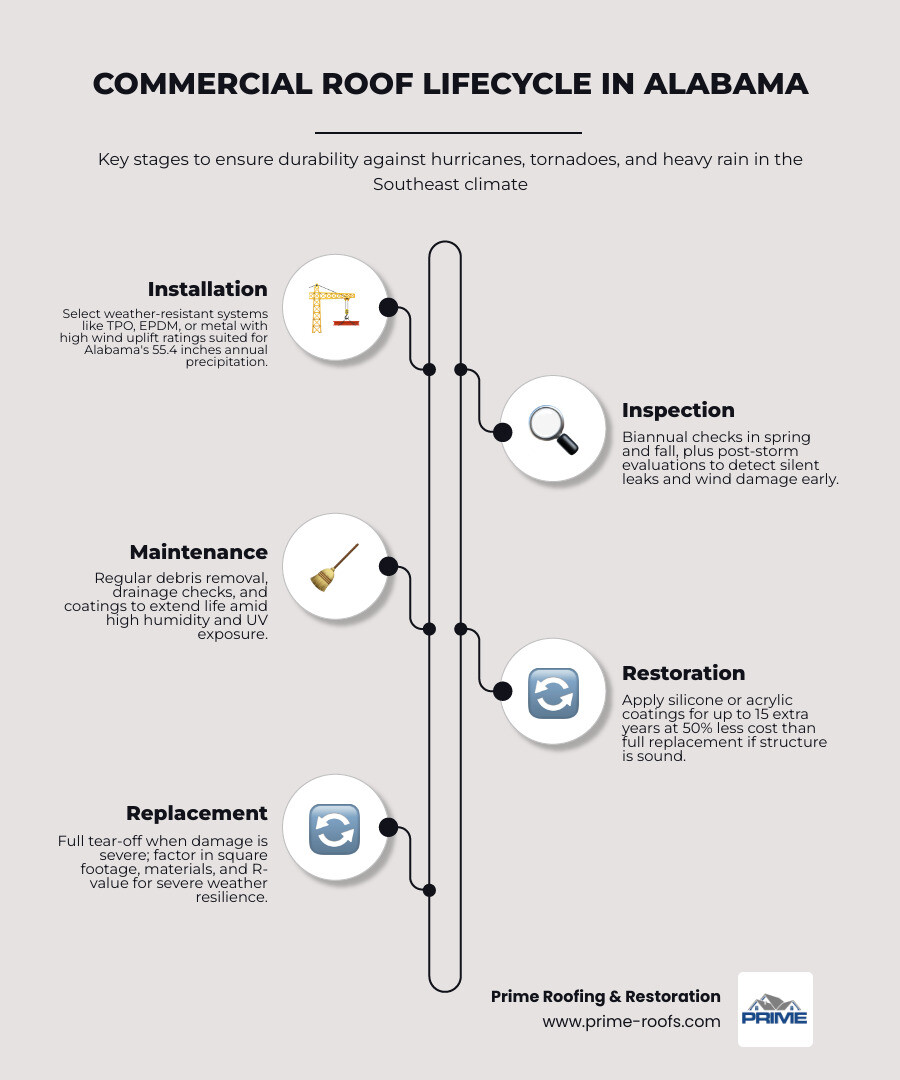
Basic Commercial roofing Alabama vocab:
Essential Guide to Commercial Roofing Alabama
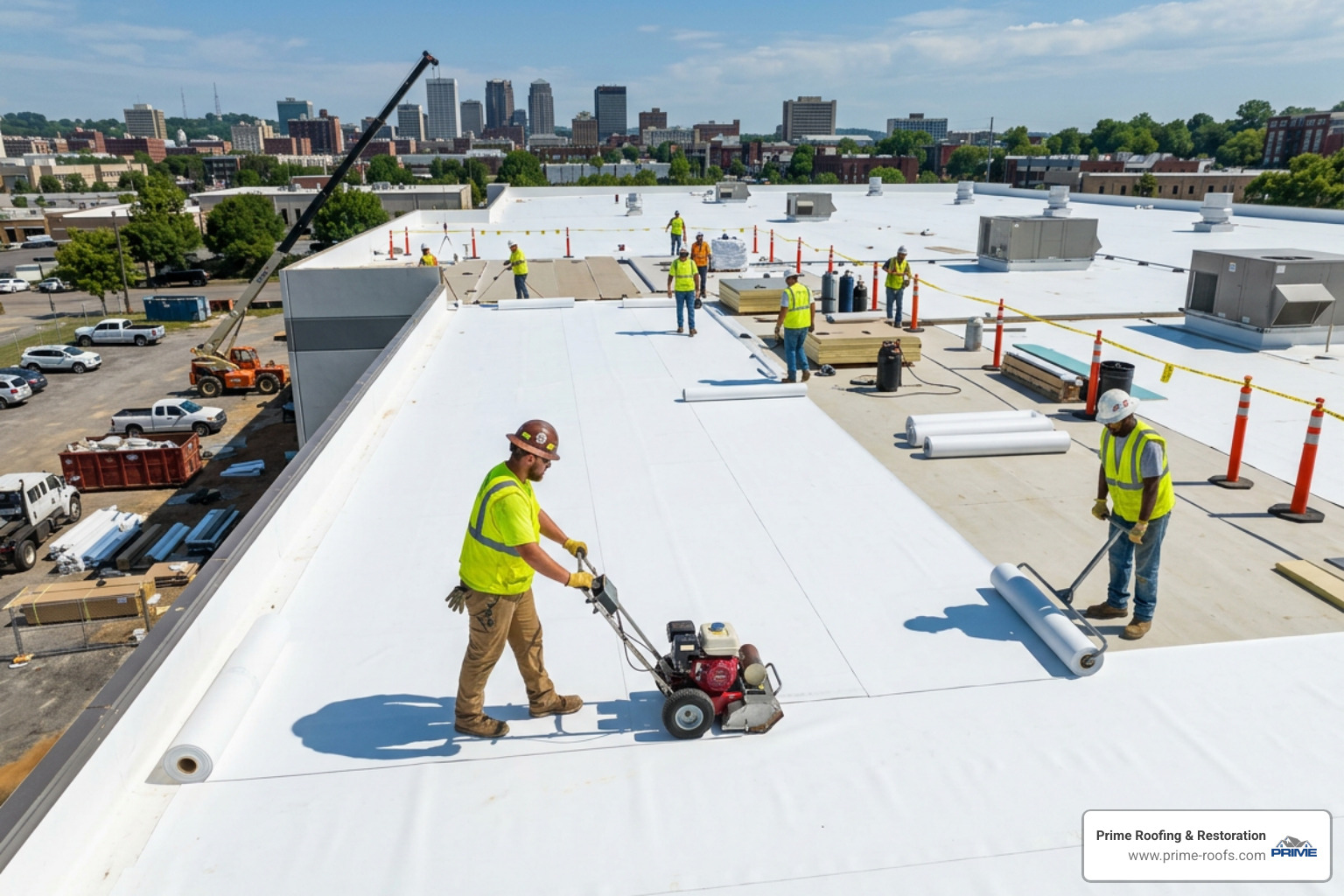
Whether you are managing a warehouse in Birmingham, a retail center in Huntsville, or an office complex in Montgomery, the roof over your head is your first line of defense. Navigating your options with our Commercial Roofing Near Me Guide and the comprehensive Commercial Roof Services Guide 2025 ensures that your facility remains compliant with regional building codes and industrial standards.
In Alabama, commercial roofing isn’t a “set it and forget it” asset. Because of the high stakes involved—protecting expensive machinery, inventory, and employees—business owners must understand the nuances of the local market. This includes knowing which materials handle the UV load of a Southern summer and which contractors have the licensing to perform large-scale industrial work. According to the National Roofing Contractors Association (NRCA), proactive management can double the lifespan of a commercial roof, a fact that is especially true in the volatile Alabama climate.
Weather Resilience in Commercial Roofing Alabama
Alabama’s unique climate, marked by a distinct hurricane season and cities that rank among the most tornado-prone in the U.S., demands robust roofing solutions. With an average annual precipitation of 55.4 inches in areas like Birmingham, roofs must withstand significant moisture and potential ponding. In coastal areas, the salt-laden air adds another layer of complexity, requiring corrosion-resistant materials for metal components and fasteners.
At Prime Roofing & Restoration, we maintain an A+ BBB Rating, ensuring that our quality and reliability meet the high standards Alabama businesses deserve. Key considerations for weather resilience include:
- Wind Uplift Ratings: Essential for surviving the high-velocity winds associated with tornadoes and tropical storms. We adhere to ASCE 7 standards to ensure your roof stays attached during extreme pressure changes.
- Advanced Moisture Barriers: Crucial for preventing leaks during the heavy downpours common in the “Heart of Dixie.” This includes high-quality underlayments and vapor retarders.
- Reflective Surfaces: Necessary to combat the intense UV radiation that can prematurely age roofing membranes. A “cool roof” can significantly reduce the thermal expansion and contraction that leads to seam failure.
Specialized Services for Alabama Business Owners
Protecting your investment requires more than just a hammer and some nails. It requires expert services including precise leak detection, advanced thermal imaging to find hidden moisture, and rapid emergency repairs. Alabama’s high humidity can often mask slow leaks that lead to mold growth within the building envelope, making professional moisture surveys essential.
We recommend consulting our Commercial Roof Repair Contractors Guide and the Commercial Roof Repair Company Ultimate Guide for comprehensive solutions. These guides detail the importance of preventative maintenance programs and efficient drainage solutions, such as tapered insulation systems that ensure water moves off your roof rather than sitting on it. In Alabama, “ponding water” (water that stays on a roof for more than 48 hours) is the leading cause of premature membrane degradation and warranty voidance.
Navigating Alabama’s Severe Weather: Hurricanes, Tornadoes, and Hail
Alabama businesses face a challenging climate characterized by two distinct severe weather seasons. The hurricane window runs from June through November, while the peak tornado season typically strikes between March and May, with a secondary “mini-season” in November and December. During these times, your roof is under constant assault from wind, pressure differentials, and debris.
The Impact of Wind and Pressure
When a tornado or hurricane passes near a building, it creates a massive pressure differential. The air inside the building pushes up, while the high-velocity wind outside pulls the roof off—a phenomenon known as wind uplift. In Alabama, commercial roofs must be designed to resist these forces. We utilize the IBHS Fortified Commercial standards to provide enhanced protection against these events, focusing on stronger edge metal, reinforced fasteners, and superior adhesive patterns.
Hail is another major factor that property managers often overlook until it is too late. In Alabama, hail sizes are a direct indicator of potential damage:
- 1.5 inches: Moderate roof damage (dents in metal, bruising of membranes that can lead to leaks months later).
- 1.75 inches: Significant roof damage; likely to fracture the fiberglass mat in asphalt-based systems.
- 2.75 inches (Baseball size): Severe roof damage, often requiring immediate replacement to prevent total facility failure and structural compromise.
Roofs in cities like Birmingham, Hoover, and Alabaster must be designed to resist wind-borne debris, mitigate the impacts of high humidity (which can lead to mold and rot in poorly ventilated systems), and endure intense UV radiation exposure. According to NOAA, Alabama ranks among the top states for billion-dollar weather disasters, making the roof your most important insurance policy.
Top Commercial Roofing Systems for the Deep South
Choosing the right system is a balance of budget, building use, and longevity. Here is how the most popular systems stack up for the Alabama climate:
| System Type | Best Use Case | Alabama Advantage |
|---|---|---|
| TPO (Thermoplastic Polyolefin) | Retail, Offices, Warehouses | Highly reflective; lowers HVAC costs in hot summers. |
| Metal (Standing Seam) | High-wind areas, Industrial | Exceptional wind resistance and longest lifespan (50+ years). |
| EPDM (Rubber) | Large industrial footprints | Cost-effective and excellent at handling temperature swings. |
| PVC | Restaurants, Labs | Chemical and grease resistant; highly durable and fire-resistant. |
| Modified Bitumen | High-traffic roofs | Multi-layer protection that stands up to physical wear and punctures. |
For detailed insights into specific materials, refer to our Commercial Metal Roofing Companies Guide and the Complete EPDM Commercial Roofing Guide. You can also discover our full range of Services / Commercial Roofing, where we focus on energy efficiency and cool roof technology to help your bottom line.
Cost Factors for Commercial Roofing Alabama
Understanding the investment involves more than just a price per square foot. While TPO might cost between $5 to $12 per square foot depending on the complexity, other factors significantly impact the final quote. In Alabama, labor costs and material logistics can vary between the Birmingham metro area and the Gulf Coast.
Key cost drivers include:
- Insulation R-Value: Modern Alabama building codes (based on the IECC) require specific insulation levels. Using advanced Polyiso taper systems adds cost but prevents “ponding water,” which is the number one killer of flat roofs. Proper insulation also reduces the load on your HVAC system during 100-degree July days.
- Tear-off vs. Roof-over: Removing two layers of old roofing is more labor-intensive and involves higher disposal fees. However, a full tear-off allows for the inspection of the structural deck, which is vital in older Alabama buildings.
- Structural Load Analysis: Before a Commercial Roof Replacement, an engineer must ensure the building can handle the weight of the new system, especially if moving to a heavier material like Modified Bitumen or adding a ballasted system.
- Access and Complexity: Tall buildings in downtown Birmingham or facilities with numerous HVAC units, vents, and skylights require more specialized labor, safety equipment, and flashing details.
Benefits of TPO and Metal for Local Climates
TPO and metal roofing systems are the “gold standard” for Alabama for several reasons. TPO offers superior reflective properties, which is vital when the Alabama sun is beating down. This “cool roof” effect can reduce cooling costs by up to 30%, providing a rapid return on investment.
Standing seam metal roofs, meanwhile, are champions of durability. They are highly effective at heat gain reduction and are often the preferred choice for commercial metal roof contractors because they can be engineered to withstand the extreme wind zones found in coastal Alabama and tornado-prone northern counties. Many of these systems come with robust 20-year NDL (No Dollar Limit) warranties, providing ultimate peace of mind for the property owner.
Maximizing ROI: Maintenance, Restoration, and Insurance Claims
A commercial roof is a massive capital expenditure. To maximize your Return on Investment (ROI), you cannot ignore it until it leaks. Regular biannual inspections—ideally in the spring before tornado season and in the fall before winter rains—are crucial for identifying minor issues before they become five-figure repairs.
Our Commercial Roof Maintenance guide and Commercial Flat Roof Replacement Guide provide essential strategies for extending the life of your asset. One of the most effective ways to save money is through Roof Restoration.
The Power of Roof Coatings
If your roof is structurally sound but reaching the end of its design life, a silicone or acrylic coating can be a game-changer. This process involves cleaning the existing membrane, repairing seams, and applying a high-solids liquid coating that cures into a seamless, waterproof barrier. Benefits include:
- Extended Life: Add up to 15-20 years to your existing roof.
- Cost Savings: Restoration typically costs 50-70% less than a full tear-off and replacement.
- Tax Advantages: Restoration is often classified as a maintenance expense rather than a capital improvement, allowing for a 100% tax deduction in the year the work is performed under Section 179 of the tax code.
- Energy Efficiency: Reflects up to 85% of solar heat, significantly lowering ambient temperatures inside the building.
Navigating the Insurance Maze
When storms do hit, navigating insurance claims is the next hurdle. Alabama’s insurance market can be complex, and adjusters often miss the “silent” damage caused by hail or wind uplift. We provide detailed documentation, including thermal imaging and core sampling, to ensure your insurance company sees the full scope of the damage. This 3-step process—Evaluation, Documentation, and Restoration—is the fastest way to get your business back to normal operations. We work directly with your carrier to ensure that the scope of work meets all local building codes and manufacturer warranty requirements.
Choosing the Right Partner for Your Alabama Commercial Property
Don’t trust your business to a “storm chaser” with an out-of-state license plate. You need a partner who understands Alabama’s specific building codes, municipal requirements, and weather patterns. Select licensed, bonded, and insured contractors with elite certifications like GAF Master Elite or Firestone Building Products Red Shield status.
For local expertise, you can trust Commercial Roofers Near Me Alabaster AL. At Prime Roofing & Restoration, we provide:
- 24/7 Emergency Response: Because leaks don’t wait for business hours, especially during a hurricane or severe thunderstorm.
- Insurance Claim Assistance: We speak the language of adjusters and use Xactimate (the industry-standard estimating software) to get you the coverage you deserve.
- End-to-End Solutions: From minor repairs to massive industrial replacements and multi-family roofing projects.
Our Location and Contact Information
We are proud to serve the heart of Alabama from our Alabaster headquarters. Whether you are in Birmingham, Hoover, Pelham, or down on the Gulf Coast, we are your local roofing authority.
Prime Roofing & Restoration
1009 Guy St, Alabaster, AL 35007
Phone: 205-623-0151
Website: www.prime-roofs.com
Find us on the map:
View our Alabaster Location on Google Maps
Explore our insights on Local Commercial Roofing Companies to see how we stand out through our commitment to quality, safety, and lasting relationships with Alabama business owners.
Frequently Asked Questions about Alabama Commercial Roofing
How often should I schedule commercial roof inspections in Alabama?
Professional inspections should occur at least twice a year—ideally in the spring (before the peak tornado season) and fall (after hurricane season ends)—and immediately following any severe weather event. In Alabama, debris from storms can clog drainage systems, leading to ponding water that destroys membranes. A proactive approach is critical for long-term roof health and maintaining your manufacturer’s warranty.
Can a commercial roof be restored instead of replaced?
Yes, if the underlying structure is sound and the insulation is dry, a commercial roof coating (silicone or acrylic) is a fantastic option. It can extend the roof’s life by up to 15 years, improve energy efficiency, and cost significantly less than a full tear-off. It also minimizes business disruption since there is no loud “tear-off” process involved. We use infrared moisture scans to ensure restoration is a viable option for your specific building.
What are the most common signs of a commercial roof leak?
Common indicators include interior water stains on ceiling tiles, musty odors in the workplace, bubbling or “pillowing” in the roof membrane, and ponding water that remains for more than 48 hours after a rain. You might also notice a sudden increase in monthly energy bills, which often indicates that your roof insulation has become saturated with water and lost its R-value. If you see “alligatoring” on a bitumen roof, it’s a sign that the oils have dried out and the roof is failing.
What role does energy efficiency play in Alabama roofing?
In Alabama’s hot summers, a dark-colored roof can reach temperatures of 150°F or higher. Energy-efficient solutions like “cool roofs” (TPO or white coatings) reflect sunlight rather than absorbing it. This keeps the building interior cooler, reduces the strain on your HVAC systems, and lowers overhead costs for business owners. Many Alabama utilities also offer rebates for energy-efficient roofing upgrades.
How do I handle a storm damage insurance claim for my roof?
The first step is a professional evaluation by a qualified commercial roofer. We provide a detailed scope of work and photographic evidence of the damage. Having a licensed contractor present during the adjuster’s meeting ensures that no damage is overlooked, from wind-uplifted seams to hail-bruised membranes that might not be visible to the untrained eye. We help you navigate the entire process from filing the claim to the final inspection.
What is an NDL Warranty?
An NDL (No Dollar Limit) warranty is the gold standard in commercial roofing. Unlike a standard material warranty, an NDL warranty covers both labor and materials for the full term of the warranty (usually 10, 15, or 20 years) without a cap on the payout. This provides the ultimate protection for Alabama business owners against manufacturing defects or installation errors.
How long does a commercial roof replacement take in Alabama?
The timeline varies based on the size of the building and the material used. A typical 20,000-square-foot TPO replacement might take 1 to 2 weeks, depending on weather conditions. We work closely with business owners to minimize disruption to daily operations, often staging materials and performing loud work during off-peak hours.
Conclusion
Protecting your business in the “Heart of Dixie” requires a roofing system that is as tough as the Alabama weather. From the high winds of tornado alley to the torrential rains of hurricane season, your roof is the only thing standing between your assets and the elements. Investing in a high-quality commercial roof is not just a maintenance task; it is a strategic business decision that impacts your bottom line and long-term stability.
Prime Roofing & Restoration is your local expert for Commercial roofing Alabama. Based in Alabaster, AL, and serving the surrounding areas including Hoover, Birmingham, and the Gulf Coast, we are committed to using only the highest quality materials and building lasting relationships with our clients. Whether you need a simple leak repair, a cost-saving restoration coating, or a full-scale industrial replacement, our licensed experts are ready to help 24/7.
Don’t let your business leak in the Heart of Dixie—Call us today at 205-623-0151 for a comprehensive roofing solution and a free, no-obligation estimate. Let us help you protect what matters most with a roof built for Alabama’s unique challenges.