
Choosing the Right Local Commercial Roofing Company Can Save You Thousands
Local commercial roofing companies offer more than just roofing services; they provide peace of mind through expertise, accountability, and community investment. When your business needs reliable protection, choosing the right contractor can mean the difference between decades of worry-free performance and a constant cycle of costly future repairs. As a trusted commercial roofing contractor in Alabama, we understand that a single leak can disrupt operations, damage millions of dollars in inventory, compromise sensitive equipment, and put employees and customers at risk. Investing in a reputable local expert isn’t just a facilities management decision; it’s a critical business continuity strategy for your long-term success and profitability.
Quick Answer: What to Look for in Local Commercial Roofing Companies:
-
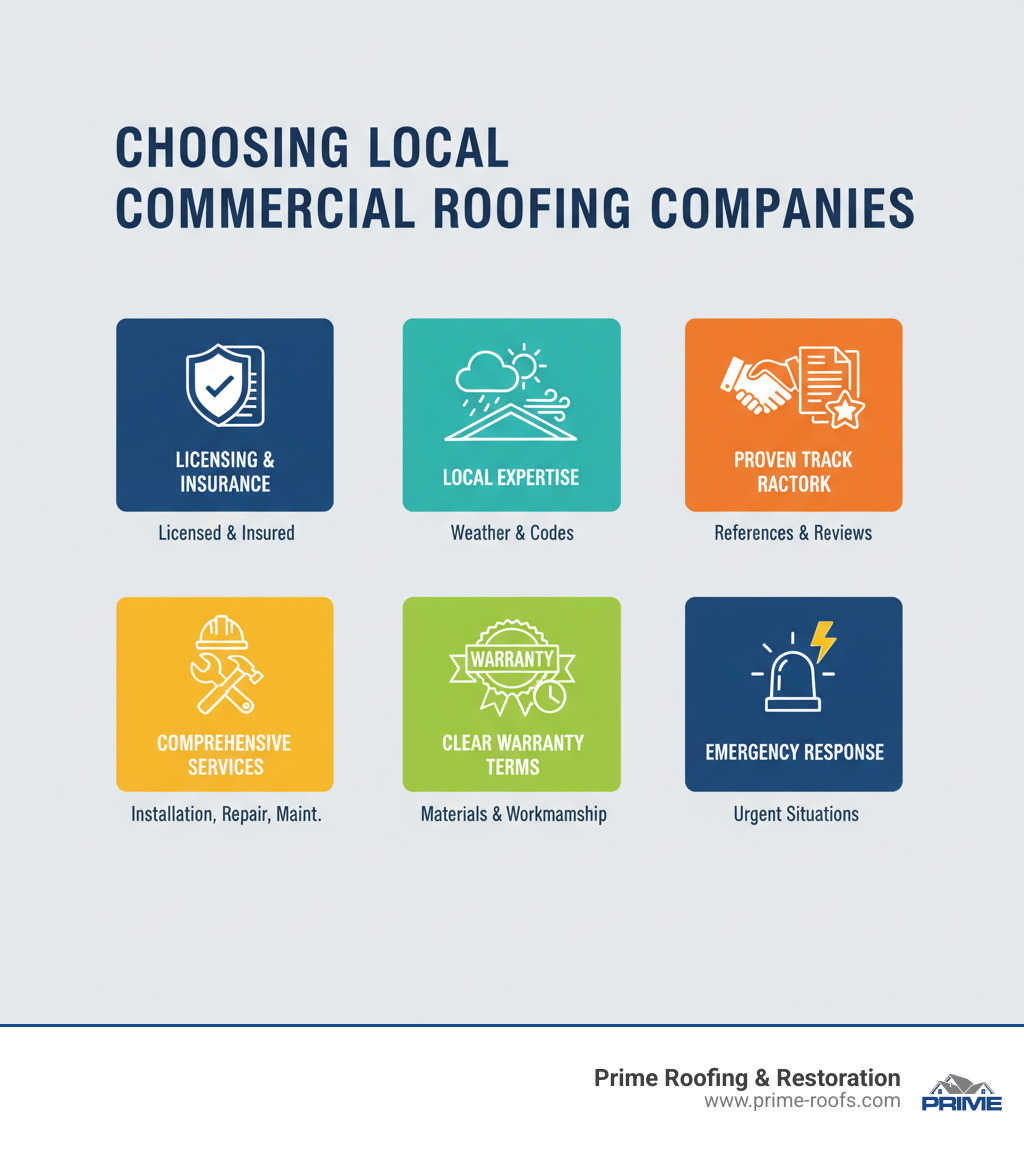
Licensed and Insured Contractors: This is the absolute baseline for any professional you consider. A valid license proves they meet state standards, while comprehensive general liability and workers’ compensation insurance protects you from any financial liability in case of accidents or property damage during the project. Never take a contractor’s word for it; ask for a certificate of insurance sent directly from their provider.
-
Deep Local Expertise: A roofer from another state won’t understand the specific challenges of Alabama’s climate. Local experts have firsthand experience with the intense UV radiation, high humidity, and severe weather events like hailstorms and hurricane-force winds that are common in our region. They know which materials and installation techniques hold up best against these specific threats and are well-versed in local building codes and permitting processes, preventing costly delays and violations.
-
A Proven Track Record: A reputable company will be proud to showcase its work. Look for a detailed portfolio of completed projects similar to yours. Scour online reviews on Google and other platforms for consistent themes in customer feedback. Are they praised for their communication, professionalism, and ability to stay on budget? Ask for a list of local references you can call to inquire about their experience firsthand.
-
Comprehensive Service Offerings: Your relationship with a roofing contractor shouldn’t end once the installation is complete. The best partners offer a full suite of services, including new construction installation, roof replacement, emergency repairs, and, most importantly, proactive maintenance programs. This ensures you have a single, trusted point of contact for the entire lifespan of your roof.
-
Clear, Understandable Warranties: A strong warranty is a sign of a contractor’s confidence in their work. You should receive two types of warranties: a manufacturer’s warranty covering material defects and a contractor’s workmanship warranty covering installation errors. A trustworthy roofer will take the time to explain the terms, conditions, and limitations of both in plain English.
-
Rapid Emergency Response Capabilities: When a storm tears a hole in your roof at 2 a.m., you can’t wait for a contractor from three states away to respond. A local company with a dedicated emergency response team can be on-site within hours to mitigate damage, protecting your assets and minimizing business disruption. This immediate availability is invaluable.
Commercial roofing projects are a significant capital expenditure, typically ranging between $5-$12 per square foot, with high-quality systems designed to last 20-30 years or more when properly installed and maintained. This investment is not just about protecting the building itself; it’s about safeguarding your business operations, your assets, and your bottom line from the top down.
Commercial Roofing 101: The Most Common Systems and How Long They Last
Your commercial roof is a critical business investment that affects everything from your building’s structural integrity and energy bills to employee comfort and safety. With most modern systems lasting 20 to 30 years, and some even longer, understanding the primary options available is essential for making a sound financial decision. Let’s walk through the most popular commercial roofing systems we install for businesses here in Alabama, exploring their unique characteristics, benefits, and ideal applications.
Built-Up Roofing (BUR)
Often called “tar and gravel” roofs, BUR systems are the time-tested workhorse of the commercial roofing industry, with a history spanning over 150 years. They are constructed on-site with multiple alternating layers of bitumen (asphalt) and reinforcing fabrics (plies), and then topped with a final layer of gravel, slag, or a mineral-coated cap sheet. This multi-layer design creates a thick, seamless, and highly redundant waterproof barrier.
- Pros: Exceptional durability, high resistance to punctures and foot traffic, excellent fire resistance, and a long, proven history of performance.
- Cons: Very heavy (requiring a strong roof structure), installation is labor-intensive and produces strong odors, and black surfaces absorb heat, increasing cooling costs.
- Best For: Buildings that require maximum durability and can support the significant weight, such as large industrial facilities and warehouses.
- Lifespan: 20-30 years with proper maintenance.
Single-Ply Membranes (TPO, EPDM, & PVC)
Single-ply membranes represent the modern evolution of flat and low-slope roofing, offering lightweight, flexible, and cost-effective solutions. These systems consist of a single layer of factory-manufactured material that is rolled out and secured to the roof deck, creating a continuous waterproof barrier.
-
TPO (Thermoplastic Polyolefin): Currently the most popular commercial roofing material in the U.S., TPO is the energy-efficient champion. Its standard white surface is highly reflective, bouncing sunlight away from the building to significantly reduce cooling costs during Alabama’s scorching summers. The seams are heat-welded together, forming a bond that is stronger than the membrane itself.
- Pros: Excellent energy efficiency, strong seam strength, good puncture resistance, and cost-effective.
- Cons: As a newer technology (compared to EPDM), its long-term performance is still being evaluated by some; seam quality is entirely dependent on installer skill.
-
EPDM (Ethylene Propylene Diene Monomer): Commonly known as rubber roofing, EPDM is a synthetic rubber membrane prized for its superior flexibility, durability, and proven performance over several decades. It easily accommodates building movement and extreme temperature fluctuations without cracking. While traditionally black, which absorbs heat, it is now available in white to improve energy efficiency.
- Pros: Exceptional flexibility and durability, proven track record of 40+ years, relatively simple installation, and cost-effective.
- Cons: Black EPDM absorbs heat; seams are sealed with adhesives, which can be a weaker point than welded seams over time; more susceptible to punctures than TPO or PVC.
-
PVC (Polyvinyl Chloride): This premium single-ply membrane is renowned for its exceptional resistance to chemicals, grease, fire, and punctures. Like TPO, its seams are heat-welded for maximum strength. This robustness makes it an ideal choice for specific commercial applications where other membranes might fail.
- Pros: Highly resistant to chemicals, oils, and grease; excellent fire rating; very durable and puncture-resistant; strong, welded seams.
- Cons: Higher initial cost compared to TPO and EPDM; less flexible in cold temperatures during installation.
- Best For: Restaurants (due to grease vent exhaust), airports, and industrial or manufacturing facilities that handle chemicals.
Metal Roofing
When ultimate longevity and durability are the primary goals, metal roofing is hard to beat. Systems made from steel, aluminum, or copper can regularly last 40 to 70 years or more, often outlasting the building itself. Standing seam metal roofs are particularly effective in high-wind situations—a crucial advantage in Alabama’s storm-prone climate—as the concealed fastening system provides superior wind uplift resistance. While the initial investment is higher, its exceptional durability, minimal maintenance requirements, and long lifespan often make it the most cost-effective choice over the long term.
Sustainable & Energy-Efficient Options
Modern roofing can be transformed from a passive shield into an active, energy-saving asset. Green roofs create living ecosystems on your rooftop, providing natural insulation, managing stormwater runoff to reduce strain on local drainage systems, and extending the life of the underlying membrane by protecting it from UV rays. Cool roof coatings are liquid-applied membranes that can be installed over existing roofs to reflect heat, potentially reducing cooling costs by 20% or more. Finally, solar panel integration allows you to turn your vast, unused roof space into a power generator, reducing your carbon footprint and delivering significant, measurable ROI through lower energy bills. For more insights, check out our blog for the latest industry developments.
The Ultimate Checklist: How to Vet Local Commercial Roofing Companies
Finding a trustworthy, competent, and reliable contractor is the most crucial step in any commercial roofing project. An investment designed to last 20-30 years requires a partner who gets it right the first time. Local commercial roofing companies are uniquely positioned to deliver superior results because they are accountable to their community and possess an intimate understanding of the regional challenges your building faces. This comprehensive checklist will help you navigate your options and select a true professional.
Why Local Expertise is Non-Negotiable
A local contractor’s knowledge is your secret weapon for a long-lasting, code-compliant, and resilient roof. This expertise goes far beyond simply knowing how to install a roofing system.
-
Understanding Alabama Weather: A contractor from Alabaster, AL knows that a roof here must withstand more than just rain. They plan for the intense, prolonged UV exposure that degrades materials, the extreme humidity that can trap moisture, and the violent wind uplift forces associated with severe thunderstorms and tornadoes. This knowledge informs their recommendations for materials, attachment methods, and flashing details.
-
Mastery of Local Building Codes: Navigating the web of city, county, and state building codes can be complex. Local roofers are experts in these specific requirements, from minimum R-value for insulation to specific fastener patterns required in high-wind zones. They ensure your project is fully compliant, handling the Roofing Permits process seamlessly and avoiding costly fines or rework orders.
-
Faster Emergency Response: When a storm hits and your roof is compromised, time is of the essence. A local company can mobilize a crew and be on-site within hours to perform temporary repairs and prevent further water damage. This rapid response can save you tens of thousands of dollars in inventory and structural repairs.
-
Established Relationships with Local Suppliers: Local contractors have long-standing relationships with regional material suppliers. This means they can often source materials more quickly and at better prices. After a major storm event when demand skyrockets, these relationships can be the difference between getting your roof fixed in weeks versus months.
-
Supporting the Local Economy: Choosing a local business means your investment stays within your community, supporting local jobs and families. These companies have a vested interest in maintaining a stellar reputation where they live and work.
Verifying Credentials: Licensing, Insurance, and Certifications
Any reputable contractor will be transparent and forthcoming with their credentials. If a company is hesitant or defensive when asked for proof, consider it a major red flag and walk away.
-
Licensing: In Alabama, commercial roofing is a licensed trade. Always ask to see a current Licensed Roof Contractor certificate and verify it with the state’s licensing board. This ensures the contractor has met minimum standards of competency and financial stability.
-
Insurance: This is non-negotiable. The contractor must carry adequate General Liability Insurance to protect your property from damage and Workers’ Compensation to cover their employees in case of injury. Request a Certificate of Insurance (COI) be sent to you directly from their insurance agent. This ensures the policy is active and prevents fraudulent documents.
-
Manufacturer Certifications: Top-tier contractors pursue certifications from the manufacturers of the products they install (e.g., GAF, Firestone, Carlisle). These certifications indicate that the contractor has been factory-trained on proper installation techniques. More importantly, only certified installers can offer the best, most comprehensive manufacturer warranties, such as No-Dollar-Limit (NDL) warranties.
-
Industry Associations: Membership in professional organizations like the National Roofing Contractors Association (NRCA) demonstrates a commitment to professionalism, ongoing education, and adherence to industry best practices and safety standards.
Evaluating Reputation and Past Performance
A company’s history is the best predictor of its future performance. Dig deep to get a clear picture of who you’re hiring.
-
Years in Business: Longevity often indicates a stable, reliable business that has weathered economic ups and downs by consistently satisfying customers.
-
Portfolio and Project Gallery: Review their Project Gallery for projects of a similar size and scope to yours. Pay close attention to the quality of the finished work, the cleanliness of the job site, and the complexity of the projects they’ve handled.
-
Online Reviews and Testimonials: Check honest testimonials and reviews on search engines for patterns in customer feedback. Look beyond the star rating. Are customers consistently praising their communication, punctuality, and problem-solving skills? How does the company respond to negative feedback? Our own Testimonials showcase the strong relationships we’ve built with our clients.
-
Local References: Ask for a list of 3-5 local business owners they’ve recently worked for and call them. Ask specific questions: Did the project finish on time and on budget? How did they handle unexpected challenges? Was communication clear and consistent? Would you hire them again without hesitation?
Warning Signs: 5 Indicators Your Commercial Roof Needs Professional Help
Your commercial roof works silently and tirelessly to protect your business, but it’s not invincible. Ignoring its subtle (and sometimes not-so-subtle) distress signals can lead to catastrophic failures, resulting in major operational downtime, expensive structural damage, and potential safety hazards. Proactive inspections are your best defense, but if you spot any of these red flags, it’s time to call a professional from one of the top local commercial roofing companies immediately. Don’t wait for a small issue to become a business-halting disaster.
-
Visible Leaks or Interior Water Stains: This is the most obvious and urgent sign of a roof failure. Brown or yellow stains on ceiling tiles, discolored patches on walls, or active drips are clear evidence that the waterproof barrier has been breached. Water intrusion can quickly lead to widespread damage, including saturated and ineffective insulation, dangerous mold and mildew growth within your walls and HVAC system, corrosion of structural steel, and rotting of wood decking. The longer you wait, the more extensive and expensive the remediation will be.
-
Bubbling, Blistering, or Ridges on the Roof Surface: Raised, bubble-like areas on your roof’s surface are a sign of trapped moisture or air between the membrane and the substrate below. As the sun heats the roof, this trapped moisture expands, causing the membrane to stretch and lift, creating a blister. These pockets create significant weak spots that expand and contract with daily temperature changes, eventually leading to stress fractures, membrane failure, and leaks.
-
Damaged or Deteriorating Flashing: Flashing is the metal or membrane material used to seal the most vulnerable areas of your roof—where the roof plane meets a vertical surface like a wall, curb, vent, or skylight. These transition points are responsible for a high percentage of roof leaks. If you see flashing that is cracked, rusted, loose, or pulling away from the wall or curb, it’s like leaving a door wide open for water to enter your building and cause extensive, often hidden, damage.
-
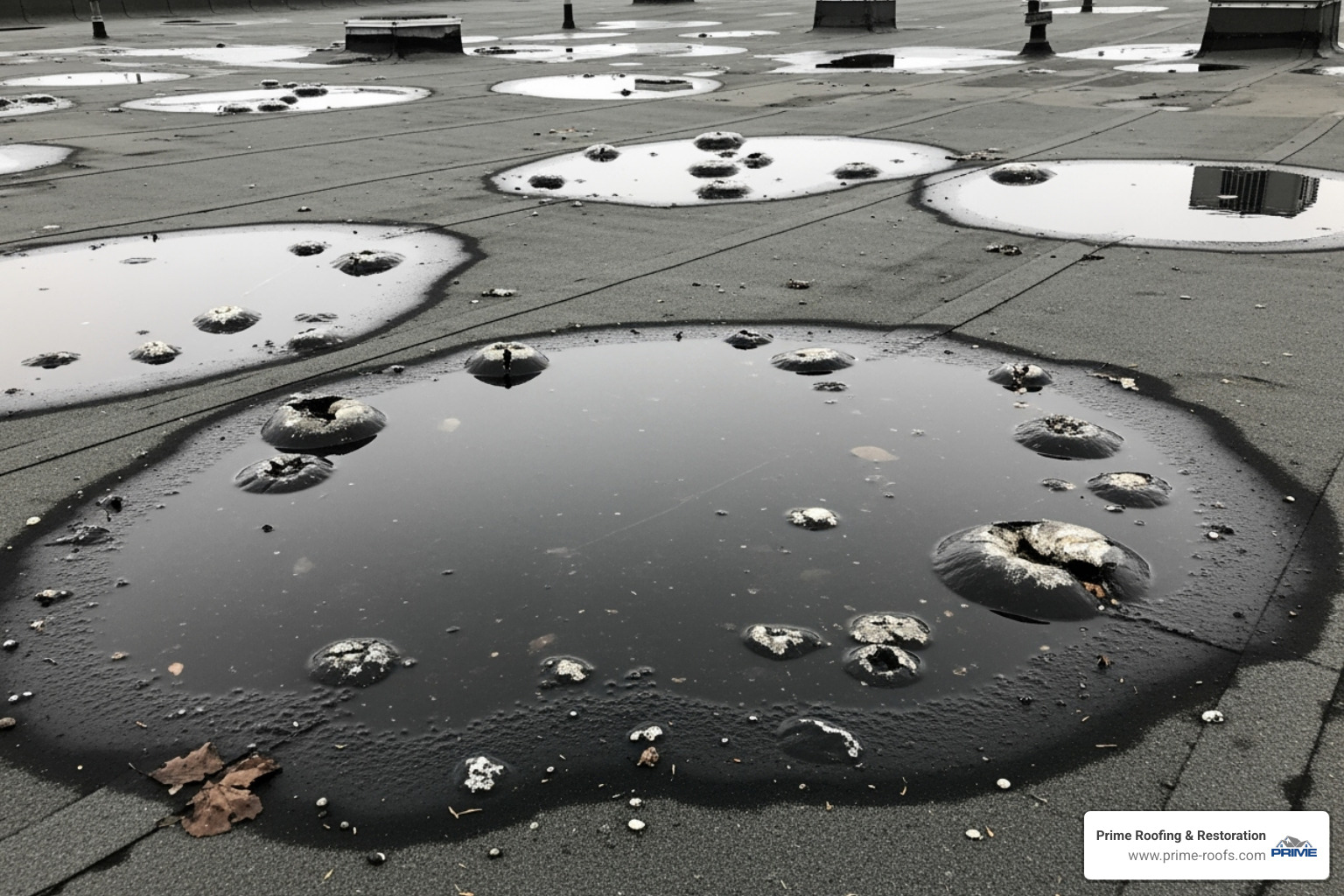
Ponding Water: If you see standing water on your flat roof for more than 48 hours after a rainstorm, you have a serious problem. Flat roofs are designed with a slight slope to direct water toward drains, gutters, or scuppers. Ponding water indicates a drainage issue, which could be caused by clogged drains or a structural issue like sagging. The excess weight puts immense stress on the building’s structure—just 1 inch of water over a 10×10 foot area adds over 520 pounds of dead load. This weight accelerates the deterioration of the roofing membrane and creates a perfect environment for leaks to develop.
-
Sudden, Unexplained Spikes in Energy Bills: Your roof is a critical component of your building’s thermal envelope. If your heating or cooling costs jump unexpectedly without a corresponding change in weather or utility rates, your roof could be the culprit. A breach in the membrane or, more commonly, wet and compressed insulation, can drastically reduce your roof’s R-value (its ability to resist heat flow). This allows conditioned air to escape and outside air to infiltrate, forcing your HVAC system to work much harder and consume more energy.
Recognizing these signs early is key to mitigating damage and controlling costs. A small repair today can prevent a full roof replacement tomorrow. For urgent situations where you’ve spotted one of these critical signs, contact our team for an immediate response. We can help you protect your business when you need it most. For more tips, see our comprehensive guide on 5 Signs You Need Roof Replacement.
From Blueprint to Completion: The Commercial Roofing Project Lifecycle
A professional commercial roofing project is a highly coordinated effort that follows a structured process to ensure quality, safety, and minimal disruption to your business. Understanding these steps helps you know what to expect and allows you to evaluate whether a potential contractor is thorough and professional. Experienced local commercial roofing companies know that your business can’t afford surprises, which is why we follow a refined, transparent process from the initial call to the final warranty delivery, designed to maximize results and provide you with complete peace of mind.
Step 1: Initial Inspection and Detailed Proposal
Every successful project begins with a thorough, forensic evaluation of your existing roof’s condition. This is far more than a quick glance from the ground. Our comprehensive roof assessments involve a physical walk-through to examine the membrane for defects, check all flashing and penetration seals, and inspect drainage systems. We may also perform core sampling to analyze the composition and condition of the underlying layers and use infrared thermography to detect hidden moisture trapped within the insulation. Afterward, you’ll receive a detailed, itemized proposal that clearly explains:
- The Full Scope of Work: A clear description of the work to be performed, including whether it’s a tear-off or an overlay.
- Recommended Materials: A breakdown of the specific system and materials recommended, along with their pros, cons, and data sheets.
- Projected Timeline: A realistic schedule that accounts for your business operations, including start and completion dates.
- Logistics and Safety Plan: An outline of how materials will be staged, how debris will be removed, and what safety measures will be in place.
- Warranty Details: Copies of both the manufacturer’s material warranty and the contractor’s workmanship warranty.
Step 2: Pre-Construction, Preparation, and Installation
This phase is where meticulous planning meets skilled craftsmanship. Our process is built around three core principles: safety, efficiency, and communication.
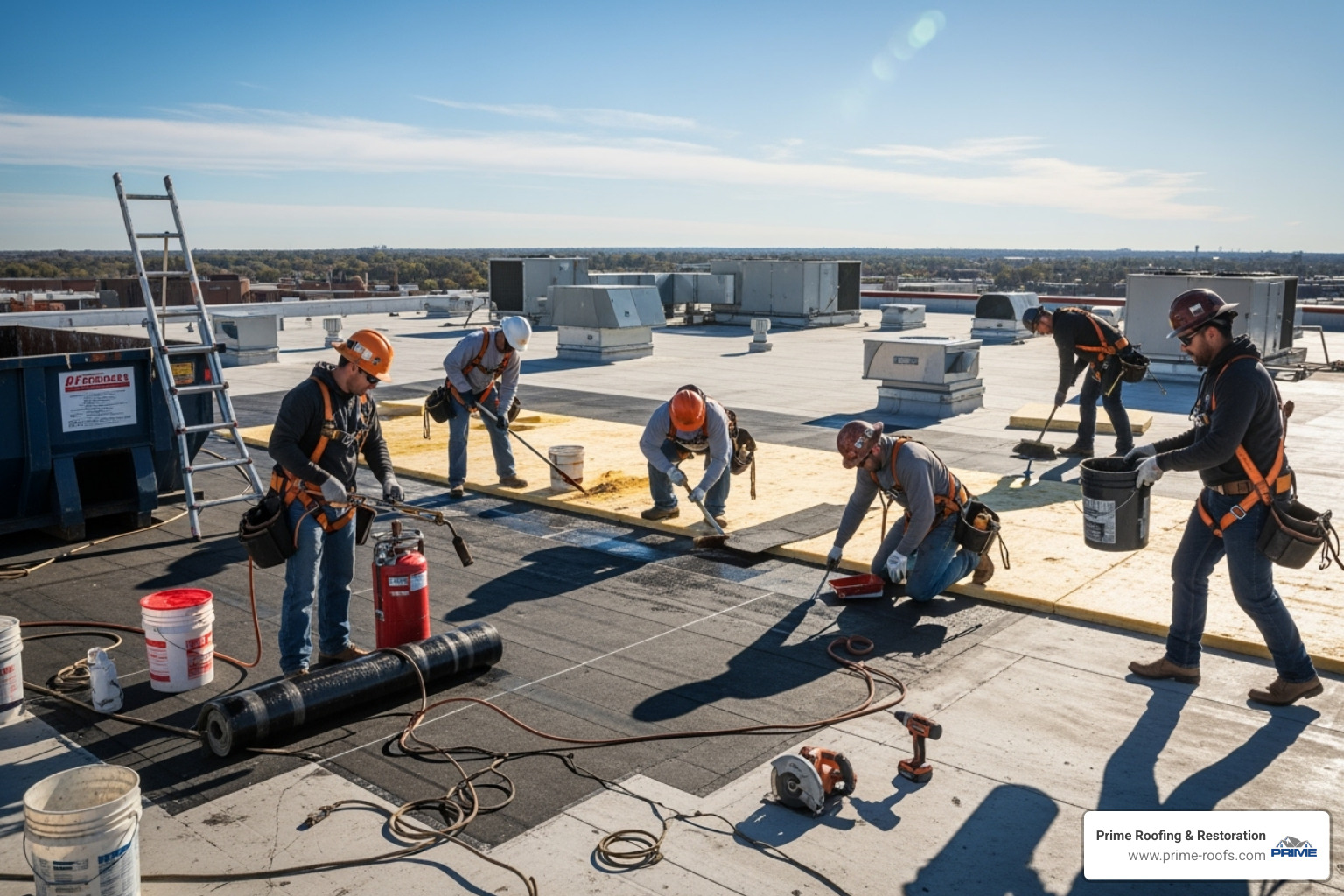
- Safety First: Before any work begins, we establish comprehensive safety protocols compliant with OSHA standards. This includes setting up perimeter warnings, fall protection systems, and secured work zones to protect your staff, customers, and our crew at all times. Daily “toolbox talks” reinforce safety procedures.
- Strategic Staging and Site Protection: Materials are delivered and staged in a pre-approved location to minimize disruption to your parking, loading docks, and daily operations. We take care to protect landscaping, windows, and walls from any potential damage during the project.
- Professional Installation: Whether it’s a complete tear-off of the old system or an overlay, our factory-certified crews follow manufacturer specifications and industry best practices to the letter. An on-site project manager oversees all work, conducting regular quality control checks to ensure every seam is welded perfectly, every fastener is correctly installed, and every flashing detail is flawless.
- Constant Communication: We believe an informed client is a happy client. You will receive regular progress updates from the project manager, so you always know what’s happening on your property. We maintain an open line of communication to address any questions or concerns immediately.
Step 3: Final Inspection, Walkthrough, and Warranty
Our job isn’t finished until you are 100% satisfied and your investment is fully protected for the long term.
- Manufacturer’s Inspection: For premium NDL (No Dollar Limit) warranties, a technical representative from the manufacturer will perform an independent, rigorous inspection to certify that the roof was installed perfectly according to their specifications.
- Client Walkthrough: Once the manufacturer has signed off, we conduct a final walkthrough with you to review the finished work, answer any remaining questions, and ensure every detail meets your expectations.
- Thorough Cleanup: We pride ourselves on leaving your property cleaner than we found it. All project-related debris is removed, and the entire area is swept with magnets to collect any stray screws or metal.
- Final Paperwork and Warranty Delivery: You will receive a comprehensive closeout package containing all final invoices, permits, and, most importantly, the official warranty certificates from both our company and the manufacturer. We take the time to explain your coverage completely, so you understand how to keep your warranty in force for its full term.
Budgeting for Durability: Understanding Commercial Roofing Costs & Maintenance
A new commercial roof is a significant capital investment, typically costing $5 to $12 per square foot, and sometimes more for premium systems or complex projects. Understanding the key factors that influence this price, as well as the immense long-term value of proactive maintenance, will help you budget effectively and make a strategic decision that protects your business’s future.
Key Factors Influencing the Price
The final cost of a commercial roofing project depends on several interconnected variables, which is why a custom, detailed quote from a reputable contractor is essential. No two roofs are exactly alike.
| Roofing System | Average Cost Per Square Foot |
|---|---|
| Built-Up Roofing (BUR) | $4.00 – $8.00 |
| EPDM | $4.00 – $8.00 |
| TPO | $5.00 – $9.00 |
| PVC | $6.00 – $10.00 |
| Metal Roofing | $7.00 – $12.00+ |
-
Roof Size and Complexity: While a larger roof has a higher total cost, the price per square foot often decreases due to economies of scale. Conversely, a smaller roof with numerous penetrations (like vents, skylights, and HVAC units) requires more intricate, labor-intensive flashing work, which increases the per-square-foot cost.
-
Material Choice: As the table illustrates, material costs vary significantly. A standard TPO or EPDM system is generally more budget-friendly upfront, while a high-performance PVC or standing seam metal roof carries a premium price tag. However, the more expensive materials often provide superior durability and a longer lifespan, resulting in better long-term value.
-
Condition of the Existing Roof: A full tear-off and disposal of the old roofing system is necessary if there are already two or more roof layers, or if the underlying substrate is wet or damaged. This process can add $1.00 to $3.00 per square foot to the project cost. A roof-over (or overlay) is a less expensive option but is only viable if the existing roof is a suitable, dry, and stable substrate.
-
Insulation Requirements: Modern building codes often mandate minimum R-values for insulation to improve energy efficiency. Adding or replacing insulation can add $1.50 to $3.00+ per square foot but typically pays for itself over time through significant energy savings.
-
Warranty Selection: A standard manufacturer’s warranty may be included, but a premium, long-term No-Dollar-Limit (NDL) warranty requires stricter installation protocols and inspections, which adds to the upfront cost. However, this provides the most comprehensive long-term protection available.
-
Labor and Location: Labor costs are a major component of the total price and vary based on project complexity and regional wage rates. Geographic location also affects material pricing and logistical costs.
For a deeper dive into budgeting for your project, read our guide on How Much Does a New Roof Cost?.
The Critical Value of Proactive Maintenance
Think of your commercial roof like a high-performance vehicle; it requires regular, scheduled service to perform optimally and reach its maximum lifespan. A proactive maintenance plan is not an expense; it is a strategic investment in asset protection.
-
Maximizes Roof Lifespan: A well-maintained roof can easily last years beyond its estimated 20-30 year warranty period, maximizing your initial investment.
-
Prevents Costly Emergency Repairs: Regularly scheduled inspections catch small issues like clogged drains, minor punctures, or failing sealant before they can escalate into major leaks that cause thousands of dollars in damage and business disruption.
-
Protects Your Warranty: Most major manufacturer warranties require documented proof of regular, professional maintenance to remain valid. Neglecting your roof can void your warranty, leaving you fully exposed to the cost of future repairs.
A professional commercial roof maintenance program is the most effective way to protect your asset. These programs typically include bi-annual inspections (in the spring and fall), comprehensive debris removal from the roof surface and drainage systems, inspection of all seams and flashings, minor repairs as needed, and a detailed condition report with photos for your records. This small annual investment protects your roof, your warranty, and your entire business.
Partner with Alabaster’s Premier Commercial Roofing Experts
When it comes to protecting your commercial property, the choice of contractor makes all the difference. For businesses in Alabaster and throughout Alabama, you need more than just a roofer; you need a partner who understands the unique challenges of our local climate and is committed to the community. Choosing the right local commercial roofing companies is essential for your peace of mind and your bottom line.
At Prime Roofing & Restoration, we have built our reputation on a foundation of superior quality workmanship, unwavering transparency, and a deep-rooted connection to the Alabaster community we call home. We’re not just contractors passing through; we’re your neighbors. We understand that your commercial roof is the primary shield protecting everything you’ve worked so hard to build. Our team brings years of direct, hands-on experience with Alabama’s weather—from the scorching summer heat that tests membrane durability to the severe thunderstorms and high winds that demand robust installation techniques. We know which materials and methods will ensure maximum longevity and performance for your specific building.
As a fully licensed, insured, and transparent partner, we provide detailed assessments, clear and itemized pricing, and some of the strongest warranties in the industry. Our comprehensive commercial roofing services cover the full lifecycle of your roof, including:
- TPO, EPDM, and PVC Single-Ply Systems
- Standing Seam Metal Roofing
- Elastomeric Roof Coatings
- Full Roof Replacements and Tear-Offs
- Proactive Roof Maintenance Programs
- 24/7 Emergency Leak Repair
When a storm hits or you discover a leak, you need a local team that can respond immediately. Roof problems don’t wait for convenient business hours, which is why our team is available 24/7 for emergencies. When you call us, you’re calling a local company that can be on-site quickly to mitigate damage and secure your property.
Don’t leave your most critical asset in the hands of an out-of-town storm chaser. When you’re ready to protect your business with a roofing solution built to last, we’re here to help. Partner with a team that is invested in your success.
Prime Roofing & Restoration
Address: 5 Brown Cir, Alabaster, AL 35007
Phone: (205) 661-8190
Conclusion: A Strategic Investment in Your Business’s Future
Your commercial roof is far more than just a part of your building; it is a vital component of your business’s safety, operational continuity, and financial success. It serves as the first and most important line of defense against Alabama’s often unpredictable and severe weather. Making a well-informed, strategic decision when selecting a roofing system and contractor is paramount to protecting your investment for decades to come.
Here are the key takeaways to guide your decision-making process:
-
Understand Your Options to Match Your Needs: The roofing landscape is diverse. From the proven durability of BUR to the energy-efficient reflectivity of TPO and the exceptional longevity of metal, choosing the right system requires balancing your budget, building use, and long-term performance goals.
-
Thoroughly Vet Your Contractor: When searching for local commercial roofing companies, your diligence is crucial. Prioritize contractors who can readily prove their state license, comprehensive insurance, and factory certifications. Dig into their local reputation, demand references, and confirm their expertise in navigating our regional climate and building codes. These are non-negotiable pillars of a trustworthy partnership.
-
Recognize Warning Signs and Act Decisively: Ponding water, bubbling membranes, damaged flashing, and sudden energy bill spikes are urgent calls to action. Addressing these issues promptly with a professional inspection and repair is always more cost-effective than dealing with the catastrophic consequences of a full-blown roof failure.
-
Commit to Proactive Maintenance: The single most effective way to maximize the life of your roof and prevent major problems is through a consistent maintenance program. Regular inspections, cleanings, and minor repairs extend your roof’s life, prevent costly emergencies, and ensure your manufacturer’s warranty remains in full effect.
Choosing a commercial roofing partner can feel like a daunting task, but by following this guide, you are well-equipped to find a contractor who shares your commitment to quality, transparency, and long-term value. You are not just buying a roof; you are investing in the security and stability of your business. If you’re ready to secure your property with a team that understands your needs and is rooted in the Alabama community, don’t hesitate to contact us for a comprehensive, no-obligation consultation. Let us help you ensure your business stays protected, come rain or shine.