
Why Selecting the Right Commercial Building Roofing Contractors Matters for Your Business
Commercial building roofing contractors protect business assets by installing and maintaining low-slope systems designed for continuous waterproofing, safe drainage, and code compliance. If you manage a facility in Alabama, start by partnering with a team that specializes in commercial membranes and documented safety programs. For owners who want a long-term partner, work with a local commercial roofing team you can trust in Alabaster to reduce downtime, improve budget predictability, and protect inventory and equipment.
Unlike residential roofing, commercial projects involve large-scale single-ply membranes, specialized flashing around penetrations, engineered drainage, and strict OSHA fall-protection requirements. The complexity of a commercial roof is often underestimated; it is not merely a cover but a sophisticated engineering system designed to manage thermal expansion, structural load, and extreme weather events. In Alabama, where humidity levels are high and tropical storms are a seasonal reality, the stakes for selecting qualified commercial building roofing contractors are even higher. A failure in the roofing system can lead to catastrophic interior damage, mold growth, and significant financial loss due to operational downtime.
Professional contractors bring a level of technical precision that general handymen or residential roofers simply cannot match. This includes understanding the chemical compatibility of different materials, the physics of wind uplift, and the nuances of manufacturer-specific installation protocols. When you hire a specialist, you are investing in the longevity of your building’s envelope.
Here’s what sets professional contractors apart:
- Materials expertise: Deep knowledge of TPO, PVC, EPDM, modified bitumen, and built-up roofing (BUR) systems, including their specific ASTM standards.
- Licensing and insurance: Verified compliance with Alabama state licensing boards and comprehensive insurance coverage, including general liability and workers’ compensation specifically for high-risk commercial work.
- Manufacturer certifications: Status as an authorized installer for major brands like GAF, Carlisle, or Firestone, which allows for the provision of No Dollar Limit (NDL) warranties.
- Commercial experience: A proven portfolio of warehouses, medical facilities, retail centers, and industrial plants.
- Emergency response: Dedicated 24/7 teams equipped for rapid deployment during storm events or sudden structural failures.
- Insurance claims support: Expertise in documenting damage for adjusters, providing forensic-level reporting, and ensuring the scope of work covers all necessary repairs to meet current building codes.
A single roof leak can halt operations, damage equipment, and create slip or electrical hazards. Industry-wide performance data commonly cited by the National Roofing Contractors Association (NRCA) shows many flat commercial roofs begin experiencing leakage risk in the 7 to 15 year range. However, premium systems paired with scheduled maintenance can deliver 20 to 30 years of service life. This discrepancy highlights the importance of the initial installation quality and the ongoing care provided by your contractor.
Whether you need a new installation, a complex restoration, or urgent leak response, choosing experienced professionals determines whether your roof becomes a long-term asset or a recurring expense. As Bill Spencer, Owner and President of Prime Roofing & Restoration, I’ve spent more than five years leading installation and restoration projects for commercial building roofing contractors across Alabama’s Gulf Coast. My hands-on experience in flat-roof detailing, drainage design, and claims documentation helps building owners in Alabaster and Orange Beach protect their facilities with minimal disruption.
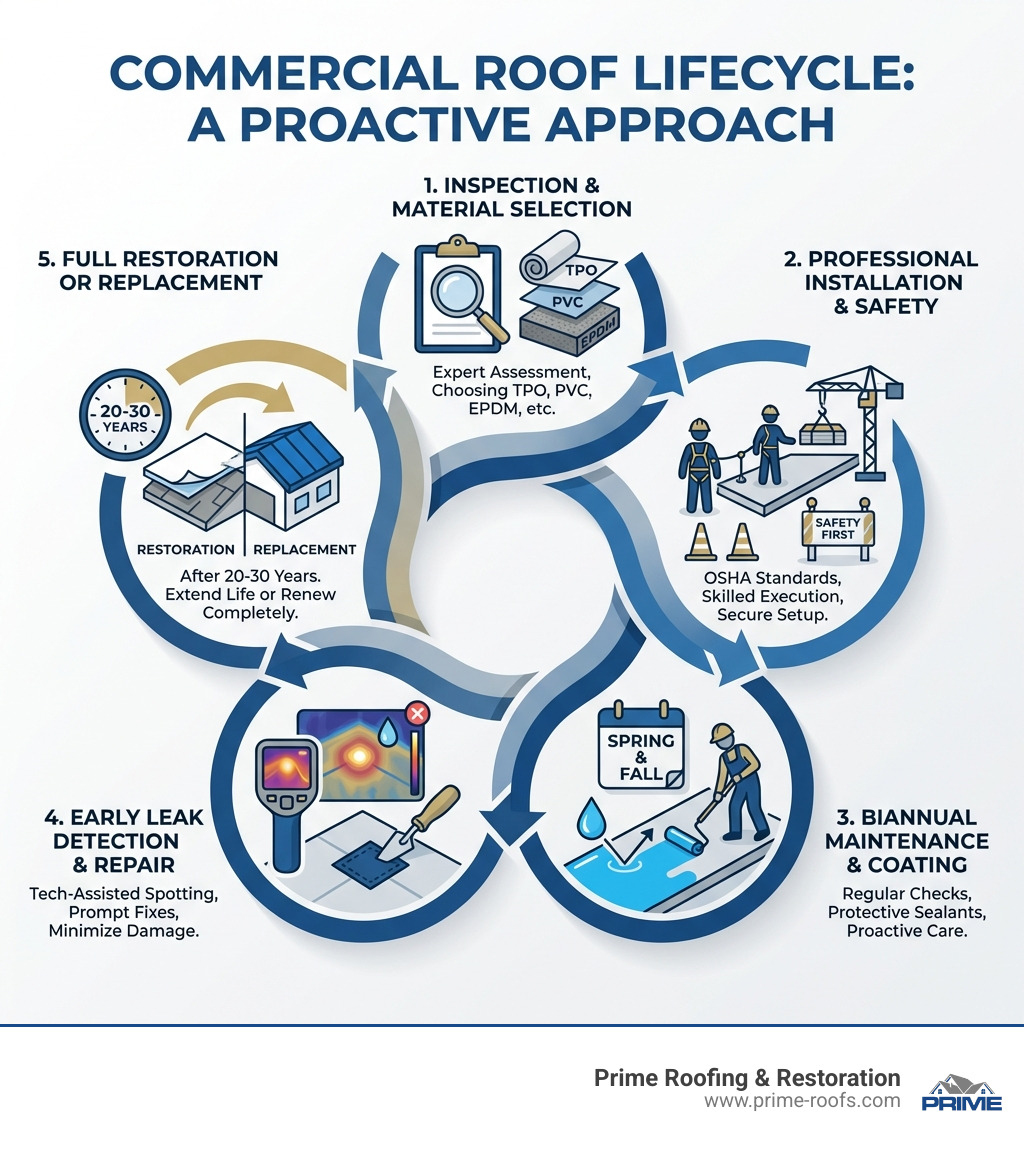
Commercial building roofing contractors terms you need:
Understanding Commercial Roofing Systems and Lifespans
Choosing the right roofing system is the foundation of a successful commercial project. In Alabama, our roofs face intense UV radiation, heavy seasonal rains, and the occasional threat of tropical storms. Commercial building roofing contractors must select materials that balance upfront costs with long-term durability, energy efficiency, and maintenance requirements.
Lifespan Statistics for Flat Roofs
The longevity of your roof depends heavily on the material selected and the quality of the installation. The average flat commercial roof will last between 7 to 15 years before it starts to leak. However, the best new commercial flat roofing systems, when installed by certified experts, will remain waterproof for 20 to 30 years. Factors such as foot traffic, chemical exposure, and the frequency of maintenance inspections play a critical role in reaching these upper limits. For instance, a roof that is neglected and allowed to accumulate debris will likely fail 30-50% faster than one on a preventative maintenance plan.
Pros and Cons of Single-Ply Membranes
Most modern commercial buildings use single-ply membranes due to their flexibility, lightweight nature, and ease of installation compared to traditional multi-layered systems.
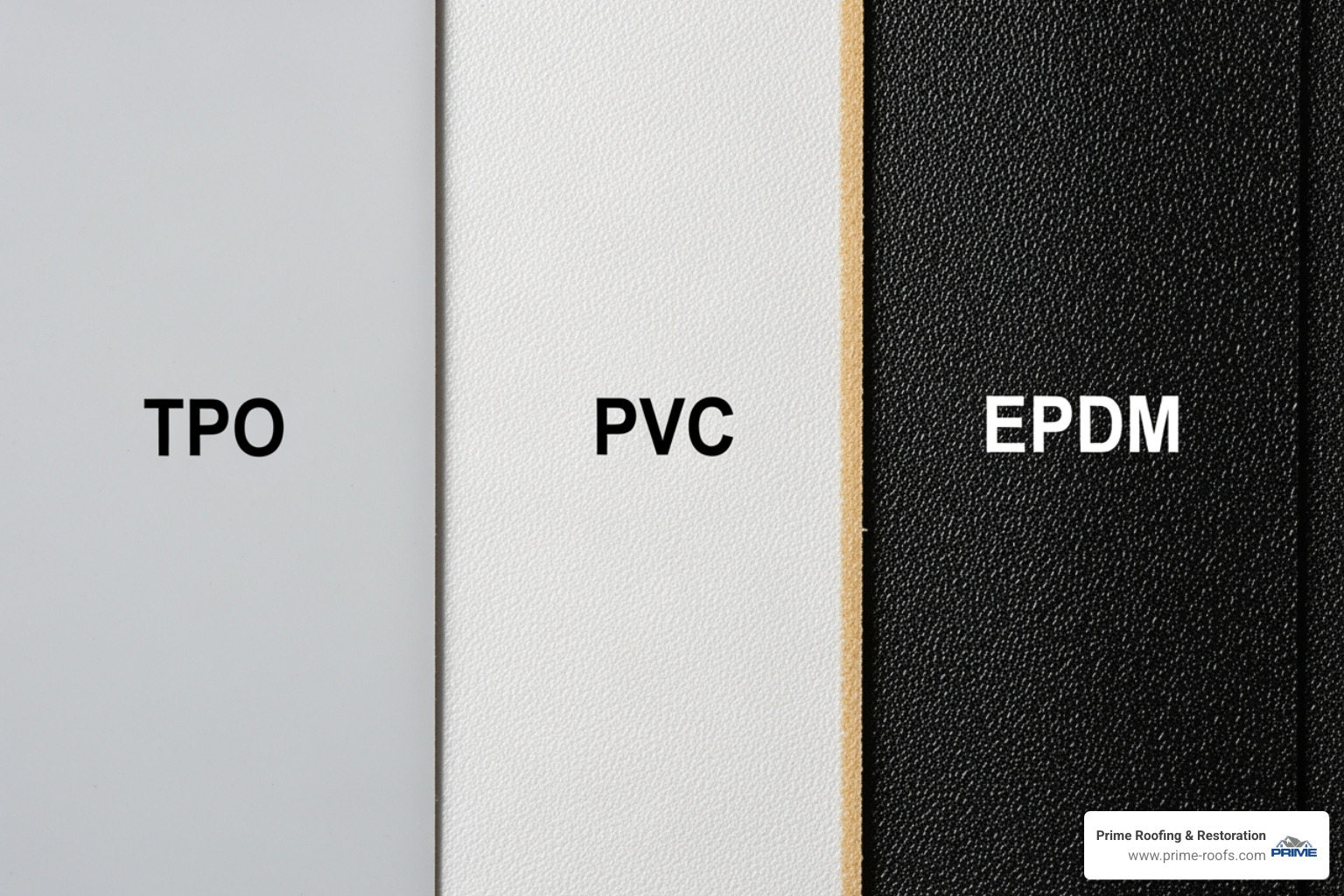
- TPO (Thermoplastic Polyolefin): TPO has become the industry standard for its reflectivity and energy efficiency. These white membranes reflect UV rays, significantly lowering cooling costs during Alabama’s blistering summers. Modern TPO is reinforced with polyester scrim for added puncture resistance. While cost-effective, TPO requires expert heat-welding of the seams to ensure a monolithic, waterproof barrier. It is essential to use the latest, reformulated versions to avoid the cracking issues seen in early-generation TPO products.
- PVC (Polyvinyl Chloride): PVC roofing is often considered the “gold standard” for durability and chemical resistance. It is highly resistant to grease, oils, and fire, making it the ideal choice for restaurants, airports, and manufacturing facilities. PVC membranes are also highly flexible and can withstand significant building movement. Because of its superior chemical stability, PVC formulations have remained proven for over 40 years, often outlasting TPO in harsh industrial environments.
- EPDM (Ethylene Propylene Diene Terpolymer): Often called “rubber roofing,” EPDM is a tried-and-true technology used for over 40 years. It is exceptionally durable and resistant to hail and thermal shock. However, EPDM is typically black, meaning it absorbs more heat than TPO or PVC. While this can be an advantage in colder climates, in Alabama, it often leads to higher cooling costs unless a reflective coating is applied. For a deeper dive, check out our Complete EPDM Commercial Roofing Guide.
Traditional Layered Systems and Metal Options
- Built-up Roofing (BUR): One of the oldest types of commercial roofing, BUR uses alternating layers of felt or fabric and bitumen (tar), finished with a layer of gravel. It offers excellent fire resistance and is extremely tough against foot traffic. However, it is significantly heavier than single-ply options and requires a robust structural deck. It is also more labor-intensive to install and repair.
- Modified Bitumen: This is an evolution of BUR, using asphalt-coated rolls applied in overlapping layers. It is often “torch-applied” or installed with cold adhesives. It is tough, handles foot traffic well, and is a common choice for smaller commercial roofs or those with many penetrations.
- Commercial Metal Roofing: Metal is an excellent choice for steep-slope commercial buildings. It offers the longest lifespan (often 50+ years) and is highly resistant to wind. However, the initial cost is higher, and it requires specialized knowledge to manage expansion and contraction. See our Commercial Metal Roofing Companies Guide for more details.
| Material Type | Typical Lifespan | Reflectivity (Cool Roof) | Best For |
|---|---|---|---|
| TPO | 15–20 Years | High | Retail, Offices, Schools |
| PVC | 20–30 Years | High | Restaurants, Industrial, Labs |
| EPDM | 20–30 Years | Low | Warehouses, Cold Storage |
| BUR | 15–25 Years | Low/Medium | Heavy Industrial, High Traffic |
| Metal | 40–60 Years | Medium/High | Churches, Schools, Sloped Roofs |
Key Differences Between Commercial and Residential Roofing
Many property owners wonder why they can’t just hire a residential roofer for their warehouse or office building. The reality is that the two fields are entirely different disciplines requiring different tools, safety protocols, and engineering knowledge.
Material Composition and Design
Residential roofs are typically steep-slope and rely on gravity to shed water using shingles, slate, or wood shakes. Commercial buildings are usually low-slope or “flat.” This means they require a completely waterproof “envelope” rather than just water-shedding layers. While residential roofs might use concrete tiles or asphalt shingles, commercial systems rely on large-scale membranes like TPO and PVC to prevent “ponding” water from seeping into the structure. In a flat roof system, the water doesn’t just run off; it must be actively managed through a system of internal drains, scuppers, and tapered insulation that creates artificial slopes.
Installation Complexity and Safety
The scale of commercial projects is vastly larger. Commercial building roofing contractors must manage large crews, heavy machinery (like cranes for material hoisting), and complex drainage systems. Safety is also a major differentiator. Commercial projects must strictly adhere to OSHA standards for fall protection on high-rise or large-acreage roofs. This includes the use of safety flags, personal fall arrest systems (PFAS), and specialized training for all personnel.
Furthermore, commercial installations often happen while the business is still operating. This requires a contractor who can minimize noise, manage hazardous fumes (especially with BUR or torch-down systems), and ensure the safety of employees and customers entering and exiting the building. A residential roofer is rarely equipped to handle the logistics of a 50,000-square-foot warehouse replacement while the facility remains fully functional. For more on these specialized services, see our Commercial Roof Services Guide 2026.
How to Choose the Best Commercial Building Roofing Contractors
In Alabaster and Orange Beach, your choice of contractor is just as important as your choice of membrane. A poorly installed roof, even with premium materials, fails early at seams, penetrations, and transitions. The goal is to find a partner who understands the local building codes and the specific environmental stressors of the Alabama climate.
Benefits of Certified Commercial Building Roofing Contractors
When vetting companies, prioritize manufacturer certifications and verifiable training. Certain manufacturer-backed programs can offer long-term system guarantees (in some cases up to 35 years) when the roof is installed to spec and inspected by a third-party manufacturer representative. These are often called “No Dollar Limit” (NDL) warranties, meaning the manufacturer covers the full cost of repairs for the duration of the warranty, regardless of the original cost of the roof.
Certified contractors are typically evaluated on:
- Inspection ratings: Consistent high marks from manufacturer inspectors on previous jobs.
- Warranty and claim history: A low rate of warranty claims, indicating high-quality initial workmanship.
- Responsiveness and reputation: A track record of honoring commitments and responding to service calls.
- Financial stability and safety record: The ability to bond large projects and a low Experience Modification Rate (EMR) for safety.
For an overview of end-to-end solutions (inspection, repair, replacement, and restoration options), review Prime Roofing & Restoration’s commercial roofing services.
Evaluating Contractor Reputation and Experience
Don’t rely on marketing alone. A professional contractor should be an open book regarding their past performance. Ask for:
- A portfolio of completed commercial projects: Look for facilities similar to yours in size and complexity.
- Proof of licensing and active insurance: Ensure they have general liability and workers’ comp that specifically covers commercial roofing (which is a higher risk category than residential).
- A written safety plan: This should align with OSHA fall-protection expectations and include site-specific hazards.
- A documented scope of work: This should include details at drains, parapets, curbs, and penetrations. Avoid vague quotes that just say “replace roof.”
Also ask how they schedule work around operating hours to reduce disruption. A restaurant roof has different detailing needs than a warehouse, and an occupied office requires different staging and noise controls than a vacant building. If your project is local, it helps to choose a contractor with crews and support in your area. For Alabaster property owners who want local responsiveness, start with a commercial roofer near you in Alabaster, AL.
Maintenance, Repair, and the Role of Roof Coatings
Proactive care is the only way to reach that 20-to-30-year lifespan. We recommend biannual inspections—once in the spring and once in the fall—to identify issues before they become catastrophes. In Alabama, the expansion and contraction caused by rapid temperature changes (thermal shock) can stress seams and flashing, making regular check-ups essential.
Signs Your Roof Needs Immediate Attention
If you notice any of the following, call commercial building roofing contractors immediately:
- Consistent Leaks: Even small drips can lead to mold, structural rot, and damage to expensive inventory.
- Ponding Water: Standing water for more than 48 hours indicates drainage issues. The weight of ponding water can actually cause the roof deck to deflect, creating a deeper bowl and leading to eventual collapse.
- Blistering or Bubbling: This often means moisture is trapped beneath the surface. When the sun heats the roof, this moisture turns to steam and expands, which can lead to a “blowout” during high winds.
- Clogged Gutters and Drains: If water can’t leave the roof, it will find a way into your building. This is the most common cause of avoidable commercial roof damage.
- Flashing Gaps: Most leaks occur at the edges or around roof penetrations (like HVAC units and vents). If the sealant is cracked or the metal is pulling away, the system is compromised.
Our Industrial Roofing Repairs Complete Guide provides a detailed checklist for identifying these red flags.
When to Choose Coatings Over Replacement
If your roof is leaking but the underlying structure and insulation are still sound, a roof coating might be a viable alternative to a full replacement. This process, often called restoration, involves cleaning the roof, repairing defects, and applying a high-performance liquid membrane.
- Cost-effectiveness: Coatings can cost 40-60% less than a full tear-off and replacement.
- UV Protection: They provide a seamless, highly reflective barrier that lowers energy bills by reducing the “heat island effect” on your building.
- Sustainability: You avoid the landfill fees and environmental impact of a full roof tear-off. Many coatings are also low-VOC.
- Tax Benefits: In many cases, a roof coating can be classified as a maintenance expense rather than a capital improvement, allowing for a full tax deduction in the year the work is performed.
However, coatings are not a “magic fix.” If the insulation is wet (which can be detected via infrared thermography) or the decking is rotting, a coating will only hide the problem temporarily. A professional evaluation is essential to determine if your roof is a candidate for restoration. Learn more at our Commercial Roof Maintenance page.
Cost Considerations and Storm Preparedness
Budgeting for a commercial roof involves more than just the initial quote. You must consider the total cost of ownership over 20 years, including energy savings, maintenance costs, and potential insurance premium reductions.
Budgeting for Commercial Building Roofing Contractors
Several factors influence the cost of your project:
- Square Footage: Larger roofs have a higher material cost but often a lower cost per square foot due to economies of scale.
- Penetrations: Every HVAC unit, vent, and skylight requires specialized flashing. A roof with 50 penetrations will cost significantly more than a clear roof of the same size.
- Parapet Walls: High walls around the roof edge require more material and detailing, as the membrane must be wrapped up and over the wall.
- Material Choice: PVC is generally more expensive than TPO, but its longer lifespan and chemical resistance may offer a better ROI for specific industries.
- Tear-off vs. Overlay: If your building already has two layers of roofing, building codes usually require a full tear-off, which increases labor and disposal costs.
For those in the Birmingham area, our Commercial Roofers Birmingham AL page offers localized insights into pricing and material availability. You can also explore our Commercial Flat Roof Replacement Guide for a breakdown of typical expenses.
Emergency Services and Storm Preparedness
In Alabama, storm preparedness is a part of life. High winds and hurricanes can peel back membranes or send debris through your roof deck. Commercial building roofing contractors should offer 24/7 emergency response to mitigate damage immediately after a storm.
How to prepare for a storm:
- Pre-storm inspection: Ensure all flashing is secure and drains are clear. Loose metal can become a projectile in high winds.
- Document everything: Take high-resolution photos of your roof in its current condition. This is vital for insurance purposes if you need to prove the damage was storm-related.
- Secure equipment: Ensure HVAC panels are fastened and any loose materials on the roof are removed or secured.
If damage occurs, we provide rapid tarping and structural assessments to prevent further interior damage. Rapid response is key to minimizing business downtime and protecting your assets. We also assist with the complex documentation required for commercial insurance claims, ensuring you receive the full value of your policy.
Frequently Asked Questions about Commercial Roofing
How long does a typical commercial flat roof last?
Most commercial flat roofs last 7 to 15 years before leak risk rises significantly. High-quality systems (including premium TPO, PVC, and EPDM), when installed by experienced commercial building roofing contractors and kept on a preventative program, commonly reach 20 to 30 years of service life. The key is early detection of minor issues.
Is a roof coating a permanent alternative to replacement?
No. A roof coating is a restoration method that can extend service life by 10 to 20 years when applied over a clean, dry, and structurally sound roof assembly. It is a way to defer replacement, not avoid it forever. If insulation is wet or the deck is deteriorated, replacement is required.
What is the most energy-efficient commercial roofing material?
White single-ply membranes like TPO and PVC are widely used “cool roof” options because they reflect a large portion of solar radiation. According to the Department of Energy, cool roofs can reduce the peak cooling demand of a building by 10-15%.
Can I get my roof inspected for free?
Many reputable contractors, including Prime Roofing & Restoration, offer free initial inspections and estimates. This allows you to compare repair, restoration, and replacement paths with documented photos and a written scope. We use drone technology and moisture meters to provide a comprehensive view of your roof’s health.
What is an NDL Warranty?
An NDL (No Dollar Limit) warranty is a manufacturer-backed guarantee that covers the full cost of labor and materials for repairs during the warranty period. Unlike pro-rated warranties, the coverage does not decrease over time. These are only available through certified commercial building roofing contractors.
How does ponding water affect my warranty?
Most manufacturers will void a warranty if ponding water (water that stays on the roof for more than 48 hours) is not addressed. This is because standing water accelerates the degradation of the membrane and increases the risk of structural failure.
For certification verification and general contractor guidance, consult an industry authority such as the National Roofing Contractors Association (NRCA): https://www.nrca.net/
Conclusion
Your commercial roof is a capital asset that requires professional management. Selecting qualified commercial building roofing contractors is the most reliable way to prevent operational downtime, protect employees and tenants, and avoid expensive structural damage. By investing in high-quality materials and a rigorous maintenance schedule, you can turn a potential liability into a long-term asset.
For businesses in Alabaster and Orange Beach, Alabama, Prime Roofing & Restoration provides end-to-end commercial solutions, including repairs, high-performance replacements, restoration options, and insurance claims assistance. We focus on durable detailing, safe job sites, and responsive service so your facility stays protected through Alabama heat, rain, and storm seasons.
Contact Information (NAP)
Prime Roofing & Restoration
117 Market Center Dr, Alabaster, AL 35007
Phone: 205-453-1803
Website: www.prime-roofs.com
Find us on Google Maps:
View our Alabaster Location
To schedule a professional evaluation or request emergency service, call Prime Roofing & Restoration at 205-453-1803.
Quick Links for Property Owners: