
A Commercial Roof Leak Can Destroy Your Building Faster Than You Think
A commercial roof leak is one of the most damaging — and most underestimated — problems a property owner can face. According to data from the National Roofing Contractors Association (NRCA), nearly 40% of all building-related problems stem from water intrusion through the roof, yet most leaks go undetected until the damage is already severe. For a business owner, a leak isn’t just a maintenance headache; it is a direct threat to your inventory, your electronics, your structural integrity, and the safety of your employees and customers.
In the humid, storm-prone climate of Central Alabama, a small drip can escalate into a full-scale disaster in a matter of days. The presence of moisture in a warm environment like Alabaster or Hoover creates the perfect breeding ground for mold and mildew, which can compromise indoor air quality and lead to expensive remediation requirements under EPA guidelines.
Here are the most common causes of commercial roof leaks at a glance:
| Cause | Key Detail | Impact Level |
|---|---|---|
| Flashing damage | Responsible for 95% of all commercial roof leaks | Critical |
| HVAC equipment | 29% of leaks originate at rooftop AC units (GAF study) | High |
| Clogged drains | Ponding water for 48+ hours breaks down membranes | Severe |
| Aging membranes | Most systems fail between 15–20 years | Moderate |
| Open seams or laps | Second most frequent source of water intrusion | High |
The clock starts ticking the moment water gets in. You have a 24-48 hour window to act before water spreads through insulation and into structural materials — turning a minor repair into a major remediation project. Catching a leak early can reduce your repair costs by 60-70% compared to dealing with extensive interior water damage. Furthermore, wet insulation loses its R-value, meaning your cooling costs will skyrocket as your HVAC system struggles to compensate for the loss of thermal resistance.
Whether you manage a warehouse, retail center, or office building in Central Alabama, getting expert commercial roofing help early is the single most effective way to protect your investment. Delaying action often leads to the “domino effect,” where a small leak leads to saturated decking, which leads to mold, which eventually leads to a total roof collapse if left unaddressed for years.
I’m Bill Spencer, Owner and President of Prime Roofing & Restoration, with hands-on experience diagnosing and repairing commercial roof leaks across Alabama’s Gulf Coast region — from flat TPO systems to metal roofing battered by our notoriously severe spring storms. In this guide, I’ll walk you through exactly how to identify the source of a leak, what to do in the first 24 hours, and how to keep it from happening again.

Important commercial roof leak terms:
Common Causes of a Commercial Roof Leak
Identifying the root cause of a commercial roof leak is often harder than it looks because water rarely travels in a straight line. Gravity is a tricky business on a flat roof. We often find that water enters at one point, travels along a structural beam or insulation layer, and finally drips into an office fifty feet away. This phenomenon, known as “water tracking,” is why professional diagnostic tools are so critical.
Flashing Damage: The #1 Culprit
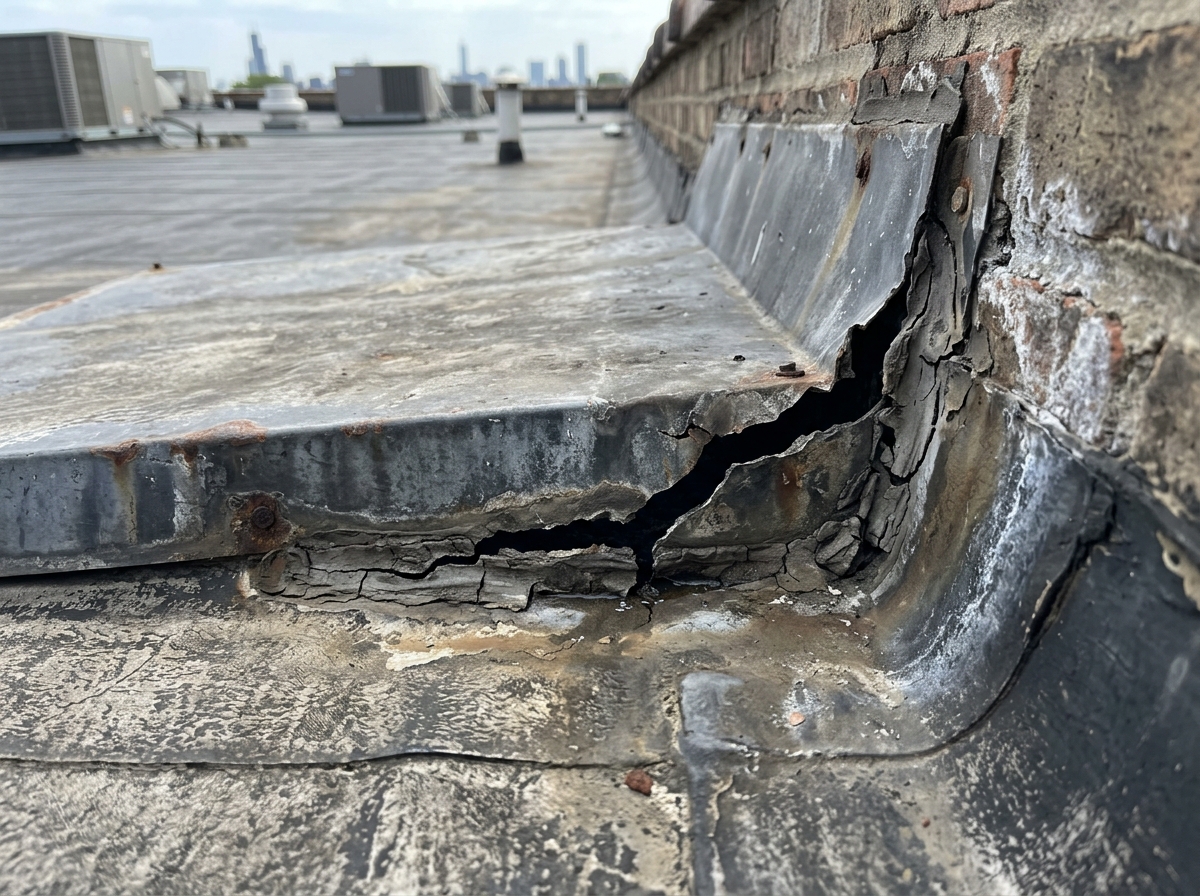
If there is one thing we want you to remember, it is this: 95% of all commercial roof leaks occur due to flashing damage. Flashing consists of the metal strips or membranes used to seal the “breaks” in your roof — like where the roof meets a wall, a chimney, or the edge of the building. Because these areas involve two different materials meeting, they expand and contract at different rates during Alabama’s hot summers and cool winters. This “thermal shock” eventually cracks the seals, inviting water right in. If your flashing is improperly installed or has reached the end of its service life, it acts as a funnel rather than a shield.
Rooftop Equipment and HVAC Units
Your air conditioning unit is a giant, vibrating box sitting on top of your building. According to an independent study by GAF, 29% of roof leaks occur at the air conditioning equipment. The constant vibration of the fans can loosen the “curbs” (the frames the units sit on) and the flashing around them. Furthermore, HVAC technicians often have to remove panels or walk around the units frequently. If they aren’t careful, dropped tools or heavy foot traffic can puncture the membrane, leading to a stubborn commercial roof leak. We also frequently see leaks caused by clogged HVAC condensate lines, which back up and spill water directly onto the roof surface or into the building envelope.
Drainage Obstructions and Ponding Water
Flat roofs aren’t actually perfectly flat; they are designed with a slight slope to move water toward drains. However, when drains, gutters, or scuppers become clogged with leaves, bird nests, or debris, water begins to “pond.”
Any water that remains on a flat roof surface for more than 48 hours is a major red flag. This standing water exerts hydrostatic pressure, literally forcing moisture through microscopic pores in the roofing material. It also accelerates the breakdown of adhesives and membranes, significantly shortening the lifespan of your roof. In the winter, this ponding water can undergo freeze-thaw cycles, where the water expands as it freezes, physically tearing apart the roof’s seams and flashing.
Aging Membranes and Open Seams
Most commercial roofing systems, such as TPO or EPDM, have a functional lifespan of 15 to 20 years. As they age, the chemicals that keep them flexible begin to evaporate. The roof becomes brittle, and the seams — the second most frequent cause of leaks — start to pull apart. Once a seam opens even a fraction of an inch, wind-driven rain will find its way underneath. This is particularly dangerous because the water can travel miles under the membrane before finding a hole in the decking to enter the building, making the source nearly impossible to find without thermal imaging.
Identifying the Source: Interior and Exterior Signs
You don’t always need to climb a ladder to know you have a problem. In fact, we recommend starting your investigation from the safety of the ground or inside the building. Early detection is the difference between a $500 patch and a $50,000 replacement.
Interior Indicators of a Commercial Roof Leak
Inside your building, the signs of a commercial roof leak are often subtle before they become disastrous:
- Ceiling Stains: Look for tea-colored rings or sagging ceiling tiles. If you see a bubble in the paint or the tile, there is likely a pool of water sitting right above it. Do not ignore small spots; they are the precursors to major failures.
- Musty Odors and Mold: If your employees are complaining of a weird smell, don’t just buy an air freshener. Moisture trapped in insulation is a breeding ground for mold, which can compromise the building’s air quality and R-value. This can lead to health liabilities and decreased productivity.
- Wall Streaks: If you see water marks running down your internal walls, the leak might not be in the roof field itself. This often points to a failure in the parapet wall coping (the metal cap on top of the wall) or siding defects. It could also indicate a failure in the building’s “through-wall” flashing.
- Electrical Issues: Flickering lights or short circuits can sometimes be traced back to water traveling through conduit pipes from the roof. This is a major fire hazard and requires immediate emergency roof leak repair. If water enters your electrical panels, the cost of repair can escalate into the hundreds of thousands.
Advanced Professional Detection Techniques
When the source isn’t obvious, we use high-tech tools to find the “invisible” entry points. These techniques prevent the common mistake of patching the wrong spot, which is a waste of time and money.
- Infrared Thermography: We use thermal imaging cameras to “see” heat. Wet insulation retains heat longer than dry insulation. By scanning the roof at night after a sunny day, the wet spots will literally glow on our screens, showing us exactly where the water is hiding. This allows us to perform surgical repairs rather than replacing the whole roof.
- Electronic Leak Detection (ELD): This is a non-invasive method where we use low-voltage electricity to find breaches. Water is conductive, so if there’s a hole in the membrane, the electricity will find it, pinpointing microscopic leaks that the human eye would never see. This is especially useful for new TPO or PVC installations to ensure they are 100% watertight.
- Moisture Mapping: We use specialized sensors to create a sub-surface map of the roof. This helps us determine if a small leak has already saturated a large area of insulation, which helps you decide between a simple repair and a commercial roof replacement. Moisture mapping is often required by insurance companies to prove the extent of the damage.
Vulnerabilities by Roofing System Type
Different roofing materials have different “weak spots.” Understanding what you have on your building in Alabaster or Hoover is key to predicting where a commercial roof leak might start. Each system has a unique chemical composition and installation method that dictates its failure points.
| Roof Type | Typical Lifespan | Common Leak Vulnerability | Maintenance Need |
|---|---|---|---|
| TPO (Thermoplastic) | 20–25 Years | Poorly welded seams; punctures from foot traffic | High (Seam checks) |
| EPDM (Rubber) | 20–25 Years | Membrane shrinkage pulling away from edges | Moderate (Shrinkage monitoring) |
| Metal Roofing | 30–50 Years | Loosened fasteners; oxidation/rust; seam failure | Low (Fastener tightening) |
| Built-Up (BUR) | 15–20 Years | “Alligatoring” (cracking) of the bitumen; gravel displacement | High (Gravel replacement) |
| Modified Bitumen | 15–20 Years | Flashing failure at transitions | Moderate (Joint sealing) |
Specific Risks for a Commercial Roof Leak
- TPO and PVC: These are popular because they reflect heat, helping you meet Energy Star requirements. However, they rely on hot-air welded seams. If the technician who installed the roof had the welder set to the wrong temperature, the seams might look fine but will fail under the stress of Alabama’s thermal cycling. You can learn more in our PVC roof repair guide.
- EPDM (Rubber): This material is like a giant rubber band. Over time, it can shrink due to UV exposure. When it shrinks, it pulls away from the walls and penetrations, creating a direct path for water to enter. This is often called “bridging,” and it can tear the membrane right off the fasteners.
- Metal Roofing: Metal roofs are tough, but they expand and contract significantly. This movement can “back out” the screws (fasteners) over time. If you have a leaky metal roof, it’s often as simple as replacing old fasteners with new ones that have fresh rubber washers. However, if rust has set in, you may need a specialized coating to stop the oxidation.
- Built-Up Roofing (BUR): These are the old-school “tar and gravel” roofs. They are prone to “alligatoring,” where the sun bakes the tar until it cracks like an alligator’s skin. Once those cracks reach the felt layers underneath, you have a leak. These systems are also very heavy, so a leak that saturates the layers can lead to structural strain.
- Liquid Applied Membranes: These are becoming popular for restoration. While they are seamless, they can fail if the substrate wasn’t properly cleaned before application, leading to delamination and “blistering” where water can collect.
Immediate Actions and Long-Term Repair Solutions
If you discover an active commercial roof leak, don’t panic — but do act fast. You are in a race against time. Every gallon of water that enters your building is another dollar added to your repair bill. Following a structured disaster recovery plan can save your business from prolonged downtime.
The 24-Hour Rule
You must take action within 24 to 48 hours to prevent the water from spreading. Once water saturates the insulation, it loses its ability to keep your building cool, and it begins to rot the structural decking. Acting quickly can save you thousands in remediation costs. If you wait longer than 48 hours, mold growth becomes almost a certainty in the Alabama humidity.
Step-by-Step Emergency Response
- Contain the Water: Place buckets under the drips. If the water is pooling on a ceiling tile, you may need to carefully puncture a small hole in the tile to direct the water into a bucket, preventing the tile from collapsing and causing injury.
- Protect Assets: Move computers, inventory, and sensitive documents. Cover heavy equipment with plastic sheeting. If you have high-voltage machinery, shut off the power to that area immediately.
- Document Everything: Take photos and videos of the leak and the interior damage. This is crucial for your commercial roofing insurance claim. Insurance adjusters need proof of the “point of entry” and the resulting damage.
- Mark the Area: Use “Wet Floor” signs to prevent slip-and-fall accidents. Under OSHA standards, you are responsible for maintaining a safe walking surface for employees.
- Call the Pros: Contact a commercial roof repair company immediately. Do not attempt to climb onto a wet, slippery roof yourself.
Long-Term Repair Solutions
Once the emergency is over, we look for permanent fixes.
- Membrane Patching: For small punctures (under 6 inches), we can apply a patch of compatible material. We always ensure a minimum 6-inch overlap and use professional-grade cleaners and primers to create a watertight bond.
- Roof Coatings: If your roof is aging but still structurally sound, a silicone or acrylic coating can be a lifesaver. These liquid-applied membranes create a seamless, UV-resistant barrier over the entire roof, effectively resetting the clock on your roof’s lifespan for another 10–20 years. This is often 50-70% cheaper than a full replacement.
- Section Replacement: If only one area of the roof is saturated, we can cut out the damaged section, replace the insulation, and install a new “patch” of membrane that is hot-air welded to the existing system. This prevents the rot from spreading to the rest of the roof.
Preventative Maintenance and Drainage Optimization
The best way to handle a commercial roof leak is to make sure it never happens in the first place. Proactive maintenance leads to 40-60% fewer emergency repair incidents and can extend your roof’s life by up to 50%. In the world of commercial real estate, a dollar spent on maintenance saves five dollars on repairs.
Scheduled Inspections
We recommend a professional inspection at least twice a year — once in the spring and once in the fall. In Alabama, we also suggest an inspection after any major severe weather event, like our notorious spring hailstorms or hurricane-force winds. Check out our commercial roof maintenance guide for a full checklist. During these inspections, we check every seam, every pipe boot, and every inch of flashing.
Drainage Upgrades
If your roof has chronic ponding issues, we can install tapered insulation. This involves using sloped foam blocks under the new membrane to “build in” a slope where one didn’t exist before. We also recommend secondary “overflow” scuppers. If your main drain clogs, these overflow outlets prevent the water from reaching a dangerous weight that could threaten the building’s structural integrity. A single inch of water weighs about 5 pounds per square foot; on a large roof, that adds up to thousands of pounds of extra stress.
Walkway Installation
Foot traffic is a silent killer of commercial roofs. HVAC techs, plumbers, and electricians all need access to the roof, but their heavy boots and toolboxes can cause punctures. By installing designated walkway pads (thick, reinforced sections of membrane) leading to and around all rooftop equipment, you protect the “field” of the roof from accidental damage. These pads also provide a non-slip surface for workers, increasing safety.
The ROI of Maintenance
Studies show that buildings with a proactive maintenance plan have an average roofing cost of $0.14 per square foot per year, while those who only react to leaks spend an average of $0.25 per square foot. Over a 20-year period, that is a massive difference in your bottom line. Maintenance also keeps your manufacturer’s warranty in force; many warranties are voided if the owner cannot provide proof of annual inspections.
Choosing a Qualified Contractor in Alabaster, AL
Not all roofers are equipped to handle the complexities of a commercial system. Residential shingles and commercial TPO are two completely different worlds. A mistake on a commercial roof can lead to catastrophic failure and massive liability.
At Prime Roofing & Restoration, we are proud to be a local leader in Alabaster, AL, and the surrounding areas like Hoover and Birmingham. We understand that for a business, a roof leak isn’t just a repair — it’s a disruption to your livelihood. We work around your schedule to ensure minimal impact on your operations.
When choosing a contractor for your commercial roof leak, look for these three things:
- Insurance and Licensing: Ensure they carry at least $2 million in general liability insurance and full workers’ compensation. This protects you if an accident happens on your property. Ask for a COI (Certificate of Insurance) before any work begins.
- Manufacturer Certifications: We are certified by major manufacturers like GAF, Firestone, and Carlisle. This means we can offer extended NDL (No Dollar Limit) warranties that uncertified “chuck-in-a-truck” roofers cannot.
- Local Reputation: A local company knows the Alabama climate. We know how the humidity affects cure times for adhesives and how our storms impact different materials. You can find us easily by searching for commercial roofing near me.
Company Information & Location
Prime Roofing & Restoration 1000 Corporate Woods Dr Suite 100 Alabaster, AL 35007 Phone: 205-901-0401
View our Alabaster Location on Google Maps
We offer 24/7 emergency services because we know that leaks don’t wait for business hours. We also specialize in insurance claims assistance, helping you navigate the paperwork to ensure your repairs are covered under your policy’s storm damage provisions.
Frequently Asked Questions about Commercial Leaks
How much does a commercial roof leak repair cost?
Minor repairs, such as patching a few punctures or resealing a pipe boot, typically cost between $500 and $2,500. However, if the leak is ignored and the insulation becomes saturated, you could be looking at a partial replacement costing $10,000 or more. A full replacement for a large building can easily exceed $50,000. This is why we say catching it early saves you 60-70%.
Can I use a DIY sealant for a flat roof leak?
We strongly advise against this. Many “off-the-shelf” sealants found at big-box hardware stores are silicone-based or petroleum-based and may react chemically with your specific roof membrane (especially TPO or EPDM). This can cause the membrane to dissolve or bubble, and it will almost certainly void your manufacturer warranty. Always use professional-grade materials compatible with your system.
When should I replace my roof instead of repairing it?
A good rule of thumb is the 25% Rule. If more than 25% of your roof is damaged or the insulation is saturated, it is usually more cost-effective to replace it. Also, if your repair costs are approaching 30% of the cost of a new roof, the “smart money” is on replacement to avoid the “wasteful cycle of repeated temporary fixes.” If your roof is over 20 years old, repairs are often just a band-aid.
Does insurance cover commercial roof leaks?
It depends on the cause. If the leak was caused by a “sudden and accidental” event — like a hailstone puncture or a tree limb falling during a storm — it is likely covered. If the leak is due to “wear and tear” or lack of maintenance, insurance typically will not pay. This is why keeping maintenance records is so important! We can help you document the damage for your adjuster.
How long does a typical commercial roof repair take?
Most minor repairs can be completed in a single day. Larger projects, such as section replacements or full restoration coatings, can take 3 to 7 days depending on the weather and the size of the building. We always prioritize making the building watertight on day one.
What is the best commercial roofing material for Alabama?
For our climate, TPO and PVC are excellent because of their high reflectivity, which lowers cooling costs. However, metal roofing is the most durable against high winds and hail. The “best” material depends on your building’s structure and your long-term budget goals.
Conclusion
A commercial roof leak is more than just a drip in a bucket; it is a ticking clock that threatens your building’s structural health, your inventory, and the safety of your employees. By understanding the common culprits — like failing flashing and HVAC vibrations — and staying proactive with biannual inspections, you can keep your business dry and your overhead low.
In Alabaster and the surrounding Birmingham area, the weather is unforgiving. Don’t let a small drip turn into a disaster that shuts down your operations or leads to a costly lawsuit. Whether you need a quick patch, a high-tech infrared moisture scan, a full restoration coating, or help with a complex insurance claim, our team at Prime Roofing & Restoration is ready to help.
Do not wait for the damage to worsen. For a professional, no-obligation inspection or immediate emergency assistance in Alabaster, Hoover, or the greater Birmingham area, contact the licensed experts at Prime Roofing & Restoration today. We have the tools, the experience, and the local knowledge to fix your leak right the first time.
Call us 24/7 at 205-901-0401 or visit our Alabaster location page to schedule your free roof assessment.
Prime Roofing & Restoration 1000 Corporate Woods Dr Suite 100 Alabaster, AL 35007 205-901-0401