
Understanding End Lapping Roof Sheets and Their Critical Role
End lapping roof sheets is the process of overlapping two roof panels lengthwise – where the bottom edge of one sheet lays over the top edge of the sheet below it – to create a continuous, weatherproof surface across a long roof slope. At Prime Roofing & Restoration, our reliable roofing solutions are designed to ensure every joint is perfectly sealed against the elements, protecting your home from the unpredictable Alabama weather. Whether you are dealing with the intense humidity of Alabaster or the storm surges near the Gulf Coast, understanding the mechanics of a proper end lap is the difference between a dry home and a structural nightmare.
Quick answer – how to end lap roof sheets correctly:
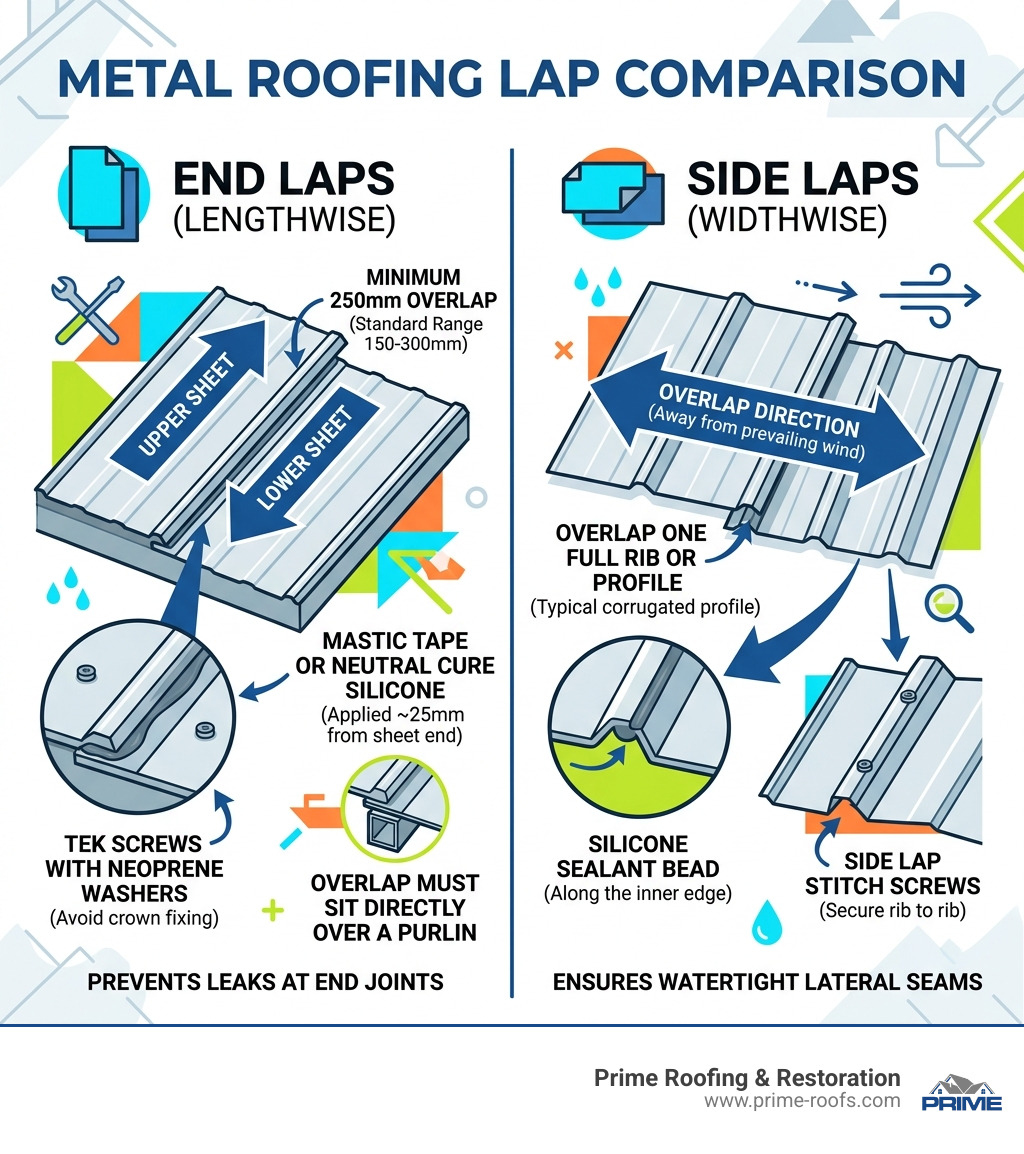
- Overlap amount: Minimum 250mm (about 10 inches); 150-300mm is the standard range depending on profile and pitch.
- Direction: Always lap upper sheets over lower sheets, starting from the eaves and working upward toward the ridge.
- Support: Every end lap must sit directly over a structural purlin underneath to ensure compression.
- Sealing: Apply mastic lapping tape or neutral cure silicone approximately 25mm from the sheet end, across the full width.
- Fastening: Use TEK screws with neoprene washers; avoid crown fixing at lap joints to prevent metal deformation.
- Wind: Start laying from the corner away from the prevailing wind to stop rain being driven into seams.
If a corrugated or metal roof leaks but shows no rust or obvious damage, the end lap is almost always the first place to look. One real-world example from Sydney’s inner west tells the story perfectly: a large skillion roof with two end laps was leaking consistently – not because all the laps were wrong, but because some of them were installed backwards. The rest of the roof was fine. That’s how sensitive end lap installation is to technique. In Alabama, where we face heavy convective thunderstorms in May 2026, even a minor error in the lap direction can lead to gallons of water entering the building envelope in minutes.
End laps are necessary whenever a single sheet can’t span the full roof length. Box profile sheets max out at around 9 meters, corrugated at 5-7 meters, and tile form at 6 meters. Anything longer needs at least one end lap – and every one of those joints is a potential entry point for water if it isn’t done right. Our team is built around getting these details correct the first time. We understand that metal roofing is an investment, and the longevity of that investment depends entirely on the integrity of the seams.
I’m Bill Spencer, owner of Prime Roofing & Restoration, with hands-on experience diagnosing and repairing end lapping roof sheets failures across Alabama’s Gulf Coast – from storm-damaged agricultural buildings to commercial flat roofs. In this guide, I’ll walk you through exactly how to do it right, what goes wrong, and how to fix it. We will dive deep into the physics of capillary action, the importance of thermal expansion, and the specific tools required for a professional finish.
End lapping roof sheets terms to remember:
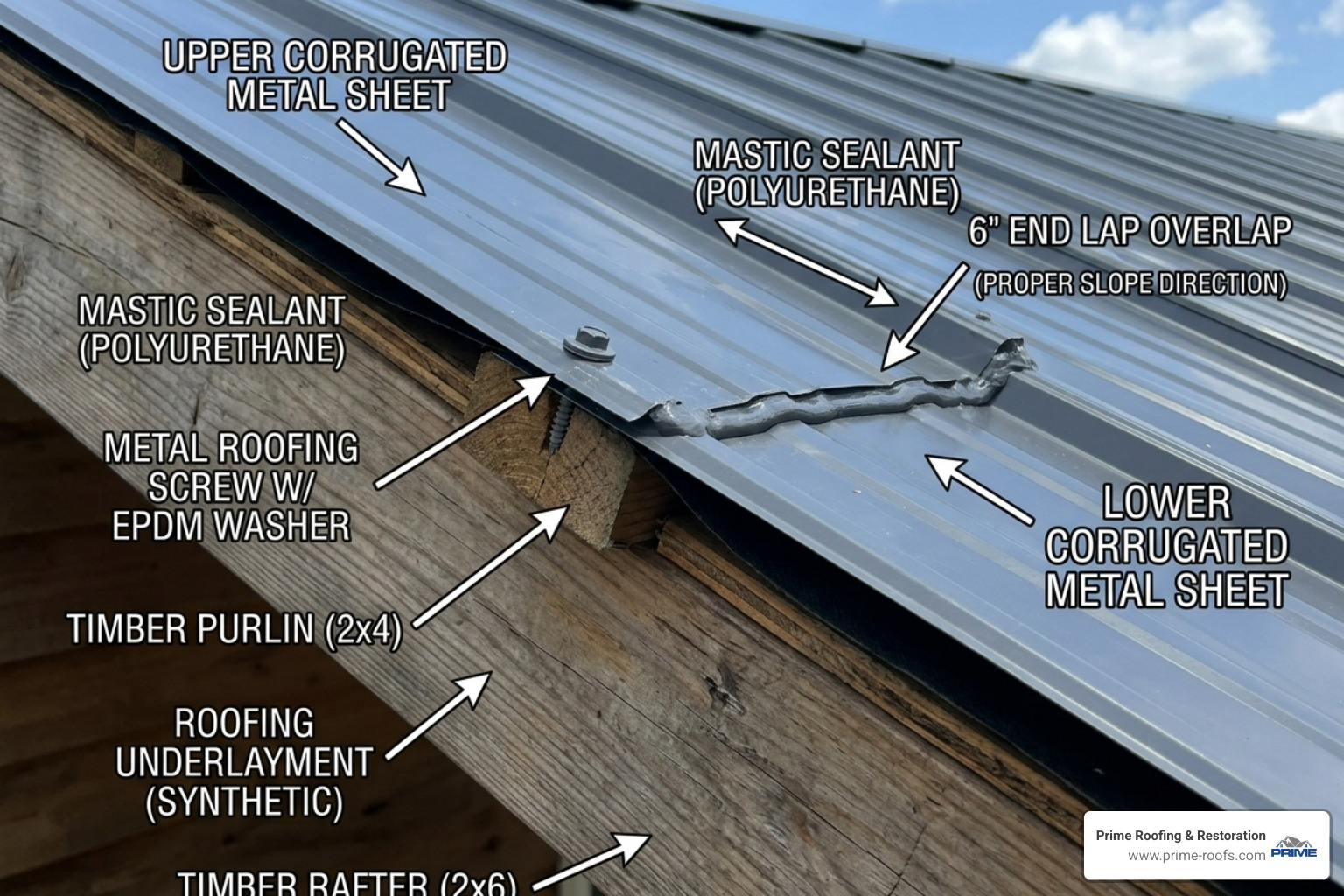
In metal roofing, the integrity of your roof is only as strong as its weakest seam. While many homeowners focus on the color or the material, the way we handle end lapping roof sheets determines whether your home stays dry during a heavy Alabama thunderstorm or ends up with a bucket in the living room. The physics of water movement on a metal surface is complex; surface tension can pull water uphill if the gap between sheets is just the right size—a phenomenon known as capillary action.
An end lap is fundamentally different from a side lap. A side lap is the horizontal overlap where the edges of two sheets meet side-by-side. An end lap is the vertical joint where the bottom of an upper sheet meets the top of a lower sheet. Because water flows down the roof pitch, end laps are under constant hydraulic pressure during heavy rain. If the roof pitch is low, the water moves slower and builds up deeper, increasing the pressure on the seal.
Several factors make end laps a high-stakes engineering detail:
- Capillary Action: If the overlap is too tight or lacks proper sealant, water can actually be “sucked” upward between the sheets against gravity. This is why a 250mm overlap is standard; it provides enough distance that water rarely overcomes the vertical climb.
- Wind Uplift: During high-wind events in Alabaster or Hoover, improperly secured end laps can act like a sail, catching the wind and peeling back the roofing material. This can lead to catastrophic roof failure during hurricane season.
- Thermal Expansion: Metal expands and contracts with the Alabama heat. A 10-meter sheet can expand by several millimeters between a cold night and a 100-degree afternoon. If the lap isn’t installed with this movement in mind, fasteners can back out or sealants can delaminate.
According to technical resources like End Laps: Definition, Benefits & Uses in Roofing Systems | Interlock®, proper execution is the most important consideration for long-term roof performance. Without a doubt, the end lap is the most common point of failure in metal roofing systems that have been installed by inexperienced contractors.
Side Laps vs. End Laps: A Quick Comparison
| Feature | Side Lap | End Lap |
|---|---|---|
| Orientation | Parallel to the slope | Perpendicular to the slope |
| Primary Risk | Wind-driven rain entry | Capillary action & water “back-up” |
| Standard Overlap | One or two corrugations | 6 to 12 inches (150-300mm) |
| Support Requirement | Usually spans between purlins | Must be supported by a purlin |
Recommended Overlap Lengths for End Lapping Roof Sheets
The “golden rule” for end lapping roof sheets is that more is usually better, but there is a strict minimum. For most standard corrugated and box profile sheets, we recommend a minimum overlap of 250mm (roughly 10 inches).
However, the specific length can vary based on your roof’s pitch. On a steep pitch (over 15 degrees), water moves quickly, and a 6-inch (150mm) lap might suffice. On a low-pitch roof (below 10 degrees), we often increase this to 12 inches (300mm) to prevent water from backing up under the sheets during torrential downpours. If you are installing metal roofing on a shed, these measurements are just as critical as they are on a full-sized home. Low-slope roofs are particularly vulnerable to “ponding,” where water sits on the lap for extended periods, testing the sealant to its limit.
Structural Support and Purlin Requirements
One of the most common DIY mistakes we see is “floating” an end lap. An end lap should never hang in the air between supports. It must be positioned directly over a structural purlin. This is non-negotiable for the structural integrity of the roof.
This support serves two purposes:
- Compression: It provides a solid base so that when you drive your fasteners, the upper and lower sheets are squeezed together against the sealant, creating a watertight gasket. Without the purlin, the metal will simply flex away from the screw, leaving a gap.
- Load Bearing: End laps are naturally heavier and more prone to movement; the purlin ensures the roof doesn’t sag at the joint. A sagging joint will collect water, leading to premature corrosion.
For 0.7mm thick steel sheets, purlins should be spaced no further than 1.2m apart. For thinner 0.5mm sheets, this spacing should be reduced to 1.0m to provide adequate support. More details on these structural requirements can be found at Roofing Sheet End Lap | NZ Metal Roofing Manufacturers. Proper purlin alignment is the foundation of a successful end lap.
Step-by-Step Guide to Installing End Laps

Installing end lapping roof sheets is a systematic process. You can’t just throw the sheets up and hope for the best. Precision is the difference between a 40-year roof and a 4-year headache. In Alabama, where the sun can bake a roof to 160 degrees, every measurement must account for the expansion of the metal.
Before you start, ensure your purlins are square and the first sheet is laid perfectly aligned with the eaves. If your first sheet is “off,” every subsequent lap will be crooked, creating gaps that sealants can’t fill. We recommend using a string line across the length of the roof to ensure the bottom edge of your first row is perfectly straight.
Preparation and Tool List
To do this job correctly, you need the right tools. Using the wrong equipment can damage the protective coating of the metal, leading to rust within months.
- Nibblers or Shears: Never use an angle grinder. Grinders create heat that destroys the galvanization and produces sparks that melt into the paint.
- Impact Driver: With a depth-sensing nosepiece to avoid over-tightening.
- Mastic Tape: High-quality butyl tape is preferred over silicone for the primary seal.
- Chalk Line: For marking the 250mm overlap clearly on the lower sheets.
- Safety Gear: Cut-resistant gloves and a full-body harness.
Directional Laying and Water Flow
Always lay your sheets starting from the bottom (the eaves) and work your way up toward the ridge. This ensures the upper sheet always sits on top of the lower sheet, allowing water to shed naturally down the slope. This is the most basic rule of roofing, yet it is frequently ignored in DIY projects.
Furthermore, consider the prevailing wind in your part of Alabama. You should start laying sheets from the side of the roof opposite the prevailing wind. This ensures that the side laps face away from the wind, preventing rain from being driven into the seams. If the wind usually comes from the West, start your installation on the East side of the roof.
The Installation Sequence
- Install the Eave Sheet: Secure the first sheet at the bottom of the slope. Ensure it overhangs the gutter by the manufacturer’s recommended distance (usually 50mm).
- Mark the Lap: Use a chalk line to mark exactly 250mm from the top edge of this sheet. This is where the next sheet will end.
- Apply Sealant: Place your mastic tape just below this line. Do not remove the paper backing until you are ready to drop the next sheet.
- Position the Upper Sheet: Align the upper sheet with the chalk line. Ensure the ribs of the upper sheet nest perfectly into the ribs of the lower sheet.
- Fasten: Secure the sheets through the valleys into the purlin below.
Fastening Patterns for Secure End Lapping Roof Sheets
To secure the lap, we use self-drilling TEK screws equipped with neoprene washers. The neoprene acts as a tiny umbrella for the hole you just drilled. When the screw is tightened, the washer should compress slightly but not bulge out or split.
- Spacing: For side laps, stitching screws should be placed at 600mm intervals. For end laps, you should fasten at every second valley for corrugated profiles, or every valley for box profiles in high-wind areas.
- End Lap Pattern: Fasten through the “valleys” (the low parts) of the profile at the end lap to ensure maximum compression against the sealant and the purlin. This creates a tight sandwich of metal-sealant-metal-purlin.
- Avoid Crown Fixing: While some older methods suggest fixing through the high ribs (crowns), modern guidance from the LABC suggests this results in poor compression and should be avoided at end lap joints. Crown fixing is more susceptible to vibration and fastener loosening over time.
When mastering roof flashing installation for a leak-proof home, the same principles of “top-over-bottom” apply to your ridge caps and barges as well. Every transition on the roof must respect the downward flow of water.
Essential Sealing Techniques for a Watertight Joint
Even with a massive overlap, metal is never perfectly flat. Micro-gaps will always exist due to manufacturing tolerances and the profile of the metal. That is where sealant comes in. For end lapping roof sheets, you have two main choices: mastic lapping tape or neutral cure silicone.
At Prime Roofing & Restoration, we generally prefer mastic lapping tape (butyl tape). It provides a consistent thickness across the entire width of the sheet and doesn’t “squeeze out” as easily as liquid silicone. Butyl tape remains flexible for decades, which is vital for handling the thermal expansion and contraction common in Alabama’s climate.
Sealant Positioning and Application
The placement of your sealant is a “make or break” detail. If the sealant is placed too high, water can bypass it. If it’s too low, it won’t be compressed by the fasteners.
- The 25mm Rule: Apply your mastic tape or silicone bead approximately 25mm (1 inch) from the top edge of the bottom sheet. This ensures that any water that manages to wick up the first few inches of the lap is stopped well before it reaches the top.
- Compression Point: Position the sealant so it sits directly under the line where your fasteners will go. This ensures that when the screw is tightened, it applies direct pressure to the sealant, creating a “gasket” effect. This is the only way to ensure a 100% airtight and watertight seal.
- Clean Surfaces: Metal sheets often come with a thin film of oil from the factory to prevent white rust during shipping. Always wipe the lap area with a clean cloth and a mild degreaser to ensure the sealant actually bonds to the metal. Sealant applied to an oily surface will eventually peel away.
Guidance from the LABC suggests that positioning sealant about 15mm from the bottom of the lap is also an effective way to prevent water from wicking up. For more technical specifics, you can refer to Sealing end laps in metal roofing | LABC. In high-wind areas, we often recommend a “double bead” system—one strip of tape at the top of the lap and another at the bottom—for maximum security.
The Science of Capillary Action
Why is sealing so critical? Capillary action occurs when the space between two surfaces is so small that the surface tension of the water actually pulls the liquid into the gap. Think of how a paper towel draws up a spill. In a metal roof end lap, the two sheets of metal act like the paper towel. Without a break in that gap (the sealant), water can travel 10 inches uphill and drop into your attic. This is why we emphasize the “gasket” effect of the sealant under the fastener.
Advanced Systems and Manufacturer Solutions
In May 2026, we are seeing more advanced systems like SecureLap® and PIR (Polyisocyanurate) insulated panels. These systems often feature built-in “expansion steps” that allow for long runs over a single purlin without the traditional risks of end lap failure. These steps create a physical break in the capillary path, adding an extra layer of safety.
Insulated panels, like MetecnoSpan®, offer module widths of 1000mm and provide R-values ranging from 1.85 to 4.55. These are fantastic for commercial buildings in Alabama where energy efficiency is just as important as waterproofing. The insulation also helps dampen the sound of heavy rain, which is a common complaint with traditional metal roofing. For general installation tips from a leading supplier, check out How to Install Metal Roofing Sheets – Installation Guide. These guides provide excellent visual aids for understanding the nesting of different profiles.
Common Mistakes and Troubleshooting Leaks
Even professionals can get tripped up if they rush the job. Metal roofing is unforgiving; once a hole is drilled, it’s there forever. Here are the most common failures we see when inspecting end lapping roof sheets in the Alabaster and Hoover areas:
- Overtightening Screws: This is the #1 mistake. If you drive the screw too hard, you’ll crush the neoprene washer or deform the metal sheet, creating a “bowl” or depression around the screw. This bowl collects water, which eventually eats through the washer and leaks directly into the hole.
- Staggering Failures: If you align all your end laps in a single straight line across the roof, you create a structural weak point and a long horizontal seam that is more likely to fail. It is often better to stagger laps between adjacent rows, creating a “brick-bond” pattern that distributes the load and the risk.
- Debris Entrapment (Swarf): Leaving metal shavings (swarf) from drilling or dirt inside the lap will lead to premature corrosion. These tiny bits of raw steel will rust rapidly, and that rust will spread to the panels. Always sweep the lap area before joining the sheets.
- Using the Wrong Sealant: Never use acid-cure silicone (the kind that smells like vinegar). The acetic acid will react with the zinc coating on the metal and cause it to rust from the inside out within a year. Always use “Neutral Cure” silicone.
We often tell our clients that the overlap lowdown applies to all materials; whether it’s cedar or steel, the physics of water remains the same. Gravity and surface tension are universal forces.
Identifying and Fixing Improperly Installed Laps
If you suspect a leak, don’t just start slathering caulk on the outside of the seam. That’s a temporary fix that usually makes the problem worse by trapping water inside the lap, accelerating rust. A proper repair requires addressing the root cause.
- Visual Inspection: Look for gaps where the sheets aren’t sitting flush. Check for “back-driven” fasteners that have wiggled loose due to thermal expansion. Look for rust streaks originating from the lap.
- The Water Hose Test: This requires two people. Have someone stand in the attic with a flashlight while you run a hose over the suspected lap. Start at the bottom of the roof and work your way up slowly. Do not spray water up the lap, as this doesn’t simulate rain; spray it above the lap and let it flow down.
- The Fix: Often, the only real fix for a failed end lap is to remove the fasteners, clean out the old sealant, apply fresh mastic tape, and re-fasten. If the metal is deformed, you may need to install a wider “patch” sheet over the joint. In severe cases, a professional roof replacement may be necessary if the metal has begun to rust from the inside out.
Safety Precautions During Installation
Roofing is dangerous work, especially when handling long metal sheets that can catch the wind like a sail. A 6-meter sheet of steel can easily pull a grown man off a roof during a sudden gust.
- Cutting: Always cut sheets on the ground, face down, using a nibbler or shears. This prevents swarf from landing on the finished side of the sheet.
- Handling: Wear cut-resistant gloves. Metal edges are razor-sharp and can cause deep lacerations. Use a team of at least two people to handle sheets longer than 3 meters.
- Fall Protection: Always use OSHA-approved harnesses and anchor points. On the steeper pitches found in Alabama residential architecture, a fall can be fatal. Ensure your ladder is secured at the top and extends at least 3 feet above the eave.
- Weather Awareness: Never install metal roofing when rain or high winds are forecast. A wet metal roof is as slippery as ice.
Frequently Asked Questions about End Lapping
What is the minimum overlap for a corrugated metal roof?
The industry standard is a minimum of 250mm (about 10 inches). However, for very shallow roofs (less than 10-degree pitch), we recommend increasing this to 300mm (12 inches) and using double rows of sealant. On very steep roofs (over 25 degrees), you can sometimes reduce this to 150mm, but 250mm remains the safest bet for all conditions.
Can I use silicone instead of mastic tape for end laps?
Yes, but it must be a neutral cure silicone. Standard acid-cure silicone will react with the metal coating and cause rapid corrosion. Mastic tape is generally preferred because it provides a more uniform seal, doesn’t dry out as quickly, and is much easier to work with in windy conditions where liquid silicone might get messy.
Why should I avoid crown fixing at the end lap?
Fixing through the “crown” or the high rib makes it very difficult to get enough compression on the sealant. When you tighten a screw on the crown, the metal tends to flex or “oil can” rather than squeeze the two sheets together. Fixing in the “valley” ensures the sheets are clamped tightly against the purlin and the sealant, creating a true gasket seal.
How do I calculate how many sheets I need with end laps?
When calculating your sheet lengths, you must subtract the overlap from the total length. For example, if your roof slope is 10 meters and you are using two 5.25-meter sheets, you will have exactly 10.5 meters of metal, which allows for a 500mm overlap (or a 250mm overlap with some extra at the eaves/ridge). Always order slightly more than you think you need to account for cutting errors.
Does the color of the metal affect the end lap?
Indirectly, yes. Darker colors (like Charcoal or Bronze) absorb more heat, leading to greater thermal expansion. This puts more stress on the end lap fasteners and sealant. If you choose a dark color in Alabama, ensure you are using high-quality butyl tape that can handle significant movement.
Can I end lap different profiles of metal roofing?
Generally, no. The ribs must nest perfectly to create a seal. If you are trying to join a corrugated sheet to a box profile sheet, you will need a custom transition flashing. Attempting to lap different profiles will result in massive gaps that cannot be sealed.
How often should I check my end laps?
We recommend a professional roof inspection every 2-3 years. We look for fastener back-out, sealant degradation, and signs of internal rust. Catching a failing seal early can save you thousands in interior water damage repairs.
Is it okay to walk on the end laps?
Avoid walking directly on the lap if possible. If you must walk on the roof, stay on the purlin lines and step in the valleys of the profile. Stepping on the ribs or directly on a lap joint can deform the metal and break the sealant bond.
Conclusion
At Prime Roofing & Restoration, we believe that a roof is more than just a cover; it’s a long-term relationship. Whether you’re in Alabaster, AL, or Hoover, our mission is to provide end-to-end solutions that protect your home and your family. We use only the highest quality materials and our licensed experts are available 24/7 for emergency services. Properly end lapping roof sheets is a technical skill that requires patience and precision. If you’re unsure about your roof’s integrity or need a professional eye to catch those tricky leaks before they become disasters, we’re here to help.
Don’t leave your home’s safety to chance. Contact the expert Alabaster roofers at Prime Roofing & Restoration today. We provide free estimates and comprehensive roof health reports to ensure your peace of mind.
Contact Information
Prime Roofing & Restoration
Address: 5 Brown Cir, Alabaster, AL 35007
Phone: (205) 661-8190
Hours: Available 24/7 for Emergency Services