
Why Installing Metal Roofing on a Shed is a Smart Long-Term Investment
Installing metal roofing on a shed is more than a simple upgrade; it transforms a basic backyard storage unit into a durable, weather-resistant fortress for your valuables. A professionally installed metal roof can last an incredible 50 to 70 years, a lifespan that dramatically outpaces traditional asphalt shingles, which often require costly replacement every 15 to 30 years. For homeowners seeking expert roofing services, understanding this long-term value is the first step toward making a wise investment. This comprehensive guide provides a complete, detailed walkthrough of the installation process, ensuring your expensive tools, lawn equipment, and stored belongings are protected from the elements for decades to come.
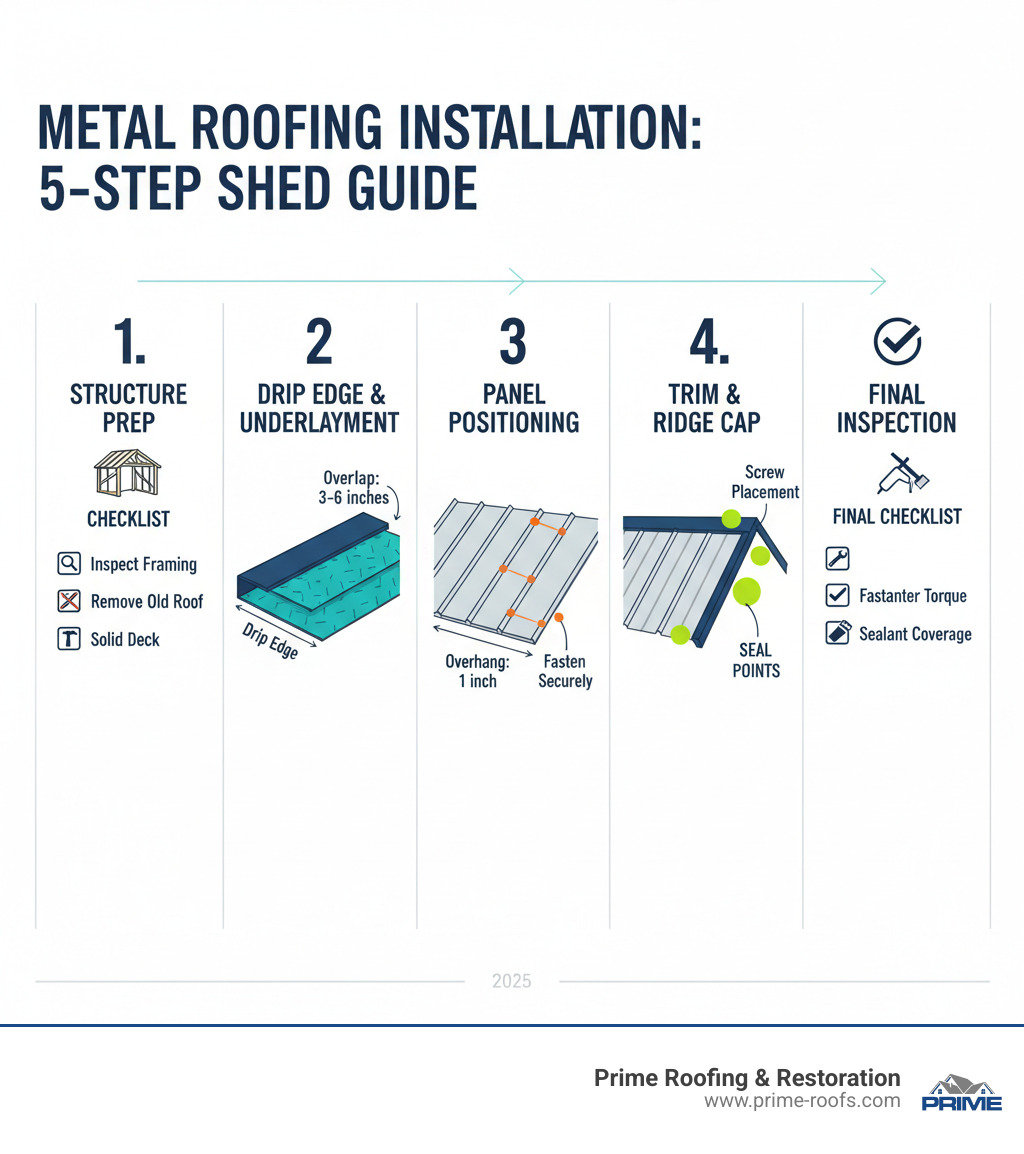
Quick Installation Overview:
- Prepare the Structure: This crucial first step involves a thorough inspection of the shed’s framing for any signs of rot or weakness, a complete tear-off of the old roofing material, and ensuring you have a solid, clean, and flat roof deck to work on.
- Install Drip Edge & Underlayment: This creates the primary moisture barrier. Drip edge is installed at the eaves and rakes to direct water away from the fascia, while a high-quality synthetic underlayment provides a secondary layer of protection against water intrusion.
- Position & Fasten Panels: Starting at one edge, panels must be squared to the roof, overlapped correctly to engage the anti-siphon channel, and fastened with the proper screws and torque to create a watertight seal.
- Add Trim & Ridge Cap: This finishing stage involves sealing all exposed edges and the peak of the roof with the appropriate flashing, including gable trim and a ridge cap, using sealant and closure strips to block out weather and pests.
- Inspect & Seal: The final step is a meticulous review of the entire roof, checking all fasteners for proper torque and applying high-grade sealant to any remaining gaps or joints.
Metal roofing offers a host of clear advantages: it’s Class A fire-resistant, sheds snow and rain with unparalleled efficiency, requires virtually no maintenance, and can significantly reduce heat absorption, keeping the shed’s interior cooler. Unlike asphalt, it completely resists the growth of moss, mold, and algae and will not degrade under harsh UV exposure. While the initial cost of metal roofing—ranging from $115 to over $900 per square (100 sq. ft.)—is higher than asphalt, its exceptional lifespan and near-zero maintenance costs deliver superior long-term value. For shed owners in storm-prone regions like Central Alabama, the outstanding wind and hail resistance provides invaluable peace of mind.
As Bill Spencer, Owner and President of Prime Roofing & Restoration, I’ve spent years overseeing installations and can attest that meticulous preparation and a deep understanding of fastening details are what make a metal roof last for generations. A well-installed roof on a shed is not just a cover; it’s a permanent, worry-free solution that protects your assets and enhances your property.
Why Metal is the Superior Choice for Your Shed Roof
When it comes to protecting the contents of your shed, the choice of roofing material is one of the most critical decisions you’ll make. While many builders default to cheap asphalt shingles to save on upfront costs, installing metal roofing on a shed represents a far smarter long-term investment, offering a level of protection and durability that traditional materials simply cannot match. A metal roof does more than just keep the rain out; it actively protects your valuables by reflecting intense solar heat, which keeps the interior significantly cooler during Alabama’s scorching summers. With a functional lifespan of 50 to 70 years, it is often a one-time installation that will likely outlast the shed itself, providing decades of worry-free performance.
Advantages of Metal Roofing
The compelling case for metal roofing is built on a foundation of proven performance, resilience, and long-term financial sense. Here’s a more in-depth look at why it consistently outperforms other materials for shed applications:
- Unmatched Longevity: A metal roof is a lifetime investment. It lasts 50 to 70 years, which is three to four times longer than asphalt shingles (15-30 years) and significantly longer than wood shakes (20-40 years). This means you install it once and can essentially forget about re-roofing for the next half-century.
- Extreme Durability: Metal panels are engineered to withstand the worst of Mother Nature. They can handle heavy snow loads without buckling, resist winds of up to 140 mph without lifting, and often carry a Class 4 impact rating, the highest available for resistance against hail. Unlike other materials, metal will not crack, warp, rot, or become brittle over time.
- Superior Weather Resistance: The smooth, non-porous surface of metal roofing is its greatest asset in wet climates. It sheds rain and snow with incredible efficiency, preventing water from pooling and minimizing the risk of moisture penetration and leaks. The interlocking or overlapping panel design creates a formidable barrier against wind-driven rain.
- Critical Fire Resistance: Metal is a non-combustible material, typically earning a Class A fire rating—the highest possible. This means it will not ignite from flying embers from a nearby wildfire or bonfire, offering critical protection for your shed, especially if you store flammable materials like gasoline, propane, or paint.
- Minimal Maintenance: Forget spending your weekends on roof repairs. Metal roofs require little more than an annual visual inspection to check for debris in valleys or around penetrations and to ensure fasteners remain snug. This low-maintenance nature frees up your time and saves money on repairs.
- Impressive Energy Efficiency: Metal is a “cool roofing” material. Its surface reflects a high percentage of solar radiant heat, which can lower the interior temperature of your shed by as much as 20-30 degrees in the summer. This not only protects heat-sensitive items like electronics or chemicals but also makes the space more comfortable if used as a workshop.
- Lightweight Construction: Despite their strength, metal panels are surprisingly lightweight. This reduces the structural load on your shed’s frame, which can be particularly beneficial for smaller or older structures. The lighter weight also makes the panels easier and safer to handle during installation.
- Inherent Moss and Mold Resistance: The non-porous surface of metal offers no purchase for moss, mold, mildew, or algae to grow. This ensures your shed roof maintains a clean, attractive appearance for years without the need for chemical treatments or harsh power washing.
- Increased Property Value: A shed is no longer just a shed when it features a professional-grade metal roof. It becomes a durable, high-quality outbuilding that is an attractive asset to potential buyers, improving your property’s overall curb appeal and value. Learn more about the Benefits of Metal Roofing for Alabama Homes.
Best Metal Panel Types for a Shed
Choosing the right panel profile and base metal is crucial for balancing performance, aesthetics, and ease of installation. Here are the most practical options for shed projects:
- Corrugated Panels: This is the classic, iconic wavy-profile panel. It’s one of the most economical choices, is widely available at home improvement stores, and its straightforward exposed-fastener system makes it ideal for DIY installation.
- R-Panel and PBR-Panel: These are robust commercial-grade panels featuring strong, trapezoidal ribs for increased strength and water-shedding capability. The Purlin Bearing Rib (PBR) variant is superior, as it features a wider overlap leg that provides a better seal and more surface area for sealant application, offering enhanced protection against leaks.
- Standing Seam: This is the premium option, featuring concealed fasteners and raised, interlocking seams that are mechanically or hand-crimped. It offers a sleek, modern look and is virtually leak-proof. However, it requires specialized tools (like seamers) and considerable expertise, making it less common for DIY shed projects and better suited for professional installation.
The base metal and its coating are just as important as the panel’s profile:
- Galvanized Steel: This is steel coated with a layer of zinc to prevent rust. It’s an economical and widely used choice for sheds and agricultural buildings, offering good corrosion resistance in most environments.
- Galvalume Steel: This is steel coated with a specialized blend of zinc, aluminum, and silicon. This coating offers superior, long-term corrosion resistance, especially against atmospheric corrosion, making it a better choice than galvanized steel in coastal or industrial areas.
- Aluminum: Naturally rust-proof, aluminum is an excellent choice for sheds in coastal regions with high salt spray. However, it is a softer metal than steel, making it more prone to denting from hail or foot traffic, and it also has a higher rate of thermal expansion and contraction.
- Coatings (e.g., Kynar 500): The paint finish on a metal panel is its first line of defense. High-end finishes like Kynar 500 (PVDF) provide exceptional color retention, resisting fading and chalking from UV exposure for decades, ensuring your roof looks great for its entire lifespan.
Here’s a detailed comparison to guide your decision:
| Feature | Galvanized/Galvalume Steel (Corrugated/R-Panel) | Aluminum (Corrugated/R-Panel) | Standing Seam (Steel/Aluminum) |
|---|---|---|---|
| Cost | Moderate | Moderate to High | High |
| Lifespan | 30-50 years (Galvanized), 40-70 years (Galvalume) | 30-50 years | 50-70+ years |
| Rust Resistance | Good (Galvanized), Excellent (Galvalume) | Excellent (inherently rustproof) | Excellent |
| DIY-Friendliness | High | High | Low (professional often required) |
| Dent Resistance | Good | Fair (dents easily) | Good |
For the vast majority of shed projects, Galvalume steel panels in a corrugated or PBR-panel profile provide the absolute best balance of cost, long-term durability, and ease of installation.
Preparation is Key: Tools, Materials, and Shed Prep
Proper, meticulous preparation is the non-negotiable foundation of a professional-quality metal roof installation. Before a single panel is laid, you must gather the right equipment and ensure the shed’s structure is sound, square, and ready to support a roof designed to last for decades. The time and effort invested in this prep work will directly impact the quality, watertightness, and longevity of your finished roof. Rushing this stage is the single biggest cause of installation failure.
Essential Tools and Materials Checklist
Having every single item on hand before you begin prevents frustrating delays and dangerous improvisations. A complete and organized setup ensures a smooth, safe, and efficient workflow from start to finish.
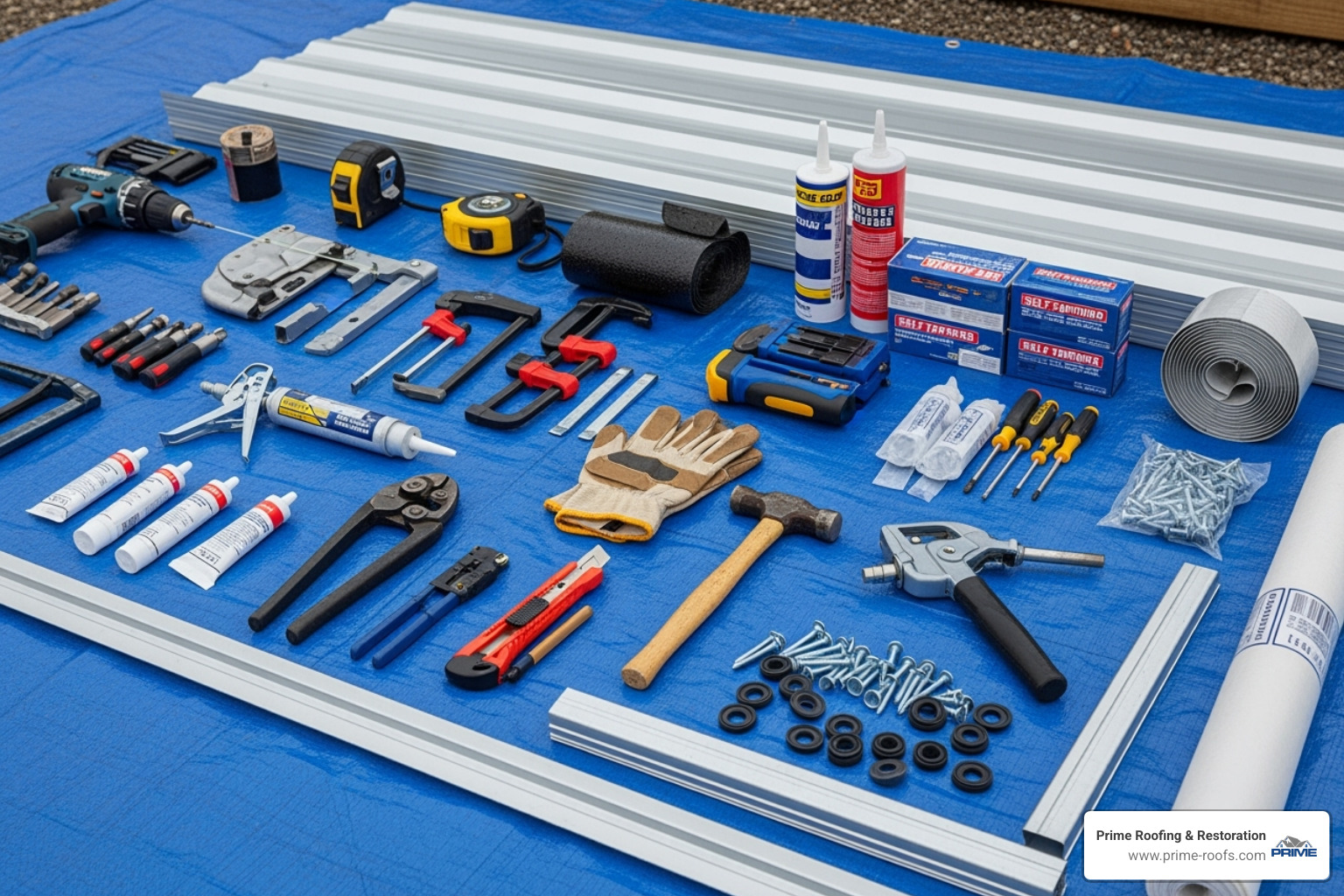
- Safety Gear: This is paramount. A hard hat, ANSI-rated safety glasses, heavy-duty cut-resistant gloves, and slip-resistant work boots are absolutely mandatory. A fall protection harness is also recommended if the shed roof is high or steeply pitched.
- Measuring & Layout Tools: A quality tape measure, a long chalk line (preferably in a non-staining color like white or blue), a 4-foot level, and a speed square for ensuring precise 90-degree angles and rafter cuts.
- Cutting Tools: A circular saw equipped with a metal-cutting blade (a carbide-tipped blade with a high tooth count is best for clean cuts). A pair of straight-cut tin snips (red and green aviation snips are also useful for left and right curves). For more advanced users, a power shear or a nibbler can make cutting faster and cleaner.
- Fastening Tools: A variable-speed drill with an adjustable torque clutch is essential for driving screws correctly. You will also need a magnetic hex-head driver bit (typically 1/4″ or 5/16″) that matches your roofing screws. A utility knife for trimming underlayment and a high-quality caulking gun are also necessary.
- Materials:
- Metal Panels: Order panels pre-cut to the exact length of your roof slope if possible to eliminate horizontal seams.
- Synthetic Underlayment: A high-quality, tear-resistant synthetic underlayment is far superior to traditional asphalt felt.
- Drip Edge: E-style or F-style flashing for the eaves and rakes.
- Trim Package: This includes gable (or rake) trim, a ridge cap, and any other necessary flashing like sidewall or endwall trim.
- Roofing Screws: Use self-tapping wood grip screws (e.g., #10 or #12 gauge) that are long enough to penetrate the sheathing by at least 1 inch. Ensure they have a high-quality EPDM rubber washer for a durable, UV-resistant seal.
- Sealant: High-grade, non-curing butyl tape and a tube of 100% silicone or polyurethane sealant designed for metal roofing.
- Foam Closure Strips: These must be profile-matched to your specific panel type. You will need both vented (for the ridge) and solid (for the eaves) strips.
Preparing the Shed Structure and Roof Deck
A solid, clean, and perfectly level roof deck is mandatory for a successful metal roof installation. Do not cut corners here, as any imperfections in the substrate will be magnified by the metal panels.
First, thoroughly inspect the shed’s frame. Look for any signs of rot, insect damage, or structural weakness in the rafters, trusses, and top plates. Reinforce or replace any compromised framing members before proceeding. Next, perform a full tear-off of all old roofing material. This is the only way to properly inspect the underlying sheathing for hidden damage. Once the old roof is removed, meticulously clean the roof deck. Sweep away all dirt and debris, and use a hammer to pound down or remove any protruding nails or staples that could puncture your new underlayment.
Finally, critically evaluate the sheathing. Walk the entire roof deck, feeling for any soft, spongy, or delaminated sections of plywood or OSB. These must be cut out and replaced with new sheathing of the same thickness. We strongly recommend a minimum of 1/2-inch thick sheathing (5/8-inch is even better) to provide adequate holding power for the roofing screws.
Framing for Success: Achieving the Correct Roof Pitch
Roof pitch, or slope, is a critical factor for ensuring proper water drainage on any roof. For exposed-fastener metal roofs on sheds, a minimum slope of 3:12 is strongly recommended. This means the roof rises 3 inches vertically for every 12 inches of horizontal run. A steeper pitch, like 4:12 or greater, is even better as it promotes faster water and debris runoff. For more details on calculating and understanding slope, consult our comprehensive Roof Pitch Guide.
When framing a new shed, cut your rafters with precision to achieve this pitch. To guarantee a professional installation free of alignment headaches, you must square the frame using the 3-4-5 rule. From one corner, measure exactly 3 feet along one wall and make a mark. Then, measure exactly 4 feet along the perpendicular wall and make a mark. The diagonal distance between these two marks must be exactly 5 feet. If it’s not, adjust the frame by pushing or pulling the corners until the diagonal measures precisely 5 feet. A square frame ensures your panels will align perfectly from eave to ridge. For a helpful visual guide, watch this video on how to square up framing.
The Ultimate Guide to Installing Metal Roofing on a Shed
With all the preparation complete, you are now ready to begin the installation. Following these steps methodically and with great attention to detail is the key to installing metal roofing on a shed that is not only watertight and durable but also looks clean and professional. This process is about building a complete, integrated weather-resistant system from the roof deck up.
Step 1: Install Drip Edge and Underlayment
This first layer of material is your primary defense against moisture and sets the geometric foundation for the entire roof. Do not rush this step.
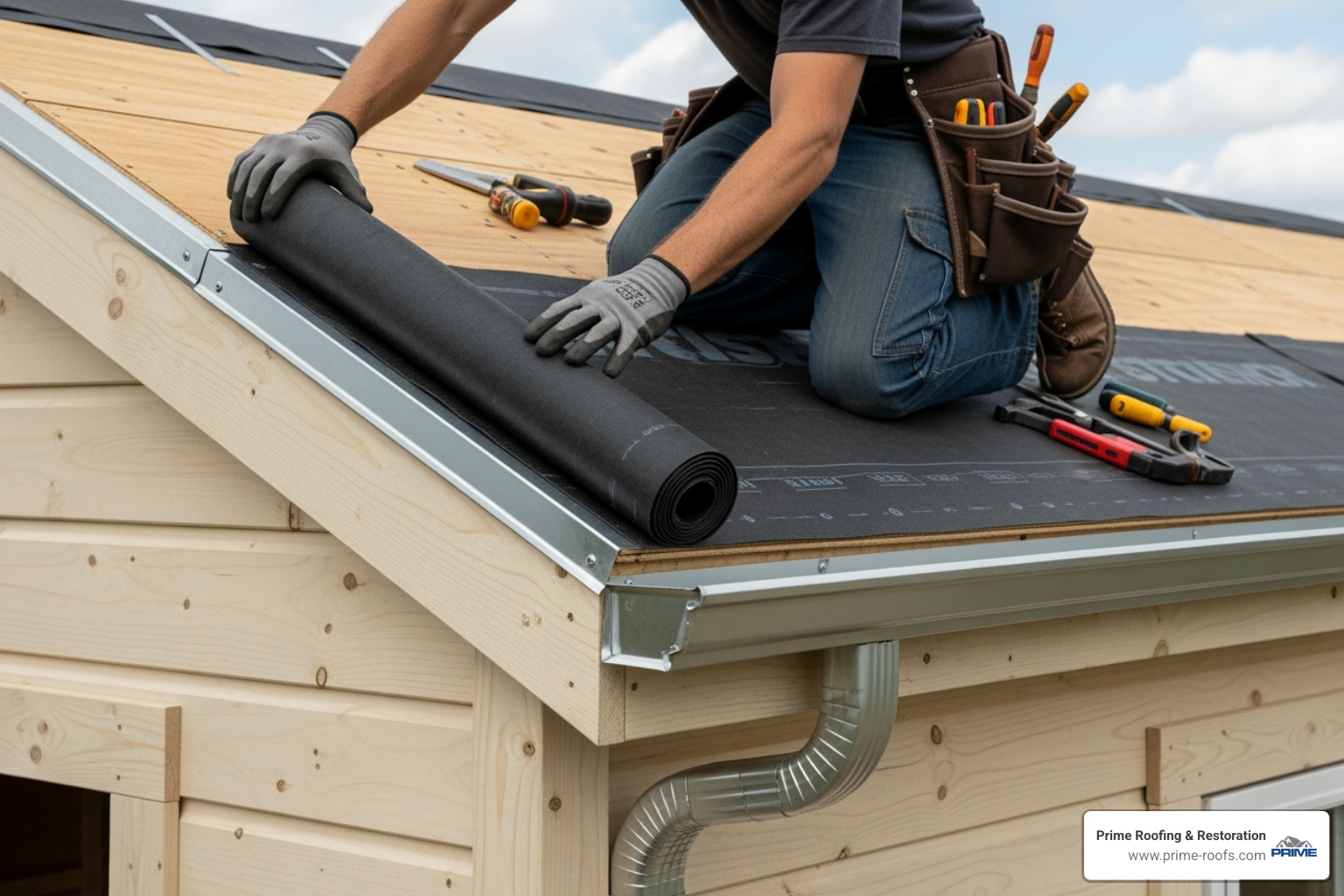
First, install the drip edge along the lower eaves (the horizontal bottom edges of the roof). This L-shaped metal flashing directs water away from the fascia board and into the gutters (if you have them), preventing rot. The drip edge should be placed directly on the wood sheathing. Overlap consecutive pieces by at least 1 inch and secure them with roofing nails every 12-16 inches.
Next, install the underlayment. We strongly recommend a high-quality synthetic underlayment for its superior tear resistance and water-repelling properties. Start at the bottom edge of the roof, laying the first course parallel to the eaves so it drapes over the drip edge you just installed. Work your way up toward the ridge, ensuring each subsequent row overlaps the one below it by at least 4 to 6 inches (follow the printed guidelines on the material). Keep the underlayment as smooth and free of wrinkles as possible, securing it with just enough cap staples to hold it in place until the panels are installed.
Finally, install the drip edge along the sloped rake edges (the gable ends). This time, the drip edge is installed on top of the underlayment. This critical detail ensures that any water that gets onto the underlayment cannot run sideways off the roof and get behind the rake drip edge.
Step 2: How to Correctly Measure, Cut, and Position Panels
Precision is paramount in this stage. The old carpenter’s adage “measure twice, cut once” has never been more applicable. Mistakes here are costly and can compromise the entire project.
Ideally, you ordered panels pre-cut to the full length of your roof slope to eliminate the need for horizontal seams. If you must cut panels to length, plan your cuts carefully to minimize waste. Always allow for a 1 to 2-inch overhang at the eave. This ensures that water sheds completely clear of the roof edge and fascia board.
Squaring the first panel is the single most critical step of the entire installation. An out-of-square first panel will cause a compounding error, making every subsequent panel crooked and creating unsightly, leaky gaps. Start at the edge of the roof opposite the prevailing winds (so wind blows over the laps, not into them). Snap a chalk line perfectly square (90 degrees) from the eave to the ridge to serve as a guide for the edge of your first panel. Position the first panel precisely along this line, ensuring it has the correct eave overhang. Double-check its alignment with your level and square before driving a single screw.
For cutting panels, a circular saw with a metal-cutting blade provides the straightest, fastest cuts. Pro Tip: When cutting, orient the panel so the saw’s baseplate is on the “good” side of the panel to avoid scratching the paint. Always wear safety glasses and gloves, as the cut edges will be extremely sharp. Use tin snips for any detailed trimming, such as around vent pipes. Crucial Safety Note: Immediately and thoroughly clean up all metal shavings (swarf) from the roof surface after cutting or drilling. These tiny steel fragments will rust within hours and cause permanent, ugly rust stains on your new roof’s finish.
Step 3: The Right Way to Fasten and Overlap Panels for a Watertight Seal
Proper fastening and overlapping techniques are what transform individual panels into a single, monolithic, watertight system. Attention to detail here is what guarantees a leak-free roof for the next 50 years.
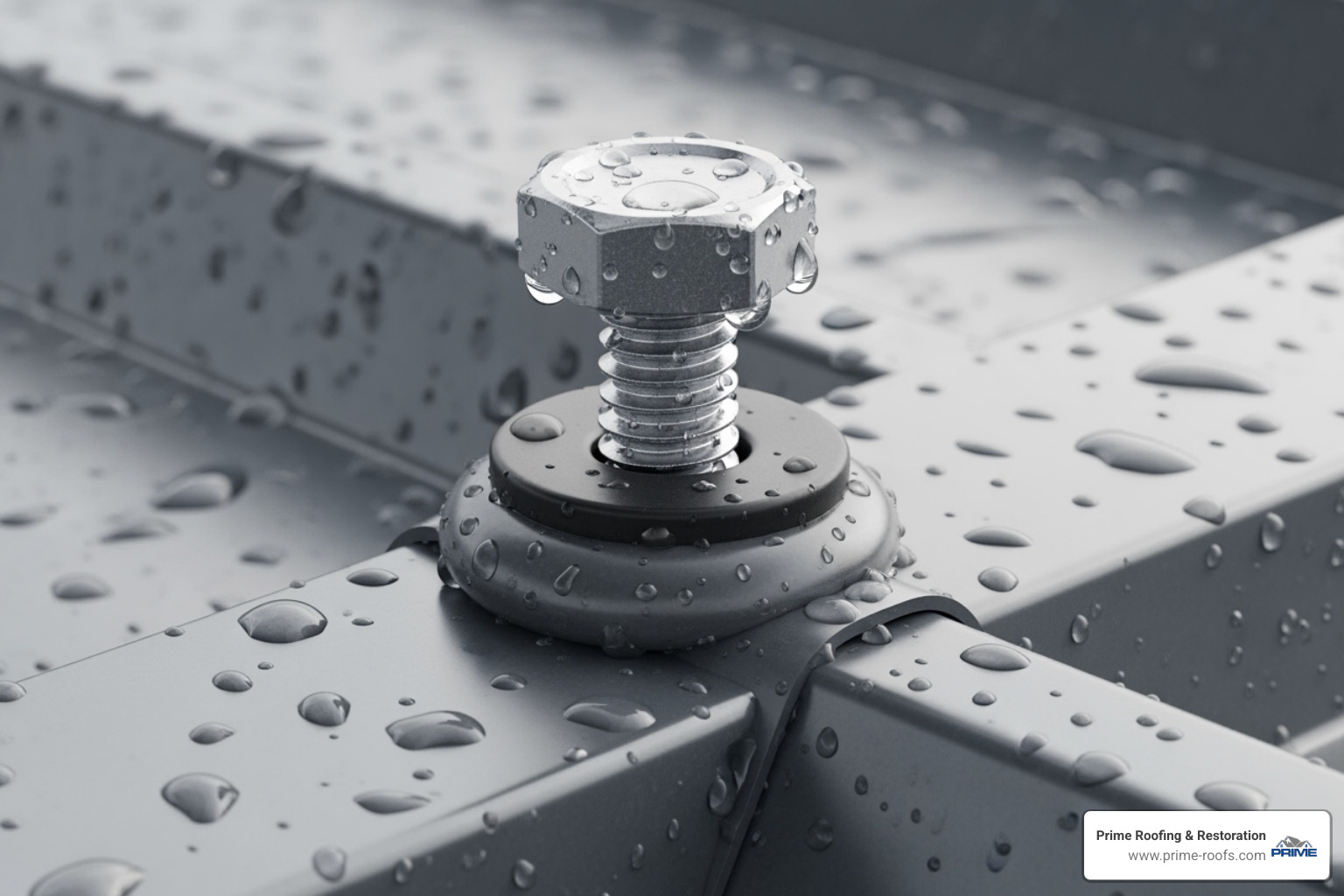
Screw placement for most exposed-fastener panels (like R-Panel or Corrugated) is in the flat part of the panel directly next to a major rib. This provides a solid connection to the deck and allows the washer to seal against a flat surface. Space screws approximately every 24 inches on center horizontally across the panel and vertically up the roof. At the perimeter of the roof—the eaves, ridge, and rake edges—and at panel overlaps, place screws closer together (every 8-12 inches) for added resistance against wind uplift.
Proper screw torque is absolutely crucial. Use a drill with an adjustable torque setting (clutch). Drive the screw until the rubber EPDM washer is snug and slightly compressed, but not crushed or bulging out from under the screw head. An over-tightened screw will damage the washer’s seal and can dimple or warp the panel, creating a channel for water. A loose screw won’t create a seal at all. The goal is “just right”—a firm, watertight compression.
For panel overlap, the design makes it straightforward. Nest the larger, taller rib of the new panel over the shorter, smaller rib of the previously installed one. Ensure the anti-siphon channel—a small, almost invisible groove in the underlapping rib designed to stop water from wicking backward via capillary action—is fully engaged and covered by the overlapping panel. For an extra layer of bulletproof protection, especially on lower-sloped roofs, apply a bead of non-curing butyl tape along the full length of the overlap seam before fastening.
Step 4: Finishing with Trim, Flashing, and Ridge Cap
These finishing components are not merely decorative; they are critical for sealing all exposed edges and completing the weather-resistant system.
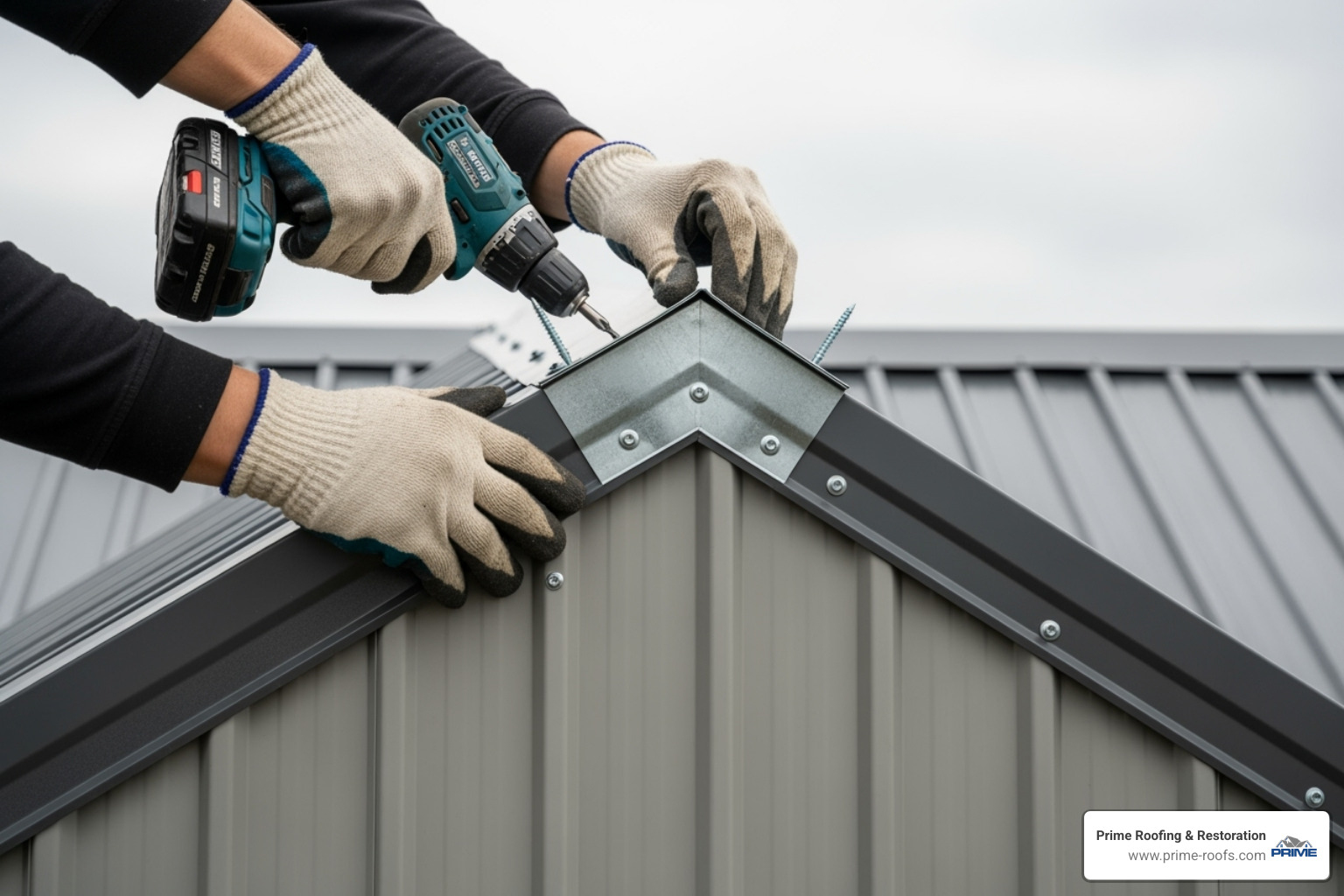
First, install the gable (or rake) trim along the sloped edges of the roof. This trim covers the exposed ends of the panels and the drip edge. Apply a continuous bead of butyl tape where the top of the trim meets the roof panels to create a watertight seal. Fasten the trim from the side into the fascia or gable framing and from the top through the panel into the roof decking, with screws every 12-16 inches.
Next, use foam closure strips to fill the corrugated gaps under the panels at the eaves and under the ridge cap at the peak. These profile-matched strips are essential for blocking wind-driven rain, snow, pests, and debris from entering the roofing system. Use solid (non-vented) strips at the eaves and vented strips at the ridge if you want to allow for attic ventilation.
Finally, install the ridge cap to cover the peak where the two roof slopes meet. Center it perfectly over the peak, on top of the vented closure strips. Overlap consecutive pieces of ridge cap by at least 6 inches, applying a generous amount of sealant in the overlap. Fasten the ridge cap by driving screws through the cap, through the high ribs of the panels below, and securely into the roof deck. Place screws on both sides of the ridge cap every 8 to 12 inches for maximum wind resistance. With the final screw driven, your roof is complete and ready to perform for the next 50 to 70 years. For more detailed manufacturer specifications, you can consult a guide like this R-Panel Installation Manual.
Pro Tips and Special Considerations
Even a perfectly executed plan can encounter unique situations on the job. Understanding how to handle these challenges and, more importantly, how to avoid common, preventable pitfalls is what separates a passable amateur job from a truly professional, long-lasting installation.
Common Mistakes to Avoid When Installing Metal Roofing on a Shed
After years of installing metal roofing on a shed for countless homeowners across Alabama, our team at Prime Roofing & Restoration has seen the same preventable mistakes time and again. Avoid these common errors with a little awareness and patience:
- Over-tightening Screws: This is the #1 mistake. Crushing the rubber washer breaks its seal, voids its warranty, and can warp the panel, creating a water channel. Use a drill with a clutch and tighten only until the washer is snug and slightly compressed.
- Misaligned First Panel: If the first panel is not perfectly square to the eave, the error will compound with every subsequent panel, resulting in crooked lines and widening gaps. Use a chalk line and the 3-4-5 method to ensure a perfectly square start.
- Incorrect Overlap Engagement: Forcing panels together or failing to properly nest the ribs and engage the anti-siphon channel is a guaranteed recipe for leaks. The panels should fit together naturally. If they don’t, check for debris in the channel or an alignment issue.
- Forgetting or Skimping on Sealant: Butyl tape at panel overlaps (especially on low slopes) and high-grade polyurethane or silicone sealant at all trim intersections, overlaps, and end dams are absolutely essential for a 100% watertight seal. Don’t skip this critical step to save a few minutes.
- Cutting Panels on the Roof: The hot metal shavings (swarf) produced by cutting will embed in the paint and rust almost immediately, leaving ugly, permanent stains on your brand-new roof. Always cut panels on the ground on a protected surface and thoroughly sweep or blow off the roof before leaving for the day.
- Walking Improperly on Panels: Never walk on the high ribs of the panels, as they can easily bend or crush. Always step in the flat pan area, directly over a purlin or rafter, to ensure you are stepping on a fully supported section.
Installing Over Shingles vs. a Full Tear-Off
While some local codes may permit installing a metal roof over a single, relatively flat layer of existing asphalt shingles, a full tear-off is always the recommended and superior method. A tear-off is the only way to properly inspect the roof deck for rot, delamination, or other hidden damage that could compromise the integrity of your new roof. It also provides a perfectly flat, clean surface for the new underlayment and panels, which is critical for a professional-looking result.
If installing over shingles is your only viable option, you must first install furring strips (typically 1×4 or 2×4 battens) vertically over the old roof. These strips must be screwed through the shingles and securely into the rafters below. These furring strips accomplish two things: they create a level and solid attachment point for the new metal panels, and they create an air gap that improves ventilation and energy efficiency. A new layer of synthetic underlayment must then be installed over the furring strips before laying the metal panels.
Lean-To Sheds: What’s Different?
For a lean-to shed, which has a single-slope roof that abuts a taller wall, the most critical detail is the high-side wall flashing, also known as endwall or transition flashing. This area is a natural collection point for a large volume of water running down the adjacent wall. You must use robust sidewall flashing (often a custom-bent Z-flashing or L-flashing) that extends several inches up the wall and laps over the high side of the metal panels. The joint between the flashing and the wall must be sealed with both butyl tape and a heavy bead of high-quality polyurethane sealant. For ultimate protection, a counter-flashing should be installed over the top of this flashing, cut into the wall’s siding or a mortar joint, to create a two-part, completely waterproof seal.
Handling Penetrations (Vents, Pipes, Skylights)
Any object that penetrates the roof plane is a potential leak point and must be flashed meticulously. For a simple plumbing vent pipe, use a pre-fabricated pipe boot with a rubber gasket. The base of the boot should be installed so the uphill flange is under the roofing panel and the downhill flange is over the panel. Seal the base to the panel with butyl tape and sealant. For larger penetrations like skylights or chimneys, a more complex, multi-part flashing kit is required, typically involving head flashing, sill flashing, and step flashing woven into the panels, all sealed with extreme care.
Frequently Asked Questions About Shed Metal Roofs
Here are answers to some of the most common questions homeowners have when considering installing a metal roof on their shed.
What is the expected lifespan and maintenance for a metal shed roof?
A properly installed metal shed roof, using quality materials like Galvalume steel with a Kynar 500 finish, has an expected functional lifespan of 50 to 70 years. This is significantly longer than asphalt shingles, which typically last only 15 to 30 years in a hot, humid climate like Alabama’s. Maintenance is minimal. It consists of an annual visual inspection to clear any accumulated leaves or debris from the roof, check that fasteners are still snug (but not over-tightened), and ensure that sealants around trim and penetrations are intact and not cracking. Promptly addressing any minor issues found during this check-up will ensure the roof reaches its maximum potential lifespan.
Can a metal roof be installed directly over existing shingles on a shed?
Yes, it is physically possible, but it is not the recommended best practice. If you choose to do so, it’s only acceptable over a single layer of shingles that is in good, flat condition. To do this correctly, you must install vertical furring strips (battens) screwed through the shingles and into the roof rafters. These strips create a level attachment plane for the new metal panels and a beneficial air gap for ventilation. A new layer of synthetic underlayment should also be installed over the furring strips. However, a full tear-off is always the superior method. It allows for a thorough inspection and repair of the underlying roof deck, ensuring your lifetime roof is built on a solid foundation.
How does a metal roof on a shed affect Wi-Fi or cell signal?
A solid metal roof can potentially weaken Wi-Fi and cell signals inside a shed. The conductive metal acts as a partial Faraday cage, which can block or reflect the electromagnetic waves used by cell phones and routers. For most small sheds used for storage, the effect is often minimal and may not be noticeable, especially if doors or windows are open. However, if you plan to use the shed as a home office, workshop, or recreational space where a strong, reliable signal is critical, you may need to plan for a solution. This could include installing a cell signal booster, a Wi-Fi range extender, or running an ethernet cable to the shed to ensure reliable connectivity.
How much does it cost to install a metal roof on a shed?
The cost can vary widely based on materials, size, and whether you DIY or hire a professional. For a DIY project using economical corrugated panels, materials might cost $3 to $5 per square foot. For higher-quality PBR panels with a premium finish, the cost could be $5 to $8 per square foot. If you hire a professional roofer, the total installed cost for a typical 10×12 shed could range from $1,500 to $4,000 or more, depending on the complexity, material choice, and local labor rates. While the upfront cost is higher than shingles, the 50+ year lifespan and lack of maintenance make it a more economical choice over the long run.
Is a metal roof noisy when it rains?
This is a common myth. A metal roof on a modern shed with a solid wood deck (plywood or OSB) and a layer of underlayment is not significantly louder than an asphalt shingle roof. The sound of rain is muffled by the solid substrate. The loud, drum-like noise people associate with metal roofs comes from old barns where the panels were installed directly over open purlins with no sheathing or insulation. On a properly constructed shed, the rain will produce a gentle, pleasant sound, not an intrusive roar.
Do I need a permit to install a metal roof on my shed?
It depends entirely on your local municipality’s building codes and the size of your shed. For small, prefabricated sheds (e.g., under 120 or 200 square feet), a permit is often not required for re-roofing. However, for larger, custom-built structures, or if you are changing the roof structure itself, a permit may be necessary. Always check with your local building department before starting work to understand the requirements and avoid potential fines or legal issues.
Conclusion: Protect Your Investment for Decades
Installing metal roofing on a shed is one of the smartest, highest-value upgrades a homeowner can make. It’s a long-term investment that dramatically improves the structure’s durability, functionality, and even its appearance. By carefully following the detailed steps in this guide, you can achieve a professional, completely weather-tight result that will reliably protect your tools, equipment, and stored valuables for the next 50 to 70 years. The keys to a successful, lifetime roof are rooted in thorough preparation, precise alignment and measurement, correct fastening techniques, and meticulous sealing at every joint and transition.
While a DIY installation is achievable for a handy homeowner, the nuances of a perfect, leak-proof installation often benefit from a professional touch. For homeowners in Alabaster, Pelham, and the greater Birmingham area who demand the highest quality and peace of mind, the licensed and insured experts at Prime Roofing & Restoration are ready to help. We live and work here, so we understand the unique challenges of Alabama’s climate—from intense summer sun to severe thunderstorms—and we provide robust, end-to-end solutions to protect your property.
Whether you’re looking to put a lifetime roof on a new shed or need comprehensive roof installation services for your home, our team brings decades of combined experience and a commitment to excellence to every single project.
Getting started on your project is easy. Contact our local team for a free, no-obligation estimate.
Prime Roofing & Restoration
Address: 2032 Little Valley Ct, Pelham, AL 35124
Phone: (205) 579-8316
You can also connect with our local team of roofers near me in Alabaster, AL to schedule an on-site consultation. We are available 24/7 to answer your questions and respond to any roofing needs.
Your shed is an important part of your property. Give it the permanent protection it deserves with a roof that will perform flawlessly for generations. This investment will pay dividends in security and peace of mind for decades to come.