
When Water Damage Strikes: How to Find the Right Contractor Fast
If you’re searching for water damage contractors near me, here’s what you need to know right now:
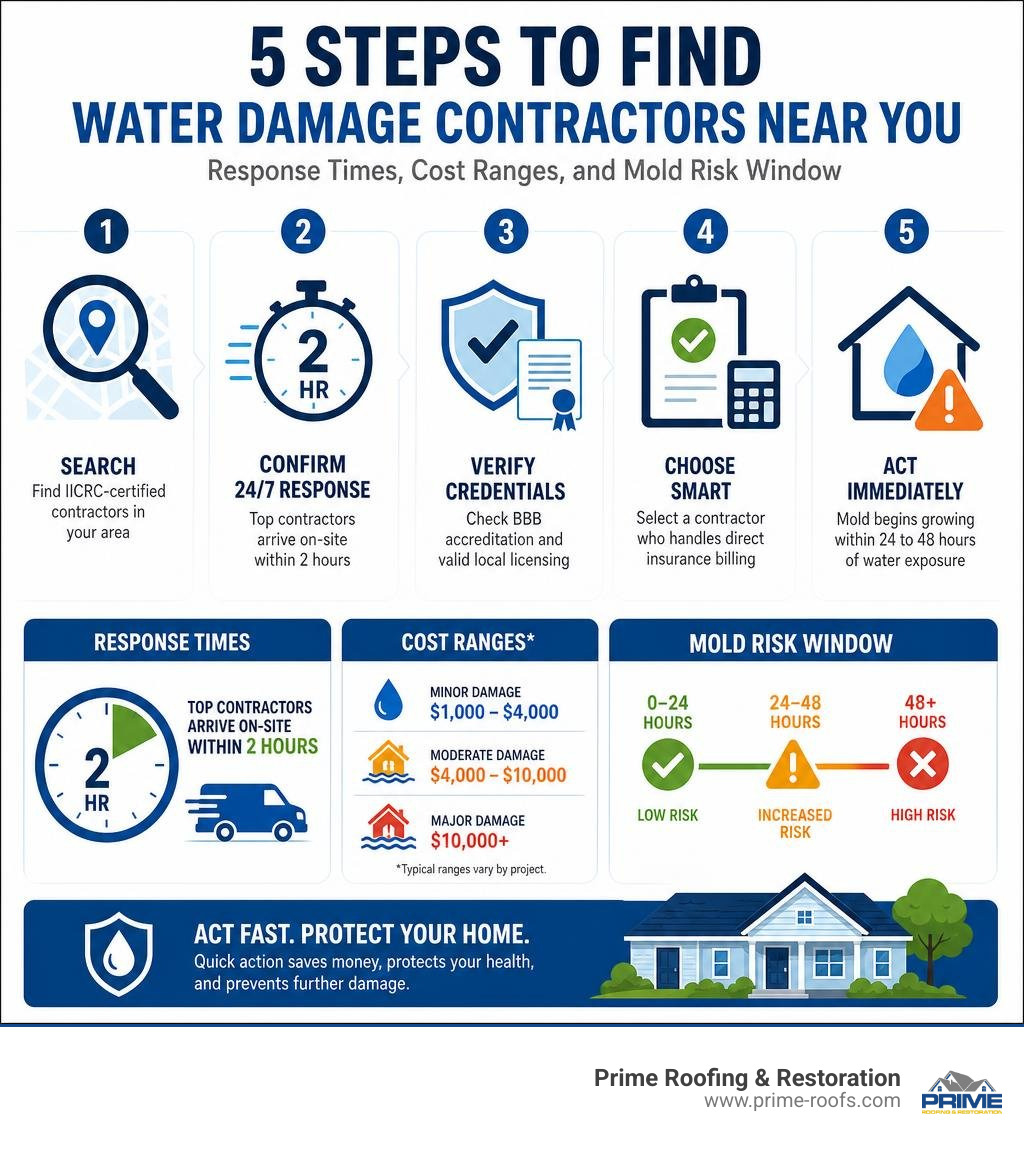
How to find a water damage contractor near you — fast:
- Search for IICRC-certified contractors in your area
- Confirm they offer 24/7 emergency response (top contractors arrive on-site within 2 hours)
- Verify BBB accreditation and valid local licensing
- Choose a contractor who handles direct insurance billing
- Call immediately — mold begins growing within 24 to 48 hours of water exposure
Water damage is one of the most common and costly home emergencies in the U.S. Over 14,000 water damage emergencies occur every single day across the country. The average insurance claim runs $11,745 — and homes left unrestored can lose up to 22% of their value.
The clock starts ticking the moment water enters your home. Every hour of delay raises your restoration costs and your health risks. That’s why knowing how to find and hire the right contractor — before disaster strikes — is so important. This guide walks you through exactly how to do it, from vetting credentials to navigating your insurance claim.
Whether your damage comes from a burst pipe, a failed appliance, or a storm-damaged roof, professional restoration services are almost always faster, safer, and more cost-effective than going it alone. In fact, homeowners who hire professionals recover 30% faster than those who attempt DIY cleanup.
I’m Bill Spencer, Owner and President of Prime Roofing & Restoration — a BBB A+ accredited contractor serving Central Alabama with over five years of hands-on experience helping homeowners find reliable water damage contractors near me and navigate the full restoration process. In this guide, I’ll share exactly what to look for so you can act fast and protect your home.
Key water damage contractors near me vocabulary:
Understanding the Classes and Categories of Water Damage
To make informed decisions when hiring water damage contractors near me, you must first understand what you are dealing with. Water damage is not all the same. The water that floods your home is professionally classified into three distinct categories based on its level of contamination, as well as four classes based on the rate of evaporation and the materials affected.
Professional restoration companies use these classifications to determine the safety protocols, protective gear, and drying techniques required for your property.
Category 1 (Clean Water)
Category 1 water originates from a sanitary source and does not pose an immediate threat if inhaled, ingested, or contacted. Typical sources include:
- Broken water supply lines
- Tub or sink overflows without contaminants
- Melting ice or falling rainwater
- Malfunctioning appliances that only handle clean water supply
While Category 1 water is initially safe, it will rapidly degrade. If left standing for more than 24 to 48 hours, clean water can easily absorb contaminants from drywall, carpets, and subfloors, transitioning into Category 2 or even Category 3 water.
Category 2 (Gray Water)
Category 2 water contains significant chemical, biological, or physical contaminants. It has the potential to cause discomfort or sickness if consumed or contacted. Common sources include:
- Discharge from dishwashers or washing machines
- Toilet bowls containing urine (but no feces)
- Sump pump failures
- Seepage from hydrostatic pressure under basement floors
When dealing with Category 2 water, professional contractors wear basic personal protective equipment (PPE) and prioritize disinfecting all salvageable porous materials.
Category 3 (Black Water)
Category 3 water is highly unsanitary and contains pathogenic agents, toxins, or harmful bacteria. Contact with black water poses severe health risks and requires extreme safety precautions. Common sources include:
- Sewage backups and toilet overflows containing feces
- Rising floodwaters from rivers, streams, or heavy storms (which carry agricultural runoff, chemicals, and soil pathogens)
- Standing water that has supported microbial growth for several days
- Wind-driven rain from hurricanes or severe storms entering through damaged roofs
Category 3 water requires specialized remediation. Porous materials like carpets, padding, and drywall touched by black water cannot be saved and must be safely removed and disposed of.
The Classes of Water Damage
While categories define the cleanliness of the water, classes define the drying difficulty based on the materials affected:
- Class 1 (Slow Evaporation Rate): Only a small portion of the room is wet. Materials are low-porosity (concrete, plywood).
- Class 2 (Fast Evaporation Rate): An entire room, including carpets and cushions, is wet. Water has wicked up drywall less than 24 inches.
- Class 3 (Fastest Evaporation Rate): Moisture comes from overhead, saturating ceilings, walls, insulation, and entire subfloors.
- Class 4 (Specialty Drying Situations): Deeply saturated materials that require specialty drying equipment (hardwood, brick, stone, plaster).
IICRC S500 Standards: The Professional Benchmark
Professional water damage restoration is governed by the IICRC S500 Standard for Professional Water Damage Restoration. This is a highly detailed, scientific benchmark set by the Institute of Inspection, Cleaning and Restoration Certification.
The S500 standard dictates how moisture is measured, how drying equipment is calculated based on cubic footage, and when materials must be discarded versus dried in place. When interviewing contractors, always verify that they strictly adhere to the S500 standard to ensure your home is dried scientifically and safely. You can learn more about these industry standards via the IICRC standards portal.
What to Do Immediately After Discovering Water Damage
When you discover water pooling in your home, your immediate actions can save you thousands of dollars in structural repairs and prevent hazardous mold growth. Before the water damage contractors near me arrive, follow these critical steps.
Safety First: Stop the Flow
Your absolute first priority is safety. If you can safely locate the source of the water, stop it immediately.
- For plumbing leaks: Locate your home’s main water shut-off valve (usually found in the basement, crawlspace, or near the street curb) and turn it clockwise to shut off the water supply.
- For appliance leaks: Shut off the local valve behind the washing machine, refrigerator, or toilet.
If the water is entering through a compromised roof or ceiling during a storm, do not attempt to climb onto your roof. Instead, place buckets to catch dripping water and proceed to the next safety steps.
Electrical Hazard Mitigation
Water and electricity are a deadly combination. Before stepping into any room with standing water, you must eliminate electrical hazards:
- Go to your main electrical panel (breaker box) and shut off the circuit breakers leading to the wet areas.
- If the breaker box is located in a flooded basement or area, do not enter. Call an electrician or wait for emergency restoration professionals to handle it.
- Never use standard household vacuum cleaners or electric appliances in wet areas.
Photo Documentation
Before you begin cleaning up or moving items, document everything. This evidence is vital for your insurance company to process your claim successfully.
- Take clear, high-resolution photos and videos of the standing water.
- Document the point of origin (e.g., the burst pipe, the leaking ceiling, or the broken hose).
- Take close-up photos of damaged personal property, furniture, electronics, and structural elements like warped flooring or stained drywall.
- Keep a written log of the timeline, noting when you first discovered the leak and what steps you took.
To ensure you are taking the correct precautions for your family and your property, you can follow the official FEMA emergency guidelines for safe property evacuation and initial hazard mitigation.

How to Choose the Best Water Damage Contractors Near Me
Finding a contractor is easy, but finding a reputable, highly qualified professional who will protect your home and advocate for your interests during an insurance claim takes careful vetting. Here is how to filter the local options to find the best fit.
Key Credentials
Never hire a restoration company that lacks proper credentials. A reputable contractor should readily provide:
- IICRC Certification: Ensure the firm is an IICRC Certified Firm and that the technicians sent to your home hold individual certifications in Water Damage Restoration (WRT) and Applied Structural Drying (ASD).
- BBB Accreditation: Look for Better Business Bureau (BBB) accredited businesses with an A+ rating. This indicates a history of fair dispute resolution and transparent business practices.
- Valid State and Local Licensing: In Alabama, restoration contractors must hold proper general contracting licenses. Ensure they are fully licensed to operate in your specific municipality.
Insurance Requirements
A certified contractor must carry robust insurance coverage to protect you from liability. Do not hesitate to ask for proof of:
- General Liability Insurance: Protects your property from accidental damage caused by the crew during the restoration process.
- Workers’ Compensation: Ensures you are not held liable if a technician is injured on your property.
- Pollution Liability Insurance: This is a crucial, often overlooked coverage. It protects you if the contractor accidentally spreads mold spores, hazardous chemicals, or sewage pathogens throughout your home during cleanup.
Local Expertise and Regional Challenges
Hiring local professionals is highly beneficial. Local contractors understand regional building construction, local building codes, and the unique weather patterns of Central Alabama. For example, homes in Alabaster and Hoover experience high humidity levels that can accelerate mold growth, and they are susceptible to severe seasonal storms that require rapid, secure structural tarping.
Working with established local roofers in Alabaster, AL ensures that any exterior storm damage is repaired using materials designed to withstand local wind and heat loads. Local teams can also navigate the specific permitting processes required by Shelby and Jefferson counties, preventing costly project delays.
Vetting Water Damage Contractors Near Me for Emergency Response
Water damage is a time-sensitive emergency. The speed of your contractor’s response directly correlates to the amount of structural material that can be saved.
- Response Times: Top-tier contractors maintain a 30-minute response time for emergency calls.
- On-Site Arrival: A reliable local contractor should guarantee a 2-hour on-site arrival time, 24 hours a day, 7 days a week, 365 days a year.
- 24/7 Dispatch: Ensure you are speaking to a live dispatcher or local technician when you call, not an out-of-state call center that cannot deploy immediate help. If you are facing an active leak or flood, do not wait. Call our emergency dispatch line immediately at (205) 555-0199 for rapid 2-hour on-site response.
Questions To Ask Water Damage Contractors Near Me Before Hiring
Before signing a work authorization form, ask these crucial questions to protect yourself from hidden costs and poor workmanship:
- “Do you offer direct insurance billing and assistance with claims?”
- Why it matters: A professional contractor should work directly with your insurance adjuster, submitting detailed moisture logs, digital photos, and standardized pricing estimates (typically using industry-standard software like Xactimate) to streamline your claim.
- “Will you provide a detailed, written estimate before work begins?”
- Why it matters: You should receive a clear breakdown of the mitigation scope, including the daily cost of equipment rental (dehumidifiers and air movers) and labor rates.
- “What warranties do you offer on structural drying and reconstruction?”
- Why it matters: Reputable contractors stand behind their work with structural drying guarantees and multi-year warranties on rebuild and mold remediation work.
- “Are all technicians on-site fully certified, or do you use unlicensed subcontractors?”
- Why it matters: You want trained, background-checked, and certified professionals handling sensitive structural drying in your home, not untrained temporary labor.
What to Expect During the Professional Water Damage Restoration Process
If you have never dealt with a water loss, the restoration process can seem overwhelming. Understanding the stages of professional restoration will help you monitor progress and maintain peace of mind.
Mitigation vs. Remediation
These two terms are often used interchangeably, but they represent different phases of the recovery process:
- Mitigation: This is the immediate, emergency phase. It focus on stopping the water, preventing further damage, extracting standing water, and drying out the structure. Mitigation is about containment and stabilization.
- Remediation/Restoration: This phase occurs after the structure is dry. It includes cleaning, sanitizing, deodorizing, and rebuilding. This is where damaged drywall is replaced, new flooring is installed, and your home is returned to its pre-loss condition.
The 24-48 Hour Mold Window
Mold spores exist naturally in the air, but they require moisture, warmth, and an organic food source (like drywall paper or wood subfloors) to germinate. Under typical indoor conditions, mold will begin to grow within 24 to 48 hours of water exposure.
If structural drying is delayed, mold remediation becomes necessary, which can increase your overall restoration costs by up to 50%. This is why professional contractors prioritize rapid water extraction and immediate dehumidification.
Advanced Equipment and Techniques
Professional contractors do not just set up household fans and open windows. They use highly specialized, industrial-grade equipment to manage airflow, temperature, and relative humidity:
- LGR (Low Grain Refrigerant) Dehumidifiers: These pull large volumes of moisture out of the air, lowering the relative humidity to facilitate rapid evaporation from wet structural materials.
- Industrial Axial Air Movers: These create high-velocity airflow across wet surfaces, breaking the boundary layer of saturated air and accelerating drying.
- Thermal Imaging Cameras: These infrared cameras detect temperature differentials, allowing technicians to map hidden moisture pockets behind drywall, under hardwood floors, and inside insulated wall cavities without destructive demolition.
- Moisture Meters and Probes: Pin and pinless meters are used daily to measure the moisture content of wood, drywall, and plaster, ensuring materials reach their specific “dry standard” before equipment is removed.
To understand the safety standards governing mold containment and moisture control, you can review the EPA mold remediation guidelines.
Storm Damage Repair and Structural Vulnerability
Frequently, interior water damage is caused by an exterior structural failure. If a severe storm damages your roof shingles, flashing, or decking, water will quickly find its way into your attic and ceilings.
To prevent future water intrusion, your contractor must address these exterior vulnerabilities. Utilizing professional storm damage repair services ensures that your roof is professionally repaired or replaced, stopping the cycle of water damage before interior cosmetic restoration begins.
Water Damage Restoration Costs and Insurance Coverage
Understanding the financial side of water restoration can help you avoid unexpected out-of-pocket expenses.
Average Claim Cost and Price Factors
The national average water damage insurance claim is $11,745. However, actual costs vary widely based on several key factors:
- The Category of Water: Category 3 (black water) mitigation requires extensive PPE, specialized sanitization, and the disposal of porous materials, making it significantly more expensive than Category 1 mitigation.
- The Size of the Affected Area: Saturated drywall and subfloors are priced by the square foot for extraction, treatment, and replacement.
- The Class of Water Damage: Class 4 losses (drywood, plaster) require specialized drying equipment and longer run-times, increasing equipment rental costs.
- The Response Time: Acting quickly prevents water from wicking higher into walls and prevents mold growth, keeping costs low.
Insurance Navigation: What is Covered?
Most standard homeowners insurance policies cover water damage if it is sudden and accidental. Examples include:
- A burst copper pipe or water main
- An appliance hose suddenly ruptures
- A roof leak caused by wind or hail from a recent storm
The “Duty to Mitigate” Clause
Almost every homeowners insurance policy contains a “duty to mitigate” clause. This clause legally obligates the homeowner to take immediate, reasonable steps to prevent further damage to the property once a leak or flood is discovered. If you fail to act quickly—such as leaving standing water for days without calling a professional—the insurance company may deny your claim entirely, citing negligence. Hiring certified water damage contractors near me immediately satisfies this requirement and ensures your expenses are documented for reimbursement.
Furthermore, professional restoration companies utilize Xactimate, the standardized estimating software used by major insurance adjusters. This ensures that pricing for labor, equipment, and materials is completely transparent and aligned with industry standards, minimizing disputes and accelerating claim approvals.
However, insurance policies strictly exclude coverage for water damage resulting from gradual neglect or lack of maintenance. For example, if a pipe has been slowly dripping behind a wall for months, causing rot and mold, the insurance company will likely deny the claim. Additionally, standard homeowners insurance does not cover rising groundwater flooding (such as storm surge or rising rivers); this requires a separate flood insurance policy through the National Flood Insurance Program (NFIP).
The table below provides a general cost comparison based on the category of water and the scope of the damage.
| Water Damage Category | Average Cost Range | Common Sources | Salvageability of Porous Materials |
|---|---|---|---|
| Category 1 (Clean) | $450 – $2,500 | Water supply lines, sink overflows, rainwater | High (can usually be dried in place) |
| Category 2 (Gray) | $2,500 – $7,500 | Dishwashers, washing machines, sump pumps | Moderate (requires thorough sanitization) |
| Category 3 (Black) | $7,500 – $15,000+ | Sewage backups, rising storm floodwaters | Low (must be discarded and replaced) |
Frequently Asked Questions About Water Damage Restoration
How long does the water damage drying process take?
The professional structural drying process typically takes 3 to 5 days. This timeline depends on the class of water damage, the materials affected (drywall vs. hardwood), and the continuous operation of industrial dehumidification and air-moving equipment. Technicians monitor moisture levels daily using specialized meters to verify that your home’s unique “dry standard” has been met before removing the equipment.
Does homeowners insurance cover water damage from a leaking roof?
Homeowners insurance covers water damage from a leaking roof only if the leak was caused by a sudden, accidental event, such as wind or hail damage from a recent storm. Insurance policies strictly exclude coverage for water damage resulting from neglected roof maintenance or wear and tear. For active leaks, contact emergency roof leak repair services immediately to mitigate damage and secure documentation for your claim.
Can I handle water damage cleanup myself?
You should only attempt DIY cleanup for minor Category 1 water damage covering less than 10 square feet (such as a small spill on a tile floor). Professional restoration contractors achieve 30% faster recovery times and utilize thermal imaging to locate hidden moisture behind walls and under flooring, preventing structural rot and toxic mold growth.
Conclusion
When water threatens your home’s structural integrity, immediate action is your best defense. Delaying restoration by even a few hours can lead to structural failures, ruined personal belongings, and toxic mold growth that endangers your family’s health.
At Prime Roofing & Restoration, we provide 24/7 emergency response with licensed experts in Alabaster and Hoover, AL, specializing in comprehensive exterior restoration, roof repair, and water mitigation. We focus on building lasting relationships through quality craftsmanship, transparent communication, and dedicated insurance claims assistance.
Contact Your Local Experts Today
If you are dealing with water damage, every second counts. Contact Prime Roofing & Restoration immediately to secure your property, prevent mold growth, and start the restoration process.
Company Contact Information (NAP):
- Company Name: Prime Roofing & Restoration
- Physical Address: Alabaster, AL 35007
- Phone Number: (205) 555-0199 (Click to Call for 24/7 Emergency Service)
- Service Areas: Alabaster, Hoover, Pelham, Helena, Calera, and the greater Birmingham, AL metro area.
Find Us on Google Maps
For directions to our office or to view our local service footprint, you can view our Google Maps Location (or search for Prime Roofing & Restoration in Alabaster, AL).