
Wind Damage Insurance Claims: What Every Alabama Homeowner Needs to Know
Living in Alabama means dealing with some of the most volatile weather in the United States. From the devastating tornadoes of “Dixie Alley” in Central Alabama to the hurricane-force winds that batter the Gulf Coast, our homes are constantly under threat. A wind damage insurance claim is a formal request to your homeowners insurance company to pay for repairs caused by wind, including damage from tornadoes, thunderstorms, straight-line winds, and hurricanes. As a leading professional roofing company in Alabama, we understand that navigating the aftermath of a storm is stressful, confusing, and often overwhelming.
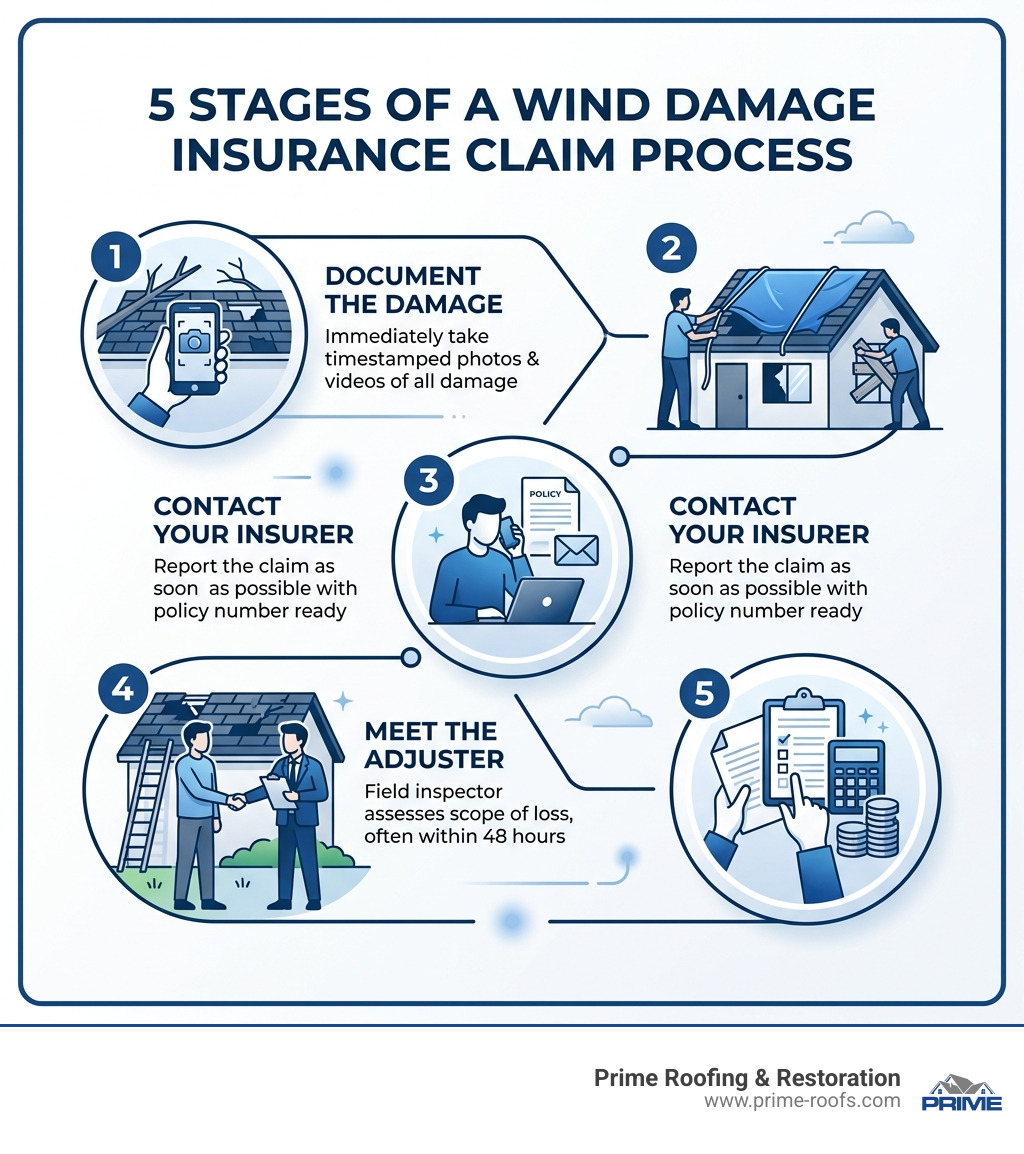
When a storm hits, the clock starts ticking. Most homeowners don’t realize that the decisions they make in the first 24 to 48 hours can determine whether their claim is fully funded or flatly denied. Here is a quick overview of how the process works:
How to file a wind damage insurance claim:
- Document the damage – Take timestamped photos and videos immediately after the storm. Don’t just focus on the roof; look at fences, siding, and interior ceilings.
- Prevent further damage – Tarp exposed areas and board up broken windows; save all receipts for materials. This is a policy requirement known as “mitigation.”
- Contact your insurer – Report the claim as soon as possible with your policy number ready. Ask for a claim number and the name of the adjuster assigned to your case.
- Meet the adjuster – A field inspector will assess the scope of loss, often within 48 hours. It is highly recommended to have your own contractor present during this inspection.
- Review the settlement offer – Compare it against an independent contractor estimate before accepting. Never sign a release until you are sure the funds cover the full cost of restoration.
Wind and hail damage drove more homeowners insurance claims between 2014 and 2018 than any other peril – more than fire, water damage, or theft combined. Yet a 2022 Insurance Information Institute survey found that only 48% of homeowners fully understood what their wind coverage actually included. That gap in knowledge costs homeowners real money every storm season. In Alabama, where high-wind events are a year-round reality, being under-informed is a financial risk you can’t afford.
If your Central Alabama home has been hit by a recent storm, getting a professional assessment from expert roofers in Alabaster is the fastest way to understand the true scope of your damage – before the insurance adjuster sets the terms. Often, adjusters look for obvious signs like missing shingles, but they may overlook “bruised” asphalt mats or structural racking that only a trained roofing professional would spot.
This guide walks you through every step of the process: what your policy covers, how to document damage, how payouts are calculated, and what to do when a claim is denied.
My name is Bill Spencer, Owner and President of Prime Roofing & Restoration, and I’ve spent years helping Alabama homeowners navigate every stage of the wind damage insurance claim process – from the first inspection after a storm to the final settlement. As a licensed contractor (License #30275) serving Alabaster and Orange Beach, I’ve seen how proper documentation and policy knowledge can be the difference between a full roof replacement and a denied claim. Our team is dedicated to ensuring that insurance companies honor the promises they made in your policy.
Wind damage insurance claim terms you need:
Understanding Your Coverage: Is Wind Damage Covered by Homeowners Insurance?

When a storm rolls through Alabaster or Hoover, the first question we hear is: “Am I actually covered for this?” In the vast majority of cases, the answer is yes. Standard homeowners insurance policies (typically HO-3 policies) are “open-peril” for your dwelling, meaning they cover all causes of loss unless they are specifically excluded. Wind is almost always a covered peril, but the way it is covered can vary significantly based on your specific policy language.
A wind damage insurance claim generally covers:
- The Dwelling: Your roof, siding, windows, and the main structure of your home. This includes the cost of materials and labor to return the home to its pre-storm condition.
- Other Structures: Detached garages, sheds, and fences. Note that fences are often settled at Actual Cash Value (ACV), meaning depreciation is taken out based on the age of the fence.
- Personal Property: Furniture, electronics, and clothing damaged if wind creates an opening (like a broken window or a hole in the roof) that allows rain or debris inside. This is a critical distinction: the wind must cause the opening first.
- Loss of Use: Also known as Additional Living Expenses (ALE), this covers the cost of hotels and meals if your home is uninhabitable due to wind damage.
Whether the damage was caused by a tornado, a hurricane, or a derecho with straight-line winds exceeding 100 mph, your policy is designed to help you rebuild. However, the burden of proof often lies with the homeowner to show that the damage was caused by the wind event and not by long-term neglect.
Covered Storm Perils vs. Exclusions
While wind is a “yes,” other storm-related events are a “maybe” or a “no.” Understanding these nuances is vital for a successful wind damage insurance claim.
- Hail and Lightning: These are standard covered perils. Lightning strikes can cause fires or power surges that fry your appliances. Hail damage is often bundled with wind claims, as the two frequently occur together.
- Snow and Ice: The “weight of ice and snow” is covered if it causes your roof to collapse or sag. This is less common in Alabama but can happen during rare winter storms.
- Flood Exclusions: This is the big one. Standard policies do not cover rising water or storm surges. If a hurricane blows your shingles off, that’s wind damage. If a nearby creek overflows into your living room, that’s flood damage, which requires a separate policy through the NFIP. This creates a “wind vs. water” dispute that often requires professional intervention to resolve.
- Earthquakes: These are almost always excluded unless you have a specific endorsement.
- Anti-Concurrent Causation: Some policies have clauses stating that if two events happen at once (like wind and flood) and one is excluded, the entire claim might be denied. This makes it vital to prove that wind was the “proximate cause” of the damage.
Limitations for Coastal and High-Risk Areas
In Alabama, geography plays a huge role in your coverage. If you live closer to the coast, you might face specific roof insurance coverage limitations.
- Windstorm Exclusions: In some coastal counties (like Baldwin or Mobile), wind might be excluded from your main policy, requiring you to buy a separate wind-only policy through the Alabama Insurance Underwriting Association (Beach Plan).
- Hurricane Deductibles: Instead of a flat $1,000 deductible, you might have a 2%, 5%, or even 10% deductible that only triggers during named storms. On a $300,000 home, a 5% deductible is $15,000 out of pocket.
- Maintenance and Wear: Insurance is for “sudden and accidental” damage. If your roof is 30 years old and has been leaking for five years, an adjuster will likely attribute the damage to “wear and tear” or “neglect” rather than a single wind event. This is why annual inspections are so important.
- Cosmetic Damage: Some newer policies exclude “cosmetic” damage to metal roofs or siding—meaning if the wind dents your metal roof but it doesn’t leak, they won’t pay to fix the appearance. This is a growing trend in the insurance industry that homeowners need to watch for.
Navigating the Wind damage insurance claim Process Step-by-Step
The moments after a storm are chaotic, but how you handle the first 48 hours will dictate the success of your wind damage insurance claim. We always tell our clients: be the most organized person the insurance company deals with all week. Insurance companies are processing hundreds of claims at once; the clearer your documentation, the faster your payout.
Immediate Actions After the Storm
Before you even call your agent, you need to secure the “crime scene.”
- Safety First: Check for downed power lines and structural instability. Do not climb onto a wet or damaged roof. If you smell gas or see sparks, evacuate immediately.
- Photo and Video Evidence: Take photos of everything from the ground. Use your phone to do a slow video walkthrough of every room in the house to document interior leaks, cracked drywall, or water spots on the ceiling. Don’t forget to photograph debris in the yard, as this proves the intensity of the wind.
- Temporary Repairs (Mitigation): Your policy actually requires you to prevent further damage. This means tarping holes in the roof or boarding up broken windows. If you fail to do this and a subsequent rainstorm ruins your hardwood floors, the insurance company may deny the floor repair because you didn’t mitigate the loss.
- Keep Every Receipt: If you buy plywood, tarps, or even buckets to catch drips, keep the receipts. These costs are usually reimbursable as part of your claim and do not count against your policy limits.
From Filing to Settlement
Once you’ve stabilized the home, the formal process begins. According to American Family Insurance, you should contact your insurer as soon as possible. Delaying the report can lead to questions about when the damage actually occurred.
- The Adjuster Meeting: The insurance company will send a field adjuster to inspect the home. Pro tip: Have your contractor present during this meeting. Adjusters are human; they can miss things, especially on steep roofs or in high-up eaves. Having a professional like us there to point out “structural racking,” lifted shingles, or subtle granule loss ensures the insurance services you receive are fair and comprehensive.
- The Scope of Loss: Within a week or two, you will receive a document detailing what the insurer is willing to pay for. This is called the “estimate” or “scope of loss.” It will list every item, from the number of shingles to the linear feet of flashing. Review this carefully with your roofer to ensure nothing was left out.
- The Proof of Loss Form: In some cases, the insurer will require a notarized “Proof of Loss” form. This is a legal document where you swear to the amount of the damage. Be very careful with the numbers here; once submitted, they are difficult to change.
- Settlement: Most claims are paid in two checks if you have a Replacement Cost policy. The first check is for the “Actual Cash Value” (the depreciated value). The second check, which covers the “recoverable depreciation,” is sent after the work is completed and a final invoice is submitted.
Deductibles and Payouts: RCV vs. ACV
Understanding the math behind your payout is where most homeowners get confused. The difference between Replacement Cost Value (RCV) and Actual Cash Value (ACV) can mean a difference of thousands of dollars out of pocket. In Alabama, many older policies were written as ACV to save on premiums, but this can be a devastating surprise during a wind damage insurance claim.
| Feature | Replacement Cost Value (RCV) | Actual Cash Value (ACV) |
|---|---|---|
| Definition | Cost to replace with new materials | Cost to replace minus depreciation |
| Payout Style | Usually 2 payments (ACV first, then balance) | One-time payment |
| Out-of-Pocket | Only your deductible | Deductible + Value of age/wear |
| Best For | Newer homes and comprehensive protection | Lowering monthly premiums |
Calculating Payouts for a Wind damage insurance claim
Most modern policies are RCV, but they don’t just hand you a check for a new roof on day one. They use a process called “recoverable depreciation.”
For example, let’s say a new roof costs $20,000. Your current roof is 10 years old and has a 20-year life expectancy. The insurance company determines it has lost 50% of its value due to age.
- Total Replacement Cost: $20,000
- Depreciation (50%): -$10,000
- Actual Cash Value: $10,000
- Your Deductible: -$1,000
- First Check (ACV): $9,000
Once we finish the roof replacement, we send the final invoice and a certificate of completion to the insurer. They then “release” the remaining $10,000 in depreciation to you. If you have an ACV-only policy, you would never get that second check, meaning you’d have to pay $11,000 out of your own pocket for a $20,000 roof.
The Deductible Trap: Watch out for percentage-based deductibles. If your home is insured for $400,000 and you have a 2% wind deductible, you are responsible for the first $8,000 of the claim. According to Frost Insurance, many homeowners are shocked by this amount because they assume they have a flat $1,000 deductible. Always check your “Declarations Page” to see if you have a separate wind/hail or hurricane deductible.
Understanding Ordinance and Law Coverage
If you live in an older home in Alabaster, your roof might not be “up to code.” Current building codes might require specific underlayments, drip edges, or ice and water shields that weren’t required 20 years ago. Standard insurance only pays to replace what was there. “Ordinance and Law” coverage is an endorsement that pays for the extra costs of bringing your home up to current local building codes during a repair. Without it, you might have to pay for those “upgrades” yourself, which can add $1,000 to $3,000 to a standard roof job.
The “Matching” Issue
Alabama does not have a strict “matching law” like some other states, but many policies include language about “line of sight.” If the wind blows off shingles on one side of your roof and those shingles are no longer manufactured, the insurance company may try to only pay for a patch that doesn’t match. We fight for our clients to ensure that the roof repair wind damage results in a uniform, aesthetically pleasing home, often resulting in a full replacement when matching materials aren’t available.
Why Wind Damage Roof Claims Are Denied and How to Fight Back
It is a frustrating reality: sometimes valid claims are denied. Often, the reason isn’t “bad faith” by the insurer, but rather a difference in opinion on what caused the damage. Insurance companies are looking for reasons to categorize damage as “maintenance issues” rather than “storm events.”
Common Reasons a Wind damage insurance claim is Denied
- Wear and Tear: The most common denial. The adjuster claims the shingles are just old, brittle, and reaching the end of their natural life, and that the wind didn’t actually cause the failure.
- Manufacturing Defects: They may claim the shingles failed because they were poorly made (like the infamous “organic” shingles from the 90s) and tell you to seek compensation from the manufacturer instead.
- Improper Installation: If the previous roofer used too few nails or placed them incorrectly (high-nailing), the insurer might deny the claim, stating it wasn’t a “fortuitous event” but a “workmanship issue.” This is why hiring a reputable company like Prime Roofing is so important for your next install.
- Cosmetic vs. Functional: As mentioned, if the wind didn’t cause a leak, some policies won’t pay for the “bruising” or “granule loss” that shortens the roof’s lifespan. They argue the roof still “functions” as a water barrier.
- Late Reporting: If you wait six months to report a storm, the insurer may argue that they can no longer determine if the damage was caused by that specific storm or by subsequent smaller events.
When to Hire a Professional Advocate
If you feel your claim is being unfairly denied or underpaid, you have several options to fight back:
- Independent Inspection: Get a second opinion from a reputable contractor who can provide high-resolution photos of wind damage to shingles. We often find damage that adjusters missed because they didn’t look closely at the seals of the shingles.
- Public Adjusters: These are licensed professionals who work for you, not the insurance company. They typically charge about 10% of the final settlement. They are experts at reading policy language and negotiating with carriers.
- Appraisal Process: Most policies have an “Appraisal Clause.” If you and the insurer can’t agree on the amount of the loss, you can both hire appraisers. These two appraisers then pick an “umpire.” A decision by any two of the three is binding. This is often faster and cheaper than going to court.
- Structural Engineers: If the insurer claims the damage is old, you can hire a forensic engineer to perform a “lift test” or a “brittle test” to prove the damage is fresh and storm-related.
- Insurance Attorneys: For large, complex structural claims or cases of clear bad faith, a specialized attorney may be necessary to navigate policy language and “anti-concurrent causation” issues. In Alabama, bad faith claims are difficult to win but can result in significant punitive damages if the insurer intentionally ignored evidence.
Proactive Steps to Strengthen Your Property and Policy
The best way to win a wind damage insurance claim is to have a home that is built to withstand the wind in the first place. FEMA research shows that homes built under stricter wind standards (like those enacted after 2002) suffered 57% less damage during major hurricanes. In Alabama, we have a unique opportunity to build better through the FORTIFIED Home™ program.
The Alabama FORTIFIED Advantage
Alabama is a leader in the FORTIFIED Home™ program, which provides a set of engineering and design standards that help roofs withstand winds up to 130 mph.
- Insurance Discounts: By law, Alabama insurance companies must provide a discount on the wind portion of your premium if you have a FORTIFIED roof. These discounts can range from 20% to 50%.
- Grants: The “Strengthen Alabama Homes” program often provides grants of up to $10,000 for homeowners to upgrade their roofs to FORTIFIED standards. This is a fantastic way to increase your home’s value and resilience at little to no cost to you.
Reviewing Your Policy Before the Storm
Don’t wait for a tornado warning to read your policy. Check for these “hidden” coverages that can make a huge difference in your recovery:
- Loss of Use (ALE): If your home is unlivable after a storm, this pays for your hotel and extra food costs. Ensure your limit is high enough for at least six months of displacement.
- Mold Sublimits: Many policies cap mold remediation at $5,000. In Alabama’s humidity, a wind-driven rain leak can cause $20,000 in mold damage very quickly. Consider increasing this limit.
- Matching Provisions: If your siding is discontinued, will they pay to replace the whole house so it matches, or just the damaged side? Knowing this helps you choose the right roof repair options.
- Debris Removal: Does your policy cover the cost of hauling away the old roof and fallen trees? Some policies have a separate, smaller limit for this.
Strengthening Your Claim with Pre-Damage Evidence
Insurance companies love to say damage was “pre-existing.” You can defeat this argument by keeping a “Home Health Folder”:
- Annual Inspections: Have a roofer near you in Alabaster do a quick check every year and give you a written report saying the roof is in good condition. This is “Exhibit A” if a claim is ever denied for wear and tear.
- Maintenance Logs: Keep receipts for gutter cleanings, minor shingle repairs, and tree trimming. This proves you are a responsible homeowner who maintains their property.
- “Before” Photos: Every spring, take a few clear photos of your roof, siding, and all four sides of your home from the ground. This provides undeniable proof of the home’s condition prior to a storm event.
Frequently Asked Questions about Wind Damage Claims
Does homeowners insurance cover tornado damage?
Yes. Standard homeowners insurance policies typically cover damage from tornadoes under the “wind” peril. This includes the cost to repair or replace the dwelling, other structures (like fences or sheds), and personal property. If a tornado makes your home unlivable, your “Loss of Use” coverage will also apply. Because tornadoes often cause total losses, it is vital to ensure your “Dwelling” limit is high enough to cover current construction costs in Alabama.
How long do I have to file a wind damage claim?
In most cases, you have one year from the date of the storm to file a claim. However, some policies have shorter “notice of loss” windows (as short as 30-60 days). It is critical to notify your insurer immediately, as waiting can lead to secondary damage like mold or wood rot, which the insurer may refuse to pay for because it was “preventable” through timely mitigation.
Will filing a wind damage claim raise my insurance rates?
While insurance companies can raise rates for many reasons, many states have protections against raising premiums for a single “Act of God” claim. However, if your entire zip code is hit by a massive storm, the insurer may raise rates for the whole area to reflect the increased risk, regardless of whether you personally filed a claim. Essentially, you may pay for the storm through higher premiums anyway, so you might as well file the claim to get your home repaired.
What if my tree falls on my neighbor’s house?
Generally, if a healthy tree falls due to wind, it is considered an “Act of God.” Your neighbor would file a claim with their insurance company to fix their house. However, if the tree was dead or rotting and you neglected to remove it, you could be held liable for the damage, and your liability coverage would come into play.
Can I choose my own contractor for the repairs?
Yes. You have the legal right to choose any licensed contractor to perform the repairs on your home. While insurance companies may suggest “preferred vendors,” you are not obligated to use them. It is often better to hire a local expert like Prime Roofing & Restoration who has a vested interest in the community and your long-term satisfaction.
What is a “supplement” in an insurance claim?
A supplement is an additional charge submitted to the insurance company after the work has begun. This happens when the contractor discovers hidden damage (like rotten decking under the shingles) that wasn’t visible during the initial adjuster’s inspection. We handle the supplement process for our clients to ensure all necessary repairs are covered.
Does insurance cover the cost of a temporary tarp?
Yes. Emergency mitigation, such as tarping a roof or boarding up windows, is covered under the “Reasonable Repairs” section of your policy. This is usually paid in addition to your dwelling limit and is not subject to your deductible in many cases.
Conclusion
A wind damage insurance claim doesn’t have to be a battle. By documenting the damage early, understanding the math of your deductible, and having a professional advocate on your side, you can ensure your home is restored to its full value. The key is to act quickly and stay organized throughout the process.
At Prime Roofing & Restoration, we pride ourselves on building lasting relationships with our neighbors in Alabaster, Hoover, and across the Alabama coast. We aren’t just here to nail down shingles; we are here to guide you through the entire restoration process with licensed experts and 24/7 emergency service. We use only the highest quality materials to ensure your family is protected long after the storm clouds have cleared.
If you suspect your home has suffered wind or hail damage, don’t wait for a leak to appear. Visit our storm damage repair services page to schedule your free, no-obligation inspection. Let us help you protect what matters most.
Contact Information
Prime Roofing & Restoration
Address: 117-A Market Center Dr, Alabaster, AL 35007
Phone: 205-453-1803
License: #30275
Website: www.prime-roofs.com
Find Us on the Map: