
Installing Shingles on a Shed: A Data-Backed, Step-by-Step Guide to Weatherproofing
Installing shingles on a shed is one of the most effective ways to weatherproof an outbuilding, especially in Alabama’s volatile climate. A properly installed asphalt shingle roof creates a waterproof, wind-resistant barrier that can last 20–30 years, safeguarding your valuable tools, equipment, and stored materials from intense heat, torrential rain, and storm debris. For best-practice execution and local guidance, it’s always wise to work with a trusted roofing company in Alabama like Prime Roofing & Restoration. Alabama experiences frequent severe weather—NOAA data confirms the state is a hotspot for thunderstorms, hail, and high winds—so a layered, code-informed roof assembly is not just a recommendation, it’s essential for long-term performance. Asphalt shingles dominate the U.S. residential roofing market, holding over 70% of the market share due to their unmatched combination of cost-effectiveness, durability, and ease of maintenance.
Quick Answer: The Essential Steps for Installing Shingles on a Shed
- Measure Your Roof & Plan – Calculate the total square footage of all roof planes and add 10-15% for waste, starter shingles, and ridge caps.
- Gather Materials & Tools – Purchase asphalt shingles, drip edge, underlayment, galvanized roofing nails (1” and 1 ¼”), and roofing cement. Assemble your tools, including a hammer, utility knife, and chalk line.
- Prepare the Roof Deck – Strip all old roofing materials, inspect the wood sheathing for rot or damage, make necessary repairs, and sweep the surface clean.
- Install Drip Edge & Underlayment – Fasten the drip edge along the eaves first, then the rakes. Roll out roofing felt (underlayment) horizontally, overlapping each course by at least 2-4 inches to create a secondary water barrier.
- Create a Starter Course – Cut the tabs off 3-tab shingles to create a solid starter strip. Install it along the eaves with a ¼-inch overhang to guide water away from the fascia.
- Lay the Shingle Courses – Install the first full course directly over the starter strip. Offset each subsequent row by 6 inches to create a staggered pattern, securing each shingle with 4 nails in the designated nailing zone.
- Finish the Ridge & Clean Up – Cut individual ridge caps from 3-tab shingles, bend them over the peak, and overlap them by 5-6 inches. Seal the last exposed nail heads with roofing cement.
The cost to install shingles on a shed averages around $115 to $150 per 100 square feet (one square), making asphalt shingles a highly cost-effective and durable choice. For a standard 10×12 shed, this project typically takes a dedicated DIYer about 4-6 hours. With proper planning and meticulous attention to detail, this is a manageable project—or one where professional expertise from a team like ours at (205) 555-7663 can ensure flawless, long-lasting results.
The key to a successful, leak-proof roof is understanding that it’s a complete system. Each component—from the drip edge that protects the fascia to the underlayment that backs up the shingles, to the precise staggering of each course—works in concert to create a watertight shield. Skipping a single step or cutting a corner is a direct invitation for leaks, wood rot, and premature roof failure.
As Bill Spencer, Owner and President of Prime Roofing & Restoration with over five years of hands-on roofing expertise across Alabama, I’ve seen firsthand how precise techniques and quality materials are the foundation of a durable, weather-resistant roof. “Whether it’s a 3,000-square-foot home or a 200-square-foot shed, the principles of water-shedding don’t change. This guide will walk you through every stage, ensuring you have the professional-level knowledge to protect your shed for decades to come.”
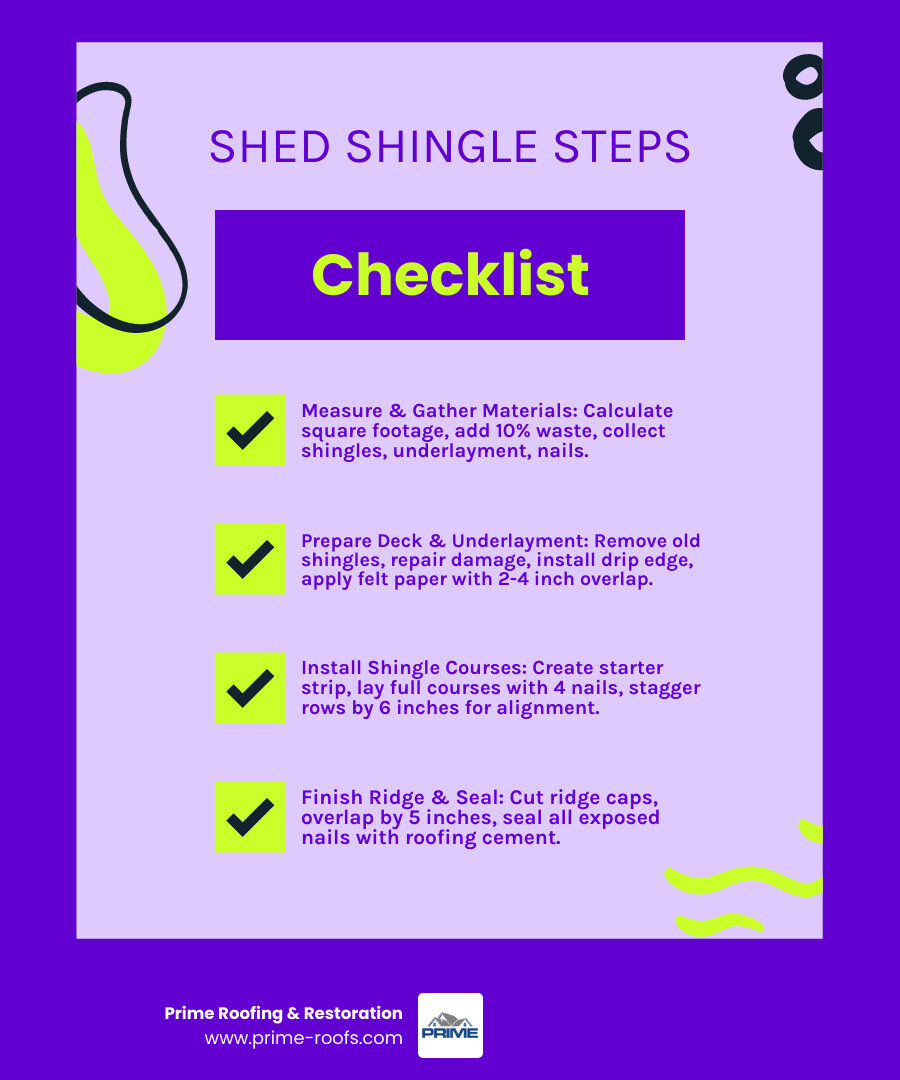
Quick look at installing shingles on a shed:
Step 1: Planning, Measuring, and Gathering Supplies
Proper planning is the bedrock of a successful roofing project, distinguishing a smooth, efficient job from a frustrating, mistake-ridden ordeal. Before you begin installing shingles on a shed, taking the time to measure accurately, choose the right materials for Alabama’s climate, and gather every necessary tool will ensure you work efficiently and achieve a professional result that keeps your shed dry for decades.
Choosing the Right Shingles and Materials
When selecting shingles, your primary choice will be between traditional three-tab and modern architectural asphalt shingles. Both are excellent for sheds but serve different priorities in terms of aesthetics, durability, and budget.
- Three-tab shingles are the budget-friendly workhorse. They are lightweight, simple to install, and provide solid, reliable protection for 15-20 years. Their flat, uniform appearance makes them a great choice for a basic storage shed where function and cost are the main drivers.
- Architectural shingles (or dimensional shingles) are the premium option and a wise investment. They are constructed with a thicker, laminated base, which creates a beautiful, textured look that can mimic wood shake. They typically last 25-30 years or more and boast superior wind resistance, often rated for up to 110-130 mph—a critical feature for weathering Alabama’s severe thunderstorms and the occasional tropical storm system. They cost about 25-40% more than three-tab shingles, but their extended lifespan and durability often make them a better long-term value.
For most sheds, three-tab shingles offer a great balance of cost and performance. However, if your shed is a prominent feature in your backyard, you want it to match your home’s roofing, or you desire maximum protection, architectural shingles are a worthwhile upgrade. Many architectural shingles also come with algae-resistant (AR) technology, which uses copper granules to inhibit the growth of the blue-green algae that causes ugly black streaks, a common issue in humid climates.
| Feature | 3-Tab Shingles | Architectural Shingles |
|---|---|---|
| Cost | Least expensive ($80-$100/square) | Approx. 25-40% more ($110-$150/square) |
| Lifespan | 15-20 years | 25-30+ years |
| Wind Resistance | 60-70 mph | 110-130 mph |
| Appearance | Flat, uniform, basic | Thicker, dimensional, high-end look |
| Durability | Good | Excellent, more impact resistant |
| Algae Resistance | Basic | Often includes AR technology |
How to Measure Your Shed Roof and Inspect Shingles
Accurate measurement is non-negotiable; it prevents frustrating mid-project trips to the store. Start by measuring the length and width (from eave to ridge) of each roof plane. For a simple gable roof, multiply the length by the width of one plane, then double it. For example, a shed with a 10×12 floor might have a roof plane that is 12.5 feet long and 7 feet wide. The total area would be (12.5 x 7) x 2 = 175 sq. ft.
The golden rule is to add 10-15% to your total square footage for waste. This accounts for the starter course, ridge caps, cuts needed for angles, and a buffer for any mistakes. For our 175 sq. ft. roof, adding 15% (26.25 sq. ft.) brings the total to ~202 sq. ft. Roofing materials are sold in “squares” (100 sq. ft.). So, you’d need just over 2 squares. Since most shingle bundles cover ~33 sq. ft., you would calculate 202 / 33 = 6.12, meaning you should buy 7 bundles.
Before purchasing, inspect every bundle. Look for torn packaging, crushed corners, or any signs of damage. Most importantly, verify that all bundles have the same production lot number printed on the packaging. This ensures consistent color and texture across your entire roof, avoiding a patchy, mismatched appearance.
Essential Tools and Materials for Installing Shingles on a Shed
Having everything on hand before you climb the ladder is crucial for safety and efficiency.
- Materials: Asphalt shingles, metal drip edge (style D is common), roofing underlayment (15-lb or 30-lb felt, or synthetic), 1-inch galvanized roofing nails (for drip edge and underlayment), 1¼-inch galvanized roofing nails (for shingles), and a tube of asphalt roofing cement. It’s also wise to have a spare sheet of plywood or OSB on hand for potential deck repairs.
- Tools: A hammer or a pneumatic roofing nailer (a huge time-saver), a sharp utility knife with hook blades (ideal for cutting shingles), a chalk line, a tape measure, a sturdy ladder, safety glasses, and heavy-duty work gloves. For removing old shingles, a roofing shovel or a simple garden pitchfork works well. Tin snips are essential for cutting the metal drip edge. For safety on any roof, but especially those with a steeper pitch, always wear non-slip boots and consider using roofing brackets and a safety harness.
Step 2: Preparing the Roof Deck for Shingles
A solid, clean, and dry roof deck is the non-negotiable foundation of a durable, long-lasting shingle installation. This critical preparation stage involves removing all old roofing materials, thoroughly inspecting the underlying structure for any signs of weakness, and installing the protective layers—drip edge and underlayment—that serve as the first and second lines of defense against moisture intrusion.
Removing Old Shingles and Repairing the Deck
If you’re re-roofing an old shed, you must start by completely stripping the old materials. Never shingle over an existing layer on a shed; it adds excessive weight and, more importantly, prevents you from inspecting the deck for damage. Use a roofing shovel or pitchfork, starting at the ridge and working your way down, letting gravity help you. As you remove the old shingles and felt paper, be meticulous about pulling out any remaining nails or staples. A single forgotten nail can puncture your new underlayment or create a bump that will wear a hole through a new shingle over time.
With the deck fully exposed, conduct a thorough inspection. Walk carefully across the entire surface, feeling for any soft, spongy, or bouncy spots, which are clear indicators of rot or water damage. Visually inspect the plywood or OSB sheathing for dark stains, discoloration, or delamination (layers of plywood peeling apart). Any damaged sections must be cut out and replaced. Use a circular saw set to the depth of the sheathing to cut out the compromised area, extending your cuts to the center of the nearest rafters to ensure the new patch is fully supported. Secure the new piece of sheathing, matching the thickness of the original, with 8d nails or structural screws.
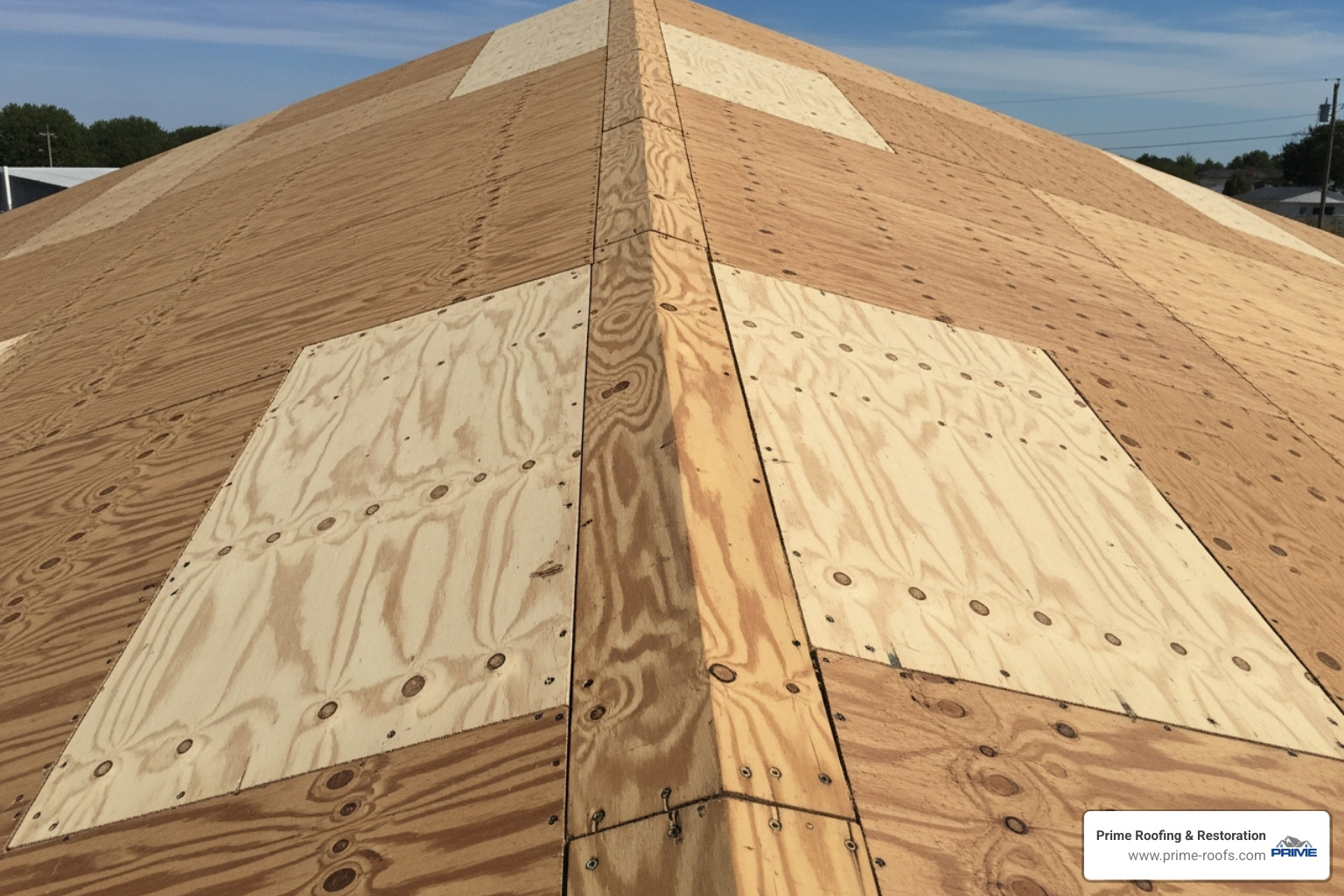
Why You Need Underlayment (Tar Paper or Synthetic)
“Do I really need underlayment under shingles on a shed?” The answer from any roofing professional is an emphatic yes. While local building codes may not strictly require it for small accessory structures, roofing felt or a synthetic equivalent is cheap insurance against costly water damage.
Roofing underlayment serves as a critical secondary water barrier. Shingles are the primary barrier, but wind-driven rain, ice dams, or a damaged shingle can allow moisture to get past them. The underlayment is what stops that water from reaching and rotting the wood deck. In a climate with high humidity and frequent downpours like Alabama’s, this extra layer is absolutely crucial for preventing rot and mold.
While traditional 15-lb or 30-lb asphalt-saturated felt is a good option (we recommend 30-lb for its superior tear resistance), modern synthetic underlayments are a significant upgrade. They are far more tear-resistant, lighter, safer to walk on (less slippery), and can be left exposed to UV rays for longer periods if the project is delayed. The added cost is minimal for a shed-sized project and well worth the enhanced protection and peace of mind.
Installing Drip Edge and Underlayment
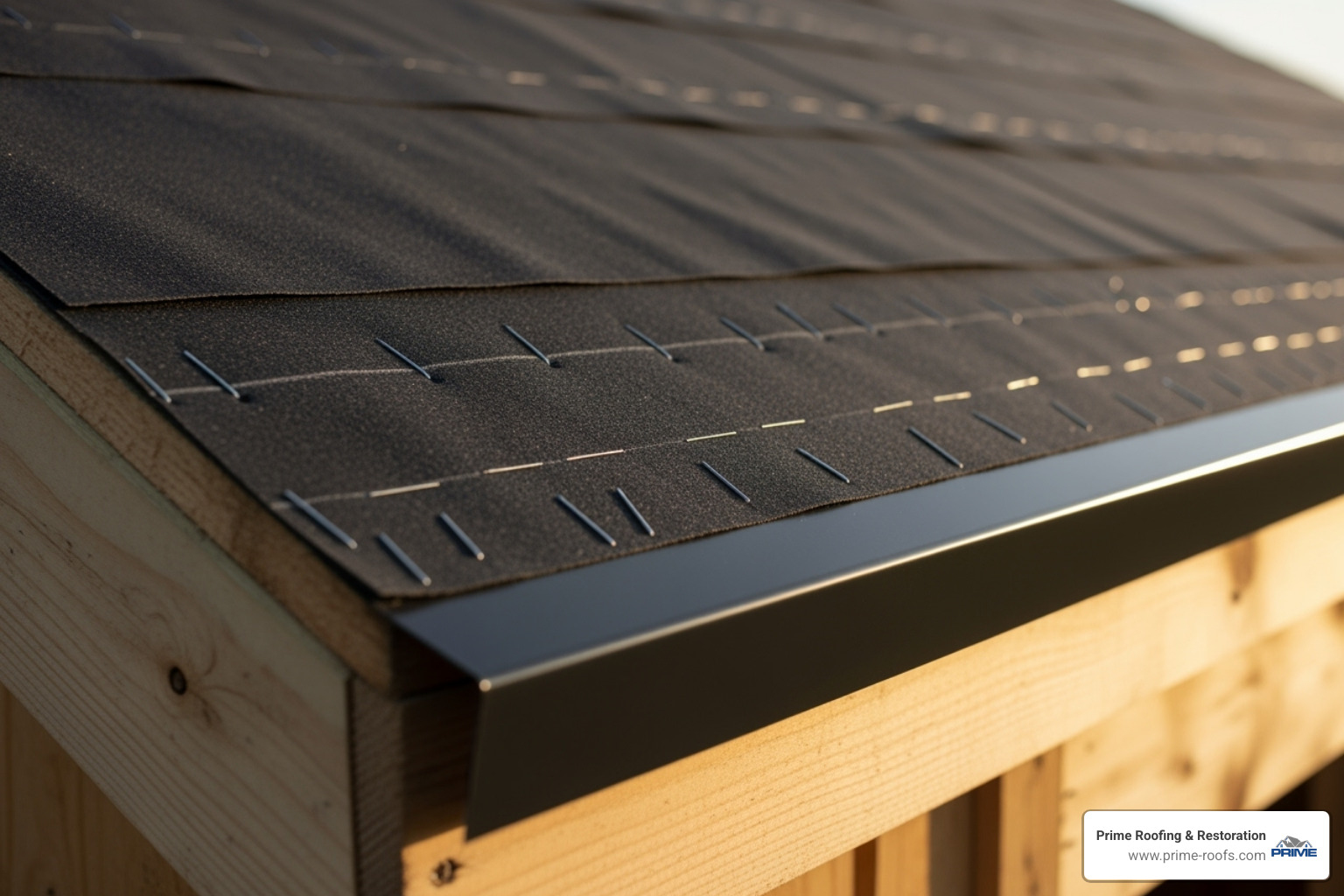
The drip edge and underlayment installation sequence is based on a simple, crucial principle: shedding water. Each layer must overlap the one below it.
- Install Drip Edge on Eaves: The first pieces of metal drip edge are installed along the bottom horizontal edges (the eaves). The flange should sit flat on the roof deck. Nail it every 10-12 inches with 1-inch roofing nails.
- Roll Out the Underlayment: Starting at a bottom corner, roll out your first course of underlayment horizontally. It should lay over the top of the eave drip edge. This ensures any water that gets on the underlayment flows over the drip edge and away from the fascia board. Secure it with plastic-capped roofing nails every few feet, keeping it smooth and taut.
- Overlap Subsequent Rows: As you move up the roof, overlap each subsequent row of underlayment by at least 4-6 inches (most have printed lines to guide you). This shingle-like layering ensures water continues to flow down and off the roof without ever getting underneath.
- Install Drip Edge on Rakes: Now, install the drip edge on the sloped sides of the roof (the rake edges). This time, the drip edge goes on top of the underlayment. This prevents wind-driven rain from blowing under the edge of the felt paper.
- Cover the Ridge: Drape the final sheet of underlayment over the ridge, overlapping both sides of the peak by at least 6 inches to create continuous protection.
Before moving on, do a final check. The underlayment should be smooth, secure, and correctly overlapped everywhere. This perfectly prepped foundation is critical for the long-term success of your new roof.
Step 3: The Complete Process for Installing Shingles on a Shed
With the roof deck perfectly prepped and waterproofed with underlayment, it’s time to lay the shingles. This stage is a game of precision and repetition. A systematic, patient approach is essential to create a watertight, wind-resistant, and visually appealing roof. Rushing this process is the single most common cause of DIY roofing failures, leading to leaks and a drastically shortened lifespan.
Creating a Starter Course and Snapping Chalk Lines
The starter course is a critical, often overlooked, foundational layer. It provides a continuous seal of adhesive along the roof’s edge, which bonds to the first course of shingles and protects against wind uplift and water infiltration. To make your own, simply take a 3-tab shingle and cut off the three tabs, leaving the solid, 5-inch upper portion. Alternatively, you can buy pre-made starter shingles. Install this strip with the factory adhesive strip facing up and positioned along the eave. It should overhang the drip edge by ¼ to ¾ inch. This small overhang creates a drip point, ensuring water falls clear of the fascia board. Secure the starter strip with 4-5 roofing nails placed about 3-4 inches up from the bottom edge.
Next, snap chalk lines to serve as your guide. An unguided installation will almost certainly result in wavy, unprofessional-looking rows.
- Horizontal Lines: Your first horizontal line should be snapped for the top of the first full course of shingles. For a standard 5-inch exposure, measure up 12 inches (the full height of a shingle) from the bottom of the starter strip and snap a line. From there, snap subsequent lines every 5 inches up the roof. These lines ensure every course is perfectly straight.
- Vertical Lines: To maintain the proper offset, snap vertical lines every 6 inches across the roof. These act as a guide for starting each new course, ensuring your shingle joints are properly staggered.
How to Lay the First and Subsequent Courses of Shingles
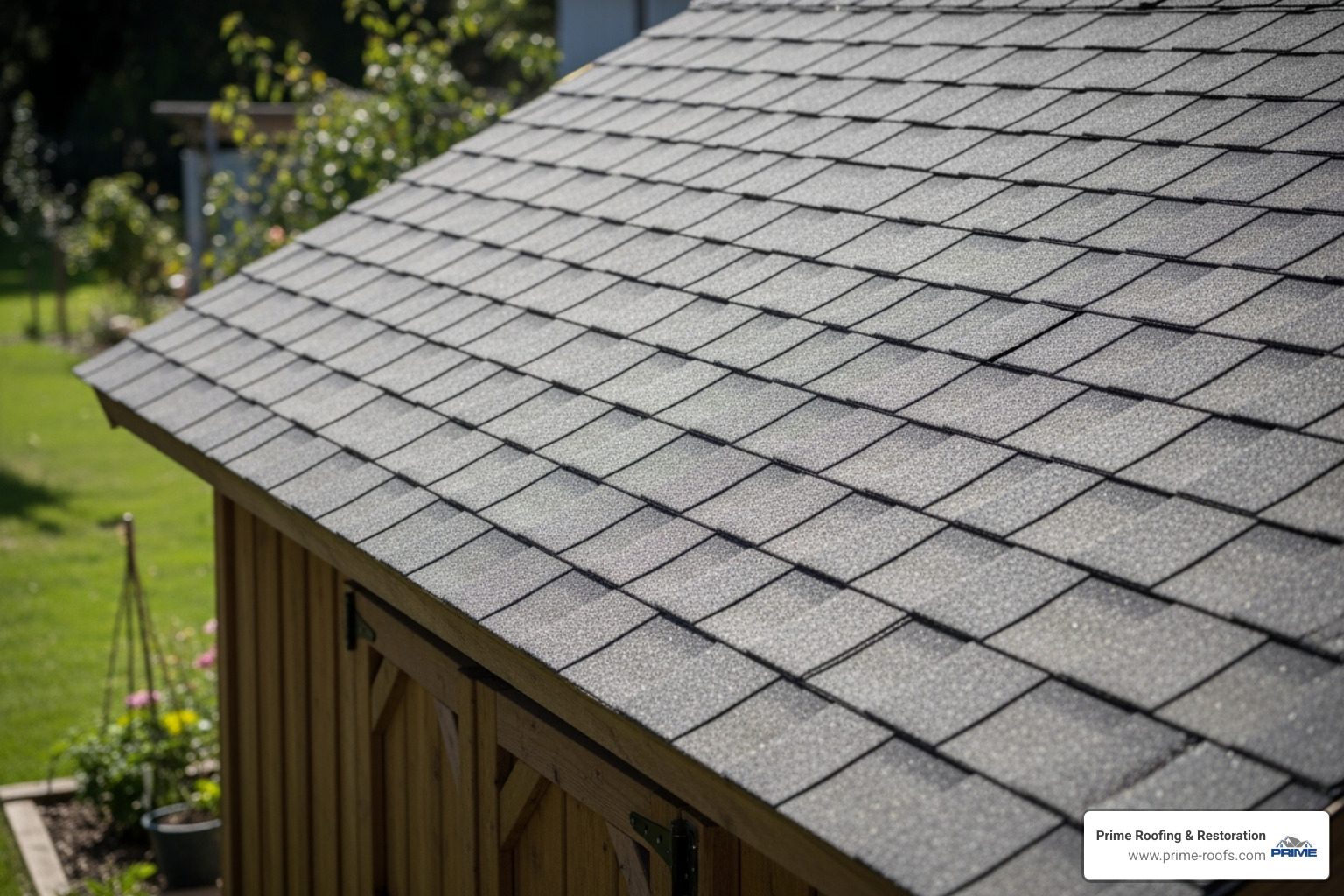
Now for the main event of installing shingles on a shed. Lay your first full course of shingles directly over the starter strip, aligning the bottom edges perfectly. The shingles should overhang the rake edges (the sloped sides) by about ½ inch. This side overhang helps guide water away from the side trim.
The nailing pattern is absolutely critical for wind resistance and warranty compliance. Use four 1 ¼-inch galvanized roofing nails per shingle. For 3-tab shingles, place nails about 1 inch in from each end and just above each cutout. For architectural shingles, there is a specific reinforced “nailing zone” or “common bond area” marked on the shingle—you must place your nails within this strip. Drive nails so the head is flush with the shingle surface. Overdriving will cut into the shingle, while underdriving will leave the shingle loose and can interfere with the course above it. For authoritative guidance, always consult the manufacturer’s installation instructions, like this guide from GAF.
To create the necessary stagger that prevents leaks, follow this classic 6-inch offset pattern:
- First Course: Start with a full shingle.
- Second Course: Cut 6 inches off the left side of the first shingle in the row.
- Third Course: Cut 12 inches off the first shingle (or a full tab).
- Fourth Course: Cut 18 inches off the first shingle.
- Fifth Course: Cut 24 inches off the first shingle (or two full tabs).
- Sixth Course: Cut 30 inches off the first shingle.
- Seventh Course: Start with a full shingle again, repeating the pattern.
This 6-inch offset creates a robust, brick-like pattern that ensures water can never find a direct vertical path through aligned seams, which is a primary cause of roof leaks.
Finishing the Ridge and Terminating the Last Row
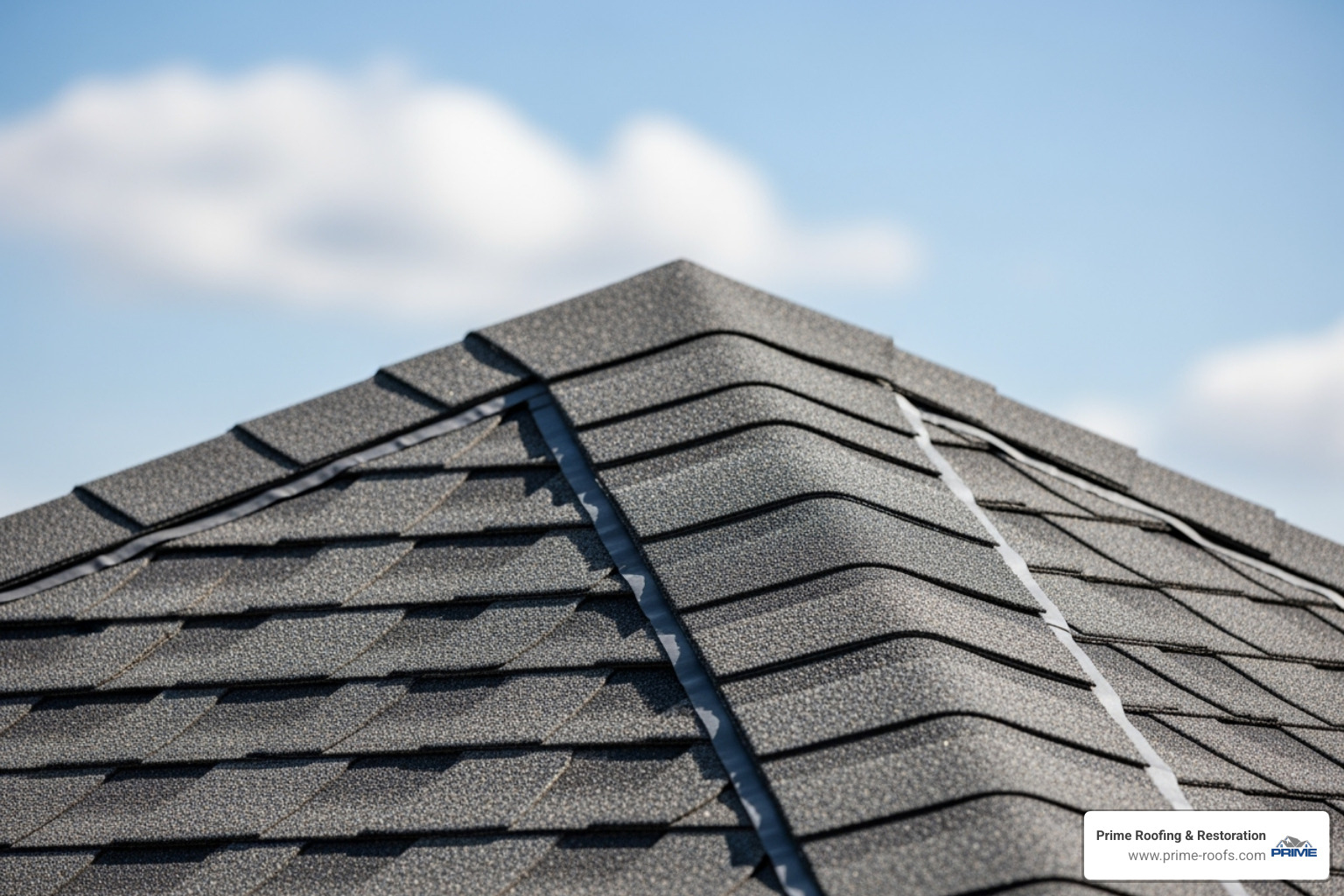
The ridge is the peak of the roof and one of the most vulnerable areas. It requires special attention to be made completely watertight. Create ridge caps by cutting 3-tab shingles into three individual pieces. For a more professional look and better performance, use dedicated hip & ridge cap shingles. Starting at the end of the ridge opposite the prevailing wind direction, bend the first cap over the peak and nail it on both sides. Place nails about 1 inch in from the side edges and 5 ½ inches up from the bottom edge, ensuring they will be covered by the next piece.
Overlap each subsequent ridge cap by about 5 to 6 inches, maintaining a straight line as you work across the peak. This generous overlap prevents wind-driven rain from being forced underneath. The nails on the final piece will be exposed; cover these nail heads with a generous dab of roofing cement to seal them from the elements.
For a lean-to shed where the last row meets a wall, you must install metal flashing. The flashing should be installed over the top edge of the final shingle course and extend up the wall. This flashing should then be integrated under the wall’s siding or have counter-flashing installed over it to create a durable, watertight seal.
Step 4: Maintaining Your New Shed Roof for Maximum Longevity
Your work isn’t finished once the last shingle is installed and the final nail is sealed. Regular, proactive maintenance is essential to ensure your new shed roof achieves its full 25+ year potential lifespan. Simple, periodic checks can identify and address small issues before they escalate into costly problems like leaks and structural rot.
Proactive Roof Maintenance and Inspection Tips
Inspect your shed roof at least twice a year—once in the spring and once in the fall—and always after a major storm. Alabama’s combination of intense sun, high winds, and heavy rain means vigilance is key. Here’s a detailed checklist for your inspection:
- Loose, Lifted, or Damaged Shingles: High winds can break the sealant strip on shingles, causing them to lift. Check for any shingles that are flapping or appear raised. If the shingle is intact, you can re-secure it by applying three quarter-sized dabs of roofing cement under the tab and pressing it down. Replace any shingles that are cracked, torn, or missing.
- Missing Granules: The sandpaper-like granules on a shingle are its primary defense against UV radiation. While some minor loss is normal over time (especially on a new roof), look for large “bald” spots where the black asphalt is exposed. These areas will deteriorate rapidly in the sun.
- Cracking or Curling: As shingles age, they lose their flexibility. Look for shingles that are starting to crack, blister, or curl up at the edges. These are signs that the shingles are no longer shedding water effectively and are nearing the end of their life.
- Clogged Gutters: If your shed has gutters, they must be kept clean. Gutters clogged with leaves and pine needles will cause water to back up, potentially seeping under the shingles at the eave and rotting the fascia and roof deck.
- Overhanging Branches: Trim any tree limbs that are touching or hanging directly over the roof. Rubbing branches can scrape off granules, while falling limbs can cause significant impact damage.
- Debris Accumulation: Sweep off any accumulation of leaves, pine needles, or dirt, especially in roof valleys or areas with a low slope. This debris traps moisture against the shingles, promoting algae growth and accelerating deterioration.
- Flashing Integrity: If your shed has a vent pipe or meets a wall, carefully inspect the metal flashing. Ensure it is not rusted, bent, or pulling away. The sealant around the flashing can dry out and crack over time and may need to be reapplied.
Recognizing When to Replace Your Shed Shingles
While minor repairs can certainly extend your roof’s life, there comes a point when a full replacement is the only sound solution. Continuing to patch a failing roof is often a losing battle. Watch for these definitive signs:
- Leaks Inside the Shed: Water stains on the ceiling, drips, or puddles on the floor are unambiguous indicators that your roof’s waterproofing has been breached. It’s time for a replacement.
- Widespread Cracking or Curling: If more than just a few isolated shingles are damaged, it’s a sign of systemic failure. The entire roof is likely compromised and needs to be replaced.
- Frequent Missing Shingles: If you find yourself replacing shingles after every significant storm, the adhesive strips across the entire roof have likely failed, and the shingles are no longer wind-resistant.
- Excessive Granule Loss in Gutters: Finding a large amount of shingle granules in your gutters is a clear sign that the shingles are aging and becoming brittle. When shingles develop bald spots, the underlying asphalt is exposed to UV rays, which rapidly accelerates deterioration.
- Extensive Algae or Moss Growth: In Alabama’s humid climate, some algae growth (black streaks) is common. However, if the roof is covered in thick moss or extensive algae, it indicates that the shingles are trapping moisture, which will speed up their degradation significantly.
- Age: Every roof has a finite lifespan. If your 3-tab shingle roof is approaching 20 years, or your architectural shingle roof is nearing 30 years, it’s wise to proactively plan for a replacement rather than waiting for an inevitable and potentially damaging failure.
Frequently Asked Questions about Installing Shingles on a Shed
Here are answers to some of the most common questions homeowners have when tackling a shed roofing project.
How many bundles of shingles do I need for a 10×12 shed?
For a typical 10×12 shed with a standard 4/12 or 6/12 pitch gable roof, you will need approximately 7 to 8 bundles of shingles. Here’s the breakdown: a 10×12 shed has a roof surface area of about 200-240 square feet, depending on the pitch and overhang. Let’s use 240 sq. ft. for a safer estimate. Add 15% for waste, starter strips, and ridge caps (240 * 1.15 = 276 sq. ft.). Since most shingle bundles cover about 33.3 square feet, you would calculate 276 / 33.3 = 8.28 bundles. Therefore, purchasing 9 bundles is the safest bet to ensure you don’t run out mid-project. It’s always better to have a few extra shingles for future repairs than to be one short.
What is the best type of shingle to use for a shed?
For most standard sheds, three-tab asphalt shingles are the best all-around choice. They offer an excellent balance of affordability, good durability (15-20 years), and are very easy for a DIYer to install. However, if your shed is a highly visible part of your landscape, you want it to match your home, or you want maximum protection against Alabama’s high winds, then architectural shingles are a superior option. They last much longer (25-30+ years), have a more attractive dimensional appearance, and offer significantly better wind resistance. The extra 25-40% cost is often justified by the longevity and improved aesthetics.
Do I absolutely need to use tar paper under shingles on a shed?
Yes, you should absolutely use underlayment (tar paper or synthetic) under shingles on a shed. While some local codes might not mandate it for small accessory structures, skipping it is a major mistake. The underlayment is your roof’s secondary moisture barrier. It protects the wooden roof deck from wind-driven rain that can get under shingles and from leaks caused by shingle damage. In a humid, rainy climate like Alabama’s, this inexpensive layer of protection is essential for preventing wood rot, mold, and premature roof failure. We strongly recommend upgrading from standard felt to a synthetic underlayment for its superior durability and water resistance.
Can I install new shingles over old ones on a shed?
No, you should not install a new layer of shingles over an old one (a “layover”). While it might seem like a time-saver, it’s a bad practice for several reasons. First, it prevents you from inspecting the wooden roof deck for rot or damage, potentially covering up a serious structural problem. Second, the new shingles will not lay flat over the old ones, creating an uneven surface that is more susceptible to wind damage. Third, the extra weight of two layers of shingles can stress the shed’s framing. Always take the time to strip the roof down to the deck for a professional, long-lasting result.
What is the best temperature to install shingles?
The ideal temperature for installing asphalt shingles is between 40°F and 85°F (4°C to 29°C). This temperature range is important for two reasons. First, in colder weather, shingles become brittle and can crack when handled or nailed. Second, and more importantly, the sealant strips on the underside of the shingles require warmth from the sun to activate and create a watertight seal between courses. Installing on a cool, cloudy day means the roof may not seal properly, leaving it vulnerable to wind uplift. Avoid installing on very hot days (90°F+), as the shingles can become overly soft, making them easy to scuff and damage while you work on them.
Conclusion: A Durable Roof for a Hardworking Shed
You now have a comprehensive, step-by-step guide to confidently tackle installing shingles on a shed. This project is more than just nailing down shingles; it’s about creating a layered, integrated, weather-resistant system that will protect your valuable tools and equipment for 25 years or more. By diligently following these steps—from meticulous deck preparation and underlayment installation to precise shingle staggering and secure ridge finishing—you can achieve a professional-quality result that will stand up to Alabama’s harshest weather.
The beauty of this project is that it’s entirely achievable for a homeowner with basic DIY skills, patience, and a strong attention to detail. When you’re done, you’ll have the satisfaction of knowing your shed will stand strong through intense summer sun, sudden thunderstorms, and whatever else Mother Nature throws its way.
However, we understand that roofing involves heights, physical labor, and a demand for precision that isn’t for everyone. If your shed has a complex roof design, a steep pitch, or if you simply want the guaranteed peace of mind that comes from a perfect, warrantied installation, calling in professionals is a smart and valuable choice.
For homeowners in Alabaster and the surrounding communities who want flawless, lasting results without the ladder work, Prime Roofing & Restoration is here to help. Our licensed and insured experts bring years of hands-on experience to every project, whether it’s a large residential home or a small backyard shed. We use only quality materials and stand behind our work, offering comprehensive roof installation services.
Ready to get started or have questions about your specific shed roofing project? Contact our team of expert roofers in Alabaster, AL today for a free, no-obligation assessment.
Prime Roofing & Restoration
Address: 123 Main Street, Alabaster, AL 35007
Phone: (205) 555-7663