
What You Need to Know About Owens Corning Shingle Installation
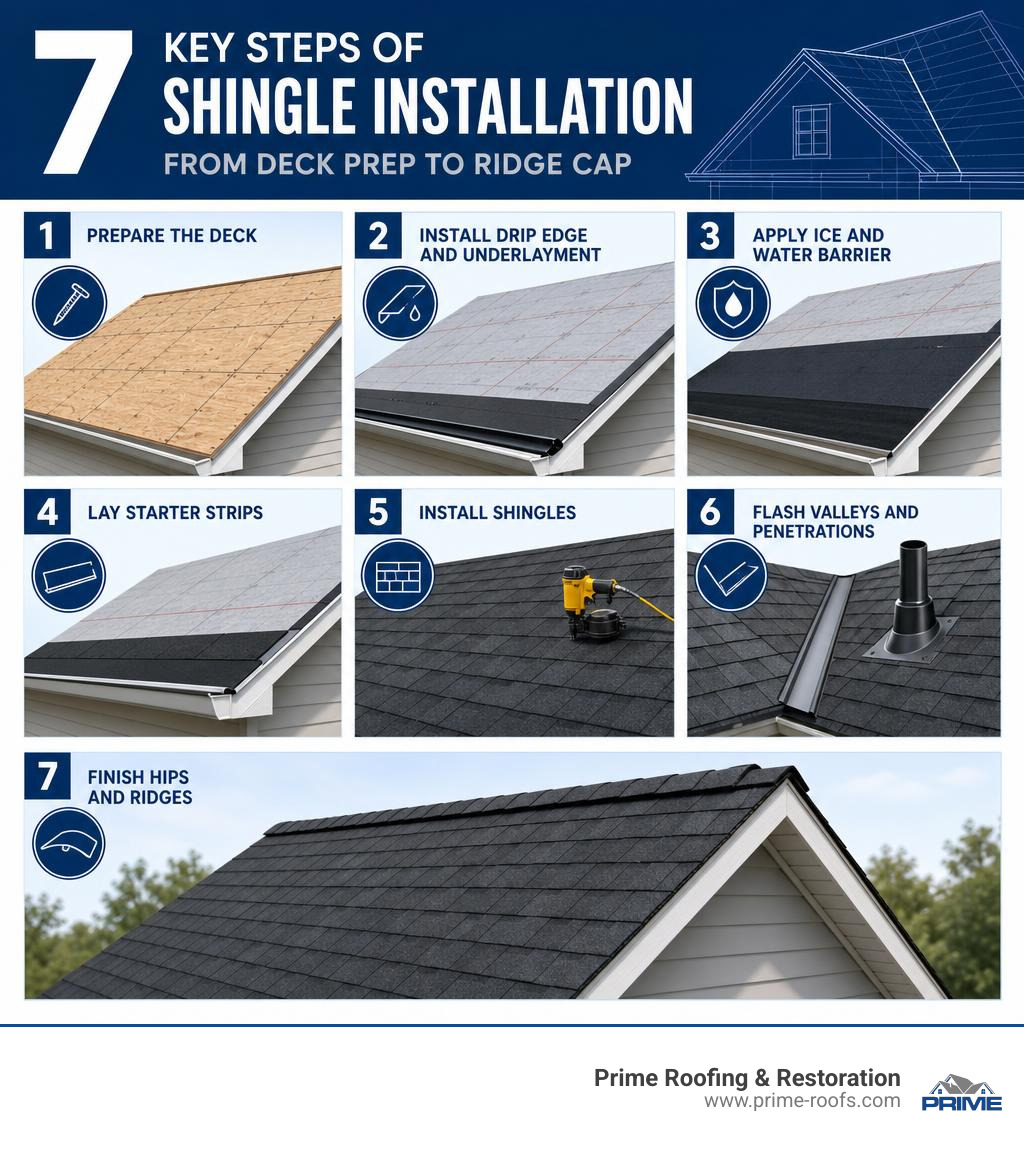
Owens Corning shingle installation done right protects your home for decades. Here’s a quick overview of the core steps:
- Prepare the deck — Inspect sheathing, ensure proper spacing (1/8″ to 1/4″ between panels), and confirm ventilation.
- Install drip edge and underlayment — Apply drip edge at eaves first, then underlayment, then drip edge at rakes.
- Apply ice and water barrier — Extend at least 24″ inside the interior wall line.
- Lay starter strips — Overhang eaves and rakes by 1/4″ to 3/4″.
- Install shingles — Use a 6-1/2″ offset pattern with 4 fasteners per shingle (6 in high-wind zones).
- Flash valleys and penetrations — Use step flashing, open or closed-cut valleys, and asphalt cement.
- Finish hips and ridges — Cap with hip and ridge shingles per manufacturer specs.
Getting these steps right isn’t just about curb appeal. It’s about protecting your home, maintaining your manufacturer warranty, and avoiding costly repairs down the road. Owens Corning is America’s most trusted roofing brand, and their shingle systems — including the Duration, Oakridge, and Supreme lines — are engineered to perform only when installed correctly.
Whether you’re dealing with storm damage, an aging roof, or planning a full replacement, understanding the installation process helps you make smarter decisions and ask the right questions when hiring a professional roofing contractor.
I’m Bill Spencer, Owner and President of Prime Roofing & Restoration, with hands-on experience overseeing hundreds of Owens Corning shingle installation projects across Central Alabama and the Gulf Coast. I’ll walk you through every step of the process so you know exactly what proper installation looks like.
Know your owens corning shingle installation terms:
Pre-Installation: Deck Preparation, Safety, and Ventilation
Before we lay a single shingle, the roof deck must be in perfect condition. At Prime Roofing & Restoration, we believe a roof is only as strong as the foundation underneath it. This is why our expert roof installation services always start with a rigorous deck preparation and safety inspection.
Roof Deck and Sheathing Requirements
A successful owens corning shingle installation requires a smooth, dry, and structurally sound wood deck. The roof deck must have adequate nail-holding capacity. Owens Corning outlines very specific sheathing specifications:
- Board Sheathing: Minimum 25/32″ thickness wood sheathing with a maximum board width of 6 inches.
- Plywood Sheathing: Minimum 3/8″ thickness exterior-grade plywood.
- OSB Sheathing: Minimum 7/16″ thickness Oriented Strand Board (OSB).
When installing new sheathing, a spacing of 1/8″ minimum to 1/4″ maximum must be maintained between the plywood or OSB panels. This gap is essential because it allows the wood to expand and contract naturally with seasonal humidity and temperature shifts without buckling. If panels are butted too tightly together, the edges will push against each other as they absorb moisture, leading to unsightly ridges or “buckling” that telegraphs directly through your new shingles.
During our pre-installation inspection, our team thoroughly examines the existing deck for signs of rot, delamination, water damage, or sagging. Any compromised sheathing is immediately cut out and replaced with fresh, matching material to ensure a level plane and maximum nail-holding power.
Safety First on the Job Site
Roofing is demanding work, and safety is our top priority. Our crews strictly adhere to OSHA standard 1926.501(b)(10) fall protection guidelines. Before starting any job, we inspect the site for hazards such as low-hanging overhead electrical lines, unstable ground, or fragile roof structures.
Our technicians wear rubber-soled shoes with excellent traction and ankle support. We never work on wet roofs, during active rain, or in high winds. We also keep the deck completely clear of loose nails, old felt, and sawdust to prevent slip-and-fall hazards. Personal Fall Arrest Systems (PFAS), including full-body harnesses, shock-absorbing lanyards, and secure roof anchors, are mandatory for all crew members working on slopes steeper than 4:12.
The Science of Attic Ventilation
Proper attic ventilation is not optional—it is a strict requirement to keep your Owens Corning manufacturer warranty valid. Without adequate ventilation, heat and moisture build up in your attic. In the summer, this cooks your shingles from the inside out, causing premature granule loss, blistering, and curling. In the winter, trapped moisture condenses on the underside of the roof deck, leading to mold growth, wood rot, and ice damming in colder climates.
A balanced ventilation system must be achieved:
- Intake Ventilation: Located low at the eaves or soffits to draw cool, fresh air into the attic.
- Exhaust Ventilation: Located high at the ridge, using ridge vents or baffles to let hot, humid air escape.
The general rule is to provide 1 square foot of net free ventilation area (NFVA) for every 150 square feet of attic floor space. If a balanced system of intake and exhaust is used (where at least 50% and no more than 60% of the exhaust is positioned high on the roof), this ratio can be optimized to 1 square foot per 300 square feet.
For example, if your attic floor space is 1,500 square feet, a balanced system requires 5 square feet (720 square inches) of total NFVA, split evenly between intake (360 sq. in.) and exhaust (360 sq. in.). Our team calculates these requirements precisely for every home to ensure optimal thermal performance and warranty compliance.
Step-by-Step Owens Corning Shingle Installation Guide
Once the deck is prepped, clean, and dry, the actual physical installation of the roof system begins.
1. Drip Edge Installation
According to the 2012 International Residential Code (IRC) and subsequent updates up to May 2026, drip edge is required at both eaves and rake edges. The drip edge protects the edge of the wood deck from water wicking backward under the shingles.
- At the Eaves: Apply the metal drip edge directly to the wood deck before laying down your underlayment.
- At the Rakes: Apply the metal drip edge over the underlayment.
The drip edge should extend approximately 3 inches back from the roof edge and overhang the fascia board slightly to direct water safely into the gutters. Secure the drip edge with roofing nails spaced every 8 to 12 inches. Ensure that adjacent pieces overlap by a minimum of 2 inches to prevent water from finding its way between the joints.
2. Starter Strip Application
Starter strips are the unsung heroes of wind resistance. They feature a pre-applied strip of sealant that bonds directly to the first course of shingles, preventing wind uplift at the eaves.
- Starter strips must overhang the eaves and rake edges by 1/4″ to 3/4″ to ensure water drips clear of the trim.
- Fasteners on the starter strip should be placed 1-1/2″ to 3″ above the eave’s edge.
- Use five fasteners for each starter course shingle, placing them 2 to 3 inches up from the bottom edge.
Using dedicated starter shingles, such as Owens Corning Starter Shingle Roll or Starter Strip Shingles, is highly recommended over cutting the tabs off standard 3-tab shingles. Factory-made starter strips ensure the sealant strip is positioned perfectly at the lower edge to lock down the first course of shingles immediately.
3. Shingle Course Patterns and Offsets
When laying Owens Corning laminate shingles, such as the Oakridge or TruDefinition Duration series, you must follow a strict offset pattern. According to the Owens Corning Oakridge PRO Series Installation Instructions, a 6-1/2″ offset pattern is highly recommended.
This means each successive course of shingles is shifted 6-1/2 inches to the side relative to the course below it. While any repeatable offset pattern between 4 and 8 inches is technically acceptable, the 6-1/2″ offset provides the cleanest aesthetic and the strongest defense against water infiltration.
Important Note: “Racking”—the practice of installing shingles straight up the roof in a vertical column rather than in a diagonal stair-step pattern—is explicitly not permitted for Duration or Oakridge shingle lines. Racking can lead to misaligned shingles, color shading variations, and poor sealant bonding.
Underlayment and Ice Barrier Requirements for Owens Corning Shingle Installation
Underlayment acts as a secondary water barrier beneath your shingles. Choosing the right underlayment and installing it according to the slope of your roof is crucial for long-term protection. If you are planning a full roof replacement, you can learn more about this process in our residential roofing guide.
Ice Dam Protection (Eave Flashing)
In regions prone to freezing temperatures, ice dams form when snow thaws over the warmer upper portions of a roof and refreezes as it reaches the cold eaves. This ice buildup backs up water under the shingles.
To prevent this, Owens Corning requires a self-adhering polymer-modified bitumen underlayment (ice and water shield) complying with ASTM D1970. This self-adhering roof underlayment must extend from the eave’s edge to a point at least 24 inches inside the interior wall line of the building. In areas with severe winters, two courses of ice and water barrier may be required to reach this 24-inch interior threshold.
Standard Slopes (4:12 and steeper)
For standard roof slopes, apply one layer of synthetic or asphalt-saturated felt underlayment over the entire deck. Overlap successive horizontal courses by 2 inches and stagger all end laps by at least 6 feet. Fasten the underlayment securely with plastic cap nails or staples to prevent wrinkling and tearing before the shingles are applied.
Low-Slope Roofs (2:12 to 4:12)
Asphalt shingles can be safely installed on low slopes ranging from 2 to 4 inches of rise per foot, but they require extra protection because water drains more slowly.
- Option A: Cover the entire deck with two layers of non-perforated asphalt-saturated felt underlayment. Overlap each course by 19 inches, leaving a 17-inch exposure, and secure with fasteners. Stagger end laps by 12 inches and keep them at least 6 feet from the previous course end laps.
- Option B: Apply a single continuous layer of self-adhering modified bitumen membrane over the entire deck. This serves as both your underlayment and your low-slope moisture barrier.
Never install asphalt shingles on slopes lower than 2:12 (less than 2 inches of rise per foot), as this will void the warranty and lead to inevitable leaks.
Fastening and Nailing Rules for Owens Corning Shingle Installation
The longevity and wind resistance of your roof depend heavily on proper fastening. High-wind warranties are only valid if the shingles are nailed exactly to manufacturer specifications. Always reference the Owens Corning Supreme Shingles Installation Instructions for specific line requirements.
Fastener Specifications
To comply with Owens Corning guidelines, fasteners must meet these strict criteria:
- Material: Galvanized steel, stainless steel, or aluminum nails. (Staples are not approved).
- Shank Gauge: Minimum 12-gauge wire shank.
- Head Diameter: Minimum 3/8-inch head.
- Penetration: Nails must be long enough to penetrate at least 3/4 inch into the wood deck sheathing or fully penetrate through plywood/OSB sheathing.
Nail Count and Placement
For normal application, asphalt shingles must be secured with no less than four fasteners per strip shingle.
- Standard Slopes: Use 4 nails per shingle. Place them 6-1/8 inches from the bottom edge of the shingle and 1 inch in from each outer end.
- High-Wind Areas or Mansard Roofs (Steep Slopes): Use 6 nails per shingle, and manually hand-seal the shingles with asphalt roof cement.
SureNail® Technology
If you choose Owens Corning Duration Series shingles, you benefit from their proprietary SureNail Technology. SureNail shingles feature a visible, tough, engineered fabric strip built right into the common bond area (where the layers overlap). This fabric strip creates a highly visible nailing zone.
Nails driven through this fabric strip have dramatically higher pull-through resistance. When using SureNail shingles, ensure the installer drives the nails straight and flush within this fabric zone. Driving nails too deep, crooked, or outside the fabric strip will compromise the wind warranty. The SureNail strip provides a consistent, reliable target for installers, ensuring that every nail penetrates the critical double-layer common bond area.
Special Application Scenarios: Cold Weather and Steep Slopes
Roofing doesn’t always happen in perfect 75°F weather on a gentle slope. When conditions get tough, installation techniques must adapt. If you need to replace your roof in challenging conditions, check out our shingle roof replacement guide for expert advice.
Cold Weather Installation (At or Below 40°F)
Asphalt shingles have been used successfully in cold climates for over one hundred years. However, installing them in freezing temperatures requires extra care. Shingles installed in cold weather may not immediately seal until warmer seasonal temperatures arrive to thermally activate the self-sealing adhesive.
If you are installing Owens Corning shingles in temperatures at or below 40°F, follow these technical guidelines:
- Warm Storage: Store shingle bundles in a covered, heated indoor space prior to application so they remain flexible. Cold shingles become brittle and can crack or break when handled.
- Hand-Sealing: Because the factory sealant won’t bond immediately in the cold, you must manually hand-seal the shingles to prevent wind blow-offs.
- Laminate Shingles (Duration/Oakridge): Apply 4 spots of asphalt roof cement (about the size of a quarter) under each shingle, placed approximately 1 inch from the bottom edge.
- Strip/3-Tab Shingles (Supreme): Place 2 spots of asphalt roof cement under each individual tab.
- Hip & Ridge Caps: Warm up hip and ridge cap shingles in a heated vehicle or space before bending them over the ridge to prevent cracking.
Standard vs. Low vs. Steep Slope Requirements
| Slope Category | Pitch (Rise:Run) | Underlayment Requirement | Fastener Pattern | Special Notes |
|---|---|---|---|---|
| Low Slope | 2:12 to < 4:12 | Double layer of felt OR 1 layer of self-adhered membrane | Standard 4-nail pattern | Never use shingles below 2:12 pitch. |
| Standard Slope | 4:12 to 21:12 | Single layer of synthetic or felt underlayment | Standard 4-nail pattern | Shingles seal naturally with sun exposure. |
| Steep Slope / Mansard | > 21:12 (or > 60°) | Single layer of synthetic or felt underlayment | 6-nail pattern + manual hand-sealing | Hand-seal with 4 spots of asphalt roof cement per shingle. |
Valleys, Flashing, and Roof Measurement Best Practices
Water naturally flows toward valleys and roof penetrations, making these areas the most vulnerable to leaks. Proper flashing and valley construction are non-negotiable for a leak-free home. You can find more details on correcting past installation errors in our asphalt shingle repair guide.
Valley Construction Methods
According to the Owens Corning Roofing Installation Manual, there are three primary ways to build a valley:
- Open Valleys:
- Lay a 36-inch wide underlayment strip down the center of the valley.
- Install a minimum 24-inch wide corrosion-resistant metal valley flashing.
- Snap chalk lines down each side of the valley, starting at 6 inches apart at the ridge and diverging outward by 1/8 inch per foot as they run down.
- Trim the shingles to these chalk lines, clip 1 inch off the upper corner of each valley shingle at a 45-degree angle, and bed the shingles in a 3-inch wide strip of asphalt cement.
- Closed-Cut Valleys (Most Popular):
- Install a 36-inch wide valley liner down the valley centerline.
- Run the shingles from the less steep roof face straight across the valley centerline, extending them at least 12 inches past the center. Fasten them no closer than 6 inches to the centerline.
- Run the shingles from the adjoining roof face over the valley, and cut them in a straight line 2 inches back from the valley centerline. Clip the top corners and seal them with cement.
- Woven Valleys:
- Shingles from both sides are woven together across the valley centerline. This method is only recommended for 3-tab shingles and is rarely used for modern thick laminated shingles because the thickness of the overlapping layers creates a bulky, uneven ridge that can lift shingles and trap debris.
Step Flashing for Vertical Walls
Where the roof deck meets a vertical sidewall, step flashing must be used.
- Use individual metal step flashing pieces that are 10 inches long and 2 inches wider than the shingle exposure (typically 7 inches wide for shingles with a 5-inch exposure).
- As each course of shingles is laid, place one piece of step flashing over the end shingle, nailing it to the deck (never to the wall).
- This creates a water-shedding stair-step system that directs water down the roof face. If you nail the flashing to both the wall and the deck, the natural settling of the house and thermal expansion will cause the flashing to buckle, tear, or pull out the nails.
Penetration Flashing (Plumbing Boots and Chimneys)
All roof penetrations, such as plumbing vent pipes, exhaust vents, and chimneys, require specialized flashing. For plumbing boots, shingles are installed up to the bottom of the pipe, the boot is slid over the pipe and bedded in sealant, and the upper shingles are installed over the top and side flanges of the boot. Chimneys require a combination of apron flashing at the bottom, step flashing along the sides, and a counter-flashing system embedded into the mortar joints of the brick to shed water over the step flashing.
Roof Measurement and Estimating Waste
To ensure you have enough materials to finish your project without excessive leftover costs, you must calculate a waste factor.
- Simple Roofs (Gable roofs with few valleys or penetrations): Add 2% to 5% extra material for trim waste.
- Complex Roofs (Hip roofs, multiple valleys, dormers, and ridges): Add 10% to 15% extra material for trim waste.
- Never use a shingle trimmed to less than 12 inches in width to finish a course running into a valley. Having a small piece of shingle near a high-flow water channel increases the risk of water getting underneath and causing a leak.
Frequently Asked Questions about Owens Corning Shingles
What is the minimum slope for Owens Corning shingles?
The absolute minimum slope for installing Owens Corning shingles is 2:12 (2 inches of vertical rise for every 12 inches of horizontal run). Installing shingles on a slope lower than 2:12 is against residential building codes and will void your manufacturer warranty. Any slope between 2:12 and 4:12 is considered a low slope and requires a double layer of underlayment or a self-adhering membrane.
How many nails are required per Owens Corning shingle?
Under normal wind conditions and standard slopes (4:12 to 21:12), Owens Corning requires 4 nails per shingle. For high-wind areas, steep slopes, or mansard roofs (slopes greater than 21:12), 6 nails per shingle are required, combined with manual hand-sealing using spots of asphalt roof cement.
Can you install Owens Corning shingles over existing shingles?
While some local building codes permit a “layover” (installing a second layer of shingles over an existing single layer), we do not recommend it. Laying new shingles over old ones traps heat, shortens the lifespan of your new roof, prevents a thorough inspection of the wood deck for rot, and makes it impossible to install a self-adhering ice and water shield. Furthermore, many manufacturer wind warranties are reduced or voided if shingles are not installed directly onto a clean wood deck.
Conclusion
Getting a new roof is a major investment, and its success hinges on the quality of the installation. When you follow the official Owens Corning guidelines—from preparing the deck and choosing the right underlayment to nailing precisely within the SureNail zone—you ensure your home remains safe, dry, and beautiful for decades to come.
As a certified local installer in Alabaster and Hoover, AL, Prime Roofing & Restoration is dedicated to providing homeowners with the highest standard of craftsmanship. We don’t cut corners, and we install every roof system to strict manufacturer specifications to protect your warranty and your peace of mind.
If you are ready for a worry-free roof replacement or need a professional inspection, let our licensed experts help. Learn more about our roof installation in Alabaster, AL to schedule your free estimate!
Contact Prime Roofing & Restoration
We are proud to serve homeowners throughout Central Alabama. Reach out to us today to discuss your Owens Corning shingle installation project.
- Company Name: Prime Roofing & Restoration
- Address: 5 Brown Cir, Alabaster, AL 35007
- Phone: (205) 661-8190
- Office Hours: Open 24 hours, 7 days a week
Find us and view our service area on Google Maps.