
Why Ignoring Broken Shingles Can Cost You Thousands
Damaged shingles repair is one of the most critical home maintenance tasks you can’t afford to ignore. A single compromised shingle is a breach in your home’s armor, an open invitation for water to invade. This seemingly small issue can rapidly escalate, leading to thousands of dollars in water damage, pervasive mold growth, and severe structural issues that compromise the integrity of your entire home. Understanding the urgency is the first step to protecting your investment.
Quick Answer: Repairing Damaged Shingles
- Inspect Thoroughly: From the ground, use binoculars to scan your entire roof for missing, cracked, curled, or blistered shingles. Pay special attention to areas around vents, chimneys, and valleys. After a storm, check your gutters and downspouts for an accumulation of shingle granules.
- Gather Essential Tools: Before starting, assemble your pry bar, hammer, roofing nails (1 ¼-inch galvanized), high-quality roofing sealant, replacement shingles, and crucial safety gear like a harness and non-slip shoes.
- Replace Full Shingles: For shingles that are missing, cracked through, or extensively damaged, a full replacement is necessary. This involves carefully breaking the seal of the shingle above, removing the nails, sliding out the old piece, and securing a new one in its place.
- Repair Minor Damage: For minor issues like a single curling corner or a hairline crack, you can use roofing sealant as a targeted repair. This can extend the shingle’s life and prevent the damage from worsening, but it should be seen as a temporary measure.
- Call a Professional Immediately: Do not attempt a DIY repair if the damage covers more than a small, isolated area (roughly 30 sq. ft. or 3-4 shingles), if you see any sagging in the roofline, if there are signs of water damage in your attic, or if your roof is over 20 years old. For a comprehensive assessment, call our experts at (205) 555-0199.
Your roof is your home’s first line of defense against Alabama’s uniquely challenging weather—from severe thunderstorms and hail to the relentless summer heat and humidity. A single damaged shingle might seem insignificant, but it’s a critical failure point. Water can seep through that small gap, saturating the roof deck, ruining your insulation (slashing its R-value), and creating the perfect environment for toxic mold to flourish in your attic, often within just 24-48 hours. The average asphalt shingle roof in our region is designed to last 15-25 years, but that lifespan is entirely dependent on prompt and proper maintenance.
Most minor shingle repairs, when caught early, cost between $200 and $1,000. Delaying that repair can transform a simple fix into a catastrophic expense. The cost of replacing rotted roof decking can be $100-$300 per sheet, attic mold remediation can easily exceed $3,000, and replacing damaged ceilings and insulation adds thousands more. Data from the roofing industry consistently shows that timely roof repairs can extend your roof’s lifespan by 5-10 years, saving you from a premature full replacement and giving you invaluable peace of mind.
I’m Bill Spencer, owner of Prime Roofing & Restoration, and over the past five years, I’ve personally overseen hundreds of damaged shingles repair projects across Central Alabama, from minor storm damage in Alabaster to complete roof restorations in Orange Beach. My hands-on experience has taught me that homeowners who understand the basics of shingle repair can prevent 80% of minor issues from becoming major emergencies. This guide is designed to give you that knowledge.
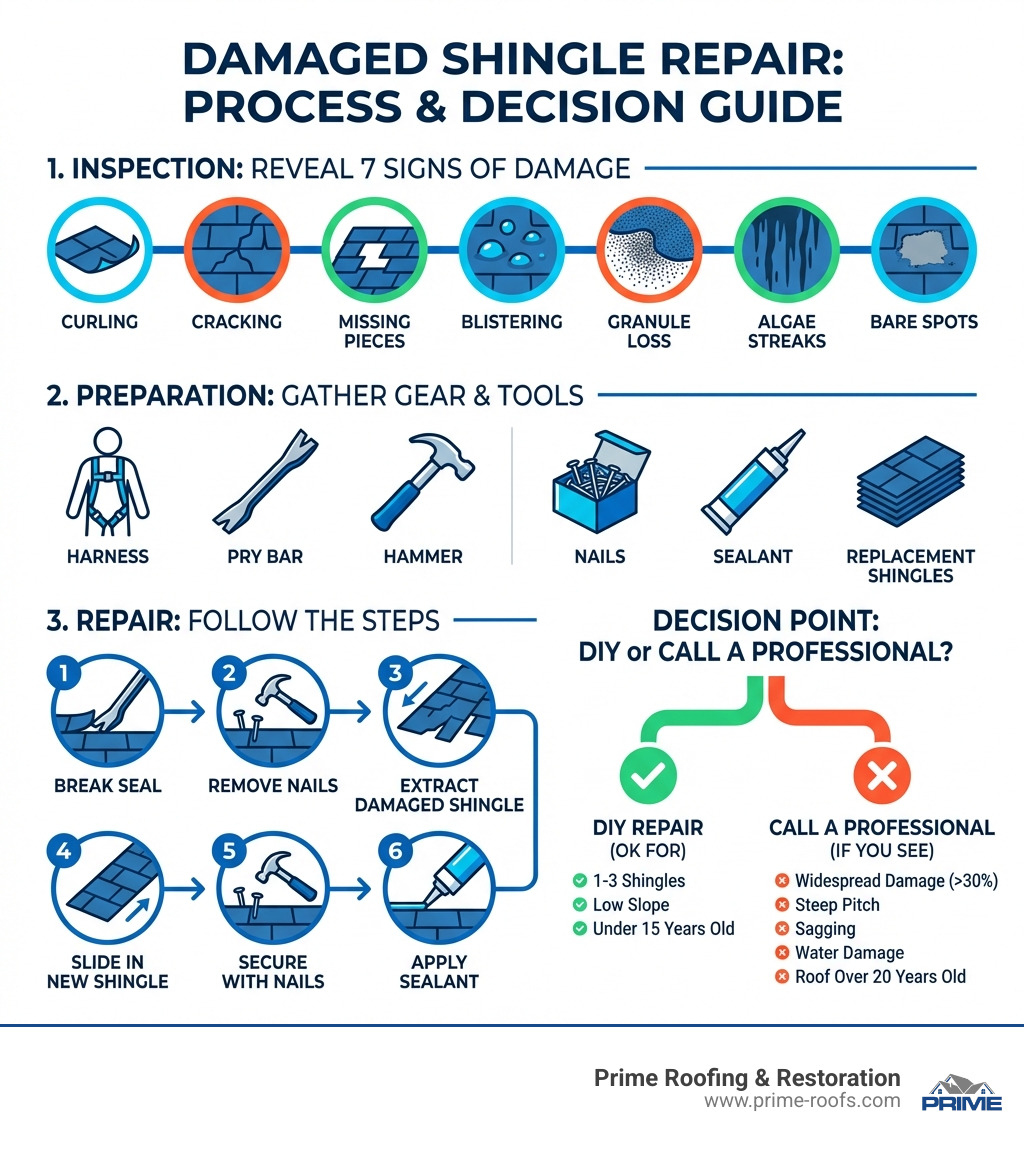
Spotting the Damage: 7 Telltale Signs Your Shingles Need Attention
Before you can perform a damaged shingles repair, you need to become a detective. Knowing what to look for is the most critical part of preventative maintenance. A thorough visual inspection from the ground with a pair of binoculars, or a careful look from a ladder (if you can do so safely), can reveal hidden problems before they cause serious damage. It’s especially crucial to perform this check after any major weather event, as even minor wind damage to roof shingles can lift seals and create vulnerabilities.
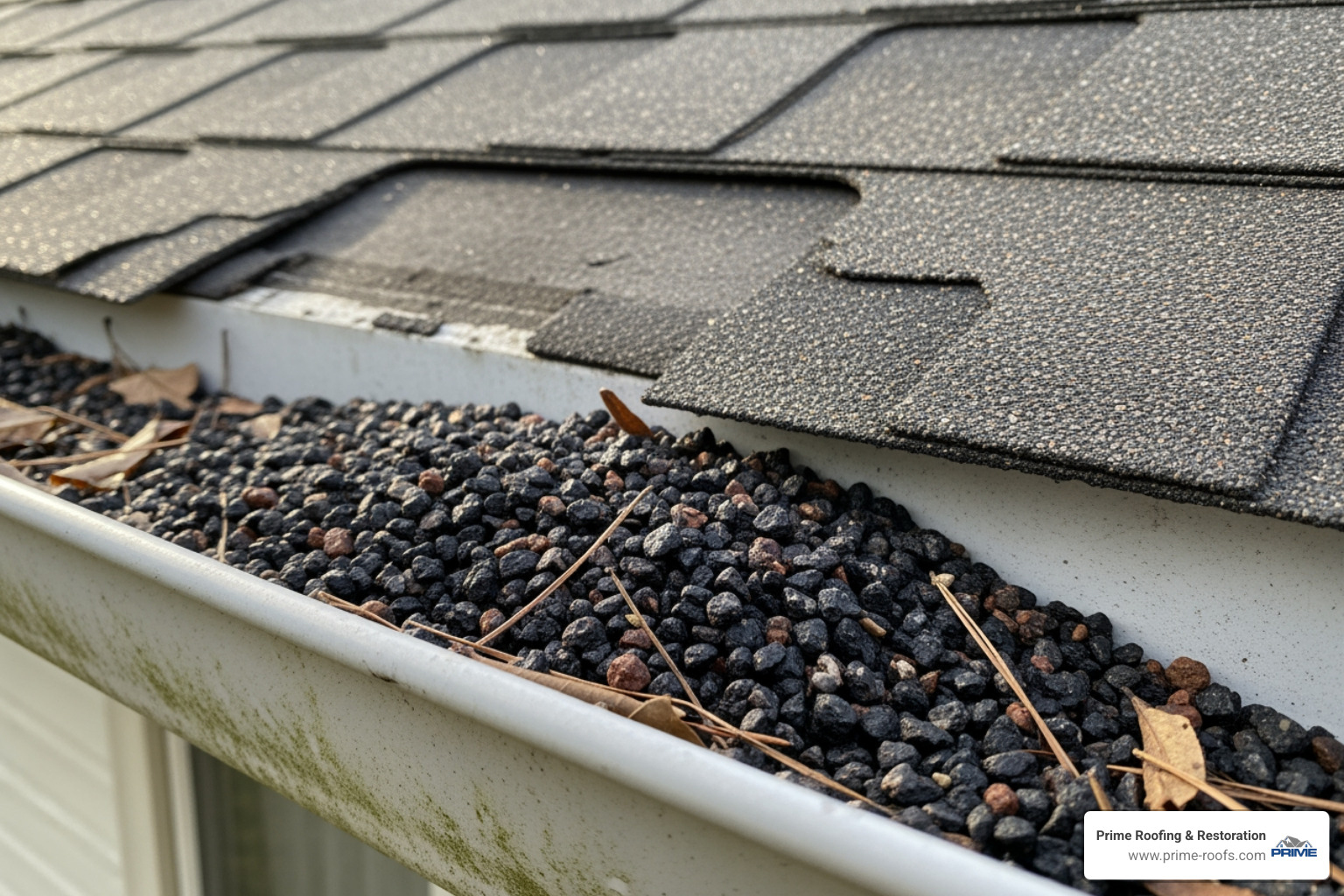
1. Granules Collecting in Gutters or on the Ground
If you notice an accumulation of what looks like coarse, dark sand in your gutters or at the base of your downspouts, you’re seeing the slow erosion of your roof. These are shingle granules, the ceramic-coated mineral pieces that form the protective top layer of asphalt shingles.
- What it Means: Granules serve two primary functions: they shield the underlying asphalt from damaging UV radiation and contribute to the shingle’s fire resistance rating. Loss of granules is a clear sign that your shingles are aging and becoming brittle. The sun’s rays can now directly bake the asphalt, accelerating its deterioration.
- What to Do: A small, gradual amount of granule loss is normal over a roof’s life. However, if you see large amounts suddenly, especially after a hail storm or heavy rain, it’s a red flag. This indicates accelerated wear and means your roof is nearing the end of its effective lifespan.
2. Curling Shingles
Shingles that are curling at the edges are a significant warning sign. This can manifest in two ways: “cupping,” where the edges turn upward, or “clawing,” where the middle of the shingle tab rises up.
- What it Means: Curling is typically caused by a combination of aging and moisture. As the asphalt shingle ages, it shrinks. The top surface, exposed to the sun, often shrinks faster than the bottom, causing the edges to pull upward. It can also be a sign of poor attic ventilation, where excessive heat from below is essentially cooking the shingles.
- What to Do: Curling shingles are no longer sealed to the roof and can be easily torn off by wind. They create a perfect pathway for wind-driven rain to get underneath. Minor curling can sometimes be repaired with sealant, but widespread curling indicates the roof is failing.
3. Cracked Shingles
Cracks can appear as fine, hairline fractures or deep, obvious splits that go all the way through the shingle.
- What it Means: Cracks are often the result of wind damage or thermal shock—the expansion and contraction caused by extreme temperature fluctuations common in Alabama. Hail impacts can also cause fractures. A cracked shingle is functionally the same as a hole in your roof.
- What to Do: A single, small crack might be temporarily sealed, but any crack that penetrates the entire shingle requires immediate replacement of that shingle. Water will find its way through, leading to rot in the roof deck.
4. Missing Shingles
This is the most glaring sign of roof damage, often discovered after a period of high winds. A single missing shingle creates a significant vulnerability.
- What it Means: The shingle’s adhesive seal likely failed, allowing wind to get underneath and rip it from its fasteners. This leaves the underlayment and roof decking exposed to direct sunlight, rain, and other elements. The underlayment is only a secondary, water-resistant barrier, not a permanent waterproof one.
- What to Do: This is a high-priority repair. The exposed area is immediately susceptible to water intrusion. This repair should be made as quickly as possible to prevent decking damage and leaks.
5. Blistering Shingles
Blisters look like bubbles or pimples on the surface of your shingles. They can be small and scattered or larger and more concentrated.
- What it Means: Blistering is usually caused by one of two things: trapped moisture within the shingle during the manufacturing process, or excessive heat buildup due to poor attic ventilation. When the roof gets hot, this trapped moisture or air expands, creating a blister.
- What to Do: When a blister “pops,” it dislodges the protective granules, creating a small bald spot. While a few small blisters aren’t an emergency, widespread blistering indicates a systemic problem, either with the shingle quality or your home’s ventilation system.
6. Algae Streaks (Dark Stains)
Those long, unsightly black or dark green streaks running down your roof are typically a type of algae called Gloeocapsa magma.
- What it Means: This algae feeds on the limestone filler used in many asphalt shingles. While it doesn’t cause immediate structural damage, its presence holds moisture against the shingle surface, which can accelerate granule loss. In humid climates like Alabama’s, it’s a very common cosmetic issue that can also hint at underlying moisture problems.
- What to Do: Algae can be cleaned with a 50/50 solution of water and bleach, but this can be a dangerous job and may damage landscaping if not done carefully. Installing zinc or copper strips near the roof’s peak can prevent future growth, as metallic ions wash down with the rain and inhibit algae.
7. Bald Spots (Significant Granule Loss)
Beyond finding granules in the gutters, you might see distinct patches on your roof where the granules have completely worn away, exposing the dark asphalt substrate.
- What it Means: This is a critical stage of shingle failure. The shingle has lost its primary defense against UV radiation. The exposed asphalt will rapidly dry out, become brittle, and crack, leading to swift deterioration and leaks.
- What to Do: A shingle with a bald spot is a failed shingle and must be replaced. If you see multiple bald spots across your roof, it’s a strong indicator that a full roof replacement is imminent.
Gearing Up: Your Essential Toolkit for Shingle Repair
Embarking on a damaged shingles repair project without the right equipment is not only inefficient but also extremely dangerous. Having every tool and material ready before you climb the ladder makes the job smoother and safer. Most of these items are readily available at local hardware stores.
- Safety Gear (Non-Negotiable):
- Safety Harness and Rope: If your roof has a pitch steeper than 4/12 (a 4-inch rise for every 12 inches of run), a harness is essential. According to OSHA guidelines, proper fall protection is required for any work done at height.
- Non-Slip Roofing Shoes or Boots: These have soft, grippy soles that provide better traction on shingle surfaces than standard work boots.
- Heavy-Duty Work Gloves: Protect your hands from abrasive shingles and sharp tools.
- Safety Glasses: Shield your eyes from flying debris, especially when removing old shingles and nails.
- Sturdy, Properly-Placed Ladder: Ensure your ladder extends at least 3 feet above the roofline and is set on stable, level ground.
- Essential Tools:
- Flat Pry Bar: A thin, flat pry bar (or a roofer’s bar) is crucial for gently breaking shingle seals without cracking the surrounding shingles.
- Hammer or Roofing Hatchet: For driving and removing roofing nails.
- Utility Knife (with extra blades): Needed for trimming shingles or cutting away damaged sections. Shingles are abrasive and will dull blades quickly.
- Caulking Gun: For applying roofing cement/sealant.
- Tape Measure: To ensure proper alignment and exposure of the new shingle.
- Tinsnips: Useful for trimming replacement shingles to fit around vents or in valleys.
- Required Materials:
- Replacement Shingles: You must ensure they match your existing shingles not just in color, but also in type (e.g., 3-tab vs. architectural).
- 1 ¼-inch Galvanized Roofing Nails: These are the standard. They must be galvanized to prevent rust. Do not use staples or standard nails.
- Roofing Cement/Sealant: Choose a high-quality, asphalt-based sealant rated for all-weather use. It’s used to reseal shingle tabs and waterproof nail heads.
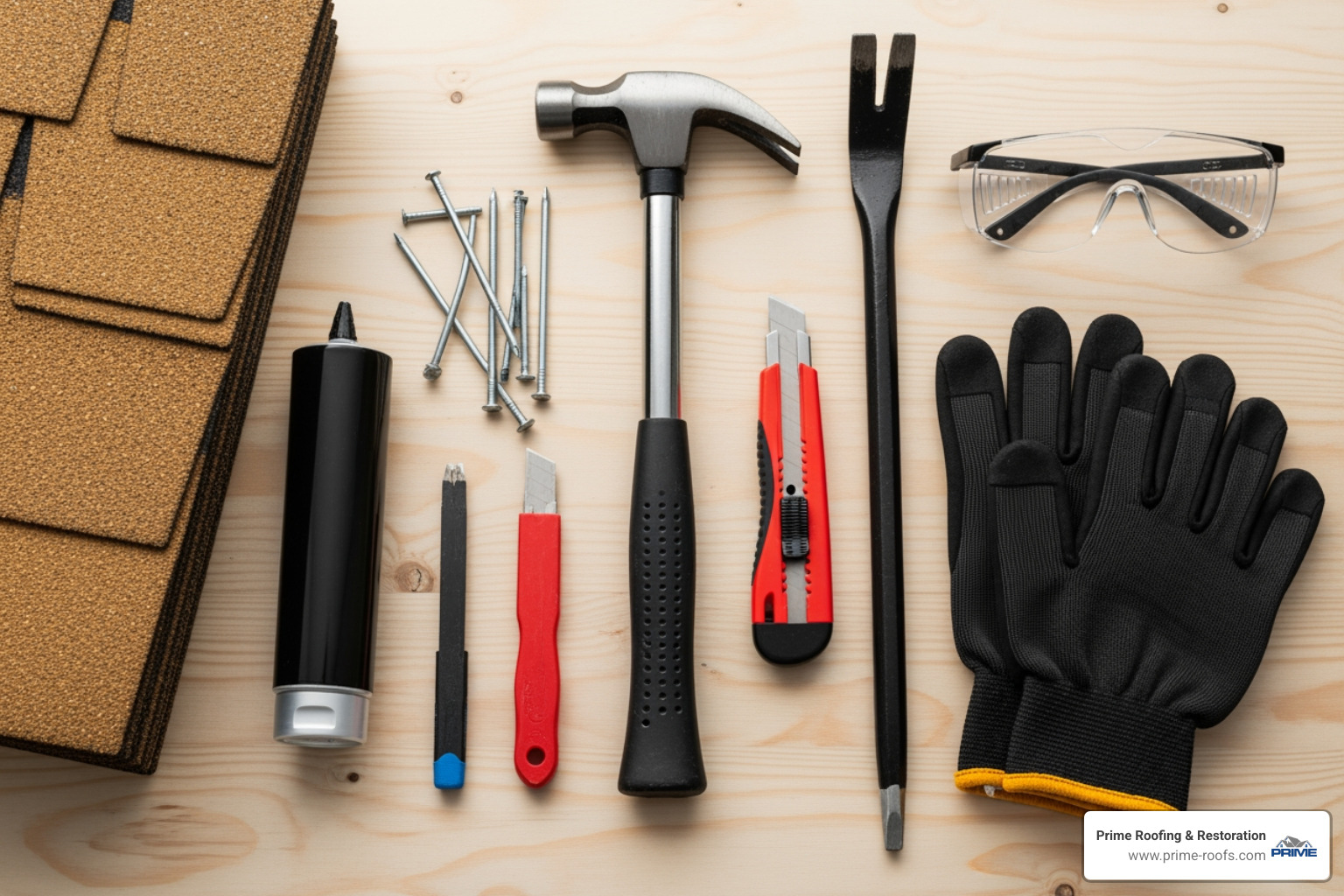
Before you even think about stepping onto your roof, ensure you have these items ready. We strongly recommend performing any damaged shingles repair on a dry, mild, and overcast day. Avoid working in the intense Alabama summer heat, as shingles can become overly soft and easily scuffed. Conversely, in cold weather, they become brittle and can crack easily. Never work in windy or wet conditions.
How to Make Repairs Less Noticeable
Matching new shingles to a roof that has been weathered by years of sun and rain is a common challenge. The color of your existing shingles will have faded over time. The best practice is to take a piece of the damaged shingle to your local supplier to find the closest possible match. Even then, a brand-new shingle will likely stand out against the older ones.
Here’s a pro trick: if the repair is in a highly visible area (like the front of your house), find a less conspicuous spot on the roof (e.g., on the back slope or over a garage). Carefully remove a weathered shingle from that hidden spot and use it for your visible repair. Then, install the brand-new, slightly mismatched shingle in the less visible location. This allows the new shingle to weather and blend in over time without creating an eyesore on the most prominent part of your roof.
The Fix Is In: A Step-by-Step Guide to Replacing a Damaged Shingle
Replacing a single damaged shingle is a manageable task if done with care and precision. This process for a damaged shingles repair should ideally be performed on a cool, overcast day. Hot sun can make the sealant underneath excessively sticky and difficult to break, while the shingles themselves can become too soft, leading to scuffing and further damage. Cold weather makes shingles brittle and prone to cracking.
The Process for Damaged Shingles Repair
Step 1: Break the Seal First, you need to release the damaged shingle from the ones around it. Identify the shingle directly above the one you need to replace. Carefully slide your flat pry bar under the edge of this overlying shingle, working it gently from side to side to break the adhesive seal connecting it to the damaged shingle below. You may need to do this for the shingles on either side as well.
- Common Mistake: Using too much force or a sharp tool. This can tear or crack the healthy shingle you are trying to preserve. Patience is key. If the seal is stubborn in cold weather, a heat gun on a low setting can be used with extreme caution to soften the sealant, but it’s often safer to wait for a warmer day.
Step 2: Remove the Nails With the tab of the overlying shingle lifted, you will see the row of nails securing the top edge of the damaged shingle. There are typically four nails per shingle. Place your pry bar under the nail head and gently pry it up. You can also use the claw of your hammer. Remove all nails holding the damaged shingle in place.
- Pro Tip: Sometimes, the nails from the course above the one you lifted will also penetrate the top of the damaged shingle. You will need to break the seal on the shingle two rows up to access and remove those nails as well. This is common with architectural shingles.
Step 3: Remove the Damaged Shingle and Inspect Once all seals are broken and nails are removed, the damaged shingle should slide out. If it’s stuck, check again for any missed nails. Once it’s out, take a moment to inspect the exposed area. Look at the underlayment (the black paper or synthetic fabric) for any rips or holes. Check the wooden roof deck underneath for signs of water staining, softness, or rot. Any damage found here must be addressed before proceeding.
Step 4: Slide in the New Shingle Take your replacement shingle and carefully slide it into the empty space. Align it correctly, ensuring the exposure (the visible part of the shingle) matches the adjacent shingles perfectly. The top edge of the new shingle should slide completely under the shingle above it.
- Common Mistake: Misaligning the shingle. If it’s too high or too low, it will disrupt the pattern and create a potential entry point for water.
Step 5: Secure with Nails This is the most critical step. Secure the new shingle with four 1 ¼-inch galvanized roofing nails. The nails must be driven into the shingle’s designated nailing strip. Proper placement is crucial: the nails should be positioned so they will be covered by the overlapping shingle tab above them.
- Critical Detail: Do not overdrive the nails (breaking the shingle mat) or underdrive them (leaving the head raised). The nail head should be flush with the shingle surface. According to the International Residential Code (IRC), improper fastening is a leading cause of roof failure.
Step 6: Seal the Shingles To complete the repair and ensure a watertight seal, apply a few quarter-sized dabs of roofing cement under the tabs of the shingle(s) you lifted in Step 1. Apply sealant under the corners of the new shingle as well. Press the tabs down firmly to ensure good adhesion. This manual seal is critical to prevent wind uplift until the sun can heat the shingle’s built-in adhesive strip and create a permanent bond. Avoid using excessive sealant, as it can trap moisture. Allow at least 24 hours of dry weather for the sealant to cure properly.
Quick Fixes: How to Handle Curled and Cracked Shingles
Not every sign of wear and tear demands a full shingle replacement. For minor, isolated issues like a curling corner or a hairline crack, a targeted repair can be a cost-effective way to extend the life of the shingle and prevent the problem from escalating. These quick fixes are an essential part of any proactive maintenance plan, stopping small leaks before they start major damaged shingles repair projects.
Repairing Curled Shingles
Curling shingles are often a symptom of age, but if it’s just an isolated tab that has lifted, you can often re-secure it. This repair is best done on a warm, sunny day when the shingles are naturally more pliable.
- Gently Lift: Carefully lift the curling shingle tab. Old shingles can be brittle, so apply slow, steady pressure. If it feels like it might crack, stop. The shingle may be too old and brittle for this repair.
- Clean Debris: Use a putty knife or brush to clean out any dirt, leaves, or old, dried-out sealant from underneath the shingle.
- Apply Sealant: Use a caulking gun to apply a thick, continuous bead of asphalt roofing cement to the underside of the curled tab.
- Press and Secure: Press the shingle tab down firmly into the sealant. To ensure a strong bond while the sealant cures, place a brick or another heavy, flat object on top of it for at least 24 hours.
Important Limitation: This is a spot treatment. If you have widespread curling across your roof, it’s a sign of systemic failure, and sealing down individual tabs is not a viable long-term solution. It indicates the roof is likely due for replacement.
A Simple Damaged Shingles Repair for Cracks
For a shingle with a minor hairline crack that hasn’t split the shingle in two, you can use sealant as a patch. This is a temporary fix that must be monitored.
- Clean the Area: Ensure the shingle surface is clean and completely dry.
- Apply Sealant: Using a putty knife, apply a thick layer of roofing sealant directly into and over the crack. Push the sealant into the crack to ensure it’s completely filled.
- Smooth and Feather: Smooth the sealant over the crack, feathering the edges to create a seamless patch. The goal is to cover the crack by at least an inch on all sides.
- Add Granules (Optional): If you’ve collected any loose granules from your gutters, you can sprinkle them over the wet sealant. This helps camouflage the repair and provides some UV protection for the sealant itself.
Critical Warning: This repair is only for very small cracks. If a shingle is split all the way through, or if the crack is wider than 1/8th of an inch, the shingle’s structural integrity is compromised and it must be replaced. A sealant patch on a major crack will fail, especially in climates with freeze-thaw cycles.
DIY vs. Pro: When Is Professional Damaged Shingles Repair Necessary?
While the satisfaction and cost savings of a DIY repair are appealing, knowing your limits is the most important skill a homeowner can have. A poorly executed damaged shingles repair can cause more harm than the original problem, potentially voiding your roof’s warranty and leading to the very leaks you were trying to prevent. Delaying a necessary professional repair can turn a thousand-dollar problem into a ten-thousand-dollar catastrophe involving water damage, mold remediation, and structural work. We’ve seen this scenario play out too many times in Alabaster, AL, and Orange Beach, AL, where a small, ignored leak becomes a massive crisis after a single heavy Gulf storm.
Use this table to help decide whether to tackle the job yourself or call in the experts.
| Feature | DIY Repair (When to Consider) | Call a Pro (When It’s Necessary) |
|---|---|---|
| Damage Extent | 1-3 missing/damaged shingles in a single, easy-to-reach area. | Widespread damage (>30% of a roof plane); multiple missing shingles across different areas; significant hail or storm damage that requires a trained eye to assess the full scope. |
| Roof Slope | Low-slope roof (e.g., 4/12 pitch or less) that is easy and safe to walk on. | Steep-pitched roof that requires specialized safety equipment (harnesses, roof jacks) and expertise to navigate safely; any roof on a home with two or more stories. |
| Comfort Level | You are 100% comfortable with heights and using the required tools safely. | Any hesitation or discomfort with heights; lack of proper safety equipment; uncertainty about any step in the repair process. Your safety is not worth the savings. |
| Roof Age | The roof is relatively new (less than 15 years old) and shingles are still pliable. | Your roof is over 20 years old and nearing the end of its expected lifespan (15-25 years for asphalt shingles). Shingles are likely brittle and a repair attempt may cause more damage. |
| Visible Issues | Minor, obvious surface damage like a single curled or cracked shingle. | Any signs of sagging, sponginess, or soft spots on the roof deck (indicates underlying rot); visible water stains in the attic or on ceilings; persistent leaks you can’t trace. |
| Underlying Cause | Clear, isolated cause (e.g., a branch fell and cracked one shingle). | The cause of damage is unclear; you suspect underlying issues with flashing around chimneys or vents, poor attic ventilation, or improper original installation. |
| Insurance Claim | Damage is minor and below your insurance deductible. | Damage is the result of a storm, hail, or other covered peril that may warrant an insurance claim. A professional roofer is essential for this process. |
| Time/Warranty | You need a quick, temporary fix to extend the roof’s life for a short time. | You are seeking a permanent, long-term solution that comes with a workmanship warranty. A professional repair is documented and guaranteed. |
The Professional Advantage for Insurance Claims
If your roof damage is from a storm, a professional roofer is your most valuable ally. Navigating an insurance claim is complex. Our team at Prime Roofing & Restoration is trained to:
- Thoroughly Document All Damage: We use photos, videos, and detailed reports to document not just the obvious damage, but also the subtle, often-missed signs of hail impacts or wind lift that an adjuster might overlook.
- Provide Accurate Estimates: We create detailed, line-item estimates using industry-standard software that insurance companies recognize and respect.
- Meet the Adjuster: We can be on-site to meet with your insurance adjuster, pointing out the damage in person to ensure a fair and accurate assessment of your claim.
For anything beyond a very minor, straightforward damaged shingles repair, we strongly recommend contacting a professional. Our expert team offers comprehensive professional roof repair services throughout our service areas, including our dedicated teams of local roofing contractors in Alabaster, AL. Call us at (205) 555-0199 to ensure the job is done correctly, safely, and in compliance with all local building codes, preventing future headaches and protecting your home.
Long-Term Care: Preventative Maintenance to Extend Shingle Life
The best repair is the one you never have to make. Proactive maintenance is the key to maximizing the lifespan of your asphalt shingle roof, which is designed to last 15-25 years in the demanding Alabama climate. A few simple, regular checks can save you from costly repairs and premature replacement, protecting your home and your investment.
Regular Roof Inspections (Twice a Year & After Storms)
We recommend a thorough visual inspection of your roof at least twice a year—once in the spring to assess any winter damage and once in the fall to prepare for the coming winter. Crucially, you should also perform an inspection immediately after any severe weather event, such as a hailstorm, tornado warning, or high-wind event.
Homeowner Inspection Checklist (from the ground):
- Use binoculars to scan each roof plane for missing, cracked, or curling shingles.
- Look for dark streaks (algae) or areas where granules have worn away (bald spots).
- Check the metal flashing around the chimney, vents, and in roof valleys for signs of rust, lifting, or separated sealant.
- Inspect your gutters for an accumulation of shingle granules—a sign of aging.
- Inside, check your attic for any signs of water stains on the underside of the roof deck, wet insulation, or daylight peeking through.
Early detection of these issues is your best defense in preventing a minor flaw from becoming a major damaged shingles repair.
Keep Gutters and Downspouts Clean
Your gutter system is an integral part of your roof. Its job is to channel thousands of gallons of water away from your home’s foundation and siding. When gutters become clogged with leaves, pine needles, and other debris, they can’t function properly.
- The Risk: Clogged gutters cause water to back up and overflow. This water can seep under the edge of your shingles, rotting the roof decking, fascia, and soffit boards. In Alabama’s humid climate, this standing water is a breeding ground for mosquitoes and can lead to premature shingle deterioration.
- The Solution: Clean your gutters at least twice a year. Consider installing high-quality gutter guards to minimize debris buildup, but remember that even guards require occasional maintenance.
Trim Overhanging Tree Branches
While mature trees add beauty and shade to your property, overhanging branches pose a significant threat to your roof’s health.
- Abrasive Wear: Branches that scrape against your roof in the wind act like sandpaper, slowly wearing away the protective granules on your shingles.
- Impact Damage: Falling acorns, pinecones, and small limbs can cause minor impact damage, while a large limb falling during a storm can be catastrophic, puncturing your roof deck.
- Other Risks: Branches provide a highway for pests like squirrels and raccoons to access your roof, where they can chew on shingles and vents. They also increase shade and debris, which promotes algae and moss growth. Trim all branches so they are at least six to ten feet away from your roof.
Ensure Proper Attic Ventilation
An often-overlooked aspect of roof health is what’s happening underneath it. A well-ventilated attic is crucial, especially in a hot climate like Alabama’s. A proper system allows cool, dry air to enter through soffit vents (at the lowest part of the roof) and pushes hot, moist air out through ridge or gable vents (at the highest part).
- The Impact of Poor Ventilation: In the summer, a poorly ventilated attic can reach temperatures of 150°F or more. This intense heat essentially bakes your shingles from the underside, accelerating the breakdown of the asphalt and shortening their lifespan. In the winter, warm, moist air from your living space can get trapped in the attic, leading to condensation on the underside of the roof deck, which can cause rot and mold. For more on this, the Building Science Corporation is an excellent resource.
Address Minor Issues Promptly
This is the golden rule of roof maintenance. Don’t let a small problem fester. A single loose shingle, a small crack, or a lifted piece of flashing is a gateway for water. Addressing these minor issues immediately—either with a careful DIY fix or a quick call to a professional—is the single most effective thing you can do to prevent thousands in water damage and extend your roof’s overall lifespan by 5-10 years.
Frequently Asked Questions about Damaged Shingle Repair
How long can a roof go with a missing shingle?
A roof should not go any significant time with a missing shingle. The exposed underlayment is only a water-resistant barrier, not a long-term waterproof solution. It can degrade quickly under direct UV exposure, and a single heavy rain can force water past it, causing damage to your roof deck and attic. Water can penetrate within hours, and mold growth can begin in as little as 24-48 hours. We always advise treating a missing shingle as an urgent repair to prevent these complications.
How much does shingle repair cost?
The cost for a professional damaged shingles repair typically ranges from $250 for a simple fix to over $1,500 for more complex jobs. The final price depends on several factors: the extent of the damage (number of shingles), the type of shingles (standard 3-tab are less expensive than premium architectural shingles), the accessibility of your roof (a steep pitch or multi-story home increases labor costs), and whether underlying damage to the decking or flashing is discovered. For a precise number tailored to your situation, it’s always best to get a professional roof repair estimate.
Can you repair just a few shingles on an old roof?
Yes, you can repair a few shingles on an old roof, but it comes with caveats. If a roof is nearing the end of its 15-25 year lifespan, the surrounding shingles are likely brittle and fragile. The process of lifting them to replace a damaged one can cause them to crack, turning a one-shingle repair into a three-shingle repair. It’s often a case of diminishing returns. If you’re seeing widespread issues like curling, cracking, and granule loss across the roof, individual repairs are like putting a band-aid on a systemic problem. In such cases, a full roof replacement is often the more cost-effective and safer long-term solution.
What if I can’t find an exact match for my shingles?
This is a very common problem, as shingle colors and styles are discontinued, and sun exposure fades existing shingles. If an exact match isn’t available, you have a few options. A professional roofer can sometimes source matching shingles from specialty suppliers. The next best option is the ‘shingle transplant’ trick: take a matching shingle from a less visible part of your roof (like the back side) to use for the repair, and put the new, slightly mismatched shingle in that hidden spot. If that’s not feasible, choose the closest possible match. While it may be a slight eyesore initially, it’s far better than leaving the roof damaged.
Is it safe for me to walk on my roof?
For the average homeowner, we advise against walking on the roof. There are many risks involved. The roof’s pitch (steepness) can make it easy to slip and fall. Shingles can be slippery even when dry, and extremely dangerous when wet, frosty, or covered in algae. Walking on old, brittle shingles can cause further damage. Walking on extremely hot shingles can scuff them and grind away granules. Professionals have the training, experience, and specialized safety equipment (like harnesses and proper footwear) to navigate roofs safely. It’s best to perform inspections from a ladder or the ground with binoculars.
Can I do a shingle repair in the winter?
Repairing shingles in cold weather is challenging and often not recommended. Asphalt shingles become very brittle in the cold and can easily crack or break when you try to lift or nail them. Furthermore, the adhesive sealant strips on the shingles and the roofing cement you apply require warmth and sun to properly cure and create a waterproof seal. A repair done in the cold may not seal correctly, leaving it vulnerable to wind and leaks. If an emergency repair is necessary during winter, it’s a job best left to a professional who may use special techniques to warm the materials.
Conclusion: Protect Your Investment with Timely Repairs
Your roof is more than just a cover; it’s a complex system that serves as the primary shield for your entire home. Taking care of damaged shingles repair promptly is one of the most critical responsibilities of a homeowner. As we’ve detailed, a single point of failure—a cracked, curled, or missing shingle—can set off a chain reaction of costly consequences, from rotted decking and saturated insulation to dangerous mold growth and compromised structural integrity. Whether it’s a quick DIY fix for a minor issue or calling in an expert for more extensive storm damage, timely action is the key to protecting your home’s value, your family’s safety, and your peace of mind.
Don’t let a small problem today become a catastrophe tomorrow. If you’ve noticed any of the warning signs discussed in this article, if you’ve experienced recent storm damage, or if the job is simply beyond your comfort level, do not hesitate to seek professional help. A professional assessment can uncover hidden damage and ensure that the repair is done right the first time, with a guarantee of workmanship.
Your Local Roofing Experts in Alabama
The expert team at Prime Roofing & Restoration is available to provide reliable, professional repair services and ensure your home is protected. We build lasting relationships with our clients by using only quality materials, adhering to the highest industry standards, and offering licensed, insured expertise to safeguard your home and family. We are proud to serve our communities in Alabaster, Orange Beach, and the surrounding areas. We’re here to help you keep your roof in prime condition.
Contact Prime Roofing & Restoration Today!
Alabaster Office: Prime Roofing & Restoration 123 Main Street Alabaster, AL 35007 Phone: (205) 555-0199
Hours: Monday-Friday: 8:00 AM – 6:00 PM Saturday: 9:00 AM – 1:00 PM 24/7 Emergency Services Available
For service in Orange Beach and the surrounding Gulf Coast area, please visit our website or call our main line to be connected with our local team. Protect your home today with a free roof repair estimate.