
Protect Your Investment: The Definitive Guide to Commercial Roofing Services Near You (2025)
Your commercial roof is the first line of defense for your business, and finding the right partner to protect it is a critical decision. Start with a trusted Alabama roofing contractor to assess risk, document current conditions, and plan ROI-driven upkeep. Our expert commercial roofing services connect Alabama property owners with licensed contractors who specialize in flat and low-slope roof systems—offering installation, repair, emergency response, and preventative maintenance designed to protect your investment.
Quick Answer: What to Expect from Local Commercial Roofing Services
- Free Inspections – Most reputable contractors offer complimentary drone or on-site roof assessments
- 24/7 Emergency Response – Immediate leak containment and storm damage mitigation
- Specialized Systems – TPO, EPDM, PVC, metal, and modified bitumen installations
- Insurance Assistance – Help navigating claims and documentation for storm damage
- Maintenance Plans – Scheduled inspections that can extend roof life by up to 50%
- Comprehensive Warranties – Dual protection covering both materials and workmanship
Your commercial property is your most significant asset, and its roof is the first line of defense against the elements. A failing roof can lead to operational downtime, damaged inventory, and costly structural repairs. With the US commercial roofing market valued at over $12.5 billion and projected to grow at 4.5% annually, finding the right partner for your roofing needs is a critical business decision.
Whether you’re dealing with a minor leak or planning a full replacement, understanding your options is key to protecting your investment. For business owners in Central Alabama facing storm damage or general wear, securing reliable and expert commercial roofing support is the first step toward long-term peace of mind and operational stability.
This guide will walk you through everything you need to know about finding and choosing the best commercial roofing services in your area—from understanding different roofing systems to vetting contractors and planning for emergencies.
I’m Bill Spencer, Owner and President of Prime Roofing & Restoration, and I’ve spent over five years helping Alabama businesses protect their properties with expert commercial roofing services in both Alabaster and Orange Beach. My hands-on approach to every project—from free inspections to insurance claim support—ensures you receive transparent, code-compliant solutions backed by an A+ BBB rating.
Ready to protect your business? Call us for a free inspection at (205) 623-0151.
Simple guide to Commercial roofing services near me:
Commercial vs. Residential Roofing: Why the Difference Matters
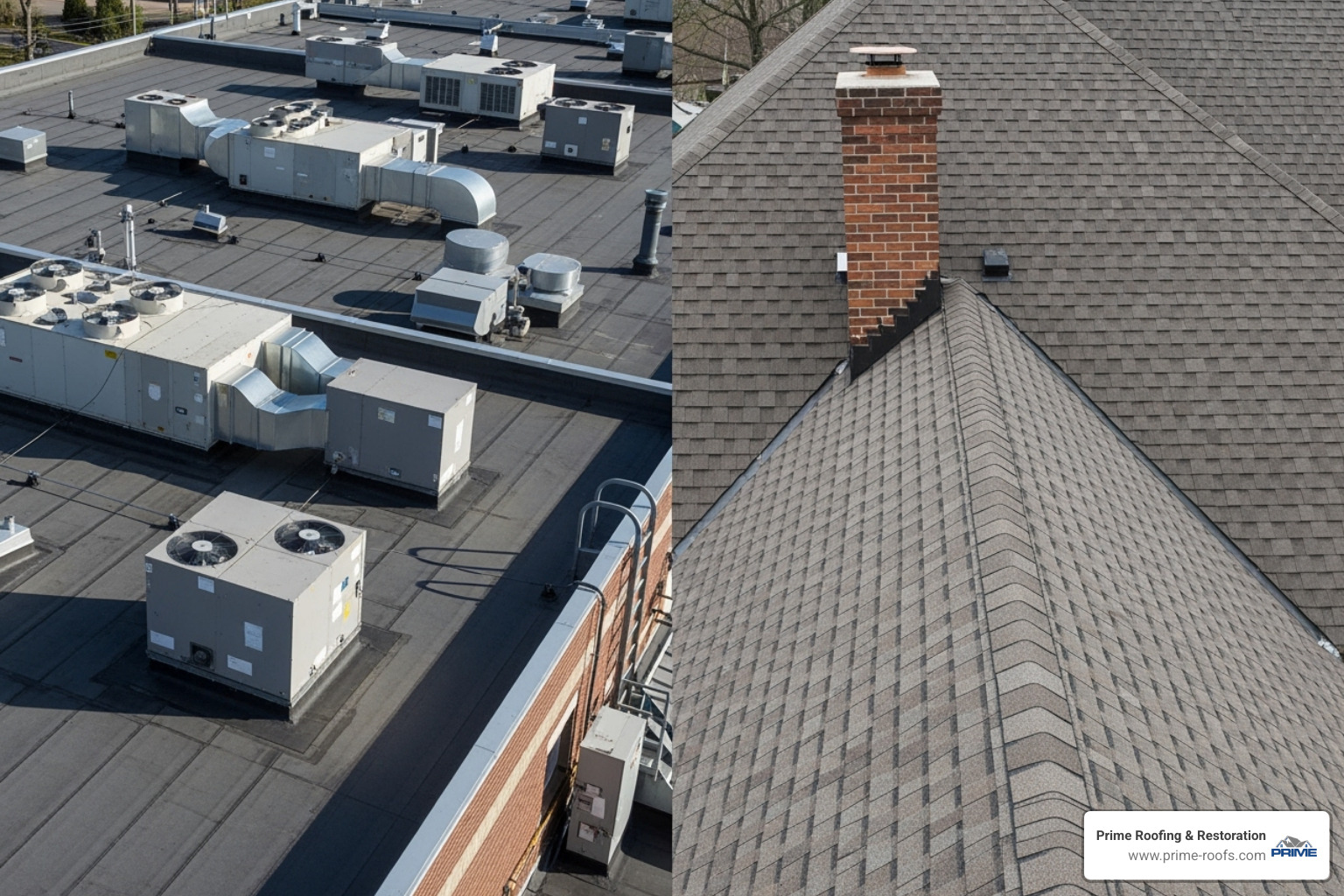
Commercial and residential roofing are two entirely different specialties. While both protect buildings from weather, the similarities end there. Understanding these differences is critical when searching for commercial roofing services near me—because choosing the wrong contractor can cost you thousands in repairs down the road.
The most obvious difference is the slope. Your home likely has a steep, peaked roof designed to shed water quickly. Commercial buildings typically feature flat or low-slope roofs that require completely different approaches to waterproofing and drainage. These nearly flat surfaces don’t naturally push water off, which means they need specialized membrane systems and carefully engineered drainage to prevent water from pooling.
Structural demands set commercial roofs apart too. A residential roof primarily protects the space below it. A commercial roof, however, often supports several tons of HVAC equipment, exhaust fans, satellite dishes, and sometimes even foot traffic for maintenance crews. This requires engineering calculations for load distribution and structural reinforcement that residential roofs simply don’t need.
The materials used on commercial roofs—TPO, EPDM, PVC, modified bitumen, and metal—demand specialized installation knowledge. These aren’t products you’ll find on residential projects. Each material has unique seaming requirements, attachment methods, and performance characteristics. A contractor who primarily installs residential shingles won’t have the expertise to properly install a TPO membrane or metal panel system.
Building codes governing commercial properties are significantly stricter than residential requirements. Commercial roofs must meet higher standards for fire resistance, wind uplift ratings, and energy efficiency. They’re subject to more rigorous inspections and often require permits that residential projects don’t. An experienced commercial roofer steers these regulations daily and ensures your project passes all inspections the first time.
Drainage systems on commercial roofs are complex networks of internal drains, scuppers, and gutters that must be precisely designed and maintained. A single blocked drain can create ponding water that accelerates roof deterioration and eventually leads to leaks. These systems require specialized knowledge to install and maintain properly.
The project management aspect is also completely different. A residential roof replacement might take a few days and inconvenience a family. A commercial roof project must be carefully scheduled to minimize disruption to your business operations, coordinate with other contractors working on the building, and often work around your operating hours to avoid impacting customers or employees.
Why Your Business Needs a Commercial Roofing Specialist
Hiring a contractor without commercial expertise is a gamble you can’t afford. Commercial roofs represent a significant investment—often tens of thousands of dollars—and mistakes are costly. A residential roofer might offer a lower bid, but they lack the specialized knowledge, equipment, and insurance coverage necessary for commercial work.
At Prime Roofing & Restoration, we’ve built our reputation on understanding these critical differences. Our team has the experience, certifications, and specialized tools to handle every aspect of your commercial roof—from initial assessment through final inspection. We understand how to work around your business schedule, meet commercial building codes, and deliver a roof that protects your investment for decades. To discuss your specific needs, call us directly at (205) 623-0151.
Commercial Roofing Materials: A Data-Driven Comparison
Choosing the right material is a balance of budget, climate, and long-term performance goals. From energy-efficient single-ply membranes to durable metal systems, each option offers unique benefits. Understanding these materials is crucial for making an informed decision that will protect your property for decades. When you’re searching for commercial roofing services near me, knowing these options helps you communicate your needs effectively and ensures you’re getting the best solution for your specific building.
Let me walk you through the most popular commercial roofing materials and what makes each one special:
| Material Type | Lifespan | Average Cost/Sq. Ft. | Key Benefits | Best Use Cases |
|---|---|---|---|---|
| TPO | 20-30 years | $7-$12 | Energy-efficient (cool roof), UV resistant, durable, flexible, reflective, hot-air welded seams | Warehouses, retail centers, offices in hot climates |
| EPDM | 25-30 years | $6-$10 | Cost-effective, proven durability, easy repairs, weather resistant, flexible in cold climates | Schools, industrial buildings, budget-conscious projects |
| PVC | 20-30 years | $9-$15 | Superior chemical resistance, fire resistant, strong welded seams, long-lasting | Restaurants, manufacturing facilities, buildings with grease exposure |
| Metal | 40-70 years | $10-$18 | Exceptional longevity, fire resistant, sustainable, low maintenance, aesthetic versatility | High-end commercial properties, eco-conscious projects, coastal areas |
| Modified Bitumen | 15-20 years | $5-$9 | Multi-layer protection, high durability, proven track record, excellent puncture resistance | Heavy foot traffic areas, buildings with rooftop equipment |
Single-Ply Membranes (TPO, EPDM, PVC)
Single-ply membranes are the workhorses of modern commercial roofing. These flexible sheets of synthetic material are rolled out across your roof and either mechanically attached, adhered with adhesive, or ballasted with gravel. The beauty of these systems lies in their simplicity and performance.
TPO (Thermoplastic Polyolefin) has become incredibly popular over the past two decades, and for good reason. Its bright white surface reflects sunlight like a mirror, dramatically reducing your cooling costs during Alabama’s sweltering summers. The seams are heat-welded together, creating bonds that are actually stronger than the membrane itself. This energy efficiency makes TPO a smart choice if you’re looking to lower your utility bills while protecting your building.
EPDM (Ethylene Propylene Diene Monomer), often called “rubber roofing,” has been protecting commercial buildings since the 1960s. It’s the reliable veteran of the roofing world—affordable, proven, and incredibly durable in all weather conditions. EPDM performs exceptionally well in cold climates, staying flexible even when temperatures plummet. If you’re interested in learning more about this time-tested option, check out our Complete EPDM Commercial Roofing Guide.
PVC (Polyvinyl Chloride) is the premium choice when you need maximum weather resistance and chemical protection. Restaurants love PVC because it stands up to grease and oils that would damage other materials. It also offers superior fire resistance and some of the strongest seam integrity in the industry. Yes, it costs a bit more upfront, but the longevity and performance often justify the investment.
Metal Roofing Systems
If you’re thinking long-term—and I mean really long-term—metal roofing deserves serious consideration. These systems can last 40 years or more with minimal maintenance, making them one of the most cost-effective options when you calculate the total lifecycle cost.
Metal roofs offer exceptional longevity that few other materials can match. They’re virtually impervious to the elements, won’t rot or crack, and laugh in the face of high winds. The fire resistance is another major selling point, especially for buildings where fire ratings matter for insurance purposes or building codes.
From a sustainability standpoint, metal roofs are champions. They’re often made from recycled materials and are 100% recyclable at the end of their service life. Many systems can even be installed over existing roofs, reducing landfill waste. Plus, their reflective properties can significantly reduce energy consumption.
Modern metal roofing also provides incredible aesthetic options—from standing seam systems with clean, contemporary lines to metal panels that mimic traditional materials. Our team specializes in these installations and can advise on system selection for lifespan, energy performance, and code compliance.
Traditional Systems (BUR & Modified Bitumen)
Sometimes the old ways are still good ways. Built-Up Roofing (BUR) and Modified Bitumen systems have been protecting commercial buildings for over a century, and they’re still going strong in many applications.
Built-Up Roofing creates a roof through multi-layer protection—alternating layers of bitumen and reinforcing fabrics create a thick, durable membrane. This redundancy means that even if one layer fails, you’ve got backup protection underneath. The high durability of these systems makes them ideal for roofs with heavy foot traffic or lots of equipment.
Modified Bitumen takes traditional asphalt roofing and improves it with rubber or plastic polymers. The result is a material with a proven track record that’s more flexible and longer-lasting than plain asphalt. These systems offer excellent puncture resistance, which is crucial if you’ve got HVAC technicians or maintenance crews regularly accessing your roof.
Both systems can be installed using torch-applied, cold-adhesive, or self-adhering methods, giving your contractor flexibility based on your building’s specific needs and local fire codes. While newer single-ply membranes have stolen some of the spotlight, these traditional systems remain solid choices for many commercial applications—especially when budget constraints are a factor.
The right material for your building depends on factors like your budget, local climate, building use, and long-term plans. That’s why working with experienced commercial roofing services near me makes all the difference. At Prime Roofing & Restoration, we’ll assess your specific situation and recommend the material that makes the most sense for your business, not just what’s easiest for us to install.