
Why Your Commercial Roof Deserves Expert Attention
Business roof repair is a critical investment that protects your property, inventory, and daily operations. It’s not an expense to be minimized, but a strategic decision that ensures business continuity. As a business owner in Alabama, you understand the unique pressures of our climate, from blistering summer heat and high humidity to the sudden violence of hurricane season and tornado warnings. You need a roofing partner you can trust to protect your commercial property from costly damage. Choose a trusted commercial roofing contractor in Alabama who understands these local challenges.
Commercial roofs face a unique and constant barrage of challenges that residential roofs do not. They must support heavy industrial equipment, endure constant foot traffic from maintenance crews, and resist chemical exposure from ventilation systems, all while covering vast, often flat, expanses. The consequences of roof failure go far beyond the simple cost of repairs—they can shut down your operations for days or weeks, damage irreplaceable equipment, ruin valuable inventory, and create severe safety hazards for employees and customers. Research from industry groups like the National Roofing Contractors Association (NRCA) confirms that a proactive maintenance program can extend a commercial roof’s lifespan by years; TPO and PVC systems can last 20-30 years with proper care, while durable metal roofs can exceed 50 years. However, neglecting early warning signs like minor leaks or separated seams can turn small, affordable repairs into major, budget-breaking replacements.
When disaster strikes, an immediate and professional response matters. Professional commercial roof repair services can prevent small issues from becoming catastrophic problems that threaten the very continuity of your business. I’m Bill Spencer, owner of Prime Roofing & Restoration, and my team specializes in designing and maintaining commercial roofing systems engineered to withstand the specific challenges of our region’s climate, keeping your operations running smoothly and your investment secure.
Telltale Signs: How to Know Your Commercial Roof Needs Attention
Your commercial roof works around the clock, protecting your business from the elements, but it can’t do its job forever without help. Most significant roof problems start small, giving you plenty of warning before they escalate into full-blown disasters. At Prime Roofing & Restoration, we’ve learned that the difference between a minor repair and a major replacement often comes down to catching problems early. Your roof is practically screaming for attention—you just need to know what to look for and listen for.
Obvious Signs of Trouble
Some roof problems are impossible to ignore. If you see any of these clear indicators, it’s time to call a professional for an immediate assessment:
- Chronic Leaks or Water Stains: Water inside your building is the most obvious sign of a roof failure. Don’t dismiss a ceiling stain just because it looks old and dry; it’s definitive evidence that water has breached your defenses and will likely do so again during the next rainstorm. Look for discoloration, peeling paint, or sagging ceiling tiles.
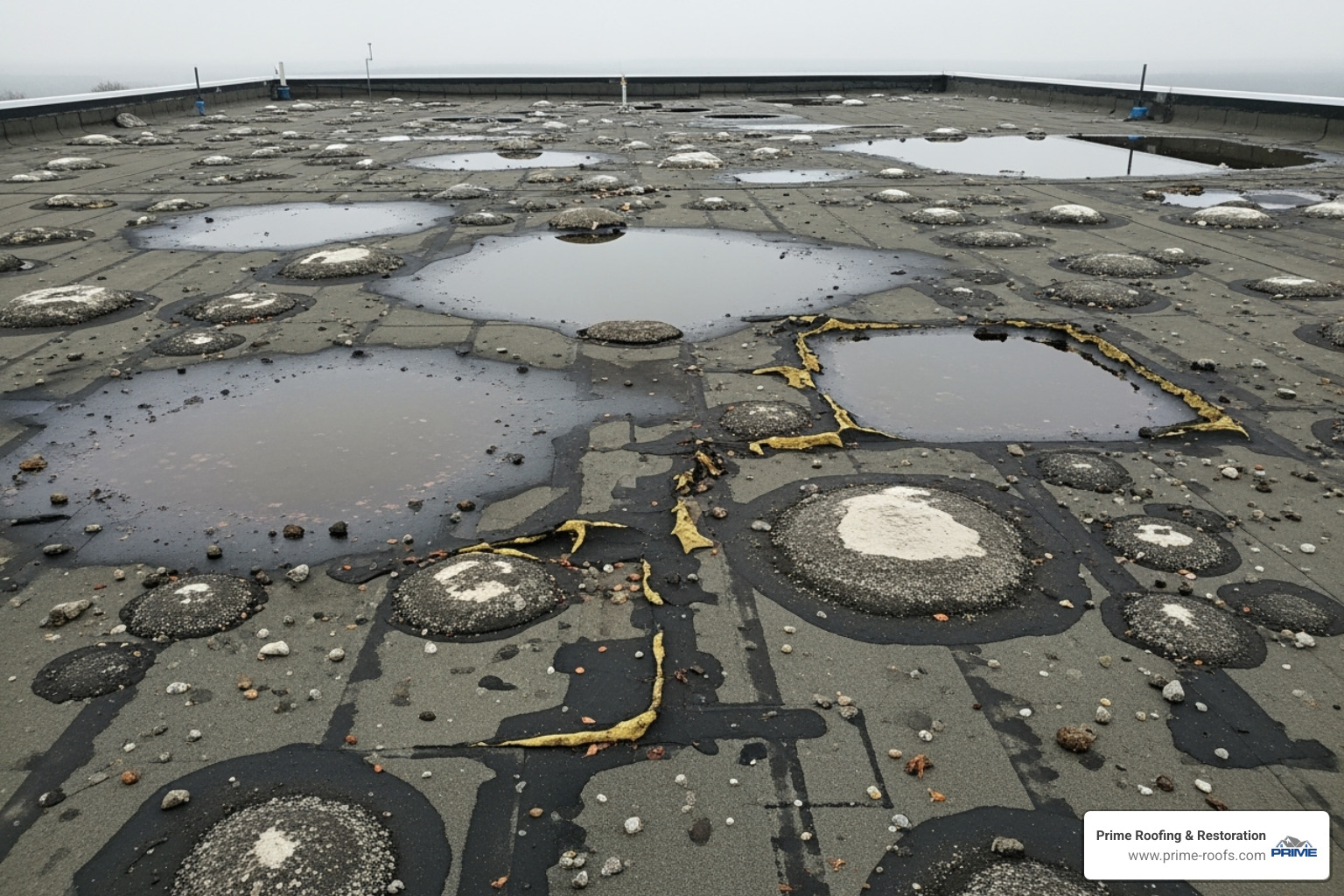
- Ponding Water: Flat roofs are designed to drain, but if water sits on your roof for more than 48 hours after a storm, you have a serious problem. Water weighs approximately 8.3 pounds per gallon. A seemingly small area of ponding water can add thousands of pounds of dead load to your roof structure, exceeding its design capacity and leading to sagging, deflection, and eventual failure. It also accelerates the deterioration of roofing materials.
- Damaged Flashing: Flashing consists of metal or membrane seals around rooftop penetrations like vents, pipes, skylights, and HVAC units. These are the most common failure points on any roof. Cracked, corroded, or loose flashing is like leaving a door wide open during a torrential downpour.
- Visible Membrane Damage: Take a close look at the surface of your roof. Are you seeing bubbling, blistering, open seams, or punctures? These issues compromise your roof’s primary protective layer. For TPO or PVC, this could be separated seams that have lost their heat-weld. For modified bitumen, you might see ‘alligatoring’—a pattern of cracking that resembles reptile skin and indicates the asphalt has dried out and lost its flexibility.
Subtle Clues You Shouldn’t Ignore
Sometimes your roof problems whisper before they shout. Acting on these more subtle clues can save you the most money and prevent the most disruption.
- Spikes in Energy Bills: If your HVAC system is suddenly working overtime to keep your building cool or warm, a compromised roof could be the culprit. When insulation becomes saturated with water, its R-value (a measure of thermal resistance) plummets. Your HVAC system is then forced to work much harder, causing a noticeable spike in your utility costs.
- Musty Odors: That persistent earthy or musty smell inside your building often indicates the presence of hidden moisture and mold growth within the roof assembly or ceiling. This isn’t just unpleasant; it can create serious health hazards for employees and customers.
- Pest Intrusion: Water damage doesn’t just let moisture in; it weakens your building’s structure, creating easy entry points for pests. If you’re suddenly dealing with mice, birds nesting in gutters, or insects inside the building, your roof might be the unlocked door they’re using to get in.
The key to protecting your investment is acting on these signs quickly. A thorough professional assessment that goes beyond what you can see from the ground can give you the complete picture and the peace of mind you need.
The High Cost of Waiting: Why Prompt Business Roof Repair is Non-Negotiable
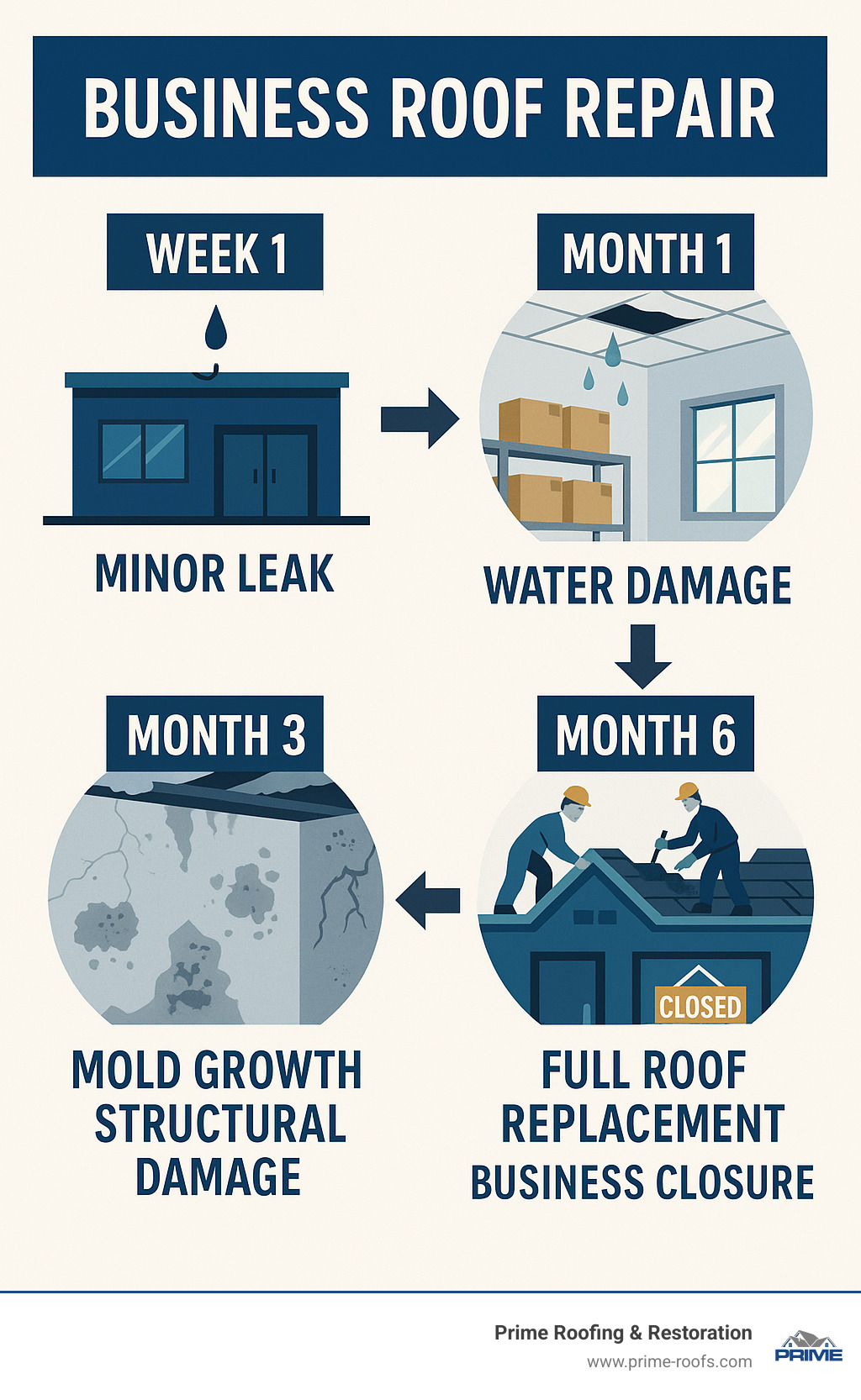
Putting off a minor roof leak is a costly gamble that business owners can’t afford to take. That small, seemingly insignificant drip can quickly invite a cascade of devastating problems that could have been easily and affordably prevented with immediate action. Industry research shows that delaying minor roof repairs can increase the total project costs by over 300% in just six months. What starts as a simple patch job can spiral into a complete structural and financial nightmare, forcing operational shutdowns and threatening the health of your business.
The Domino Effect of Delay
When water gets past your roof’s membrane, it doesn’t wait politely. It immediately begins to cause serious, compounding issues:
- Structural Damage: Moisture is the enemy of building materials. It seeps into wooden roof decks causing rot, saturates insulation rendering it useless, and corrodes steel support beams and fasteners, weakening your building’s entire structural skeleton.
- Inventory and Equipment Loss: The assets inside your building are directly at risk. We’ve seen thousands of dollars in sensitive electronics, complex manufacturing equipment, and valuable stored products destroyed by a single unaddressed leak. For businesses like data centers or food processing plants, the consequences can be catastrophic.
- Mold and Mildew Growth: Mold can begin to colonize within 24-48 hours of water intrusion. It thrives in the dark, damp spaces within your roof assembly, creating serious health hazards that can lead to ‘Sick Building Syndrome,’ decreased employee productivity, and potential legal liability. The EPA provides extensive resources on the dangers of mold, which are just as relevant for commercial properties.
Beyond the physical damage, there’s a critical financial risk: a denied insurance claim. Most commercial property insurance policies contain clauses that exclude damage resulting from neglect or poor maintenance. If an adjuster determines that a leak was a pre-existing condition you failed to address, your claim for the resulting catastrophic damage could be denied, leaving you to cover the entire cost out-of-pocket.
Here are 3 critical risks of delaying business roof repair:
- Catastrophic Structural Failure: A persistent leak can saturate structural supports to the point of failure, leading to a roof collapse that endangers lives and destroys everything beneath it.
- Health Hazards: Chronic moisture creates an ideal breeding ground for toxic mold, which can cause serious respiratory risks for employees and customers, leading to health complaints and liability issues.
- Significant Financial Loss: The combined cost of damaged assets, lost inventory, business interruption, and emergency repairs can have a devastating and lasting financial impact.
When storm damage strikes, knowing your next steps is critical. Learn what to do after a storm damages your roof to protect your investment and minimize downtime.
A Spectrum of Solutions: Common Commercial Roof Repair & Maintenance Services
When your commercial roof shows signs of wear and tear, you need a partner who understands that business roof repair is about more than just patching a leak—it’s about implementing the right solution to keep your operations running without interruption. At Prime Roofing & Restoration, we provide a comprehensive spectrum of solutions designed to address everything from routine preventative maintenance to major storm-related emergencies.
Core Repair and Maintenance Services
Understanding the available services can help you make informed decisions and save thousands in the long run. Our expert roof repair services cover all the bases to keep your roof in peak condition:
- Leak Detection and Patching: Finding the exact source of a leak on a vast, flat commercial roof is a science. We utilize advanced diagnostic tools, including infrared thermography which reveals temperature differences caused by trapped moisture, and electronic leak detection to pinpoint the smallest membrane breaches. Once located, we apply a durable, compatible patch to permanently seal the entry point.
- Seam and Joint Resealing: On many roofing systems, the seams are the weakest point. Thermal expansion and contraction cause roof seams to separate and adhesives to fail over time. We meticulously inspect and reseal these vulnerable areas to prevent water intrusion before it starts.
- Flashing Repair: We repair or replace the flashing around vents, HVAC units, parapet walls, and skylights. Since these penetrations interrupt the continuous roof membrane, they are common failure points that require expert attention.
- Gutter and Drain Cleaning: Clogged drains and gutters can turn a typical rainstorm into a rooftop swimming pool, leading to immense structural stress and forcing water into any available opening. Regular cleaning is one of the most critical and cost-effective maintenance tasks.
Emergency & Storm Damage Repairs
Storms don’t wait for business hours. That’s why emergency response is a cornerstone of our service. When a storm tears off membranes, creates punctures from hail, or sends flying debris crashing into your roof, every minute counts. We provide immediate temporary tarping and damage mitigation to prevent further water intrusion while we develop a plan for a permanent, professional fix. After any severe weather event, a comprehensive damage assessment is crucial for both the repair strategy and your insurance claim. When disaster strikes, our 24/7 emergency roofing support ensures you’re never facing the damage alone. For additional business continuity strategies, FEMA offers a valuable guide at www.fema.gov/business-industry.
Proactive Maintenance and Roof Coatings
The best repair is the one you never have to make. A proactive maintenance plan with scheduled semi-annual inspections catches small problems before they escalate. A small crack sealed today prevents a major leak and operational shutdown next month.
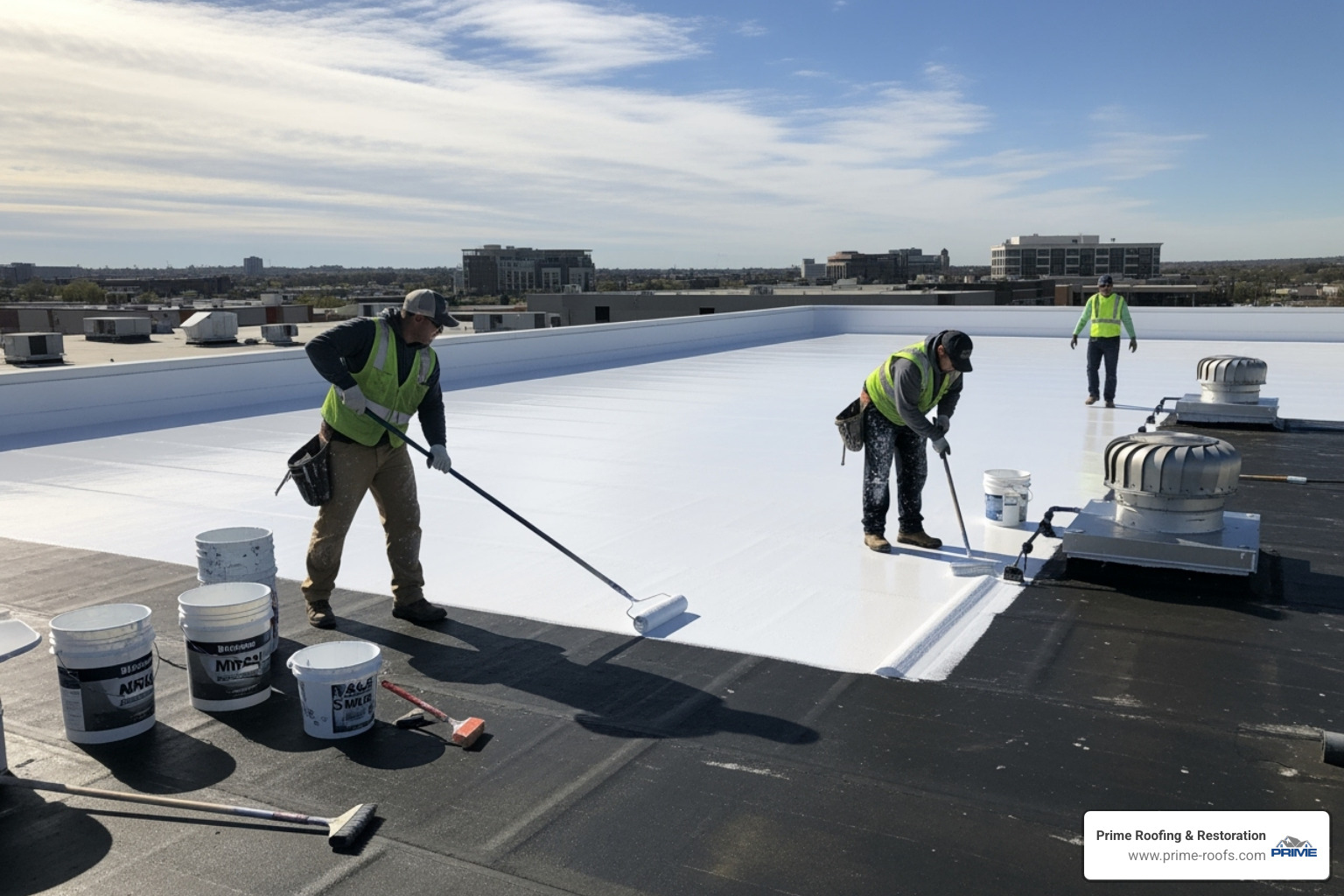
Protective roof coatings are one of the smartest investments for an existing, structurally sound roof. This isn’t just a layer of paint; it’s a multi-step process involving intensive cleaning, priming, and the application of a thick, monolithic silicone or acrylic membrane that creates a seamless, waterproof layer. This coating reflects UV rays, improves energy efficiency, and can extend your roof’s lifespan by 5-10 years, delaying the need for a costly replacement. The Department of Energy’s Cool Roofs page provides more information on the benefits.
Repair or Replace? Making the Most Cost-Effective Decision
One of the biggest and most consequential questions business owners face is whether to repair or replace their commercial roof. The decision impacts your capital budget for years to come, but with the right information and professional guidance, you can make the choice with confidence. It’s like deciding whether to keep fixing an old delivery truck or invest in a new one—sometimes a repair is a smart, targeted solution, but other times you’re just throwing good money after bad and delaying the inevitable.
Key Factors in the Decision
Several critical factors help determine the most financially sound path forward. A professional roofing contractor will analyze these points during a thorough assessment:
- Roof Age: Every roofing system has an expected service life. If your roof is approaching the end of its lifespan (e.g., 15-25 years for Modified Bitumen, 20-30 for TPO/PVC), a full replacement often makes more financial sense than investing significant funds into a system that is nearing the end of its useful life.
- Extent of Damage: We often use the “25% rule” as a general guideline. If more than a quarter of your roof’s surface or underlying insulation is damaged, a replacement is typically more cost-effective than performing widespread, patchwork repairs that may not last.
- Frequency of Leaks: Are you calling for repairs after every heavy rain? Constant repair calls are a clear sign of systemic failure, not just isolated issues. At this point, a new roof is a better long-term solution that provides peace of mind.
- Long-Term Costs (Total Cost of Ownership): A repair might seem cheaper now, but it’s crucial to calculate the Total Cost of Ownership (TCO). A new roof, while having a higher upfront cost, comes with a robust manufacturer warranty, significantly lower maintenance needs for years, and improved energy efficiency that provides a return on investment. Constant repairs, on the other hand, are an ongoing operational expense with no long-term value.
- Future Business Plans: Consider your business’s five-to-ten-year plan. Are you planning to sell the property? A new roof with a transferable warranty is a major selling point. Do you intend to install solar panels or a heavier, more efficient HVAC system? A full replacement ensures the roof structure can support the new load, something a patched-up older roof may not be able to do.
To make an informed choice, it’s best to get a professional assessment. You can get a professional roof repair estimate to weigh your options with real numbers.
How Roofing Materials Influence Repair Strategy
Different materials have unique repair needs and lifespans. Understanding your roof type is key to developing the right strategy.
- TPO & PVC: These single-ply membranes are durable and energy-efficient. Repairs typically involve cleaning the membrane and heat-welding patches for a seamless, permanent bond.
- Metal: While extremely durable with a 50+ year lifespan, metal roofs may need fastener replacement, sealant application, panel replacement, or restorative coating to address corrosion or leaks.
- Modified Bitumen & EPDM: These systems are repaired with compatible patches and adhesives. They are reliable but generally have shorter lifespans and can become brittle over time, making repairs more frequent as the roof ages.
The complexity and cost of business roof repair vary significantly by material. The table below offers a quick comparison:
| Material | Average Lifespan (Years) | Typical Cost (per sq ft) | Common Repair Needs |
|---|---|---|---|
| TPO | 20-30 | Moderate | Seam separation, punctures, flashing issues, membrane shrinkage |
| PVC | 20-30 | Moderate to High | Seam separation, punctures, chemical damage, weld failure |
| Metal | 30-50+ | High | Loose or corroded fasteners, corrosion, panel damage, sealant failure |
| Modified Bitumen | 15-25 | Moderate | Cracks, blisters, seam delamination, granule loss, ponding water |
| EPDM (Rubber) | 20-30 | Moderate | Punctures, seam adhesive failure, shrinkage, flashing failure |
When ongoing repairs are no longer the smart choice, investing in a new roof is an investment in your entire property’s future.
Choosing Your Partner: How to Select the Right Commercial Roofing Contractor
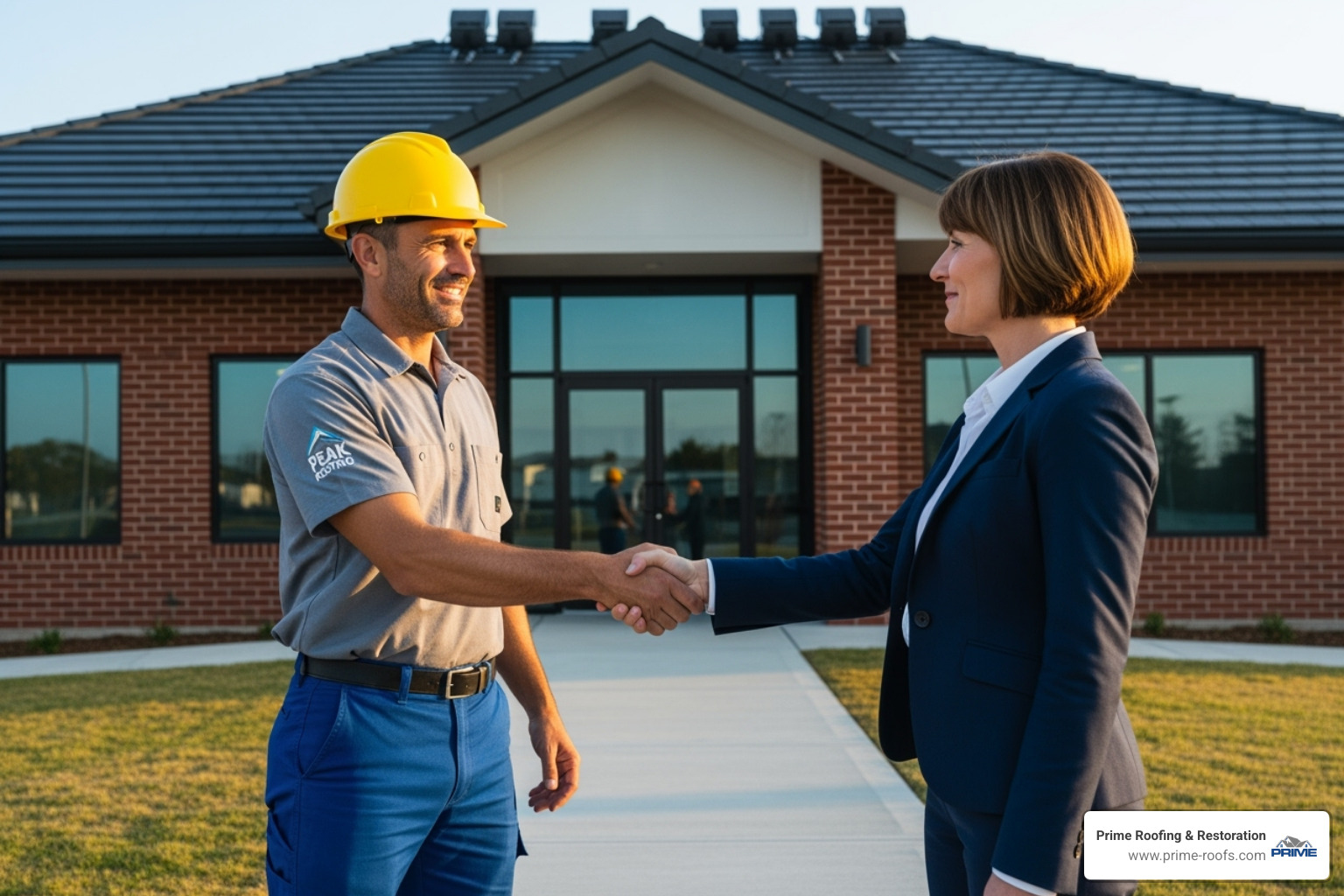
Finding the right contractor for your business roof repair is much more than a simple hiring decision; it’s about choosing a long-term partner to protect one of your most significant assets. Your commercial roof is the shield for your entire operation, and when it fails, it can bring your business to a grinding halt. That’s why selecting a qualified, experienced, and trustworthy professional is absolutely critical to your success and security.
What to Look For in a Contractor
- Licensing and Insurance: This is the absolute baseline and is non-negotiable. Ask for current certificates of insurance for both general liability and workers’ compensation. General liability protects your property from damage caused by the contractor, while workers’ comp protects you from being sued if one of their employees is injured on your property. Verify that the coverage limits are adequate for a commercial project.
- Experience and Reputation: Look for contractors with years of proven, verifiable experience specifically in commercial roofing—it is a different discipline than residential roofing. Check their portfolio, ask for recent references of similar-sized projects, and read online reviews on Google and the Better Business Bureau. Ask references specific questions: “Was the project completed on time and on budget?” and “How did the crew handle safety and cleanup?”
- Manufacturer Certifications: Top-tier contractors hold certifications from leading manufacturers like GAF, Carlisle, or Firestone. This means the contractor has received factory training on proper installation techniques and can offer the best warranties, such as No Dollar Limit (NDL) warranties, which cover both materials and labor.
- Local Expertise: An Alabama contractor understands how our region’s intense heat, high humidity, and severe storms impact different roofing systems. They will be experts in local building codes and permitting processes, ensuring your project is fully compliant and built to last in our specific climate.
- Safety Record and OSHA Compliance: A professional contractor prioritizes safety. Ask for their safety plan and their Experience Modification Rate (EMR), a number used by insurance companies to gauge past safety performance. A low EMR indicates a strong safety record. A contractor who disregards safety protocols from organizations like OSHA not only endangers their crew but also creates significant liability for you as the property owner.
- Comprehensive Services: The best partners offer more than just repairs. Look for a company that provides detailed inspections, preventative maintenance plans, and insurance claims assistance. A robust portfolio showcasing their expertise across various roofing systems is a sign of a capable and versatile contractor.
For businesses in Central Alabama, finding experienced roofers in Alabaster, AL who understand local conditions is essential. For more guidance, see our tips for choosing a licensed roof contractor.
At Prime Roofing & Restoration, we’ve built our reputation on quality work, transparent communication, and an unwavering commitment to safety. We’re here when you need us.
Prime Roofing & Restoration
Address: 5 Brown Cir, Alabaster, AL 35007
Phone: (205) 661-8190
Frequently Asked Questions About Commercial Roof Repair
As a business owner, navigating the complexities of commercial roofing can be daunting. You likely have many questions about your roofing needs, the repair process, and the associated costs. Here are the answers to the most common questions we hear during our consultations.
How long does a typical commercial roof last?
The lifespan of a commercial roof depends heavily on the material used, the quality of the initial installation, the local climate, and, most importantly, the consistency of its maintenance schedule. With proper care, modern commercial roofs can last for decades.
- TPO and PVC: These popular single-ply thermoplastic membranes typically last 20-30 years.
- Metal: As the most durable option, standing-seam metal roofing systems can last 30-50+ years.
- Modified Bitumen: These asphalt-based systems generally provide 15-25 years of reliable protection.
Regular maintenance is the key to maximizing any roof’s lifespan. A well-maintained system will often exceed its life expectancy, while a neglected one may fail years early, leading to premature replacement.
Can my business stay open during roof repairs?
Absolutely, in most cases. A professional commercial roofer understands that business continuity is paramount. We go to great lengths to minimize disruption by using phased construction to work on your roof in sections, implementing strict safety protocols to protect your employees and customers, and offering flexible scheduling to work around your peak operational hours. We create detailed logistical plans that include cordoning off work zones, using debris chutes to maintain clean and safe entryways, and communicating daily with your facility manager to coordinate noisy work or material deliveries. We have extensive experience working on occupied buildings, from medical offices to active manufacturing facilities, without interrupting operations.
Is a roof coating a good alternative to a full replacement?
Yes, in many situations, a roof coating is an excellent, cost-effective alternative to a full replacement, but only if your roof’s underlying structure and insulation are sound. Coatings form a seamless, waterproof barrier that can extend your roof’s life by 5-10 years, fix minor leaks, and dramatically improve energy efficiency by reflecting sunlight. However, a coating is a restorative measure, not a structural fix. It cannot repair severe structural damage or saturated insulation. A thorough professional inspection, including moisture scans, is the only way to determine if your roof is a good candidate for a coating.
What kind of warranty should I expect for a commercial roof repair or replacement?
This is a critical question. You should receive two types of warranties. First, a contractor’s workmanship warranty, which covers installation errors and typically lasts 1-5 years for repairs. Second, and more importantly for a replacement, is the manufacturer’s system warranty. These can range from simple material defect coverage to comprehensive ‘No Dollar Limit’ (NDL) warranties that cover both materials and labor for 15-30 years. These premium NDL warranties are only available through factory-certified installers, which is a key reason to choose a certified contractor.
Conclusion: Protecting Your Business Starts at the Top
Your commercial roof is the silent guardian of your business, a critical asset that protects your property, your inventory, your employees, and your customers from the elements 24/7. As we’ve covered, delaying business roof repair is a high-stakes gamble that can turn a minor, manageable issue into a catastrophic and expensive problem that jeopardizes your entire operation.
The key takeaways are simple and powerful:
- Proactive maintenance saves money. Regular inspections and minor, targeted repairs are the most cost-effective way to prevent costly emergencies and extend the life of your roof.
- Timely repairs prevent operational disasters. Acting quickly on leaks and storm damage protects your inventory, prevents structural decay, and keeps your doors open for business.
- Choosing the right professional partner is crucial. An experienced, licensed, local, and certified contractor makes all the difference in the quality, longevity, and value of your roofing investment.
From identifying the subtle whispers of a problem before they become a roar, to understanding the domino effect of delayed repairs, and making the critical decision between a strategic repair and a long-term replacement, every choice you make impacts your bottom line. The final, and most important, step is selecting a partner who views your roof not just as a project, but as a vital component of your business’s success. Your commercial roof is a long-term investment in your business’s security and continuity. Don’t wait for a ceiling stain to become a shutdown. Invest in the security and longevity of your business.
Contact us today for a comprehensive consultation and let us help you protect your business from the top down.