
Why Proper GAF FeltBuster Installation Is the Foundation of a Long-Lasting Roof
GAF FeltBuster installation is one of the smartest upgrades you can make before laying shingles — and getting it right matters more than most homeowners realize.
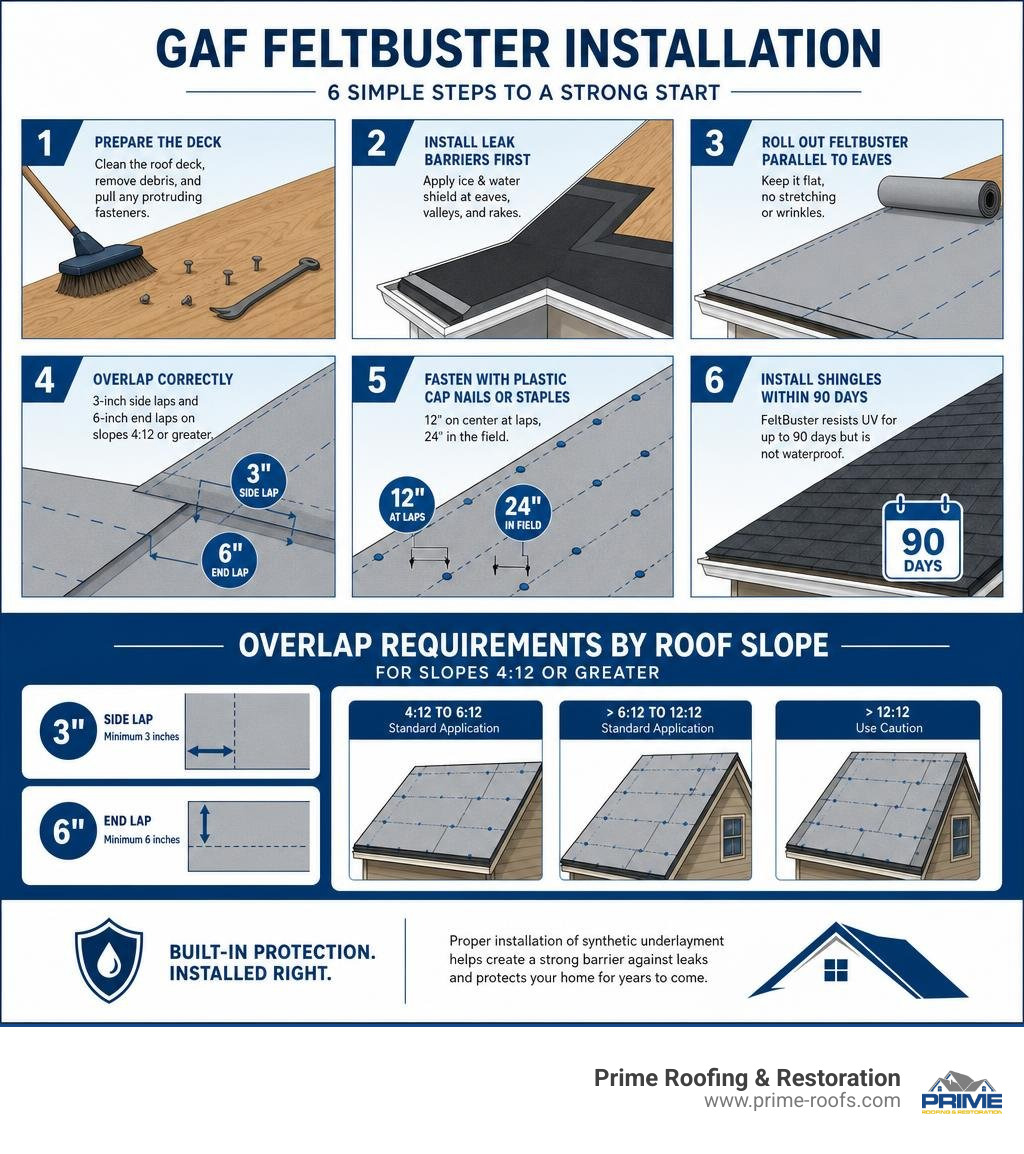
Here’s a quick overview of how to install GAF FeltBuster:
- Prepare the deck – Clean the roof deck, remove debris, and pull any protruding fasteners.
- Install leak barriers first – Apply GAF ice & water shield at eaves, valleys, and rakes.
- Roll out FeltBuster parallel to eaves – Keep it flat, no stretching or wrinkles.
- Overlap correctly – 3-inch side laps and 6-inch end laps on slopes 4:12 or greater.
- Fasten with plastic cap nails or staples – Spaced 12 inches on center at laps, 24 inches in the field.
- Install shingles within 90 days – FeltBuster resists UV for up to 90 days but is not waterproof.
Traditional asphalt felt has been the roofing industry standard for decades — but it tears easily, absorbs moisture, and wrinkles under your shingles. GAF FeltBuster is a non-asphaltic polypropylene synthetic underlayment that lays flatter, grips better underfoot, and holds up longer before shingles go on. It’s a real-world upgrade that makes a measurable difference in both installation safety and long-term roof replacement performance.
Whether you’re a homeowner trying to understand what’s going under your new shingles, or you want to know what to expect from a professional install, this guide walks you through every step.
I’m Bill Spencer, Owner and President of Prime Roofing & Restoration, and over my years leading roofing projects across Central Alabama, GAF FeltBuster installation has become a go-to spec on our jobs because of how consistently it outperforms paper felt in our climate. If you have questions about your specific roof, call us at (205) 661-8190.
Gaf feltbuster installation definitions:
What is GAF FeltBuster and How Does It Compare to Traditional Felt?
GAF FeltBuster is a high-traction, non-asphaltic polypropylene synthetic roofing underlayment designed to replace traditional asphalt-saturated paper felt. When planning a roof upgrade, partnering with a trusted local company for expert roofing services ensures that high-quality materials like GAF FeltBuster are installed to manufacturer specifications.
FeltBuster features a specially engineered spunbond surface that offers significantly better traction for installers compared to conventional felt paper. Additionally, its medium-gray surface stays cooler under the Alabama sun than black asphalt felts, improving comfort and safety on the job.
Architects and building officials recognize GAF FeltBuster for its broad compliance and high performance. It meets or exceeds industry standards including ASTM D226 Type II, ASTM D4869 Types III and IV, and ASTM D8257. It also holds ICC-ES approval and strict regional certifications like Miami-Dade County and Florida Building Code approvals.
For more details on its design and performance, you can read the FeltBuster® Synthetic Roofing Felt product details.
The Science Behind Polypropylene Underlayment
Unlike traditional organic felts, which rely on paper fibers saturated with asphalt, GAF FeltBuster is manufactured from high-grade, UV-stabilized polypropylene. Polypropylene is a thermoplastic polymer known for its exceptional toughness, chemical resistance, and hydrophobic properties. During the manufacturing process, these polymer fibers are spun and bonded together to create a dense, multi-layered sheet. This spunbond technology gives FeltBuster its signature textured surface, which provides superior slip resistance for roofing crews working on steep slopes.
Furthermore, the non-asphaltic nature of the material means it does not dry out, leach oils, or become brittle over time. Traditional asphalt felt degrades when exposed to heat and air, losing its waterproofing capabilities as the volatile organic compounds (VOCs) evaporate. FeltBuster remains stable across a wide temperature range, ensuring that it continues to protect the roof deck for decades under the shingles.
Decoding the Industry Standards and Certifications
When evaluating roofing underlayments, building codes and architectural specifications rely on standardized testing. GAF FeltBuster meets or exceeds several critical industry benchmarks:
- ASTM D226 Type II: This standard covers asphalt-saturated organic felt used in roofing and waterproofing. Meeting this standard ensures that FeltBuster provides at least the same level of physical performance and water resistance as heavy-duty #30 organic felt.
- ASTM D4869 Types III and IV: This standard specifically addresses asphalt-saturated felt underlayment for steep-slope roofing. Types III and IV represent the highest classifications for liquid water transmission resistance and physical strength.
- ASTM D8257: This is the modern standard specification for mechanically attached synthetic polymer underlayment. It evaluates tear strength, tensile strength, liquid water transmission, and UV resistance, confirming that FeltBuster is engineered specifically for modern synthetic performance.
- ICC-ES Evaluation: The International Code Council Evaluation Service provides technical evaluations of building products. FeltBuster’s ICC-ES approval proves its compliance with international building codes (IBC) and international residential codes (IRC).
| Feature | GAF FeltBuster Synthetic Underlayment | Traditional #15 / #30 Asphalt Felt |
|---|---|---|
| Material Base | Non-asphaltic UV-stabilized polypropylene | Asphalt-saturated organic paper |
| Tear Strength | Extremely high; resists wind damage and foot traffic | Low; tears easily when walked on or during high winds |
| Moisture Response | Hydrophobic; does not absorb water, swell, or wrinkle | Hydrophilic; absorbs moisture, buckles, and telegraphs wrinkles |
| Walking Surface | Spunbond slip-resistant textured surface | Slick, oily asphalt surface (especially when hot or wet) |
| Weight per Roll | Approximately 23 lbs (covers 1,000 sq. ft.) | Up to 130 lbs total for equivalent coverage |
| UV Exposure Limit | Safe for up to 90 days of direct sunlight | Degrades rapidly; typically must be covered immediately |
Understanding GAF FeltBuster Installation Specifications
GAF FeltBuster is engineered to maximize job site efficiency through lightweight, high-coverage packaging. A single roll of FeltBuster covers 1,000 square feet (10 squares) of roof area, excluding overlaps. The roll has a user-friendly width of 48 inches (4 feet) and a total length of 250 feet.
Despite its large coverage footprint, a single roll weighs approximately 23 lbs, making it substantially easier and safer to transport up a ladder than heavy rolls of traditional asphalt felt. You can review pricing and ordering options on the GAF FeltBuster 1000 sq. ft. Synthetic Roofing Underlayment Roll product page.
Using FeltBuster also unlocks superior warranty protection. It is eligible for up to a Lifetime limited warranty when installed as a qualifying accessory component with GAF Lifetime Shingles. Integrating FeltBuster with other high-quality GAF Shingles provides homeowners with an integrated system covered by GAF’s strong system warranties.
GAF FeltBuster vs. Traditional Asphalt Felt
The physical differences between GAF FeltBuster and traditional asphalt felt directly impact the longevity of your roof. Traditional felt paper is prone to absorbing water from dew, high humidity, or rain. When it absorbs moisture, the paper fibers expand, causing the underlayment to buckle, wrinkle, and warp. These wrinkles can “telegraph” upward, forcing the shingles above to sit unevenly and creating pathways for wind-driven rain.
Synthetic underlayments completely solve this issue. Because FeltBuster is manufactured from non-asphaltic polypropylene, it is entirely hydrophobic. It will not absorb water, swell, or rot over time.
Additionally, its tear resistance is vastly superior. If an installer steps on traditional felt while twisting their foot, the paper can tear open, creating immediate leak hazards. FeltBuster resists heavy foot traffic and high winds without tearing. To learn more about selecting the right materials for your home, read our comprehensive Roofing Materials Guide.
Step-by-Step GAF FeltBuster Installation Guide
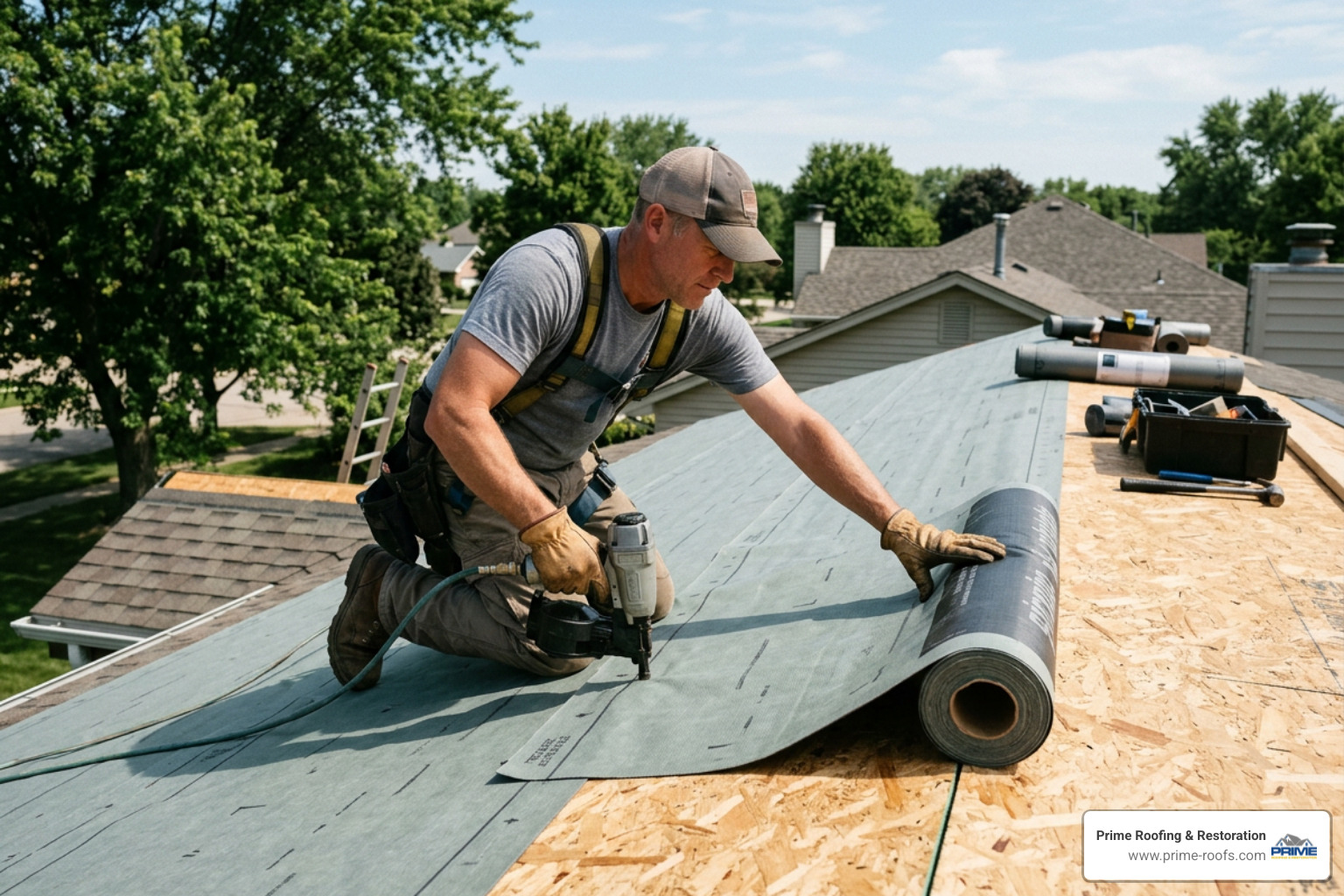
A successful installation requires systematic deck preparation and careful layout. To achieve a flat, leak-free underlayment layer, follow the official manufacturer guidelines outlined in the INSTALLATION INSTRUCTIONS FOR FELTBUSTER®….
Preparing the Roof Deck: Plywood vs. OSB Considerations
Before unrolling any underlayment, the roof deck must be completely clean, dry, and structurally sound. Whether your home utilizes plywood or Oriented Strand Board (OSB), specific preparation steps must be followed:
- Plywood Decks: Inspect for delamination, where the veneer layers begin to separate due to historical moisture exposure. Any sagging or soft spots must be cut out and replaced with matching thickness CDX plywood.
- OSB Decks: Pay close attention to the edges of the OSB panels. OSB is prone to edge-swelling when exposed to moisture. If the edges are swollen or uneven, they must be sanded down flush to prevent ridges from telegraphing through the underlayment and shingles.
- Spacing and Gaps: Ensure there is a 1/8-inch gap between all panel joints to allow for natural expansion and contraction of the wood deck during seasonal temperature swings. If panels are tight-butted, they can buckle, causing the underlayment and shingles to ripple.
- Fastener Inspection: Run a flat-backed shovel or a heavy push broom across the entire deck. This will catch on any shingle nails or deck screws that are backing out. Use a hammer to drive them flush or a pry bar to extract them completely.
Detailed Deck Preparation and Leak Barrier Integration
Once the deck is structurally sound, follow these steps to prepare the surface and integrate leak barriers:
- Clean the Deck: Sweep all dirt, dust, and pine needles from the plywood or OSB deck boards.
- Remove Fasteners: Inspect the deck for any protruding nails or staples from the old roof. Pull them out or drive them flush to prevent them from puncturing the new underlayment.
- Inspect for Rot: Replace any soft, rotted, or water-damaged decking. Ensure the gaps between deck boards do not exceed 1/2 inch.
- Install Leak Barriers: Apply a self-adhering leak barrier, such as GAF StormGuard or WeatherWatch, at all high-risk areas. This includes eaves, valleys, rakes, chimneys, and skylights. For proper application of these critical barriers, refer to the StormGuard Application Instructions.
- Manage Overlaps: Always overlap FeltBuster over the self-adhering leak barrier to prevent water from running underneath. At the eaves, install the leak barrier first, then run the FeltBuster over it. At the rakes, install the underlayment first, and place the drip edge flashing over the underlayment to shed water away from the fascia.
Standard Slope vs. Low Slope GAF FeltBuster Installation
The installation method for GAF FeltBuster depends entirely on the pitch of your roof.
Standard Slope (4:12 or Greater)
On slopes of 4:12 or steeper, GAF FeltBuster is installed in a single-coverage layer:
- Lay the underlayment parallel to the eaves, starting from the bottom of the roof and working upward.
- Overlap the horizontal side laps by a minimum of 3 inches, utilizing the printed alignment lines on the roll surface.
- Overlap vertical end laps by a minimum of 6 inches.
- Offset all end laps from course to course by at least 3 feet to prevent stacked seams.
Low Slope (2:12 to Less Than 4:12)
For low-slope applications, GAF FeltBuster requires a double-coverage installation to guard against standing water and slow-shedding snow or rain:
- Start with a 24-inch wide starter course at the eave.
- Apply subsequent full-width (48-inch) rolls, overlapping each course by 25.5 inches. This leaves an exposure of 22.5 inches for each course, creating two complete layers of synthetic protection across the entire low-slope area.
- Do not install FeltBuster on roof slopes less than 2:12.
For a deeper dive into managing complex roof shapes and pitches during a complete tear-off, check out our Roof Replacement Complete Guide.
Advanced Weather Protection and Fastening Requirements

Securing synthetic underlayment requires the correct hardware. Standard roofing nails or wire staples without caps must never be used. They do not provide enough holding power and can easily pull through the synthetic material during high winds.
Choosing the Right Fastening Tools: Pneumatic vs. Manual
While the manufacturer specifications dictate the use of plastic cap fasteners, the tool used to apply them can impact the quality of the installation:
- Pneumatic Cap Nailers: These tools use compressed air to drive a ring-shank nail and a plastic cap simultaneously. They offer the most consistent depth control, ensuring the cap is driven perfectly flush without cutting into the synthetic material. This is the preferred method for professional crews.
- Manual Cap Staplers: These mechanical staplers feed plastic caps and drive a heavy-duty wire staple through the center. While faster than hand-nailing, installers must ensure the stapler is held flat against the deck to prevent “cocked” staples that can puncture the underlayment or prevent shingles from laying flat.
- Hand-Nailing: For small areas or detailed flashing work, hand-driving plastic cap nails is acceptable. Ensure the hammer strikes the nail head squarely to avoid cracking the plastic cap.
- Prohibited Fasteners: Never use standard roofing nails without caps, or bare construction staples. These fasteners lack the surface area to hold the underlayment during high winds, leading to tears and blow-offs before the shingles can be applied.
Fastening Patterns and High-Wind Requirements
Always secure GAF FeltBuster using plastic cap corrosion-resistant nails or plastic cap staples. Fasteners must be driven at a 90-degree angle to the deck and installed perfectly flush with the underlayment surface. Fasteners must penetrate at least 3/4 inch into wood plank decks or fully through plywood and OSB sheathing. For visual fastening guides and certified mechanical specifications, refer to the FeltBuster® Roofing Felt Installation Guide | PDF | Roof | Materials.
Standard Fastening Pattern
- At Laps: Space fasteners 12 inches on center along all side and end laps.
- In the Field: Install two staggered rows of fasteners spaced 24 inches on center.
High-Wind Fastening Pattern
In areas prone to severe storms, tighten your fastener spacing to prevent blow-offs:
- At Laps: Space plastic caps 6 inches on center along all side and end laps.
- In the Field: Install two staggered rows of fasteners spaced 12 inches on center.
- Maximum Weather Protection: For ultimate rain and snow protection, increase your standard side laps to 6 inches and end laps to 12 inches. Seal all side and end laps, as well as exposed fastener heads, with a high-quality butyl adhesive tape or waterproof cloth duct tape.
Severe Weather Performance in Central Alabama
Central Alabama is no stranger to extreme weather, from intense summer thunderstorms to severe spring tornadoes and tropical storm remnants. During these events, high winds can create immense negative pressure (uplift) on the roof surface.
If a storm strips the shingles from a roof, the underlayment becomes the sole line of defense protecting the home’s interior from catastrophic water damage. GAF FeltBuster’s high tensile strength and tear resistance, combined with the high-wind fastening pattern, allow it to remain securely attached to the deck even when exposed to gale-force winds. By spacing the plastic caps at 6 inches on center along the laps and 12 inches in the field, the underlayment can withstand wind uplift pressures that would instantly shred traditional #15 or #30 organic felt paper.
Exposure Limits and Repairing Scuffed Areas
While FeltBuster is highly durable, it is water-resistant, not waterproof. It is designed to shed water, but it should never be relied upon as a temporary roof to protect a home’s interior over an extended period.
FeltBuster is formulated with UV stabilizers that resist degradation for up to 90 days. Asphalt shingles or primary roofing materials must be installed over the underlayment within this 90-day window.
Normal walking across the spunbond surface will not damage the material. However, scuffing from heavy work boots, twisting feet, or dragging heavy bundles of shingles can compromise its integrity.
If scuffing or tearing occurs, you must repair the damaged area before shingle installation:
- Small Holes (<1/8 inch): Seal with a dab of high-quality asphalt roof cement.
- Large Tears or Scuffed Areas: Cover the damaged section with a patch of FeltBuster that extends at least 6 inches beyond the damaged area on all sides. Secure the patch using a moisture-curable polyurethane adhesive meeting ASTM C557 standards, or fasten it securely with plastic cap nails.
To understand how underlayment wear fits into the overall lifecycle of your roof, explore our guide on How Often Do Roofs Need to Be Replaced?.
Frequently Asked Questions About GAF FeltBuster
Is GAF FeltBuster waterproof?
No, GAF FeltBuster is water-resistant but not completely waterproof. It is engineered to shed wind-driven rain and prevent moisture from reaching the roof deck once shingles are installed. However, it cannot stand in place of a primary roof and should not be used to protect a home during extended construction delays.
What fasteners are approved for GAF FeltBuster?
Only plastic cap corrosion-resistant nails or plastic cap staples are approved for GAF FeltBuster installation. Never use uncapped nails, wire staples, or brads. Fasteners must penetrate at least 3/4 inch into wood decks or fully through plywood/OSB decks.
How long can GAF FeltBuster be left exposed?
FeltBuster can be left exposed to direct sunlight and UV radiation for up to 90 days. If your project is delayed and the underlayment is exposed longer than 90 days, it must be inspected for UV degradation or replaced before installing the final shingles. If you suspect your underlayment or shingles have reached the end of their lifespan, read about the 5 Signs You Need Roof Replacement.
Conclusion & Local Expert Assistance
A high-performance roof is only as good as the underlayment beneath it. GAF FeltBuster installation provides a strong, tear-resistant, and flat foundation that protects your home from wind-driven rain and moisture damage. While the material itself is highly advanced, proper installation is what ensures your roof qualifies for GAF’s Lifetime limited warranty and stands up to Alabama’s intense storms.
At Prime Roofing & Restoration, we serve homeowners in Alabaster, Hoover, and across Central Alabama with licensed expertise and top-tier materials. Our team of professionals ensures that every layer of your roof — from the deck preparation to the final shingle — is installed to the highest standards.
Our Local Service Area & Contact Information
We are proud to be a locally owned and operated roofing company serving Shelby County, Jefferson County, and the surrounding Central Alabama communities. Whether you need a minor repair or a complete roof replacement, our team is ready to deliver exceptional craftsmanship.
Prime Roofing & Restoration
- Phone: (205) 661-8190 (Available 24/7 for emergency services)
- Service Areas: Alabaster, Hoover, Pelham, Helena, Calera, Chelsea, and the greater Birmingham metropolitan area.
- Office Hours: Open 24 hours, 7 days a week (Emergency services available 24/7)
For turn-by-turn directions to our service area or to view our local customer reviews, you can find us on Google Maps or visit our dedicated Roofers in Alabaster, AL page to learn more about our local community involvement.
Don’t leave your home’s protection to chance. Contact us today at (205) 661-8190 for a professional consultation and a free estimate on our comprehensive Roof Replacement Services. We are here 24/7 to protect your home and family with craftsmanship you can trust.