
Why Roof Pitch Is the First Thing Every Homeowner Should Understand
Roof pitch is one of the most important numbers in all of residential construction — yet most homeowners have never measured it or fully understood what it means. In the context of Alabama’s unique climate, where we face everything from sweltering humidity to intense tropical storm systems, the angle of your roof is more than just a design choice; it is a critical component of your home’s defense system.
Here’s the quick answer:
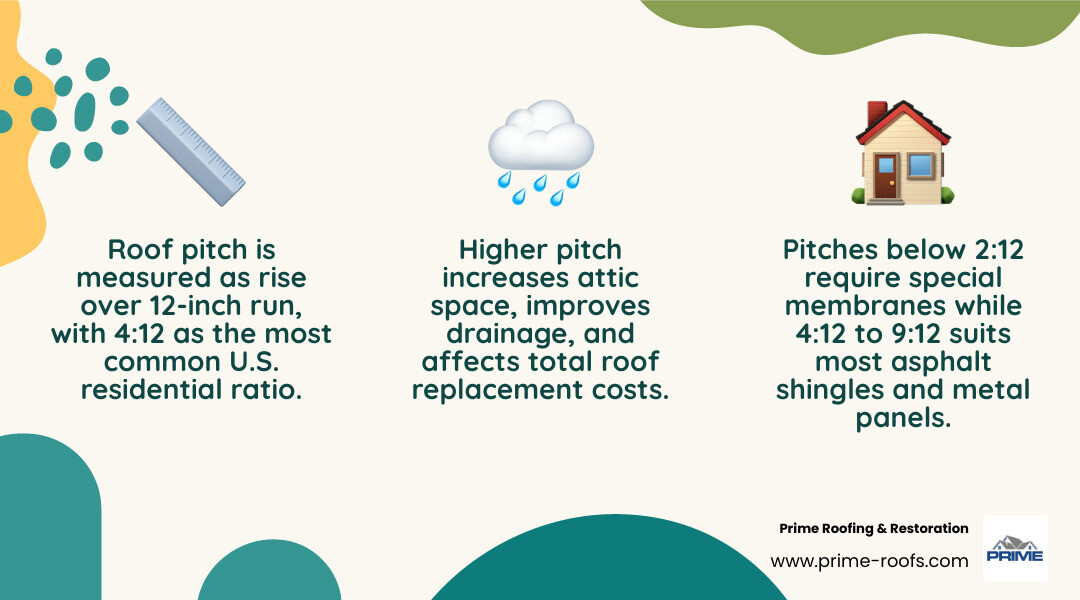
Roof pitch is the ratio of a roof’s vertical rise to its horizontal run, expressed as X:12. A 6:12 pitch means the roof rises 6 inches for every 12 inches of horizontal distance.
Common roof pitch categories at a glance:
| Category | Pitch Range | Typical Use |
|---|---|---|
| Low slope | 3:12 or lower | Modern, commercial buildings, and porches |
| Conventional | 4:12 to 9:12 | Most residential homes in Alabaster and Hoover |
| Steep | 10:12 or higher | Tudor, Victorian, and high-end colonial styles |
The most common residential roof pitch in the U.S. is 4:12. Most homes fall somewhere between 4:12 and 8:12. This range is popular because it balances aesthetic appeal with practical water-shedding capabilities and ease of maintenance.
Why does this matter to you as a homeowner? Because your roof’s pitch directly controls:
- Material Compatibility: Which materials can legally and safely be installed according to local building codes.
- Water Management: How well your roof sheds rain, prevents ponding, and handles the heavy debris from Alabama’s pine and oak trees.
- Structural Volume: How much attic space you have for insulation, HVAC equipment, or storage.
- Financial Impact: What your repair and replacement costs will look like, as steeper roofs require more labor and safety equipment.
For Alabama homeowners dealing with storm damage or wear, getting this number right before any roofing project can save thousands of dollars in material mistakes and labor overruns.
I’m Bill Spencer, Owner and President of Prime Roofing & Restoration. I’ve spent years measuring, designing, and replacing roofs across Central Alabama — from low-slope flat systems on the Gulf Coast to steep-pitched shingle roofs in Alabaster. Understanding roof pitch is the foundation of every accurate estimate and every long-lasting installation my team delivers. If you need immediate assistance, you can reach us at (205) 555-0123.
As of May 2026, roof pitch remains the most critical factor in determining a home’s structural integrity and material longevity. For homeowners in Alabama looking for expert roofing services, understanding this measurement is essential for accurate project estimates and material selection.
Understanding the Fundamentals of Roof Pitch and Slope
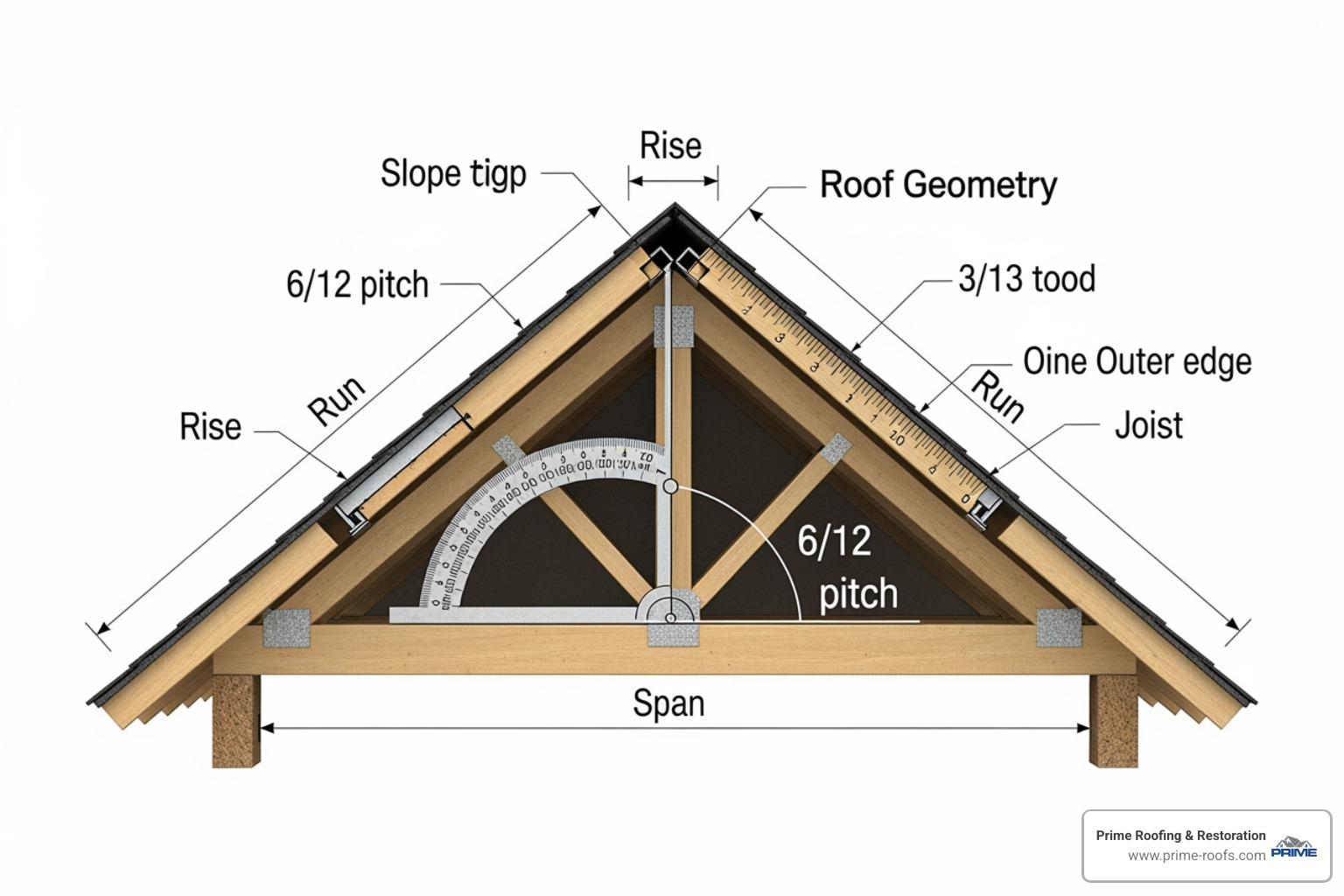
While many people use the terms interchangeably, there is a technical distinction in architecture and construction between roof pitch and roof slope. Understanding these differences helps ensure you are speaking the same language as your contractor, insurance adjuster, and local building inspectors.
The Technical Difference Between Pitch and Slope
In modern residential construction, the term “slope” is more frequently used by professionals to determine material suitability and drainage requirements.
- Slope is the ratio of the vertical rise to the horizontal “run.” In the United States, the run is almost always standardized at 12 inches. If a roof rises 4 inches over a horizontal distance of 12 inches, it has a 4:12 slope. This is the standard measurement used by the National Roofing Contractors Association (NRCA).
- Pitch, historically, is the ratio of the vertical rise to the total span of the building. The span is the distance from one wall to the opposite wall.
For example, if a house is 24 feet wide (span) and the roof rises 8 feet to the ridge, the Roof pitch is 8/24, or 1/3. However, the slope—which is what a framing square measures—would be 8 inches of rise over 12 inches of run (8:12). Measuring Roof Slope and Pitch accurately requires knowing which ratio you are using. For most residential applications today, when someone says “Roof Pitch,” they are usually referring to the X:12 slope ratio.
Why Geometry Matters for Your Roof
The geometry of your roof isn’t just about looks; it dictates how your home handles the elements. A steeper roof sheds water and debris much faster than a flat one, reducing the risk of leaks and water ponding. This is particularly important in Alabama, where heavy rainfall can exceed 5 inches in a single afternoon.
However, steeper roofs come with trade-offs. They require more materials (the surface area of a 12:12 roof is significantly larger than a 4:12 roof for the same footprint) and specialized safety equipment to install. This can answer the common question: How Much Does a New Roof Cost? Generally, as the pitch increases, the labor and material costs increase alongside it. Furthermore, the “wind load” on a steep roof is higher, meaning the structural framing must be robust enough to handle the pressure of high winds hitting a large vertical surface area.
How to Calculate Roof Pitch in 5 Easy Steps

Measuring your roof pitch is a straightforward process that you can do from either the roof surface or from inside your attic. Here is our professional guide to getting an accurate reading without needing a degree in trigonometry.
Step 1: Gather Your Tools and Ensure Safety
Before you start, you’ll need a 12-inch carpenter’s level and a measuring tape. If you are measuring from the exterior, you must use a sturdy ladder and proper fall protection. At Prime Roofing & Restoration, safety is our top priority. We always recommend homeowners consult our Expert Roof Replacement Guide before attempting any DIY roof inspections, especially on steep slopes. If you are uncomfortable with heights, measuring from the attic is a much safer alternative.
Step 2: Mark the 12-Inch Point on Your Level
To keep things simple, we use a 12-inch horizontal run as our constant. If you have a longer level (like a 24-inch or 48-inch level), use a marker or a piece of tape to clearly mark exactly 12 inches from one end. This ensures your measurement of roof pitch remains consistent with the standard X:12 ratio. Accuracy here is key; even a half-inch error can lead to miscalculating the amount of material needed for a full replacement.
Step 3: Position the Level Against the Roof Surface
You can do this on the roof itself or against a rafter in the attic. Hold the level perfectly horizontal. You’ll know it’s correct when the bubble is centered between the two lines in the vial. One end of the level (the 0-inch mark) should be touching the roof surface (or the underside of the rafter). Ensure there are no shingles or debris lifting the level, as this will skew the results.
Step 4: Measure the Vertical Rise
While holding the level steady and centered, use your measuring tape to measure the vertical distance from the 12-inch mark on your level down to the roof surface. This vertical distance is your “rise.” If the distance is 6 inches, your roof pitch is 6:12. If you are measuring from the attic, measure from the 12-inch mark on your level up to the bottom of the rafter.
Step 5: Express the Final Ratio and Convert to Degrees
Now that you have your rise and run, you can express it as a ratio. You can also convert this to degrees if you need to calculate the exact angle for architectural reasons or for installing specialized equipment like solar panels or satellite dishes.
Common Pitch-to-Degree Conversion Table:
| Pitch Ratio | Angle in Degrees | Slope Percentage |
|---|---|---|
| 2:12 | 9.46° | 16.7% |
| 4:12 | 18.43° | 33.3% |
| 6:12 | 26.57° | 50.0% |
| 8:12 | 33.69° | 66.7% |
| 10:12 | 39.81° | 83.3% |
| 12:12 | 45.00° | 100.0% |
If you find these measurements confusing, don’t worry. Our team at Prime Roofing & Restoration can provide a professional assessment. Call us today at (205) 555-0123 to schedule a consultation.
Common Residential Roof Pitch Ranges and Material Compatibility
The pitch of your roof determines what you can put on top of it. Not all materials are waterproof; many are “water-shedding,” meaning they rely on gravity to move water away before it can seep through. Choosing Your Roof requires matching the material to the incline to ensure long-term performance and warranty compliance.
Standard Roof Pitch Ranges for Alabama Homes
In Alabaster and Hoover, we see a wide variety of architectural styles. Ranch-style homes often feature a 4:12 pitch, which is cost-effective and provides a modern, low-profile look. Colonial and Victorian homes in Alabama typically feature steeper pitches, often 8:12 or higher, to create dramatic silhouettes and provide extra attic space. Our Roof Replacement Guide Alabama provides more details on how regional styles influence these choices.
Minimum Pitch Requirements for Roofing Materials
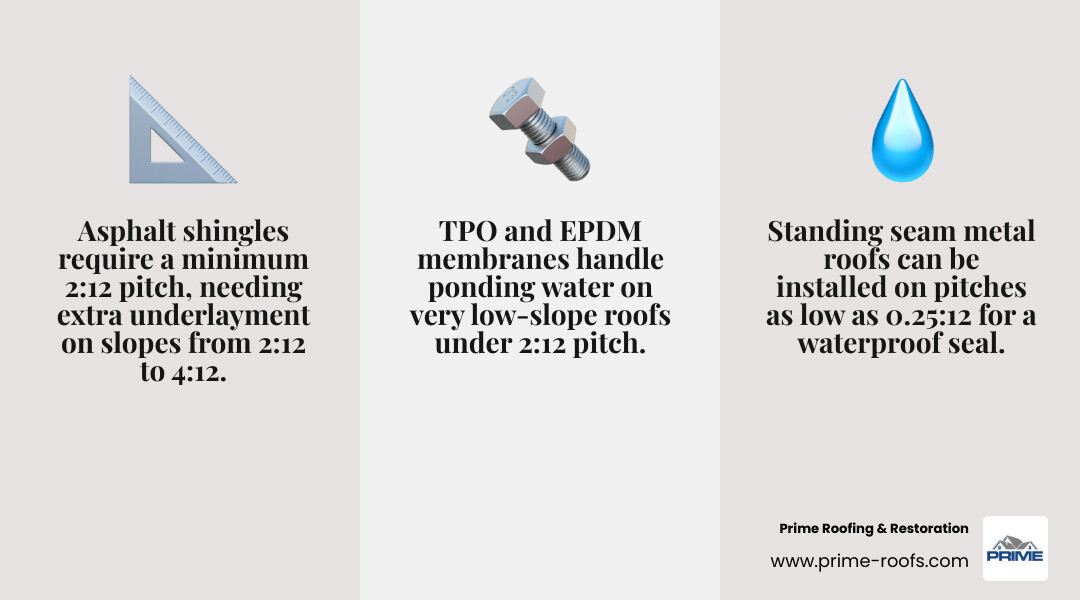
- Asphalt Shingles: These require a minimum pitch of 2:12. However, for pitches between 2:12 and 4:12, special double-underlayment installation is required to prevent leaks from wind-driven rain. Most manufacturers will void the warranty if shingles are installed on a pitch lower than 2:12.
- Metal Roofing: Standing seam metal is incredibly versatile and can be installed on pitches as low as 0.25:12 (essentially flat) depending on the seam type and sealant used. Screw-down metal panels typically require at least a 3:12 pitch to ensure water doesn’t back up through the fastener holes.
- Clay and Concrete Tiles: These are heavy and require a minimum pitch of 2.5:12 to 4:12 depending on the specific tile profile. Because of their weight, steep-pitched tile roofs require significant structural reinforcement.
- TPO and Rubber: For flat or very low-slope roofs (under 2:12), we typically recommend TPO Roofing or EPDM membranes. These systems are heat-welded or chemically adhered to create a truly waterproof seal that can handle “ponding” water without leaking.
Understanding these requirements is vital for staying compliant with the International Residential Code (IRC), which governs building standards across most of the United States, including Alabama.
Impact of Roof Pitch on Home Performance and Maintenance
The steepness of your roof affects more than just your curb appeal; it impacts your home’s performance and how much maintenance you’ll need to perform over the years. Understanding roof pitch is key to predicting these long-term factors.
How Roof Pitch Affects Drainage and Weather Resistance
Steeper roofs (6:12 and up) are excellent at shedding water, leaves, and debris. This reduces the risk of “hydrostatic pressure,” where standing water is forced under shingles. In Alabama, where we deal with heavy pollen and falling leaves, a steeper pitch helps keep the roof surface clean. However, in heavy wind events—which we certainly see during hurricane season—steeper roofs can actually act like a sail, catching more wind and potentially suffering more shingle blow-offs if not installed by residential roofing experts who use high-wind nailing patterns.
Low-pitch roofs are more prone to “ponding” and debris accumulation. If you have a low-slope roof, you must be diligent about cleaning gutters and removing wet leaves to prevent the material from degrading prematurely. Water that sits on a roof for more than 48 hours is considered “ponding” and can lead to structural rot if the membrane is compromised.
Energy Efficiency and Attic Space Considerations
A higher roof pitch creates a larger attic volume. This can be a double-edged sword. On one hand, it allows for more insulation and better airflow, which can keep your home cooler in the sweltering Alabama summers. Proper ventilation is easier to achieve in a large attic, as there is more room for air to circulate from the soffit vents to the ridge vents. It also provides the opportunity for vaulted ceilings or extra storage.
On the other hand, a larger attic means more air for your HVAC system to potentially heat or cool if the space isn’t properly sealed. Furthermore, the increased surface area of a steep roof means more heat gain from the sun. Using reflective “cool roof” shingles or radiant barriers can help mitigate this effect in Central Alabama’s climate.
Frequently Asked Questions about Roof Pitch
What is the most common roof pitch for a house?
The most common residential roof pitch is 4:12. It is widely considered the “sweet spot” for builders because it is steep enough to shed water effectively using standard asphalt shingles but low enough that it is relatively safe for workers to walk on without specialized climbing gear. This keeps labor costs manageable while providing a traditional aesthetic.
Can I use asphalt shingles on a low-pitch roof?
Yes, but with caveats. You can use asphalt shingles on a pitch as low as 2:12, but you must use a specialized low-slope underlayment application (usually two layers of 15lb felt or a single layer of self-adhering ice and water shield). We generally recommend against shingles for anything below 2:12, as water will eventually back up under the laps, leading to premature failure.
How do I convert roof pitch to degrees?
To find the angle in degrees, you use the tangent function from trigonometry. Specifically, the angle is the arctangent (inverse tan) of the rise divided by the run. For a 6:12 pitch, you calculate arctan(6/12), which results in approximately 26.57 degrees. Many smartphone apps now exist that can calculate this instantly using your phone’s built-in gyroscope.
Does roof pitch affect the cost of a new roof?
Absolutely. A steeper roof (typically 7:12 or higher) is considered a “steep charge” by roofing contractors. This is because it requires more safety equipment (harnesses, roof jacks, and ropes), takes longer to navigate, and has a larger surface area than a flatter roof covering the same square footage. For example, a 12:12 roof has about 40% more surface area than a flat roof over the same house.
Can I change my roof pitch during a renovation?
While possible, changing the pitch of a roof is a major structural undertaking. It involves removing the existing rafters or trusses and installing a new framing system. This usually requires a structural engineer and significant investment, but it can completely transform the look of a home and add valuable living space.
Final Thoughts on Mastering Your Roof’s Geometry
At Prime Roofing & Restoration, we believe an informed homeowner is a happy homeowner. Understanding the geometry of your home allows you to make better decisions regarding materials, maintenance, and long-term value. Whether you are looking for a Roof Installation in Alabaster, AL or need a professional to help navigate a complex insurance claim after a storm, our team of licensed experts is here to help. We pride ourselves on building lasting relationships through quality materials, transparent pricing, and 24/7 service.
If you’re searching for roofers near me in Alabaster, AL, look no further. We can provide a precise measurement of your roof’s geometry and ensure your next roofing system is perfectly matched to your home’s pitch. Contact our team today for a professional assessment and a free, no-obligation estimate.
Contact Information
Prime Roofing & Restoration
Alabaster, AL
Phone: (205) 555-0123
Email: info@prime-roofs.com
Our team is available 24/7 for emergency repairs and consultations. Don’t leave your home’s most important defense to chance—trust the local experts who understand the science of roofing.