
When Your Ceiling Drips, Every Minute Counts
Emergency ceiling repair is the process of stopping active water intrusion, stabilizing a damaged ceiling, and restoring it before structural failure or mold sets in. If you are dealing with a dripping or sagging ceiling right now, start with trusted roof leak and storm restoration experts and take these steps immediately:
- Move valuables and electronics away from the affected area
- Place buckets and plastic sheeting under the leak to catch water
- Shut off the power to any circuits near the leak
- Document everything with photos and video for your insurance claim
- Call a licensed roofing and restoration professional at 205-518-9111 – do not climb on a wet roof yourself
Water damage inside a home moves fast. Hidden moisture spreads through insulation, framing, and drywall within hours, weakening the structure and creating ideal conditions for mold growth. According to the EPA mold guidance, mold can begin developing when moisture is not addressed quickly. A ceiling that looks merely stained today can sag and collapse tomorrow. The difference between a repair bill under $2,000 and a five-figure restoration often comes down to how quickly you act.
That urgency is something Central Alabama homeowners understand all too well, especially after a severe storm rolls through. Whether it is a burst pipe at 2 a.m. or wind-driven rain finding a gap in your shingles, the damage does not wait for business hours. That is why knowing exactly what to do, and who to call, before an emergency happens is so important. For immediate assistance, contact Prime Roofing & Restoration at 1120 1st St N, Alabaster, AL 35007, or call 205-518-9111.
For expert emergency roofing services backed by an A+ BBB rating, Prime Roofing & Restoration is the trusted local choice across Alabaster and Orange Beach, Alabama.
I’m Bill Spencer, Owner and President of Prime Roofing & Restoration, and with more than five years leading storm restoration and emergency ceiling repair projects across Alabama’s Gulf Coast region, I’ve seen how the first 60 minutes after a ceiling emergency can make or break your outcome. This guide gives you the definitive, step-by-step roadmap – from immediate containment all the way through insurance claims and long-term prevention.
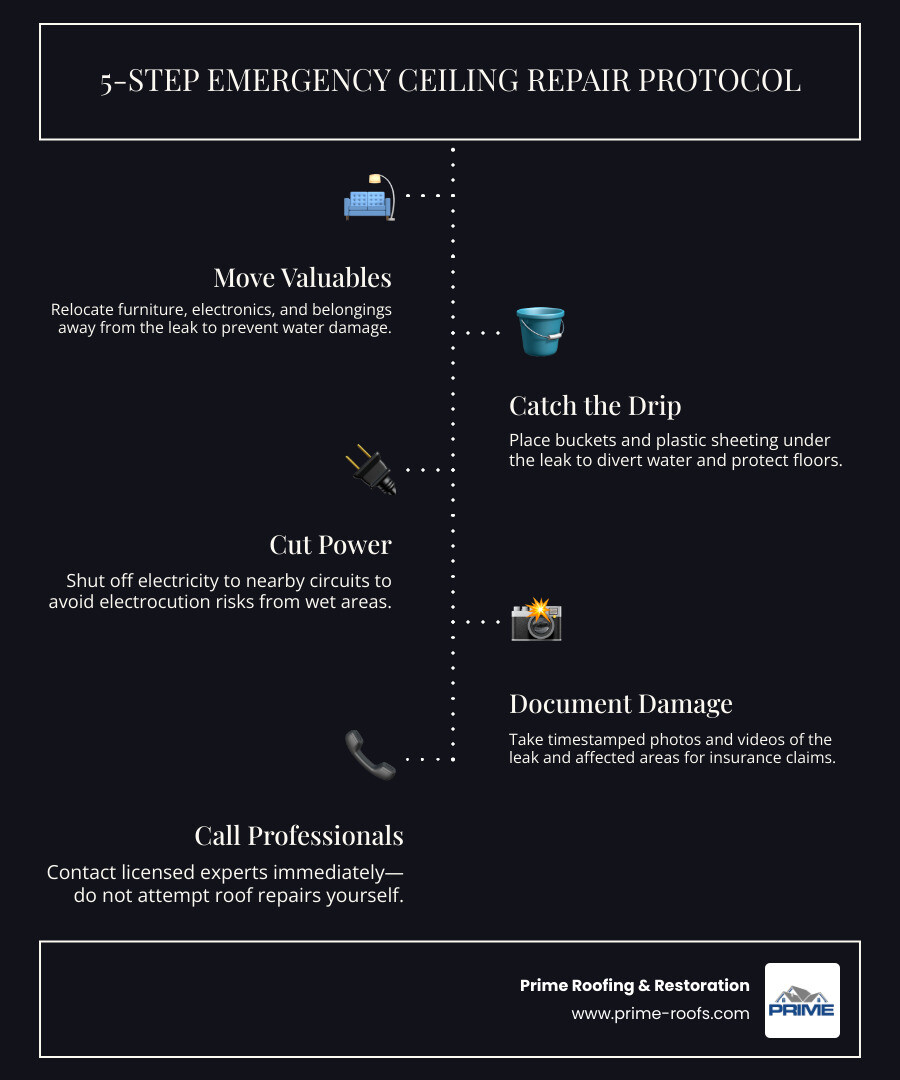
Emergency ceiling repair terms to remember:
In April 2026, homeowners must recognize that a dripping ceiling is more than an inconvenience – it is a ticking clock for your home’s structural health. When water breaches your interior, the most critical step is to contact a professional for Prime Roofing & Restoration to secure your property. Ceiling water damage accelerates in hours, spreading through insulation and framing, which can lead to sudden collapses or toxic mold blooms. This guide provides the definitive roadmap for managing these crises, from immediate containment to navigating insurance claims.
Identifying an Emergency Ceiling Repair Situation: Don’t Wait for Disaster
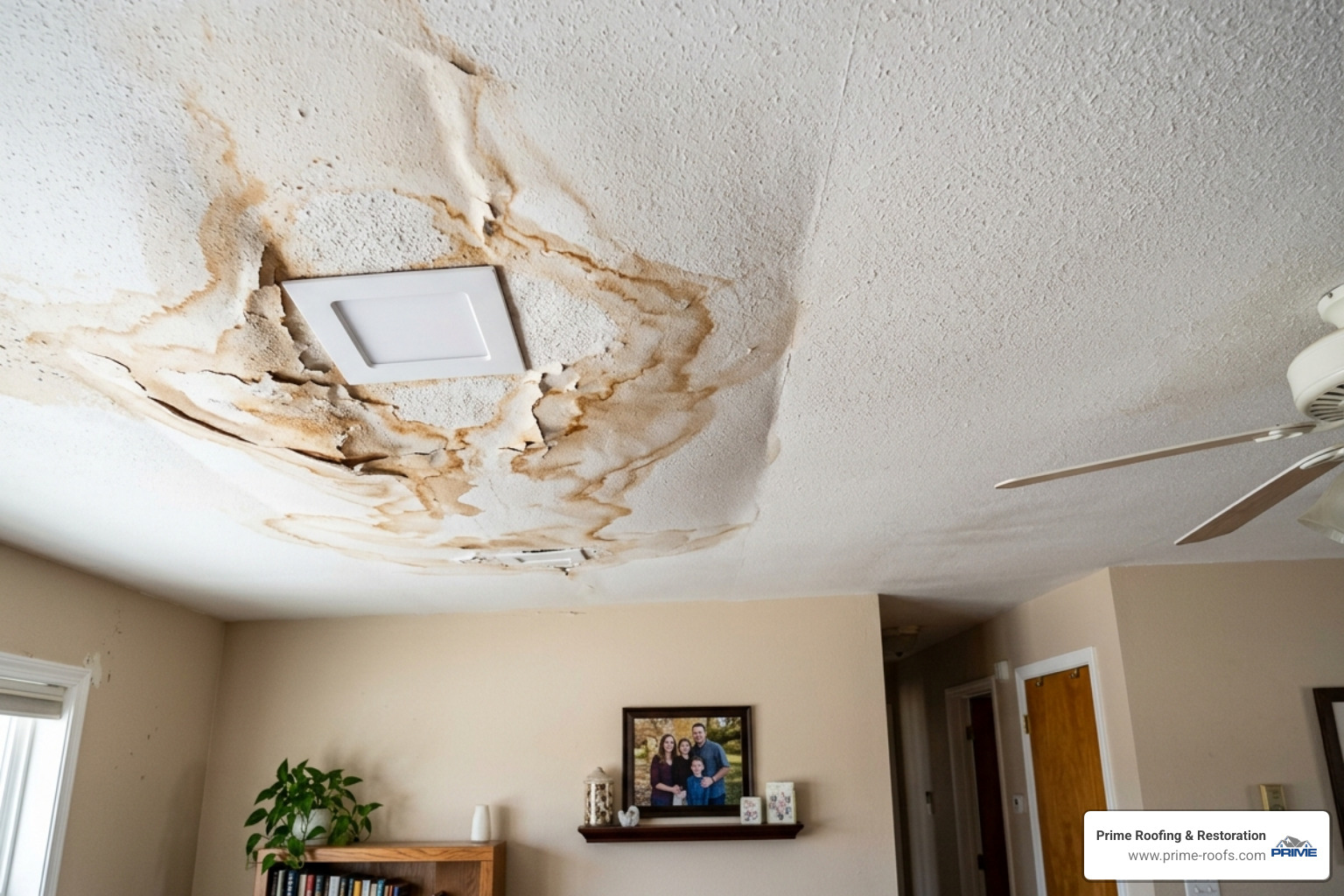
Not every water spot on a ceiling requires a 2 a.m. phone call, but knowing the difference between a cosmetic issue and a structural threat can save your home. In Alabama, where humidity levels are high and storms can be intense, a small leak can escalate into a full-blown emergency ceiling repair scenario faster than you might think. Understanding the physics of water travel is essential; water rarely moves in a straight line. It follows the path of least resistance, often traveling along ceiling joists or electrical conduits before pooling in a low spot.
What Qualifies as an Emergency Ceiling Repair? The Critical Indicators
A ceiling repair becomes an emergency when the damage threatens the safety of the occupants or the structural integrity of the building. We categorize the following as true emergencies:
- Active, Rapid Leaks: If water is pouring through the ceiling rather than just dripping, the volume of water can quickly saturate floorboards and lower levels. This volume can exceed the weight-bearing capacity of standard 1/2-inch drywall within minutes.
- Sagging Gypsum or Drywall: When drywall absorbs enough water, it loses its structural strength. A sagging “belly” in the ceiling is a sign that a collapse is imminent. This is often referred to as “pillowing” and indicates that the fasteners are pulling through the saturated core of the board.
- Electrical Proximity: Water traveling through light fixtures, ceiling fans, or near fuse boxes is an immediate fire and electrocution hazard. Water is a highly efficient conductor, and even a small amount of moisture in a junction box can cause a short circuit or a fire.
- Structural Risk: If a fallen tree limb or heavy storm has compromised the roof deck, the ceiling below is no longer supported correctly. This requires immediate stabilization to prevent the entire roof assembly from failing.
If you see any of these signs, you need emergency roofing services immediately to prevent further interior destruction. You can reach our emergency dispatch at 205-518-9111.
Signs of Imminent Ceiling Failure: Early Warnings You Can’t Ignore
Before a ceiling drops, it usually “talks” to you. Keeping an eye out for these early warnings can help you call for an emergency roof leak repair services near me before the drywall hits the floor.
- Brown Spots and Stains: Any water stain larger than an orange indicates a significant amount of trapped moisture. These stains are caused by tannins in the wood framing or minerals in the water being deposited as the moisture evaporates.
- Bubbling or Peeling Paint: This happens when water is trapped behind the paint layer, stretching the latex or oil-based finish. If you pop one of these bubbles and water comes out, you have an active leak that needs immediate attention.
- Cracked Plaster: For older homes in Alabaster or Hoover, new cracks in plaster ceilings often signal that the lath is rotting or pulling away due to moisture. Plaster is much heavier than drywall, and a plaster collapse can be significantly more dangerous.
- Musty Odors: A sudden smell of mildew in a room often means water is sitting in the attic insulation directly above the ceiling. Wet fiberglass insulation loses its R-value and becomes a breeding ground for microbial growth.
If you suspect hidden damage, a professional water damage inspection can use thermal imaging to find moisture that isn’t yet visible to the naked eye. Organizations like the IICRC set the standards for this type of professional inspection and restoration.
Immediate Steps to Contain Ceiling Water Damage: Your First 60 Minutes
When disaster strikes, your actions in the first hour are crucial. While you wait for our team to arrive, your goal is “damage control.” The objective is to minimize the “secondary damage”—the damage caused by the water after it has already entered the home, such as ruined flooring or mold growth.
How to Safely Mitigate Interior Damage: Protecting Your Home and Valuables
Safety is the priority. Do not attempt to walk on the roof during a storm, as wet shingles are incredibly slippery and the structure may be unstable. Instead, focus on the interior:
- Isolate Power: If the leak is near any electronics or light fixtures, turn off the power at the breaker box. Do not touch light switches in the affected room if the ceiling is wet.
- Contain the Flow: Place a bucket or sturdy bin under the drip. If the water is splashing, place an old towel inside the bucket to deaden the sound and prevent spray from damaging nearby walls.
- The “Nail Trick”: If you see a large bulge in the ceiling where water is pooling, you can use a small nail or screwdriver to poke a tiny hole in the center of the bulge. This allows the water to drain into your bucket in a controlled way, preventing the weight of the water from tearing down a large section of drywall. This is a critical step in emergency ceiling repair that can save you thousands in replacement costs.
- Move Valuables: Clear the area of furniture, rugs, and electronics. Use plastic sheeting to cover items that are too heavy to move. Water-damaged wood furniture can often be saved if it is moved to a dry environment quickly.
- Document: Take photos of the ceiling, the roof (from the ground), and any damaged belongings. This is vital for your insurance claim. For more tips, check our emergency roof leak fix handbook.
Temporary Fixes vs. Professional Emergency Ceiling Repair: Understanding the Limitations
Many homeowners wonder if they can handle the repair themselves. While a DIY approach might work for a tiny pinhole, an emergency ceiling repair usually involves complex layers, including insulation, vapor barriers, and structural joists.
| Feature | DIY Temporary Patch | Professional Restoration |
|---|---|---|
| Primary Goal | Stop the drip for a few hours | Restore structural integrity |
| Materials Used | Buckets, tarps, duct tape | Moisture-resistant drywall, antimicrobial spray |
| Detection | Visual only | Infrared thermography & moisture meters |
| Longevity | Fails during the next rain | Guaranteed workmanship |
| Insurance | May not be recognized | Full documentation provided |
Using products like Flex Seal or roofing cement can offer a very short-term stopgap, but they rarely solve the root cause. In fact, improper DIY fixes can sometimes trap moisture inside the ceiling, accelerating mold growth. Professional quick fixes for urgent roof damage involve tarping the roof and drying the interior simultaneously to save as much of the original structure as possible. If you are in Alabaster, call 205-518-9111 for a professional assessment.
The Professional Emergency Ceiling Repair Process: From Leak to Restoration
When our experts arrive at your Alabaster home, we don’t just put a bucket under the leak. We follow a rigorous 5-step protocol designed to stop the damage and restore your home to pre-loss condition. This process is aligned with the National Roofing Contractors Association (NRCA) guidelines for emergency repairs.
Advanced Leak Detection and Drying: Precision Technology for Lasting Solutions
We use science, not guesswork, to find where the water is hiding. Water can travel 20 feet from the actual roof leak before it shows up on your ceiling.
- Infrared Thermography: Our FLIR thermal cameras detect temperature differences. Since wet insulation is cooler than dry insulation due to evaporative cooling, we can map exactly where the water has traveled behind your walls and ceilings without cutting holes.
- Acoustic Sensors: These help us pinpoint leaks in pipes that might be hidden within the ceiling joists, distinguishing between a roof leak and a plumbing failure.
- Psychrometric Monitoring: We track humidity, dew point, and temperature to ensure the air is dry enough to pull moisture out of the wood framing. We use industrial-grade LGR (Low Grain Refrigerant) dehumidifiers that can remove up to 15 gallons of water from the air per day.
- HEPA Air Scrubbers: To keep your family safe, we run industrial air filters that catch 99.97% of mold spores and dust during the repair process. This is especially important if your home was built before 1980, as ceiling materials may contain asbestos or lead paint.
Structural Stabilization and Rebuild: Restoring Integrity and Aesthetics
Once the area is dry (usually 48-72 hours of drying time), the “repair” phase of emergency ceiling repair begins.
- Controlled Demolition: We only remove the drywall that is unsalvageable. This reduces dust and cost. We use “flood cuts” to ensure clean lines for the new material.
- Antimicrobial Treatment: We apply EPA-approved solutions to the wooden joists to prevent future mold blooms. This step is non-negotiable in the humid Alabama climate.
- Vapor Retarders: We ensure the new ceiling has the proper barriers to prevent future humidity issues, which is a common cause of “ghosting” or ceiling stains in the South.
- Texture Matching: Whether you have a smooth, popcorn, or knockdown finish, our specialists match the texture so the repair is invisible. This is an art form that requires years of experience.
- Final Verification: We use moisture meters one last time to confirm the area is 100% dry before we paint.
If your leak was caused by a roof failure, we transition directly into roofing emergency leaking repairs to ensure the exterior is just as solid as the interior. For a free estimate, call 205-518-9111.
The True Cost of Emergency Ceiling Repair and Insurance Claims: Navigating Financial Recovery
One of the first questions homeowners ask is, “How much is this going to cost?” While every situation is unique, statistics show that quick action pays off. In fact, 95% of jobs stay under $2,000 when homeowners call for professional help immediately after discovering a leak. Delaying even 24 hours can allow mold to set in, which can triple the cost of the project.
Factors Affecting Emergency Pricing: What to Expect
Several variables influence the final invoice for an emergency ceiling repair:
- Response Time: 24/7 dispatch services may carry a premium, but they prevent the much higher costs of mold remediation. At Prime Roofing & Restoration, we strive for transparency in our emergency pricing.
- The Tarping Factor: The average cost to professionally tarp a roof in an emergency is about $450 to $900 depending on the pitch and height. This is a critical investment to stop the water source and is almost always covered by insurance as a “temporary repair to prevent further damage.”
- Materials: Repairing a standard drywall ceiling is less expensive than restoring ornate plaster or wood-coffered ceilings. If your home has custom crown molding, the labor to remove and reset it will add to the cost.
- Height and Access: Ceilings in two-story foyers or vaulted Great Rooms require specialized scaffolding or lift equipment, which can increase labor costs.
Check our guide on 24-7 emergency roofing for more details on pricing and service availability.
Documenting Damage for Maximum Coverage: Your Guide to a Successful Claim
Insurance companies want data. To ensure your claim is handled fairly, we provide a comprehensive documentation package. Most policies have a “Duties After Loss” clause that requires you to take reasonable steps to protect the property from further damage—this is where our emergency tarping and drying services come in.
- Moisture Logs: Daily readings showing the progress of the drying. This proves to the adjuster that the drying was necessary and successful.
- Photo Timelines: Visual evidence of the damage from the moment we arrived to the final coat of paint. We take photos of the roof defect, the wet insulation, and the saturated drywall.
- Line-Item Estimates: We use Xactimate, the same software used by most insurance adjusters, to provide clear, transparent pricing that adjusters can easily process.
We often meet with insurance adjusters on-site at your Alabaster or Hoover home to walk them through the damage. Having a professional contractor present can help ensure that the “scope of work” includes everything needed to bring your home back to code, including matching paint on the entire ceiling rather than just a patch. For more on this, see our guide to emergency roofing services.
Preventing Future Ceiling and Roof Emergencies: Proactive Protection for Your Home
The best emergency ceiling repair is the one you never have to perform. Maintenance is the key to avoiding late-night disasters. In Alabama, our roofs face extreme heat, high humidity, and intense storm cycles, all of which accelerate the aging of roofing materials.
Maintenance Tips for Long-Term Protection: Extending Your Roof’s Lifespan
- Gutter Cleaning: Clogged gutters cause water to back up under your shingles and into your soffits. This is a leading cause of “ice damming” in the winter and rot in the summer. Clean them twice a year, especially after the fall leaves drop.
- Tree Trimming: Overhanging branches can drop heavy limbs during Alabama storms or provide a highway for pests like squirrels that chew through roofing materials. Keep branches at least 10 feet away from your roofline.
- Pipe Insulation: In the winter, insulating pipes in your attic prevents bursts that flood ceilings below. Even in Alabaster, we see several hard freezes a year that can catch homeowners off guard.
- Flashing Checks: Most leaks start around “penetrations” like chimneys, skylights, and plumbing vents. The rubber boots on plumbing vents typically last only 7-10 years, while the shingles may last 25. Have these inspected annually.
- Attic Ventilation: Proper airflow reduces attic temperatures and prevents moisture buildup. If your attic is too hot, it can “bake” your shingles from the inside out, leading to premature failure.
If you are looking for roofers near me in Alabaster, AL, we offer comprehensive maintenance packages to keep your home dry year-round. Visit us at 1120 1st St N, Alabaster, AL 35007.
When to Consider Full Roof Replacement: A Strategic Investment
Sometimes, a repair isn’t enough. You should consider a full roof replacement if:
- The 30% Rule: If more than 30% of your roof is damaged or showing signs of wear, a replacement is often more cost-effective than constant repairs. Multiple patches can also affect the curb appeal and resale value of your home.
- Age: Most asphalt shingle roofs last 20-25 years in the Alabama climate. If yours is approaching that window, the granules are likely gone, and the shingles are becoming brittle. The risk of an emergency increases significantly after year 20.
- Chronic Leaks: If you’ve had to call for an emergency ceiling repair more than twice in three years, the underlying structure is likely compromised. Repeated wetting and drying cycles can lead to wood rot in the rafters, which is a much more expensive fix than a simple roof replacement.
Frequently Asked Questions about Ceiling Leaks
How quickly should I call a professional for a ceiling leak?
Immediate action is required. Moisture spreads in minutes, weakening drywall and feeding mold. Mold can begin to grow within 24 to 48 hours of water exposure. Professional responders, like our team at Prime Roofing & Restoration, typically arrive in under 60 to 90 minutes to stabilize the structure and stop the source of the leak. Call 205-518-9111 for 24/7 service.
Will insurance cover my emergency ceiling repair?
Most standard homeowners’ insurance policies cover sudden and accidental water damage, such as a burst pipe or a storm-driven roof breach. However, damage resulting from long-term neglect, such as ignoring a known leak for months, is often excluded. We recommend reviewing your policy and working with a contractor who offers insurance claims assistance to maximize your coverage.
Can I stay in my home during the drying process?
In most cases, yes. We use containment barriers to keep dust and debris out of your living spaces and run HEPA filtration to maintain high air quality. However, if the damage involves major structural instability (like a sagging roof) or significant electrical hazards, we may advise temporary relocation until the area is stabilized.
What is the difference between a roof leak and an AC leak?
An AC leak usually occurs during the hottest months when the unit is running constantly. It often results in water dripping from a specific secondary drain line outside or pooling in an emergency pan in the attic. A roof leak is typically associated with rain events. Our thermal imaging can often distinguish between the two by tracing the moisture trail back to its source.
Is a brown spot on the ceiling always an emergency?
While a small, dry brown spot may not be an immediate emergency, it is a sign of a past or intermittent leak. It should be inspected as soon as possible to prevent it from becoming an emergency during the next heavy rain. Intermittent leaks are often caused by failing flashing or wind-driven rain.
How do I know if my ceiling is about to collapse?
Look for a visible bulge or “belly” in the drywall, cracking sounds, or water dripping from multiple points in a small area. If the drywall feels soft or spongy to the touch (use a broom handle to check, not your hand), it is saturated and at high risk of falling. Clear the room immediately and call for emergency ceiling repair.
Conclusion
Ceiling emergencies require a blend of immediate homeowner intervention and expert restoration. By acting fast, documenting thoroughly, and utilizing 24/7 professional services, you can keep 95% of repair costs under $2,000 and protect your family from the dangers of structural failure and mold. For residents in Alabaster, AL, and the surrounding areas, Prime Roofing & Restoration offers licensed expertise and insurance assistance to ensure your home remains a safe haven. Don’t let a small drip turn into a major disaster.
Contact Us Today: Prime Roofing & Restoration 1120 1st St N, Alabaster, AL 35007 Phone: 205-518-9111 View our location on Google Maps
Whether you need an immediate emergency ceiling repair or a comprehensive roof inspection, our team is ready to help you navigate the process from start to finish. We are committed to providing the highest quality workmanship and customer service to our Alabama neighbors.