
Why Your Search for “Commercial Metal Roofers Near Me” Actually Matters
Commercial metal roofers near me are specialized professionals who focus on the installation, repair, and long-term maintenance of metal roofing systems specifically designed for business, industrial, and institutional properties. Finding the right partner in this field is not just a matter of convenience; it is a critical business decision that can determine whether your facility’s roof lasts for 20 years or 60 years. When you partner with a professional roofing company in Alabaster, you are making a strategic investment in the structural integrity and operational continuity of your commercial asset for decades to come.
In the humid, storm-prone climate of Alabama, the roof is the first line of defense against the elements. For businesses in Alabaster, Hoover, and the surrounding Birmingham metro area, the search for “commercial metal roofers near me” often stems from a need for durability that traditional asphalt or single-ply membranes simply cannot match over the long term. Metal roofing systems are engineered to withstand the unique challenges of the Southeast, including intense UV radiation, high humidity, and wind speeds that can reach up to 140 mph during severe weather events.
Here’s a quick overview of what you need to know about commercial metal roofing:
| Feature | Detail |
|---|---|
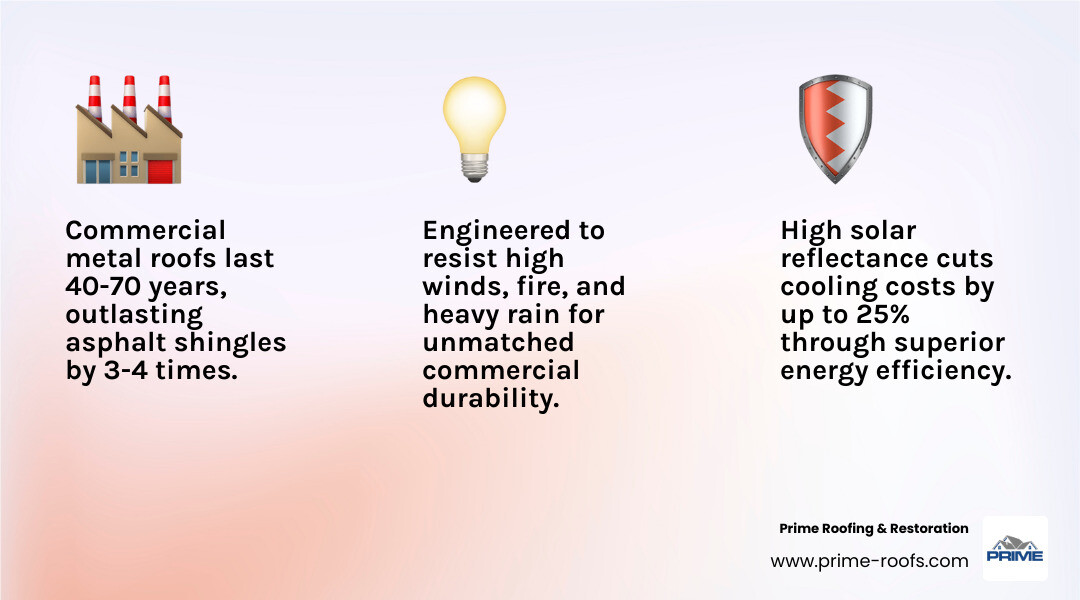
| Expected Lifespan | 40-70 years with professional installation and routine maintenance |
| Average Cost | $5-$12 per square foot, depending on material gauge and system type |
| Energy Efficiency | Reflects up to 85% of solar radiant heat, reducing cooling costs by 25% |
| Installation Versatility | Can often be installed over existing roofs (retrofit), saving on tear-off costs |
| Fire Resistance | Class A fire rating, the highest level of protection available |
| Wind Resistance | Engineered to meet or exceed local building codes for high-wind zones |
For Alabama business owners, a commercial metal roof is more than just a building material—it is a long-term financial asset. A single undetected leak in a warehouse or retail space can lead to catastrophic damage to inventory, sensitive electronic equipment, and structural components. Furthermore, roof failures can disrupt daily operations, leading to lost revenue and potential safety hazards for employees and customers. The right commercial roofing contractor identifies these vulnerabilities early through comprehensive inspections and builds systems designed to handle the rigors of the local climate.
Metal roofing has a storied history in North America, dating back to the 19th century when corrugated galvanized steel became a staple for industrial and agricultural buildings. Today, the industry has evolved significantly. Modern systems—including standing seam, corrugated panels, and stone-coated steel—offer unparalleled performance and architectural flexibility. These systems are often treated with high-performance polymer coatings like Kynar 500, which provides superior color retention and resistance to chalking, fading, and chemical exposure. This ensures that your building not only stays dry but also maintains its professional appearance for decades.
I’m Bill Spencer, Owner and President of Prime Roofing & Restoration. We serve the Alabaster and Hoover communities with expert installation, repair, and maintenance across metal, flat, TPO, and various commercial roofing systems. With over 40 years of combined experience helping property owners navigate the complexities of commercial construction, I’ve written this guide to provide you with the technical knowledge and practical advice needed to choose the best commercial metal roofers near me.
Commercial metal roofers near me terms simplified:
- commercial metal roof contractors
- commercial metal roofing companies near me
- low slope standing seam metal roof
Why Businesses Search for Commercial Metal Roofers Near Me
When you begin your search for commercial metal roofers near me, you are likely seeking a roofing solution that balances high performance with a significant return on investment (ROI). In the Alabama climate, where extreme heat and sudden thunderstorms are frequent, metal is often the superior choice for warehouses, retail centers, medical facilities, and industrial plants. If you need immediate assistance or a professional consultation for your facility, you can reach our experts at 205-623-0151.
The Economic Impact of Metal Roofing
One of the most compelling reasons to transition to a metal roofing system is the direct impact on your building’s operating costs. Metal roofs are inherently reflective. By utilizing “cool roof” technology—specialized pigments that reflect infrared light—these systems can reduce a building’s cooling costs by up to 25%. According to the Metal Roofing Alliance, this thermal efficiency is particularly valuable in the Southern United States, where air conditioning systems often run for nine or ten months out of the year. By reducing the load on your HVAC system, you not only save on monthly utility bills but also extend the lifespan of your cooling equipment.
Furthermore, because metal is non-combustible and carries a Class A fire rating, many commercial insurance providers offer reduced premiums for buildings protected by these systems. This is a critical consideration for businesses located in areas where fire safety is a primary concern. For more details on our specific offerings and how they can benefit your bottom line, visit our metal roofing service page.

The Importance of Local Expertise
Local expertise is a non-negotiable factor when selecting a contractor. A roofer from a different geographic region may not fully grasp the specific wind-load requirements or the thermal expansion challenges unique to Alabaster or Hoover, Alabama. By choosing local commercial metal roofing companies, you ensure that the installation team is intimately familiar with Alabama building codes and the specific environmental stressors of the region.
Local contractors also maintain established relationships with regional suppliers, ensuring that high-quality materials are delivered on time and meet local specifications. In the event of a severe storm or emergency, a local roofer can provide a much faster response time than a national firm. This proximity is vital for minimizing downtime and preventing secondary water damage after a leak is discovered.
What to Expect from Professional Commercial Metal Roofers Near Me
A professional commercial roofing team does not simply show up with basic tools. You should expect a comprehensive, data-driven evaluation of your building’s current structural integrity. Top-tier contractors utilize advanced diagnostic tools, such as infrared thermography, to detect hidden moisture beneath the roof surface.
At Prime Roofing & Restoration, we emphasize safety and precision. We strictly adhere to OSHA standards to protect our workers and your business operations during the project. Our services include in-house custom sheet metal fabrication, ensuring that every flashing, gutter, and piece of trim is custom-fitted to your building’s unique dimensions. We also provide 24/7 emergency services because we understand that a roof failure can happen at any time. Our team is also experienced in providing detailed documentation for insurance claims, helping you navigate the complexities of the claims process to ensure you receive the full value of your policy.
Types of Commercial Metal Roofing Systems
Not all metal roofs are created equal. Depending on your building’s architectural design, roof pitch, and budget, different systems offer varying levels of protection, longevity, and aesthetic appeal. Choosing the right profile is essential for ensuring proper drainage and long-term durability.
Standing Seam Metal Roofing
Standing seam is often considered the “gold standard” of commercial roofing. This system features vertical panels with interlocking seams that are raised above the level of the roofing surface. The primary advantage of standing seam is its concealed fastener design. Because the fasteners are hidden beneath the panels, there are no penetrations in the metal that could eventually lead to leaks.
This design also allows for natural thermal movement. In the intense Alabama heat, metal panels expand and contract significantly. Standing seam systems use a clip-and-fastener mechanism that allows the panels to “glide” without putting stress on the fasteners or the structure. It is the premier choice for low slope standing seam metal roof applications, offering a sleek, modern aesthetic that can significantly enhance the resale value of a commercial property.
Corrugated and Ribbed (R-Panels)
For businesses seeking industrial-grade durability at a more accessible price point, corrugated or ribbed panels (commonly known as R-panels) are excellent options. These systems utilize exposed fasteners with high-quality EPDM rubber washers. While they require slightly more maintenance—specifically, checking the fasteners every few years to ensure they remain tight—they provide incredible structural strength.
Corrugated panels are a staple for warehouses, agricultural buildings, and large-scale industrial facilities. They are particularly effective for steep-slope applications where rapid water runoff is a priority. Modern R-panels are available in a wide variety of gauges (thicknesses) and colors, allowing for a customized look that fits your brand identity.
Stone-Coated Steel Systems
Stone-coated steel is an innovative solution for businesses that want the aesthetic appeal of traditional clay tile, wood shakes, or asphalt shingles but require the superior strength of steel. These panels are constructed from structural-grade steel coated with an aluminum-zinc alloy and finished with ceramic-coated stone granules.
These systems offer exceptional resistance to hail and high winds, often carrying a Class 4 impact rating. They are an ideal choice for retail environments, office parks, and hospitality buildings where curb appeal is just as important as structural performance. Stone-coated steel provides the “high-end” look of premium materials without the weight or fragility associated with traditional tile.
Material Choices: Steel, Aluminum, and Copper
- Galvalume Steel: The most common choice for commercial applications, Galvalume is steel coated with a mix of aluminum and zinc. It offers excellent corrosion resistance and is highly cost-effective.
- Aluminum: Ideal for coastal environments or areas with high chemical exposure, aluminum is naturally resistant to rust and corrosion. It is lighter than steel but generally more expensive.
- Copper: Often used for historical restorations or high-end architectural accents, copper is incredibly durable and develops a beautiful patina over time. It can last well over 100 years but comes with a premium price tag.
When selecting a material, it is also important to consider the gauge. In commercial roofing, 22-gauge and 24-gauge steel are the industry standards for durability, while 26-gauge is often used for smaller structures or residential-style commercial buildings. Thicker gauges provide better resistance to wind uplift and hail damage.
The Installation and Retrofit Process
One of the most frequent questions we receive from property managers is whether a new metal roof requires a total “tear-off” of the existing roofing material. The answer is often “no,” which can lead to significant cost savings and a faster project timeline.
Can Metal Roofs Be Installed Over Existing Roofs?
In many scenarios, a metal roof can be installed directly over an existing asphalt shingle or flat roof system. This process is known as a retrofit or a “recover.” This approach offers several benefits:
- Cost Savings: You avoid the labor costs associated with tearing off and disposing of the old roof.
- Environmental Impact: It keeps tons of old roofing material out of Alabama landfills.
- Added Insulation: Retrofitting often involves the use of “flute fill” insulation. This involves placing rigid insulation boards (such as EPS or ISO) between the ribs of an existing metal roof or over an old flat roof to create a level, highly insulated surface.
Because metal is remarkably lightweight—typically weighing between 1 and 3 pounds per square foot—it rarely requires additional structural reinforcement to support the new layer. However, a professional inspection is mandatory to ensure the underlying deck is dry and structurally sound. If there is widespread rot or moisture trapped in the existing insulation, a full tear-off is necessary to prevent long-term structural failure.
The Step-by-Step Installation Timeline
A successful commercial installation requires meticulous planning and execution. Here is what the process typically looks like:
- Initial Site Assessment: We conduct a thorough inspection of the current roof, drainage systems, and structural supports. We also check for any code compliance issues.
- Engineering and Material Selection: We determine the appropriate panel profile, metal gauge, and coating system based on the building’s use and local wind-load requirements.
- Surface Preparation: The existing roof is cleaned, and any minor repairs are made to ensure a stable base. If a tear-off is required, the old material is removed and the deck is inspected.
- Underlayment Installation: We install high-performance moisture barriers and synthetic underlayments. These layers are critical for preventing condensation and providing a secondary line of defense against leaks.
- Panel Installation: Using specialized equipment, our team precision-installs the metal panels. For standing seam systems, this often involves on-site roll-forming to create continuous panels from eave to ridge, eliminating horizontal laps.
- Custom Flashing and Trim: This is the most critical stage for waterproofing. We custom-fabricate and install flashing for valleys, rakes, ridges, and penetrations (like HVAC units and vents). For more information on these essential components, see our guide to roofing sheet metal near me.
- Final Quality Audit: A project manager conducts a final walkthrough to ensure every fastener is secure and every seal is watertight.
Maintenance and Signs You Need a Repair
While metal is often marketed as a “low-maintenance” roofing solution, it is not “no-maintenance.” To achieve a 50-to-70-year lifespan, proactive care is essential. Neglecting minor issues can lead to expensive repairs and premature roof failure.
Common Red Flags for Commercial Metal Roofs
Business owners should conduct a visual inspection from the ground or a safe vantage point at least twice a year. Look for the following warning signs:
- Oxidation and Visible Rust: Rust typically starts at the edges where the metal was cut or around fasteners. If caught early, it can be treated and coated to prevent further spread.
- Fastener Issues: In exposed fastener systems, the rubber washers can degrade over time due to UV exposure. Fasteners can also “back out” due to the constant expansion and contraction of the metal panels.
- Internal Water Stains: If you see water spots on your ceiling or dampness in your attic insulation, the roof’s moisture barrier has likely been breached.
- Panel Movement or Gaps: High winds or improper installation can cause panels to shift, creating gaps that allow water and pests to enter the building.
- Sealant Failure: The sealants used around HVAC units, skylights, and plumbing stacks have a shorter lifespan than the metal itself and must be replaced periodically.
Preventive Maintenance Strategies
We recommend a professional annual inspection to identify and resolve minor issues before they escalate. A comprehensive maintenance plan typically includes:
- Debris Removal: Clearing leaves, branches, and dirt from valleys and gutters to ensure proper drainage. Standing water is a primary cause of corrosion.
- Fastener Audit: Inspecting and replacing any degraded washers or loose screws to maintain the roof’s wind resistance.
- Coating Inspection: Checking the integrity of the Kynar or silicone coatings. Small scratches should be touched up to prevent oxidation.
- Gutter and Downspout Cleaning: Ensuring that the entire drainage system is functioning correctly to move water away from the building’s foundation.
- Sealant Refresh: Removing old, cracked caulking and applying high-grade industrial sealants to all penetrations.
For more detailed information on maintaining your commercial property, check out our commercial roofing near me guide. If your roof requires specialized metalwork, you can find expert help through sheet metal roofing contractors near me.
Frequently Asked Questions about Commercial Metal Roofing
How much does commercial metal roofing installation cost?
On average, commercial metal roofing costs between $5 and $12 per square foot. The final price is influenced by several factors, including the complexity of the roof’s geometry, the type of metal (steel vs. aluminum), the gauge of the panels, and the chosen fastening system (standing seam vs. exposed fastener). While the initial investment is higher than TPO or asphalt shingles, the “lifecycle cost” is significantly lower. Because a metal roof lasts 2 to 3 times longer than traditional materials, the cost per year of service is much more favorable. Additionally, many businesses see a return on investment through energy savings and increased property value within 10 to 15 years.
Are metal roofs noisy during rain or hail?
This is one of the most persistent myths about metal roofing. In a commercial setting, metal panels are installed over a solid substrate (like plywood or metal decking) and thick layers of rigid insulation. This assembly acts as a highly effective acoustic barrier. In most cases, a metal roof is no louder than an asphalt or TPO roof during a rainstorm. Modern building codes require high R-value insulation, which further dampens sound and ensures a quiet interior environment for your employees and customers.
How long does a commercial metal roof last?
When installed by experienced commercial metal roofers near me, a high-quality metal roofing system can easily last 40 to 70 years. Many manufacturers offer 40-year or 50-year warranties on the paint finish alone. The longevity of metal is due to its resistance to common roofing enemies like rot, mold, insects, and fire. Unlike asphalt shingles, which become brittle and lose granules over time, metal remains structurally sound throughout its entire lifespan.
Is metal roofing resistant to hail damage?
Yes. Most commercial metal roofing systems carry a Class 4 impact resistance rating, which is the highest rating provided by Underwriters Laboratories (UL). While extremely large hail may cause cosmetic denting, it rarely breaches the structural integrity of the metal or causes leaks. This is a significant advantage over asphalt shingles, which can be easily punctured or stripped of their protective granules during a hailstorm.
Can I install solar panels on a commercial metal roof?
Absolutely. In fact, metal roofs are the best platform for solar integration. For standing seam roofs, solar panels can be attached using specialized clamps that grip the seams without penetrating the roof surface. This preserves the watertight integrity of the roof. Furthermore, because the roof will likely outlast the solar panels (which typically have a 25-year lifespan), you won’t have to pay to remove and reinstall the solar array to replace the roof underneath.
Is a metal roof more likely to be struck by lightning?
No. Lightning is attracted to the highest point in an area, not necessarily the material of that point. However, if a metal roof is struck, it is actually safer than other materials because metal is a non-combustible conductor. It safely dissipates the electrical charge throughout the structure and into the ground, reducing the risk of fire.
Conclusion
Investing in a commercial metal roof is one of the most prudent decisions a business owner in Alabaster or Hoover can make. The combination of a 50-year-plus lifespan, significant energy savings, and superior protection against Alabama’s volatile weather makes it a high-value asset for any commercial property. Whether you are managing a retail center, a warehouse, or an office complex, a metal roof provides the peace of mind that your operations will remain secure and uninterrupted.
At Prime Roofing & Restoration, we pride ourselves on being more than just contractors; we are your long-term partners in property maintenance. With over 40 years of combined experience, our licensed and insured experts provide end-to-end solutions, from custom metal fabrication to complex insurance claim assistance. We are committed to delivering quality craftsmanship that stands the test of time.
If you are searching for local roofers in Alabaster, AL, look no further. Contact our team today to schedule a professional inspection and receive a comprehensive, transparent estimate for your commercial project.
Contact Information: Prime Roofing & Restoration Serving Alabaster, Hoover, and the Greater Birmingham Area Phone: 205-623-0151 Website: www.prime-roofs.com View our location on Google Maps