
Why Commercial Water Damage Inspection Matters
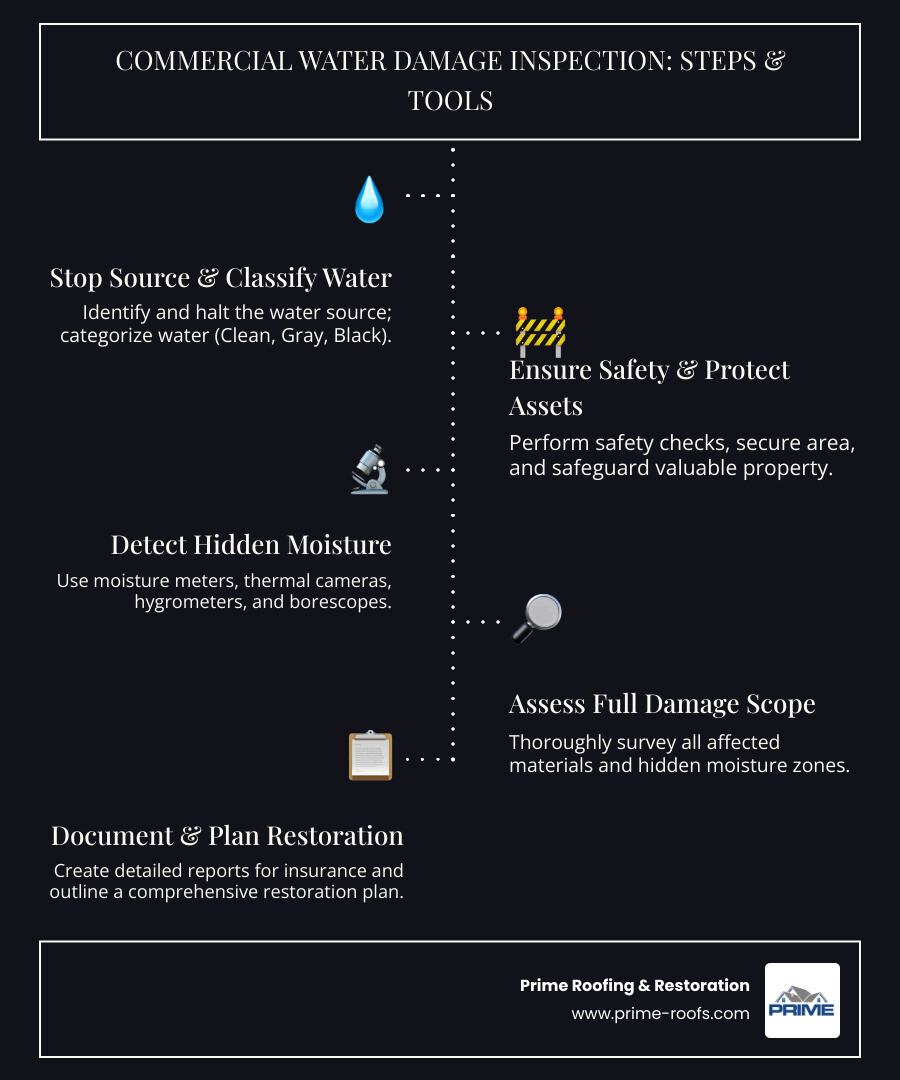
A water damage inspection is the critical first step for any business owner facing leaks or flooding. It is an essential process to protect your commercial property and minimize losses. A professional inspection involves stopping the water source, identifying the water category (clean, grey, or black), surveying the damage with tools like moisture meters and thermal cameras, and securing the site.
Water damage is a common and costly problem, often hiding behind walls or under floors. Ignoring it leads to severe structural issues, health risks from mold, and expensive repairs. For business owners, a swift and accurate water damage assessment is vital to prevent further damage and ensure a smooth insurance claim process. If you’re a business owner in Alabaster, Alabama, understanding these steps is even more critical due to local weather patterns. This guide covers everything you need to know about professional water damage assessment.
As Bill Spencer, owner of Prime Roofing & Restoration, I’ve seen the devastating impact of neglected water damage. My five years leading the company have provided deep experience in commercial property care, including crucial water damage inspection and restoration.
The First 48 Hours: Immediate Safety and Mitigation Checklist
When water enters your commercial property, your actions in the first 48 hours are crucial. They can dramatically reduce damage, prevent mold growth, and lower restoration costs. At Prime Roofing & Restoration, our priority is safety first, allowing us to protect your property and get you back to business sooner. For comprehensive property care and expert restoration solutions, learn more at Prime Roofing & Restoration.
Mold can begin to grow in as little as 24 to 48 hours in damp conditions. What starts as a simple leak can become a costly remediation project. The longer moisture remains, the deeper it penetrates building materials, making the drying process more difficult. Swift action is a necessity.
Initial Safety and Damage Control
Our first step is always safety. Before anyone enters a water-damaged space, we ensure all precautions are in place. Here are the essential safety steps for a water-damaged business:
- Safety Precautions: Immediately cordon off affected areas with caution tape and signs to prevent entry into hazardous zones, protecting staff and visitors from slips, electrical risks, and contaminated water.
- Utility Shut-Off: Water and electricity are a dangerous combination. Turn off the electrical supply at the main breaker. Shut down gas or fuel supplies. If you cannot access these safely, call your utility company. Do not enter a flooded area until a qualified professional confirms it is safe.
- Employee Safety: Ensure any employees on-site wear appropriate personal protective equipment (PPE), such as rubber boots, waterproof gloves, and masks, especially if the water is contaminated.
- Protecting Assets: When safe, move critical documents, electronics, furniture, and other valuables to a dry, unaffected area to minimize secondary damage.
- Initial Documentation: Take extensive photos and videos of the damage immediately. This visual record is invaluable for your insurance claim, providing time-stamped evidence of the initial extent of the damage.
Common Signs of Water Damage to Watch For
Early detection of water damage can save significant time and money. Be vigilant for these common red flags, which often require a professional water damage inspection to fully diagnose:
- Musty Odor: A persistent earthy or damp smell is one of the earliest indicators of hidden moisture and potential mold.
- Visible Mold Growth: Look for fuzzy, discolored patches (black, green, or white) on walls, ceilings, or around vents.
- Stains and Discoloration: Brown, yellow, or dark blotches on ceilings, walls, or floors often indicate water intrusion.
- Peeling Paint or Wallpaper: Moisture behind walls causes paint to bubble and crack or wallpaper to lift.
- Warped or Buckling Flooring: Hardwood may cup or buckle, while laminate or vinyl can swell at the seams.
- Sagging Ceilings or Walls: Drywall or ceiling tiles that absorb water become heavy, soft, and may begin to sag, indicating a serious issue.
- Spike in Utility Bills: A sudden increase in your water bill can signal a hidden plumbing leak that requires immediate attention.
The Professional Water Damage Inspection: Revealing the Full Scope
When water invades your commercial property, a professional water damage inspection is a systematic, science-based process designed to uncover the full, hidden extent of moisture intrusion. This thorough approach is essential for creating an effective restoration plan that solves the problem completely, going far beyond what is visible to the naked eye.
Our expert inspectors understand that water migrates deep into building materials, weakening structures and creating a breeding ground for mold. A comprehensive inspection ensures no hidden moisture is left behind, preventing long-term structural damage and health hazards.
The Inspector’s Toolkit: Advanced Technology for Hidden Moisture Detection
Our inspectors use a specialized toolkit to find all water damage—both obvious and hidden—for a complete and accurate assessment.
- Moisture Meters: These devices precisely measure the moisture content in materials like drywall, wood, and concrete. We use both pin-type and pinless meters to map the extent of moisture spread by comparing affected areas to a dry standard.
- Hygrometers: These measure the relative humidity and temperature in the air. High humidity indicates that moisture is evaporating from wet materials, which can promote mold growth.
- Thermal Imaging Cameras (Infrared Cameras): These cameras detect temperature differences on surfaces. Wet areas are typically cooler due to evaporation and appear as distinct colors, allowing us to “see” moisture behind walls and under floors without demolition. Accurate interpretation of these images requires an experienced professional.
- Borescopes: These are small, flexible cameras inserted through tiny holes to visually inspect inaccessible areas like wall cavities or behind fixtures without causing major disruption.
How Inspectors Identify the Source and Category of Water Damage
Identifying the water’s origin is paramount; the drying process cannot begin until the source is stopped. Our inspectors trace the water’s origin and then classify its category, which dictates the safety protocols and restoration methods.
- Leak Detection: We investigate all potential entry points, including roofing, foundations, plumbing, HVAC systems, and sprinklers.
- Roof and Foundation Assessments: As exterior restoration experts, we carefully check for damaged shingles, flashing, clogged gutters, and foundation cracks. A small roof leak can cause significant interior damage over time. Learn more about how we identify these issues in our guide to roof inspections.
- Plumbing and Appliance Checks: We examine all visible plumbing and water-reliant appliances for any signs of leaks.
- Determining Water Categories: After finding the source, we classify the water based on its contamination level. This is critical for safety and choosing the correct remediation process. The three categories—Clean, Gray, and Black Water—are detailed in the next section and determine the potential health risks and required cleanup procedures.
Decoding the Damage: Understanding Water Damage Classes and Categories
When your commercial property has water intrusion, restoration depends on understanding the type of water and how deeply it has saturated materials. The IICRC (Institute of Inspection, Cleaning and Restoration Certification) sets the industry standard for these classifications. Correctly identifying the category and class of water damage is fundamental to ensuring an efficient, safe, and effective restoration of your property.
The 3 Categories of Water: Clean, Gray, and Black
The water category defines the contamination level and associated health risks, dictating the safety protocols and personal protective equipment (PPE) required for the restoration team.
- Category 1: Clean Water. Originating from a sanitary source like a burst supply line, this water poses no immediate health threat. However, if left untreated, it can degrade into a higher category as it mixes with building materials.
- Category 2: Gray Water. This water contains significant contaminants and can cause illness upon exposure. Sources include washing machine overflows or toilet overflows with only urine. Affected porous materials often require removal.
- Category 3: Black Water. This is grossly contaminated water from sources like sewage backups or river flooding. It contains pathogenic agents and poses a severe health risk. All porous materials exposed to black water must be removed and disposed of, and the area requires intensive disinfection.
For a deeper dive into evaluating water damage types, review this comprehensive guide: Evaluating the Extent of Damage: A Comprehensive Guide.
The 4 Classes of Water Damage: From Minor to Severe
In addition to its category, water damage is classified by the volume of water and the rate of evaporation. This helps determine the intensity and duration of the drying process.
- Class 1: The least severe, affecting a small area with minimal absorption into low-porosity materials like concrete. The drying process is typically straightforward.
- Class 2: Affects an entire room, with moisture wicking up walls (usually less than 24 inches). Porous materials like carpet and drywall are saturated, requiring faster evaporation.
- Class 3: The most severe, often from an overhead source, saturating ceilings, walls, insulation, and subfloors. This class requires the fastest possible evaporation rate.
- Class 4: A specialty drying situation where water is trapped in low-porosity materials like hardwood, plaster, or concrete. These materials require specialized techniques and extended drying times.
This table provides a quick comparison of the water damage classes:
| Water Damage Class | Description | Material Saturation | Evaporation Rate | Drying Time Implications |
|---|---|---|---|---|
| Class 1 | Least amount of water, limited area | Minimal absorption | Slow | Relatively short |
| Class 2 | Affects entire room, moisture wicking up walls | Significant absorption in porous materials | Fast | Moderate, requiring air movers and dehumidifiers |
| Class 3 | Greatest amount of water, overhead source | Extensive saturation of most materials | Fastest | Longer, intensive drying with specialized equipment |
| Class 4 | Deeply held water in hard-to-dry materials | Low moisture content, but deeply bound | Slowest | Extended, specialized drying techniques often required |
From Inspection to Action: Restoration Planning and Documentation
Once the water damage inspection is complete, we create a detailed restoration plan for your commercial property. This roadmap to recovery provides the proper documentation for your insurance claim and a clear blueprint of the work ahead. Meticulous planning and transparent documentation are essential for managing expectations and ensuring your insurance process is as smooth as possible.
What to Expect in Your Water Damage Inspection Report
A professional water damage report is a vital tool that guides the restoration process and supports your insurance claim. Our reports provide a crystal-clear picture of the damage.
Here is what a comprehensive report includes:
- Moisture Mapping: A diagram of your property showing all affected areas with precise moisture readings from materials like drywall and subflooring.
- Photo Documentation: High-quality photos and videos of all damaged areas, materials, and equipment readings, which serve as critical evidence for insurance.
- List of Affected Materials: An inventory of all damaged items, from flooring and insulation to contents like furniture and equipment.
- Drying Goals and Methods: A clear outline of the target moisture content for materials and the specific equipment and techniques we will use to achieve it.
- Scope of Work and Cost Estimate: An itemized breakdown of all required tasks—from water extraction to reconstruction—with a transparent cost estimate.
- Projected Timeline: An estimated timeline for each phase of the restoration to help you plan for business interruptions.
Key Questions to Ask Your Commercial Water Damage Inspector
Choosing the right restoration team is a critical decision for your business. To feel confident in your choice, we encourage you to ask the following questions:
- “Are you IICRC certified?” IICRC certification ensures technicians are trained to the industry’s highest standards for water damage restoration.
- “What documentation will I receive?” Confirm the report will include moisture readings, photos, a scope of work, and a drying log. This documentation is proof of a successful drying process.
- “How do you handle containment and safety?” Ask about their plan for sealing off affected areas to prevent cross-contamination and ensure safety in a commercial setting.
- “What is the estimated timeline for restoration?” A professional should provide a realistic timeline based on the water damage inspection findings.
- “How do you assist with the insurance process?” A good restoration company will communicate directly with your adjuster and provide the detailed documentation needed to steer your policy.
If your commercial property is in the Alabaster area, our local team is ready to help. You can find expert roofers in Alabaster, AL right here with Prime Roofing & Restoration.
The High Cost of Delay: Structural and Health Risks of Untreated Water
When your commercial property experiences water intrusion, waiting to act is a costly mistake. Delaying restoration leads to permanent structural damage and serious health risks. The longer materials remain wet, the higher the chance of wood rot, foundation problems, and dangerous mold growth, creating significant liability for your business. The consequences of ignoring water damage go far beyond surface-level repairs, as moisture penetrates deep into the structure, making the drying process much more difficult and expensive.
Structural Integrity at Risk
Water can compromise the very structure of your commercial building, leading to complex and expensive repairs.
- Wood Rot and Framing Damage: Prolonged moisture exposure causes wood rot in floor joists, wall studs, and roof trusses, weakening the building’s stability.
- Foundation Deterioration: Saturated soil can cause foundation walls to crack, shift, or bow. In severe cases, improper water removal can risk structural collapse, as noted in FEMA recommendations on structural safety.
- Drywall and Insulation Breakdown: Wet drywall swells and crumbles, while insulation becomes compacted and ineffective, requiring complete replacement.
- Compromised Support Beams: Water causes wood beams to rot and steel beams to rust, reducing their load-bearing capacity.
- Electrical Hazards: The combination of water and electricity creates a severe risk of short circuits, fire, and electrocution, which is why shutting off power is a critical first step.
Health Hazards and Business Liability
Beyond structural damage, untreated water creates significant health risks for employees and customers, increasing your business’s liability.
- Mold and Bacteria Growth: Mold can grow within 24-48 hours of water exposure, spreading through walls, carpets, and HVAC systems.
- Respiratory and Allergy Risks: Mold releases airborne spores that can trigger allergies, asthma attacks, and other respiratory issues.
- Employee and Customer Safety: An unsafe environment is created by mold, bacteria, slippery floors, and weakened structures. As a business owner, you are responsible for maintaining a safe workspace.
- Increased Liability Exposure: Ignoring these health risks can lead to lawsuits, worker’s compensation claims, and a damaged business reputation. Swift action is crucial, as detailed in this guidance on moisture and mold prevention.
Partnering with Experts for Your Commercial Property’s Recovery
When your commercial property faces water damage, you need a trusted partner who understands the science of drying and the complexities of commercial restoration. Prime Roofing & Restoration provides comprehensive commercial restoration services for businesses, recognizing that a prompt, professional response is essential to minimize damage and ensure business continuity.
We are dedicated to building lasting relationships by delivering certified, end-to-end solutions for commercial water damage inspection, restoration, and insurance support. Our commitment extends across Alabama, proudly serving communities like Alabaster, Orange Beach, Hoover, Ono Island, and Gulf Shores. If your business is in the Alabaster area, learn more about our local expertise on our page for expert roofers in Alabaster, AL.
Our team of licensed, IICRC-certified experts uses quality materials and advanced tools to handle any scale of water damage. We identify the source, categorize the damage, and develop a custom restoration plan for your property, providing the meticulous documentation needed to streamline your insurance claim.
Let us help you steer the chaos and restore your commercial property with confidence. For immediate assistance and expert guidance, contact our team 24/7 at (205) 623-0151. We’re here to protect your business.