
Why Cedar Shingle Overlap is the Key to a Long-Lasting Roof
Cedar shingle overlap is the single most important factor in a durable, weather-tight cedar roof. It is the fundamental principle that separates a roof that lasts for generations from one that fails in a few short years. For homeowners drawn to the timeless appeal and natural beauty of a cedar roof, understanding and insisting on proper overlap—also known as “exposure”—is non-negotiable. This meticulous detail ensures your roof sheds water effectively, resists powerful wind damage, and achieves its maximum potential lifespan. At Prime Roofing & Restoration, we provide expert roofing services built on a foundation of quality materials and an unwavering commitment to code-compliant, meticulous installation. You can reach our experts by calling (205) 579-8315.
While factors like shingle grade and fastener quality are important, they are rendered useless by incorrect overlap. You can have the highest-grade cedar shingles fastened with stainless steel nails, but if the exposure is wrong, the system is fundamentally flawed and destined for early failure. The overlap creates a multi-layered, water-shedding shield. When that shield is compromised, water intrusion is not a matter of if, but when.
Quick Answer: Recommended Cedar Shingle Exposure
The correct exposure is a precise calculation based on the length of the shingle and the pitch (slope) of your roof. Adhering to these standards, set by organizations like the Cedar Shake & Shingle Bureau (CSSB), is critical.
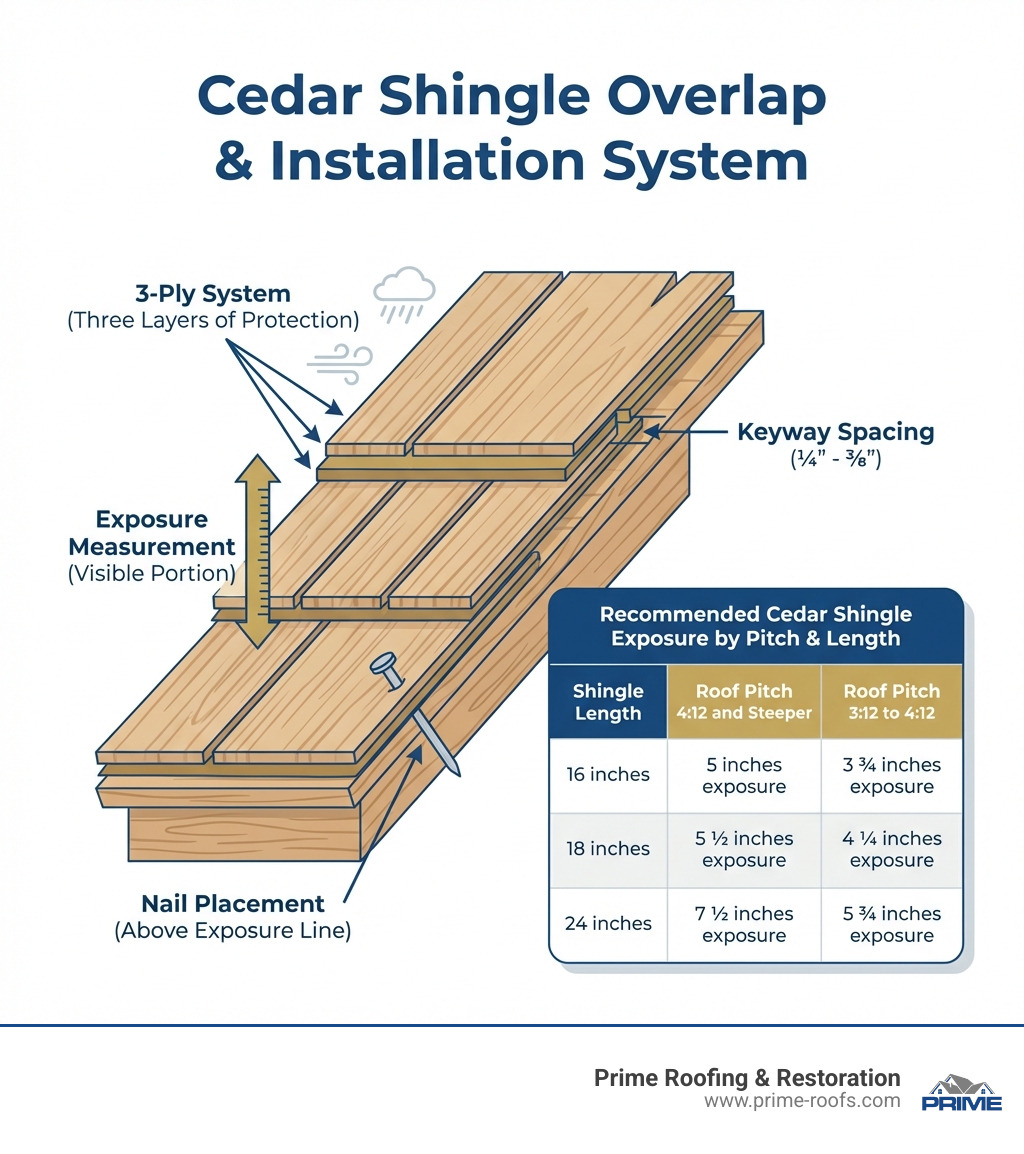
| Shingle Length | Roof Pitch 4:12 and Steeper | Roof Pitch 3:12 to 4:12 |
|---|---|---|
| 16 inches | 5 inches exposure | 3 ¾ inches exposure |
| 18 inches | 5 ½ inches exposure | 4 ¼ inches exposure |
| 24 inches | 7 ½ inches exposure | 5 ¾ inches exposure |
Key Takeaways:
- The Unbreakable Three-Ply System: Proper overlap is engineered to ensure every single point on your roof is protected by three distinct layers of shingles, creating a formidable barrier against water.
- Exposure is a Precise Measurement: The visible portion of the shingle (the exposure) is not an aesthetic choice; it’s a critical dimension determined by shingle length and roof pitch.
- The Danger of Excessive Exposure: Stretching the exposure to save on materials is the most common and catastrophic installation error. It voids the three-ply system, guarantees future leaks, and drastically shortens the roof’s life.
- Wood Needs Room to Breathe: Proper spacing, known as keyways (¼-inch to ⅜-inch gaps), between adjacent shingles is crucial to accommodate the natural expansion and contraction of the wood, preventing buckling and cracking.
- Staggered Joints for Strength: The joints (keyways) between shingles must be offset by at least 1 ½ inches from the joints in the course directly above and below, preventing a direct path for water to penetrate.
- Professional Installation is Non-Negotiable: Unlike asphalt roofing, cedar shingle installation is a craft that demands specialized knowledge. The financial risks of improper installation far outweigh the cost of hiring a certified, experienced professional.
Cedar shingle overlap is more than a guideline; it’s an engineering principle designed to protect your home from Alabama’s unique climate, from intense summer storms and humidity to the coastal challenges of Orange Beach. When installed correctly, a cedar roof is a 30- to 50-year investment in your home’s protection and beauty. When done wrong, leaks, rot, and wind damage can manifest within just a few years.
As Bill Spencer, owner of Prime Roofing & Restoration, I’ve spent over two decades inspecting, repairing, and installing roofs across Alabama. I’ve seen firsthand how precise overlap separates a roof that performs flawlessly for decades from one that fails prematurely, causing thousands in damages. Serving communities from Alabaster to Orange Beach, we stake our reputation on long-term protection and code-compliant installations that ensure your cedar roof is not just beautiful, but built to last.
The Science of Overlap: Why Cedar Shingle Exposure Matters
Cedar shingle overlap, or exposure, is the portion of each shingle that remains visible after the next course is installed above it. This isn’t just an aesthetic detail; it’s the core of the roof’s water-shedding science. A correctly installed cedar roof maintains a continuous three-ply system, meaning at least three layers of solid wood protect every single point on the roof deck. This triple coverage is the minimum standard required for shedding water effectively and ensuring the long-term durability that cedar is known for.
Think of it like the scales on a fish. Each scale overlaps the one below it, creating a continuous barrier that water simply flows over. If the scales were spaced too far apart, water would easily get underneath. The same principle applies to your roof. For example, a standard 16-inch shingle installed with a 5-inch exposure has 5 inches visible, while the remaining 11 inches are covered by the two courses above it. This creates the necessary headlap (the portion covered by two layers) to achieve the three-ply system and make it virtually impossible for water to travel uphill and penetrate the roof deck under normal conditions.
How Roof Pitch Determines Cedar Shingle Exposure
A roof’s pitch, or its steepness, is the most significant factor in determining the correct shingle exposure. Pitch is expressed as a ratio of vertical rise to horizontal run, such as “4:12,” meaning the roof rises 4 inches for every 12 inches of horizontal distance.
-
Steeper Roofs (4:12 pitch and up): On a steep roof, gravity is a powerful ally. Water runs off quickly, minimizing its “dwell time” on the roof surface. This rapid shedding reduces the risk of water being driven sideways or backing up under the shingles by wind. Because water is moving off the roof so efficiently, a slightly larger exposure (less overlap) is permissible without compromising the roof’s integrity. For instance, a 16-inch shingle can have a 5-inch exposure on a steep roof.
-
Lower-Slope Roofs (3:12 to 4:12 pitch): On a lower-sloped roof, water flows more slowly. This increased dwell time gives wind and capillary action more opportunity to push water uphill beneath the shingle edges. To counteract this, a reduced exposure (meaning more overlap) is required. This creates a longer, more difficult path for water to travel, ensuring it sheds off the roof before it can penetrate. For the same 16-inch shingle, the exposure must be reduced to 3 ¾ inches on a low-slope roof.
-
Roofs Below 3:12 Pitch: The Cedar Shake & Shingle Bureau and most building codes state that 3:12 is the absolute minimum pitch for standard shingle applications. Installing cedar shingles on a slope below this requires highly specialized, non-standard application methods. This typically involves installing a completely waterproof membrane, like a torch-down or self-adhered modified bitumen roof, and then applying the cedar shingles over a batten system purely for aesthetics. This is a complex and expensive process, and standard installation on such a low slope is a guarantee of failure.
Climate Considerations for Cedar Shingle Overlap
Beyond pitch, the local climate plays a crucial role in refining installation practices. In Alabama, with its dual threats of Gulf Coast hurricanes and statewide high humidity, a conservative approach to exposure provides an essential margin of safety.
-
Wind-Driven Rain: In coastal areas like Orange Beach, roofs must withstand horizontal, wind-driven rain, often at hurricane force. A reduced exposure (more overlap) creates a heavier, more integrated shingle mat that is more resistant to wind uplift. It also provides a more robust barrier against water being forced into tiny crevices and under shingle edges.
-
High Humidity and Moisture Management: Throughout Alabama, high humidity means that wood materials are constantly absorbing and releasing moisture. This makes proper ventilation and material choice paramount. The Cedar Shake & Shingle Bureau’s manual for new roof construction emphasizes the use of preservative-treated shingles in humid climates to inhibit the growth of mold, mildew, and algae. Furthermore, proper cedar shingle overlap must be part of a complete roofing system that includes robust ventilation. A continuous system of soffit vents (for intake) and a ridge vent (for exhaust) allows air to flow along the underside of the roof deck, removing the warm, moist air that can lead to rot and decay from within. Proper overlap keeps water out from the top, while proper ventilation keeps moisture from destroying the roof from below.
Cedar Shingles vs. Cedar Shakes: Overlap and Installation Differences
While homeowners and even some contractors often use the terms “shingles” and “shakes” interchangeably, they are distinct products with fundamental differences in manufacturing that dictate their installation methods, including overlap and underlayment requirements.
- Cedar Shingles: Are sawn on both sides from a block of wood. This process creates a relatively smooth surface and a uniform taper, resulting in a crisp, refined appearance on the roof. They lie flat against each other, creating a tight, orderly pattern.
- Cedar Shakes: Are typically hand-split from the block and then sawn on the back side (a “tapersawn” shake is sawn on both sides but has a thicker profile). This splitting process follows the natural grain of the wood, creating a rustic, heavily textured surface with a much thicker butt end and an irregular, non-uniform face.
These differences are not merely aesthetic; they directly impact how the materials handle water and how they must be installed to create a weather-tight roof.
Cedar Shingle Application
Cedar shingles are installed over a solid roof deck (like plywood or OSB) that has been covered with an appropriate underlayment, such as #30 asphalt-saturated felt or a modern synthetic underlayment. A critical distinction in shingle application is that no extra underlayment or felt is placed between the shingle courses.
The system relies on the smooth, flat surfaces of the shingles lying tightly against each other, combined with the three-ply overlap, to shed water.
- Spacing (Keyways): To manage the natural hygroscopic properties of wood (its tendency to expand and contract with changes in moisture), a specific gap must be left between adjacent shingles in the same course. For Certi-label Grade 1 shingles, this “keyway” should be between ¼-inch and ⅜-inch. If the gap is too small, the shingles can swell and buckle when they get wet. If it’s too large, it can expose the underlayment to UV degradation and create a channel for wind-driven rain.
- Fastening: Proper fastening is as critical as overlap. Each shingle requires two corrosion-resistant nails (stainless steel is the gold standard, hot-dipped galvanized is an acceptable alternative). The nails must be placed approximately ¾-inch from each side and, crucially, about 1 inch above the exposure line of the next course that will be installed. This placement ensures the nails are completely covered by the subsequent course, protecting them from the elements. Over-driving nails can crack the shingle, while under-driving them can prevent the course above from lying flat, creating a pathway for water.
Cedar Shake Application
Cedar shakes, with their irregular, hand-split surfaces, cannot create the same tight, flat seal as shingles. The textured faces create natural channels and gaps where water and wind could penetrate. To counteract this, a shake installation requires an interlay of felt between each course.
This interlay, typically an 18-inch wide strip of #30 felt, acts as a secondary water barrier or “baffle.” It is not a full underlayment but a targeted shield placed specifically to block any water that might be driven up between the shakes. According to the Cedar Shake & Shingle Bureau’s New Roof Construction Manual, this felt interlay is positioned so its lower edge is twice the weather exposure distance above the butt of the course it covers. For example, if a 24-inch shake is installed with a 10-inch exposure, the felt interlay would be placed 20 inches above the butt of the shake. This ensures the felt strip is completely concealed but perfectly positioned to catch and redirect any water that gets past the primary shake layer, directing it back out onto the surface of the course below. This fundamental difference—the required felt interlay—is what allows shakes to function effectively despite their rustic texture and is a critical step that distinguishes a proper shake installation from a shingle installation.
Calculating and Applying the Correct Cedar Shingle Overlap
Achieving a functional and beautiful cedar roof hinges on precision. The correct cedar shingle overlap must be calculated accurately and applied consistently across the entire roof. There is no room for “eyeballing” or estimation; every course must be measured and aligned to guarantee a functional, weather-tight system and a visually appealing result.
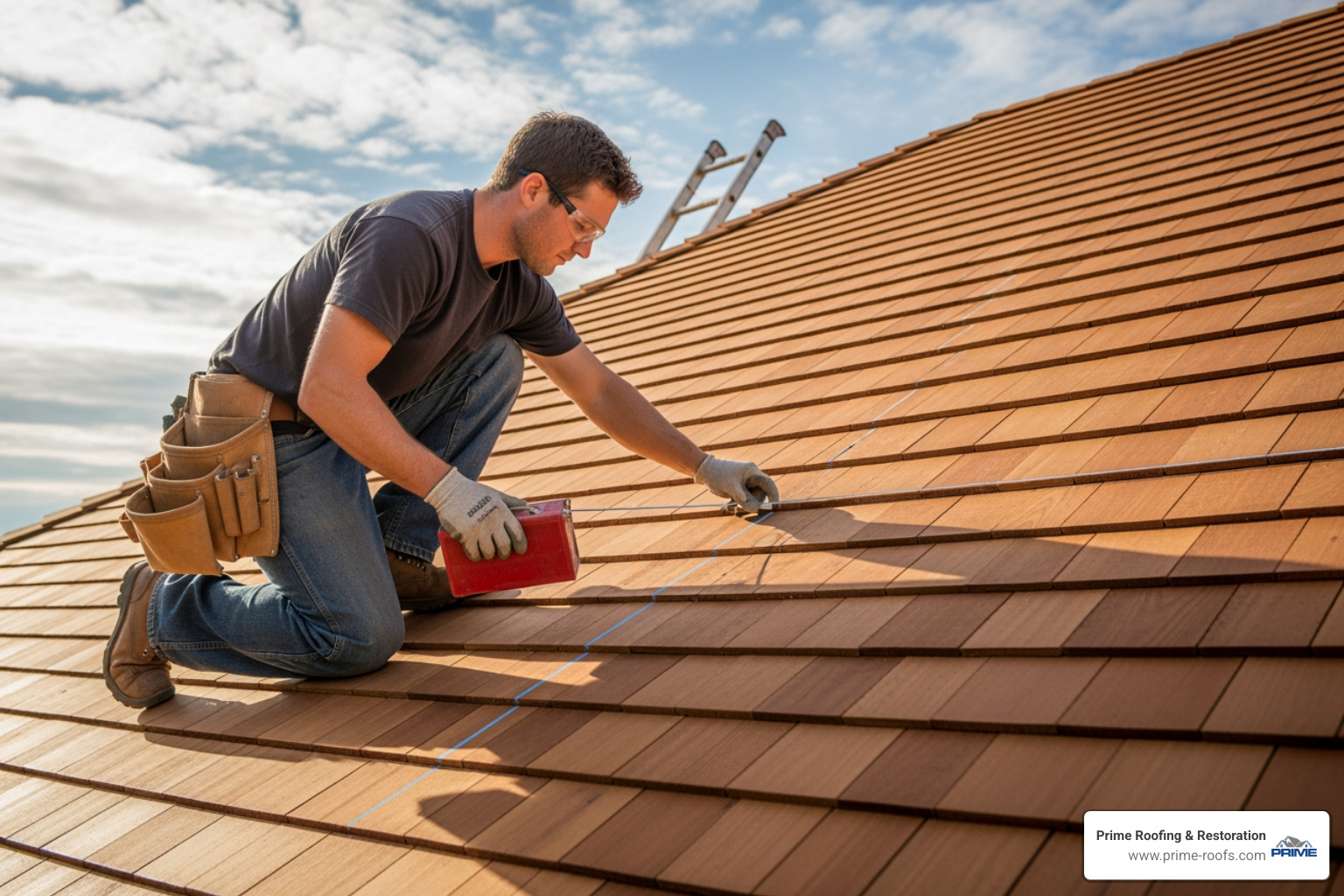
Before installation begins, professionals gather specific tools for this precise work. A high-quality chalk line is essential for snapping straight guidelines. A story pole—a long, straight board pre-marked with the correct course exposures—can be used to quickly and consistently transfer measurements across different roof sections. A shingle hatchet (a specialized hammer with a blade for trimming shingles) and a properly calibrated pneumatic nailer set to the correct depth are also vital. This level of preparation is a hallmark of a professional home roof installation.
How to Calculate Courses and Exposure
The process begins with careful measurement. First, determine the correct exposure based on the shingle length and roof pitch using the standard industry chart. Once you have your exposure value, you can calculate the number of courses needed.
- Measure the Run: Measure the distance from the bottom edge of the roof (the eave) to the top (the ridge).
- Divide by Exposure: Divide this total measurement by your chosen exposure value. This will give you the total number of courses required.
Example Calculation: Let’s say a roof plane measures 22 feet (264 inches) from the eave to the ridge. You are using 18-inch cedar shingles on a 6:12 pitch roof. According to the chart, the correct exposure for this steep-slope application is 5 ½ inches.
- 264 inches (total run) / 5.5 inches (exposure) = 48 courses.
In this scenario, you will need exactly 48 courses of shingles from eave to ridge. A chalk line should be snapped for each of these 48 courses to ensure they remain perfectly straight. If the calculation results in a fraction (e.g., 48.7), it means you will have 48 full courses and a final, shorter course at the ridge that will need to be cut to fit, while still maintaining the required headlap (overlap from the course below).
Special Installation Details: Critical Areas
While consistent exposure across the main field of the roof is vital, certain areas are more vulnerable to water intrusion and require specialized application techniques. Proper cedar shingle overlap and flashing integration are most critical in these zones.
-
Starter Course: The first course at the eave is the foundation of the entire roof. It is always doubled or even tripled. The first layer is installed with its joints (keyways) covered by the roof’s underlayment. The second layer is then installed directly on top, but its joints are offset from the joints of the layer below by at least 1 ½ inches. This creates a solid, multi-layered edge that sheds water effectively and covers the joints of the first primary course of shingles. This starter course should also project 1 to 1 ½ inches beyond the fascia board to create a drip edge, which prevents water from curling back and rotting the fascia and soffit.
-
Hips and Ridges: These convex intersections of roof planes are high-wear areas. They are capped using special pre-fabricated hip and ridge units or shingles cut to size. These caps are installed with an alternating overlap, where one side overlaps the other, and are secured with longer nails that must penetrate through the cap and the top courses of shingles into the roof decking or framing. The exposure of the ridge cap should be consistent and is typically similar to the exposure of the main roof field to maintain both aesthetic consistency and weather protection.
-
Valleys: As the primary channels for water runoff, valleys handle a tremendous volume of water and are the most leak-prone area of any roof if installed incorrectly. For cedar roofs, the most reliable method is an “open valley.” This involves installing a wide, robust metal flashing (typically 24- to 26-gauge galvanized steel or copper) in the valley first. The field shingles are then installed and cut precisely along a straight line on each side of the valley’s center, leaving a 4- to 6-inch wide open channel of metal exposed. This creates an unobstructed path for water, leaves, and debris to flow freely off the roof, preventing water from being forced sideways under the shingles.
These specialized applications require a high level of skill and experience. They underscore why choosing an experienced roofer who understands the unique demands of cedar is not just a recommendation, but a necessity for a long-lasting roof.
Risks of Improper Cedar Shingle Overlap
Exceeding the maximum recommended exposure—a practice known as “stretching the courses”—is the single most destructive mistake made in cedar roofing. It is often done by inexperienced or unscrupulous roofers to reduce material costs and finish a job faster. However, this seemingly small shortcut completely undermines the engineering of the roofing system, leading to catastrophic and premature failure. The consequences are severe, turning a small upfront saving into major, expensive repair bills down the road. This is why professional residential roofing services strictly adhere to the industry standards for overlap established by the CSSB and local building codes.
Loss of 3-Ply Protection
The most immediate and critical consequence of excessive exposure is the elimination of the three-ply system. The entire principle of a cedar shingle roof is based on having three layers of wood protecting the underlayment at all times. When a shingle is over-exposed, it reduces the “headlap”—the portion of the shingle that is covered by the two courses above it. This creates a large zone on every shingle that is only protected by two layers, or even just one.
Imagine a heavy, wind-driven rainstorm. On a properly installed roof, any water that gets past the keyway (gap) of the top shingle hits the solid wood of the shingle in the course below. If it somehow gets past that layer, it hits the solid wood of the third shingle down. The path to the vulnerable underlayment and roof deck is blocked. On an over-exposed roof, water that gets past the first keyway can flow down and directly onto the underlayment, as there is no third layer of protection. This leads directly to leaks.
Catastrophic Damage from Insufficient Overlap
The failure of the 3-ply system triggers a cascade of damaging consequences:
- Leaks and Interior Damage: The first sign of trouble is often water stains appearing on your ceiling or running down interior walls. By the time you see this, the damage to the roof structure has already begun.
- Roof Deck Rot and Structural Failure: Once water penetrates to the OSB or plywood roof deck, it becomes saturated. Persistent moisture leads to wood rot, which destroys the structural integrity of the sheathing. The wood becomes soft, spongy, and loses its ability to hold nails. This can lead to dangerous roof sagging and, in the most extreme cases, structural collapse.
- Mold, Mildew, and Health Hazards: Trapped moisture in a dark attic space is the perfect breeding ground for toxic black mold and mildew. These organisms not only accelerate the decay of your home’s structure but also release spores into the air that can cause serious respiratory problems and other health issues for your family.
- Increased Risk from Wind and Weather: Reduced overlap makes each shingle far more vulnerable to wind uplift. With less headlap, there is less weight from the courses above holding the shingle down. The exposed butt of the shingle acts as a lever for high winds to catch, lift, and tear the shingle completely off the roof. This is a major concern in Alabama’s storm-prone climate. Furthermore, improper overlap can leave fasteners exposed to the elements. This leads to rust and corrosion, causing the nails to fail and the shingles to come loose. Even using the best nail guns for cedar shingles is pointless if the nails aren’t properly covered and protected by the correct shingle overlap.
- Voided Warranties and Financial Loss: A cedar roof is a significant investment. However, if the shingles are not installed according to the manufacturer’s specifications—with proper overlap being a primary requirement—the material warranty will be voided. Likewise, any workmanship warranty from the installer may be worthless if they performed the job incorrectly. The homeowner is left bearing the full financial burden of a premature roof replacement, which can cost tens of thousands of dollars, in addition to the cost of repairing the extensive water damage.
Frequently Asked Questions About Cedar Shingle Overlap
As specialists in cedar roofing, we get many questions from homeowners about the critical details of cedar shingle overlap. Here are clear, comprehensive answers to the most common inquiries to help you understand what goes into a properly installed cedar roof.
What is the recommended exposure for cedar shingles?
The recommended exposure is not a single number; it’s a specific calculation based on two factors: the length of the shingle and the pitch of the roof. For a standard 16-inch shingle on a typical roof with a 4:12 pitch or steeper, the maximum exposure is 5 inches. If that same shingle is used on a lower slope roof (between 3:12 and 4:12), the exposure must be reduced to 3 ¾ inches to provide greater overlap and prevent water backup. The shingle’s grade (e.g., #1 Blue Label vs. #2 Red Label) does not change the exposure rule; the rule is based purely on geometry and physics.
How does roof slope affect shingle exposure?
Roof slope is the primary factor governing exposure. Gravity pulls water down, and the steeper the slope, the faster the water runs off. This rapid runoff on steep roofs (4:12 pitch and above) means there is less time for water to penetrate, so a larger exposure is safe. On lower-slope roofs (down to the 3:12 minimum), water moves more slowly, increasing its “dwell time” and making it more susceptible to being pushed under shingles by wind. To combat this, less exposure (and therefore more overlap) is required to create a longer, more difficult path for water to travel.
What is the difference in overlap for shingles vs. shakes?
This is a critical distinction. Cedar shingles are sawn smooth and lie flat, relying on a direct, tight three-ply overlap to shed water. Cedar shakes are hand-split and have a rough, irregular texture. This texture creates gaps that could trap water, so shakes require a layer of felt interlay (typically 18-inch wide #30 felt) between each and every course. This felt acts as a secondary water barrier. Because of this robust, two-stage system (shake plus felt interlay), shakes of the same length are typically installed with a greater exposure than shingles. For example, a 24-inch shake can have a 10-inch exposure, while a 24-inch shingle is limited to a 7 ½-inch exposure.
What happens if you use too much overlap (reduced exposure)?
Using more overlap than required (i.e., a smaller exposure than the maximum allowed) is not structurally harmful. In fact, it creates an even more water-resistant roof with four or more layers of protection in some areas. However, it significantly increases both material and labor costs. You will need to purchase more shingles to cover the same area, and the installation will take longer. While it technically improves performance, the added expense provides diminishing returns in terms of roof longevity and is generally not considered cost-effective.
Are there special overlap rules for ridges and valleys?
Yes. These are the most vulnerable areas of a roof and demand special techniques.
- Hips and Ridges: These are capped with special shingles applied in an alternating overlap pattern. Each piece overlaps the previous one, and the sides alternate to cover the nails and create a continuous, weather-tight seal at the roof’s peak.
- Valleys: These water channels require robust metal flashing (an “open valley” system is best for cedar) installed underneath the shingles. The shingles are then cut back from the center of the valley to leave the metal channel exposed, allowing water and debris to flow off unimpeded.
- Starter Course: The very first course at the eave is always doubled or tripled. This provides a strong, thick edge, covers the joints of the first full course, and ensures maximum water-shedding capability at the point where water leaves the roof.
What are the consequences of too much exposure?
Exceeding the maximum recommended exposure is a catastrophic installation error. It voids the three-ply protection system, leaving large areas of your roof with only two, or even one, layer of wood protecting the underlayment. This directly leads to leaks, sheathing rot, structural damage, and mold growth. It also makes shingles far more susceptible to being lifted and torn off by wind. This mistake will void manufacturer warranties and can cut the life of a 30-year roof down to less than 10 years.
What is the difference between exposure and keyways?
These two terms refer to different types of spacing. Exposure is the vertical dimension—the height of the shingle that remains visible after the course above it is installed. Keyways are the horizontal gaps—the small spaces (typically ¼ to ⅜ inch) intentionally left between adjacent shingles within the same course. These gaps are essential to allow the natural wood to expand and contract with humidity changes without buckling or cracking.
Protect Your Investment with Expert Cedar Shingle Installation
Correct cedar shingle overlap is not just a detail; it is the cornerstone of a durable, beautiful, and weather-tight cedar roof. The right exposure, precisely calculated based on shingle length and roof pitch, is what creates the essential three-ply system that can protect your home for 30, 40, or even 50 years. As we’ve detailed, mistakes in this critical step—especially over-exposing the shingles—can lead to rapid deterioration, devastating leaks, wind damage, and the premature failure of your entire roofing system.
Given the technical demands, the specialized tools, and the unforgiving nature of the material, cedar shingle installation is a craft best left to experienced professionals. An expert understands the nuances of wood, the science of water-shedding, and the precise application techniques required for vulnerable areas like valleys, hips, and eaves. For flawless, long-lasting results that protect your investment, trust the licensed and insured experts at Prime Roofing & Restoration. We are dedicated to protecting homes and families with the highest standards of craftsmanship.
Contact Your Local Cedar Roofing Experts
We proudly serve communities across Alabama, with dedicated teams ready to assist you. To schedule a free, no-obligation consultation and roof inspection, please contact our office closest to you.
For Alabaster, AL and surrounding areas:
- Name: Prime Roofing & Restoration
- Address: 123 Main Street, Alabaster, AL 35007
- Phone: (205) 579-8315
- Local Page: Roofers in Alabaster, AL
For Orange Beach, AL and the Gulf Coast:
- Name: Prime Roofing & Restoration
- Address: 456 Beach Blvd, Orange Beach, AL 36561
- Phone: (251) 232-7839
- Website: Contact Us Online
Don’t risk the health and safety of your home. Ensure your cedar roof is built to last by partnering with the professionals at Prime Roofing & Restoration.