
Why Roof Leak Detection Orange Beach Matters for Your Home
Roof leak detection Orange Beach is more than a service; it’s an essential preventative measure that shields homeowners from the staggering costs of water damage, structural decay, and health hazards. Imagine you’ve just come home from a long day, and you notice a faint, dark spot on your living room ceiling. It’s easy to dismiss it as a shadow or an old stain, but this subtle warning is often the first sign of a significant problem brewing above. A single, unaddressed roof leak can silently saturate insulation, seep along rafters, and damage up to 100 square feet of ceiling and wall space. Within just 24 to 48 hours, this persistent moisture creates the perfect breeding ground for mold, introducing a serious health risk to your home.
For homeowners in Orange Beach, Alabama, the stakes are even higher. Our beautiful Gulf Coast location brings with it a unique set of environmental challenges. The relentless summer sun beats down on roofing materials, causing them to become brittle. The high humidity and salt-laden air accelerate corrosion and encourage organic growth. Most critically, the annual threat of tropical storms and hurricanes means your roof is constantly under assault from high winds and torrential rain. This combination of factors drastically accelerates roof wear and tear, making swift, expert intervention not just advisable, but essential. For comprehensive protection against these coastal threats, it’s vital to consider reliable roofing solutions that address both immediate repair needs and long-term durability.
Quick Answer: Professional Roof Leak Detection Methods in Orange Beach
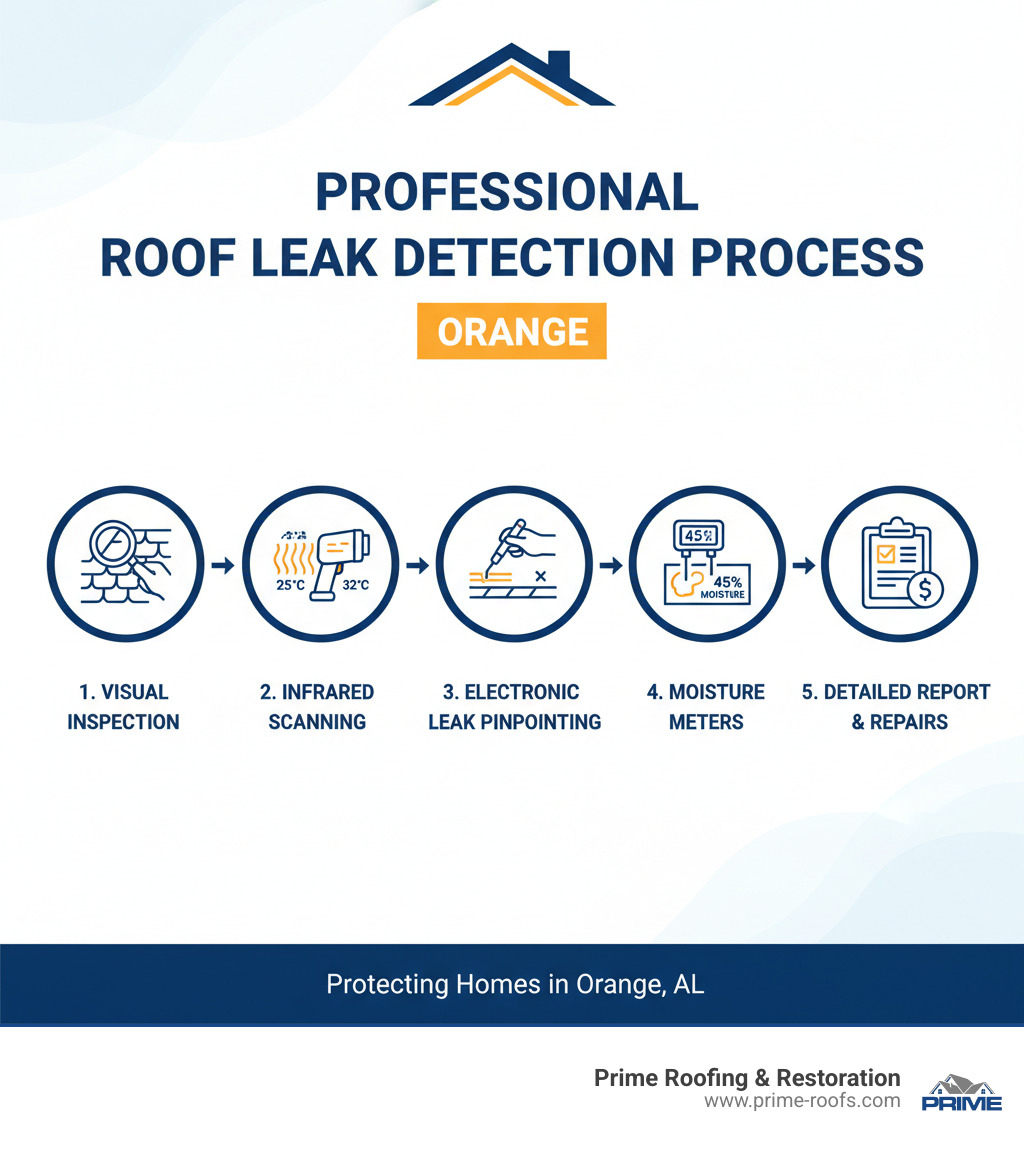
- Comprehensive Visual Inspection: This is the foundational step. A trained technician performs a systematic examination of every component of your roofing system, from the shingles and flashing on the exterior to the decking and insulation in the attic. It’s a meticulous process designed to spot obvious failures and subtle clues.
- Infrared Thermal Imaging: This advanced technology allows us to see what the naked eye cannot. An infrared camera detects minute temperature differences across a surface. Wet areas under your roof or inside your walls are typically cooler than dry areas, showing up as distinct patterns on the camera’s display, pinpointing hidden moisture without any destructive testing.
- Electronic Leak Detection (ELD): Primarily used for flat or low-slope commercial and residential roofs, ELD uses a low-voltage electrical current to find the exact location of membrane breaches. Water conducts electricity, so when a current is passed over the roof, it will ground at the point of a leak, allowing our sensors to identify the precise entry point.
- Moisture Meters: Once a potential area of moisture is identified, moisture meters are used to confirm its presence and quantify the level of saturation. These handheld tools, with both pin and pinless functions, give us precise data on how wet the building materials are, which is crucial for determining the extent of the damage and the scope of the necessary repairs.
- Controlled Water Testing: When a leak is particularly elusive and other methods are inconclusive, a controlled water test may be performed. This involves isolating specific sections of the roof and applying a controlled amount of water to replicate the conditions of a rainstorm, allowing us to trace the water’s path from entry to exit.
The financial argument for proactive leak detection is undeniable. While the average cost of a minor roof repair in our area ranges from $300 to $1,500, the cost of ignoring that same leak can spiral into tens of thousands of dollars. A professional leak detection service, which may cost around $400-$950 in the Orange Beach area, is a strategic investment. It stops the financial bleeding before it starts, preventing the exponential cost increases that come with widespread water damage, structural repairs, and mold remediation.
I’m Bill Spencer, owner of Prime Roofing & Restoration. With years of experience serving the Orange Beach community, my team has witnessed firsthand how our advanced Roof leak detection Orange Beach technology has saved countless properties from catastrophic damage. We don’t just look for a leak; we perform a comprehensive diagnostic analysis of your entire roofing system. We combine state-of-the-art tools with an intimate knowledge of Alabama’s coastal climate to find the hidden vulnerabilities that others miss, giving you the ultimate peace of mind that your home is secure and protected.
Similar topics to Roof leak detection Orange:
Identifying a Roof Leak: Common Signs and Causes in Orange Beach
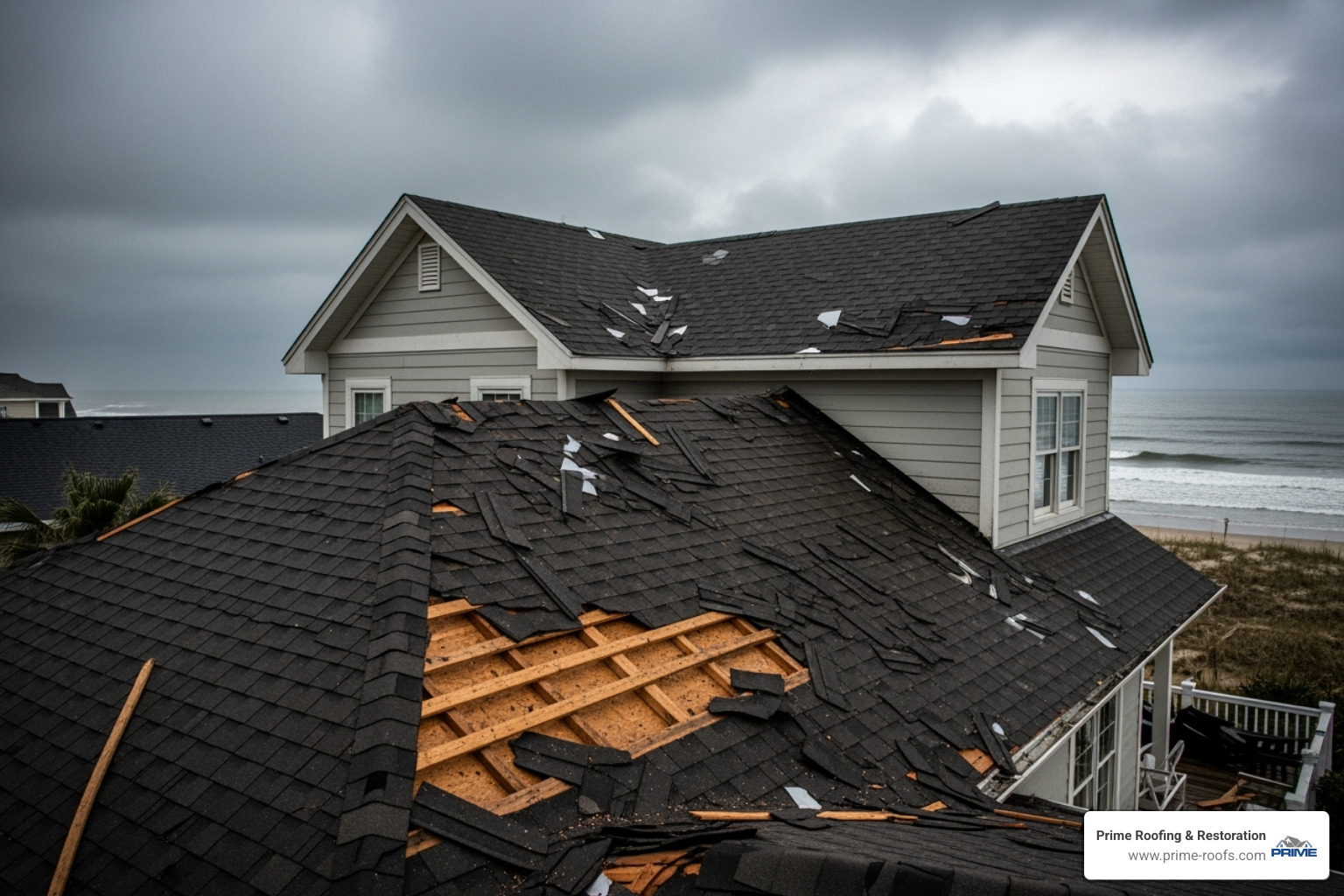
One of the most deceptive aspects of a roof leak is that water rarely drips straight down. It can enter through a compromised vent on one side of the roof, travel along a rafter, run down a wall stud, and finally reveal itself as a water stain in a completely different room. This is why understanding both the visible warning signs inside your home and the hidden causes on your roof is your best defense against extensive and costly damage in Orange Beach.
Telltale Signs You Have a Leak
The first indications of a roof leak often manifest inside your home. Be vigilant and look for these common red flags:
- Water Stains on Ceilings or Walls: These are the classic signs. They can appear as small, faint rings or large, dark brown blotches. The shape and color can offer clues; a stain with defined rings often indicates a slow, intermittent leak that has dried and re-soaked multiple times. A large, uniformly dark stain might suggest a more recent and significant water intrusion.
- Peeling, Bubbling, or Cracking Paint: Moisture seeping into drywall or plaster from behind causes the paint to lose its adhesion. You might notice paint bubbling up like a blister or developing long, spidery cracks before it begins to flake and peel away.
- Musty, Damp Odor: If you notice a persistent earthy or musty smell, especially in your attic, closets, or upper-floor rooms, it’s a strong indicator of hidden moisture. This smell is caused by microbial volatile organic compounds (MVOCs) released by active mold growth, even if you can’t see it.
- Visible Mold or Mildew: Seeing mold is an urgent warning. It can appear as black, green, or even white fuzzy spots on ceilings, in corners, or on walls. This means a moisture problem has been present long enough for a colony to establish itself, posing a direct health risk that requires immediate attention.
- Damp, Matted, or Compressed Insulation: Your attic insulation should be light, dry, and fluffy to be effective. If you inspect your attic and find insulation that is damp to the touch, matted down, or discolored, it’s a clear sign that water is getting in from the roof deck above.
- Damaged or Missing Shingles: A quick visual inspection from the ground (using binoculars for safety) can reveal a lot. Look for shingles that are cracked, curled at the edges, buckled, or completely missing. These are direct entry points for water.
- Excessive Shingle Granules in Gutters: The sand-like granules on asphalt shingles protect them from UV rays and weathering. As shingles age, they shed these granules. Finding a large accumulation in your gutters or at the base of your downspouts means your shingles are nearing the end of their lifespan and their protective capability is compromised.
- Damaged or Deteriorated Flashing: Flashing is the metal or rubber material that seals the joints around roof penetrations like chimneys, skylights, vents, and pipes. These are the most common failure points on any roof. Look for signs of rust, cracks, gaps, or pieces that have pulled away from the structure.
- Clogged and Overflowing Gutters: Gutters are designed to channel water away from your roof and foundation. When they become clogged with leaves and debris, water backs up and pools along the edge of your roof. This standing water can easily seep under the lower rows of shingles and penetrate the roof deck.
The Root of the Problem: Common Leak Causes in the Gulf Coast Climate
Understanding why roofs leak in our specific coastal environment is key to prevention and effective repair.
- Intense Weathering and Storms: The Gulf Coast climate is exceptionally harsh on roofing systems. The intense, year-round sun bombards your roof with UV radiation, which degrades materials like asphalt and rubber seals, making them brittle. The high humidity encourages the growth of algae (which can lift shingle edges) and the salty air corrodes metal components. Above all, the constant threat of tropical storms and hurricanes brings high-velocity winds that can lift and tear off shingles, and wind-driven rain that forces water into the tiniest crevices. After any significant weather event, an Orange Beach Storm Damage assessment is a crucial step.
- Age and Natural Deterioration: No roof lasts forever. Every material has a finite lifespan. Asphalt shingles, the most common material in our area, typically last 15-25 years. Over time, their protective granules wear away, the asphalt dries out, and the sealant strips that hold them together fail. Pipe boots, the rubber collars around vent pipes, are notorious for cracking and splitting after 5-10 years of UV exposure, creating a direct path for water.
- Flawed Installation: Unfortunately, many roof leaks are not caused by age or storms, but by mistakes made during the initial installation. A new roof can leak from day one if not installed correctly. Common errors include improper nail placement (over-driven, under-driven, or placed in the wrong location), inadequate flashing installation around chimneys and walls, failing to use a proper starter strip at the eaves, and using exposed nails on the surface of the roof. These errors create immediate weak points that water will inevitably exploit, which is why professional roof leak detection Orange Beach is so valuable for quality control and early intervention.
Professional Roof Leak Detection in Orange: The Modern Approach

When you call a professional for Roof leak detection Orange, you are not just hiring someone to look for a hole; you are investing in a systematic, science-backed diagnostic process. A homeowner might spot a missing shingle, but a trained expert with advanced technology can uncover hidden, slow-moving leaks that are silently causing thousands of dollars in structural damage. Modern detection methods allow us to see inside your roof structure and walls without destructive guesswork, ensuring we identify and fix the true source of the problem, not just a symptom.
Step 1: The Comprehensive Visual Inspection
Every professional detection service begins with thorough, methodical detective work. This is far more than a casual glance. A trained roofer’s inspection is a multi-point process covering both the interior and exterior of your home.
- Interior Check: The investigation often starts inside, usually in the attic. This is the best place to see the underside of the roof deck. Our technicians use high-powered flashlights to look for dark water stains on the wood, which trace the path of the leak. We check for signs of mold or mildew growth on the decking and rafters. We also inspect the insulation; damp, compressed, or discolored insulation is a dead giveaway that water has been present. Finally, we look for any signs of daylight peeking through the roof deck, which indicates an obvious hole or gap.
- Rooftop Examination: After the interior assessment, we move to the roof itself. We don’t just walk around; we systematically examine every component. We check the field of the roof for any damaged, missing, or aging shingles. We pay extremely close attention to all penetrations—the flashing around chimneys, plumbing vents, exhaust fans, and skylights, as these are the most common leak sources. We inspect the valleys where two roof planes meet, ensuring they are clear of debris and the flashing is intact. We also examine the gutters and drip edges to confirm that the water management system is functioning correctly and not causing water to back up under the shingles.
Step 2: Advanced Leak-Finding Technology
When the source of a leak isn’t immediately obvious from a visual inspection, we deploy a suite of specialized equipment to find hidden moisture without damaging your property.
- Infrared (IR) Thermal Cameras: This is one of the most powerful tools in modern leak detection. Based on the principle of thermal capacitance, water retains heat differently than dry building materials. An IR camera detects these subtle temperature differences, which are invisible to the naked eye. As the roof surface cools after sunset, wet areas retain heat longer and show up as warm spots on the camera. Conversely, on a hot day, evaporation can make wet areas inside a wall appear cooler. These thermal anomalies, displayed as a color-coded heat map, allow us to pinpoint the location and extent of hidden water damage within walls or under roofing materials.
- Electronic Leak Detection (ELD): This technology is the gold standard for finding leaks in flat or low-slope membrane roofs (like TPO, PVC, or EPDM). The most common method, known as Integrity or Vector Mapping, uses a low-voltage current. A wire loop is placed around the perimeter of the roof section being tested, and a small electrical charge is introduced to the wetted roof surface. Since the roof membrane is an insulator, the current will seek the path of least resistance to the grounded structural deck, which is through a breach in the membrane. A technician uses probes to follow the flow of the current, leading them directly to the pinhole-sized leak.
- Moisture Meters: While infrared cameras are excellent for finding potential moisture, moisture meters are used to confirm and quantify it. We use two types: non-invasive (or pinless) meters that use an electromagnetic field to get a quick reading over a large area, and penetrating (or pin-type) meters that give a precise moisture content reading of a specific spot in materials like wood and drywall. This data is crucial for understanding the severity of the saturation and creating an effective repair and drying plan.
- Controlled Water Testing: In the most stubborn and elusive cases, we may perform a methodical water test. This is not simply spraying a hose at the roof. Following industry standards, we isolate small, specific areas of the roof, starting from the lowest point and working our way up. We apply a controlled amount of water to one area at a time while a second technician inside monitors for water intrusion. This painstaking process allows us to definitively replicate the leak and trace its exact path without flooding the structure.
How a Professional Roof Leak Detection Service Works in Orange
When you contact Prime Roofing & Restoration for expert roof leak detection services, we follow a clear, customer-focused process:
- Initial Consultation: You’ll speak with a knowledgeable team member who will listen to your concerns and ask targeted questions: How old is your roof? When did you first notice the leak? Does it happen only during heavy rain? This information helps us prepare for our on-site visit.
- On-Site Inspection & Data Collection: Our certified technicians arrive and perform the comprehensive visual inspection of the interior and exterior. Based on the initial findings, they will deploy advanced tools like infrared cameras and moisture meters to gather objective data on the location and extent of any moisture.
- Pinpointing the Source: This is where expertise makes the difference. We combine the visual evidence (stains, damaged shingles) with the technological data (thermal images, moisture readings) to trace the water back to its precise entry point. This scientific approach eliminates guesswork and ensures we target the actual problem.
- Damage Evaluation & Detailed Report: We assess the full scope of the damage, including any harm to the roof deck, insulation, and interior structures. We then provide you with a comprehensive report that includes photographs, thermal images, a clear explanation of the problem, and a detailed, transparent quote for the necessary repairs.
- Expert Repair Execution: With your approval, our skilled technicians perform the repairs using high-quality materials that match your existing roof. We fix the root cause of the leak and ensure the repair is integrated seamlessly into your roofing system. For urgent situations that can’t wait, you can reach our team 24/7 at (205) 686-3337.
The High Cost of Neglect: Why You Can’t Afford to Ignore a Roof Leak

Ignoring a small roof leak is like ignoring a small crack in a dam. It’s a decision that inevitably leads to a cascade of catastrophic and costly consequences. What begins as a minor nuisance quickly evolves into a multi-faceted crisis that compromises your home’s structural integrity, your family’s health, and your financial stability. The domino effect of persistent moisture is relentless, and the cost of inaction will always be exponentially higher than the cost of a timely repair.
-
Catastrophic Structural Damage: Water is the enemy of wood. When water seeps into your home’s frame, it initiates a process of wood rot that can soften and destroy essential structural components. The plywood or OSB sheathing of your roof deck can become spongy and delaminate, losing its ability to hold nails and support weight. Ceiling joists and roof rafters can weaken, leading to sagging ceilings and, in the most extreme cases, a partial or full roof collapse. This isn’t just a repair issue; it’s a serious safety hazard.
-
Hazardous Mold Growth and Health Risks: According to the U.S. Environmental Protection Agency (EPA), mold can begin to grow on damp surfaces within just 24 to 48 hours. A hidden roof leak creates the perfect dark, damp environment for toxic molds like Stachybotrys chartarum (black mold) to thrive. These molds release airborne spores that can circulate throughout your home via the HVAC system, triggering severe allergies, asthma attacks, chronic sinus infections, and other serious respiratory issues. Professional mold remediation is an invasive and expensive process involving containment zones, air scrubbers, and the removal of all contaminated materials, often costing thousands of dollars.
-
Exponentially Escalating Repair Costs: Let’s consider a typical scenario. A minor leak caused by a cracked pipe boot might initially cost $300-$500 to detect and repair. If ignored for a few months, that leak saturates the insulation and stains the drywall below, turning the repair into a $1,500-$2,500 job. If left for a year or more, the leak will have rotted the roof decking and potentially a rafter, while mold has spread through the attic. Now, the project involves not just a roof repair, but also structural carpentry, new insulation, extensive drywall replacement, and professional mold remediation. The total cost can easily balloon to $10,000, $15,000, or more. A single unaddressed leak can affect up to 100 square feet of your home, turning a simple fix into a full-blown restoration project.
-
Drastically Decreased Property Value: A roof leak is one of the biggest red flags in a real estate transaction. During a home inspection, any sign of current or past water damage will be noted. This can cause potential buyers to walk away from the deal entirely or demand steep price reductions to cover the cost of repairs and the unknown extent of the damage. An unresolved leak is a clear signal of deferred maintenance, which significantly diminishes your home’s marketability and value.
-
Wasted Energy and Higher Utility Bills: The effectiveness of attic insulation is measured by its R-value, or its resistance to heat flow. When insulation like fiberglass or cellulose gets wet, it becomes compressed and loses its loft. This dramatically reduces its R-value to almost zero. As a result, your home loses heat in the winter and gains heat in the summer, forcing your HVAC system to work much harder to maintain a comfortable temperature. This leads to a noticeable and sustained increase in your monthly energy bills.
-
Fire Hazard and Pest Infestations: Two often-overlooked dangers of a roof leak are fire and pests. Water dripping onto electrical wiring, junction boxes, or light fixtures in the attic or ceiling can cause short circuits, creating a serious fire hazard. Furthermore, damp, rotting wood is a magnet for destructive pests like termites and carpenter ants, which can cause even more widespread structural damage.
In severe situations, such as damage from a major storm, immediate action is critical to mitigate these consequences. Understanding how emergency roofing services can quickly protect your property is vital. The conclusion is clear: professional Roof leak detection Orange is not an expense—it’s essential insurance against a predictable and devastating chain reaction of damage.
Frequently Asked Questions About Roof Leaks
We understand that discovering a roof leak can be a stressful and confusing experience. To help you navigate the situation, we’ve compiled answers to the most common questions we receive from homeowners in the Orange Beach area.
When should I call a professional for roof leak detection in Orange?
The short answer is immediately. The moment you see an interior sign of a leak—such as a water stain, peeling paint, or notice a musty odor—it’s time to call a professional. Even if a stain appears to be dry, the leak could be intermittent, occurring only during wind-driven rain, and still be causing hidden damage. It is also highly advisable to schedule a professional inspection:
- After any major storm with high winds or hail, even if you don’t see obvious damage.
- If you notice damaged, curled, or missing shingles from the ground.
- If you find a large amount of sand-like granules in your gutters.
- If your roof is over 15 years old, as it’s entering the later stages of its lifespan.
- If you’re buying or selling a home, to get a true assessment of the roof’s condition.
Waiting allows a small, manageable problem to escalate into a major catastrophe involving structural rot, widespread mold, and compromised insulation.
How much does professional roof leak detection cost?
The cost for a professional Roof leak detection Orange service typically ranges from $300 to $950. The final price depends on several factors, including the size and complexity of your roof (e.g., steepness, number of gables and valleys), the accessibility of the roof and attic, and the specific technology required to pinpoint the leak. While this may seem like a significant expense, it is a minimal investment when compared to the costs it helps you avoid. A single undetected leak can easily lead to mold remediation ($2,000-$6,000), structural wood replacement ($2,000+), and extensive interior repairs ($1,500+). A reputable contractor will provide a clear, upfront quote for the detection service, ensuring you get a precise diagnosis that saves you money in the long run.
Will my homeowners insurance cover a roof leak?
This is a critical question, and the answer depends entirely on the cause of the leak. Homeowners insurance policies are designed to cover damage from a sudden and accidental event (also known as a “covered peril”). Examples include damage from a hurricane, hail storm, tornado, or a fallen tree. However, insurance policies almost universally exclude damage that results from normal wear and tear, an old roof that has reached the end of its service life, or a lack of routine maintenance.
To maximize your chances of a successful claim, you must:
- Prevent further damage: As soon as you notice the leak, take reasonable steps to mitigate the damage, such as placing buckets or moving furniture. Insurers expect this.
- Document everything: Immediately take clear photos and videos of the roof damage (if safe to do so) and all interior damage. Keep a log of all communications.
- Contact your insurer promptly: Report the damage to your insurance company as soon as possible to begin the claims process.
- Get a professional assessment: Have a trusted roofing contractor like Prime Roofing & Restoration provide a detailed inspection report that documents the cause and extent of the damage. This professional documentation is invaluable when dealing with your adjuster.
We have extensive experience working with insurance companies and can provide the thorough assessments and documentation needed to help you navigate the claims process. For urgent storm-related issues, our emergency roofing services team is available 24/7 to help secure your property and document the damage correctly from the start.
Can’t I just find and fix the leak myself?
While the DIY spirit is admirable, roof leak detection is a job best left to trained professionals for several reasons. First and foremost is safety. Walking on a roof, especially a wet or steep one, is extremely dangerous and can lead to serious injury or death. Second, as we’ve discussed, water travels, and the entry point is rarely directly above the interior stain. A DIY repair often involves patching the wrong spot, which fails to solve the problem and allows the hidden damage to continue. Professionals have the training, safety equipment, and advanced technology to trace the leak to its true source accurately and safely, ensuring the repair is done right the first time.
What is the difference between leak detection and a standard roof inspection?
A standard roof inspection is a general check-up. It’s a visual assessment of the overall condition of the roof, designed to identify signs of aging, potential problem areas, and estimate the remaining lifespan. Leak detection, on the other hand, is a forensic investigation. It is initiated when there is a known, active leak. It is a much more intensive process that often involves advanced technology like infrared cameras and moisture meters with the specific goal of pinpointing the exact point of water intrusion and diagnosing the full extent of the resulting damage.
Protect Your Orange Beach Home with Expert Leak Detection
Proactive and professional Roof leak detection Orange Beach is the single most effective strategy to safeguard your home’s value, preserve its structural integrity, and protect your family’s health from the dangers of mold and moisture. In a coastal climate as demanding as ours, waiting for a small drip to become a major problem is a gamble you can’t afford to take. Don’t let a minor issue escalate into a financial and structural disaster.
At Prime Roofing & Restoration, we are your local experts who intimately understand the unique challenges our Orange Beach and Gulf Shores properties face. We go beyond simple repairs to provide comprehensive solutions. Our process begins with advanced, technology-driven leak detection to guarantee we find the true source of the problem. From there, we provide expert repairs, full roof replacements, and dedicated assistance with insurance claims. Our licensed and insured experts use only high-quality materials and are available 24/7 for emergencies, ensuring your roof provides the steadfast protection your family deserves.
Your home is your most valuable asset. Keep it safe, dry, and secure. For the most reliable and thorough roofing services in Orange Beach, AL, and the surrounding communities, contact the trusted professionals at Prime Roofing & Restoration.
Contact Us Today for a Free Consultation:
Prime Roofing & Restoration
Name: Prime Roofing & Restoration
Address: 4725 Main Street, Suite B, Orange Beach, AL 36561
Phone: (205) 686-3337
Our Service Areas Include:
- Orange Beach
- Gulf Shores
- Foley
- Perdido Key
- And surrounding communities.
[Map and Driving Directions Placeholder: A map showing our location in Orange Beach, easily accessible from Canal Road and the Foley Beach Express.]
Call our team today at (205) 686-3337 or visit our website to schedule your inspection online. Let us provide you with the peace of mind that comes from knowing your home is protected by the best.