
Why Your Insurance Company Cares So Much About Your Roof
A roof inspection for insurance is a professional, in-depth assessment of your roof’s current condition, structural integrity, and remaining functional lifespan, performed specifically to evaluate risk for a homeowners insurance policy. Insurance companies scrutinize roofs with such intensity for one simple reason: roof-related issues are consistently the leading source of homeowner claims, costing the industry billions of dollars annually. For homeowners in Alabama—a state frequently in the path of severe weather systems including hurricanes, tornadoes, and intense hailstorms—understanding this process is not just beneficial, it’s essential for protecting your property and financial stability. With our team of licensed experts providing comprehensive roofing and restoration services, we help you navigate complex insurance requirements and ensure your home is properly protected. A well-maintained, documented roof signals lower risk to an insurer, which can directly translate to better premiums, broader coverage, and a significantly smoother claims process when you need it most.
An insurer’s fundamental business model is based on managing and minimizing financial risk. They use roof inspections as a primary tool to avoid underwriting properties that are likely to result in preventable claims due to neglect, poor installation, or advanced age. If an inspection reveals your roof is in poor condition, you could face a range of negative consequences, from substantially higher premiums to an outright denial of coverage until critical repairs are made. Mastering this aspect of homeownership is key to safeguarding both your physical home and your financial future.
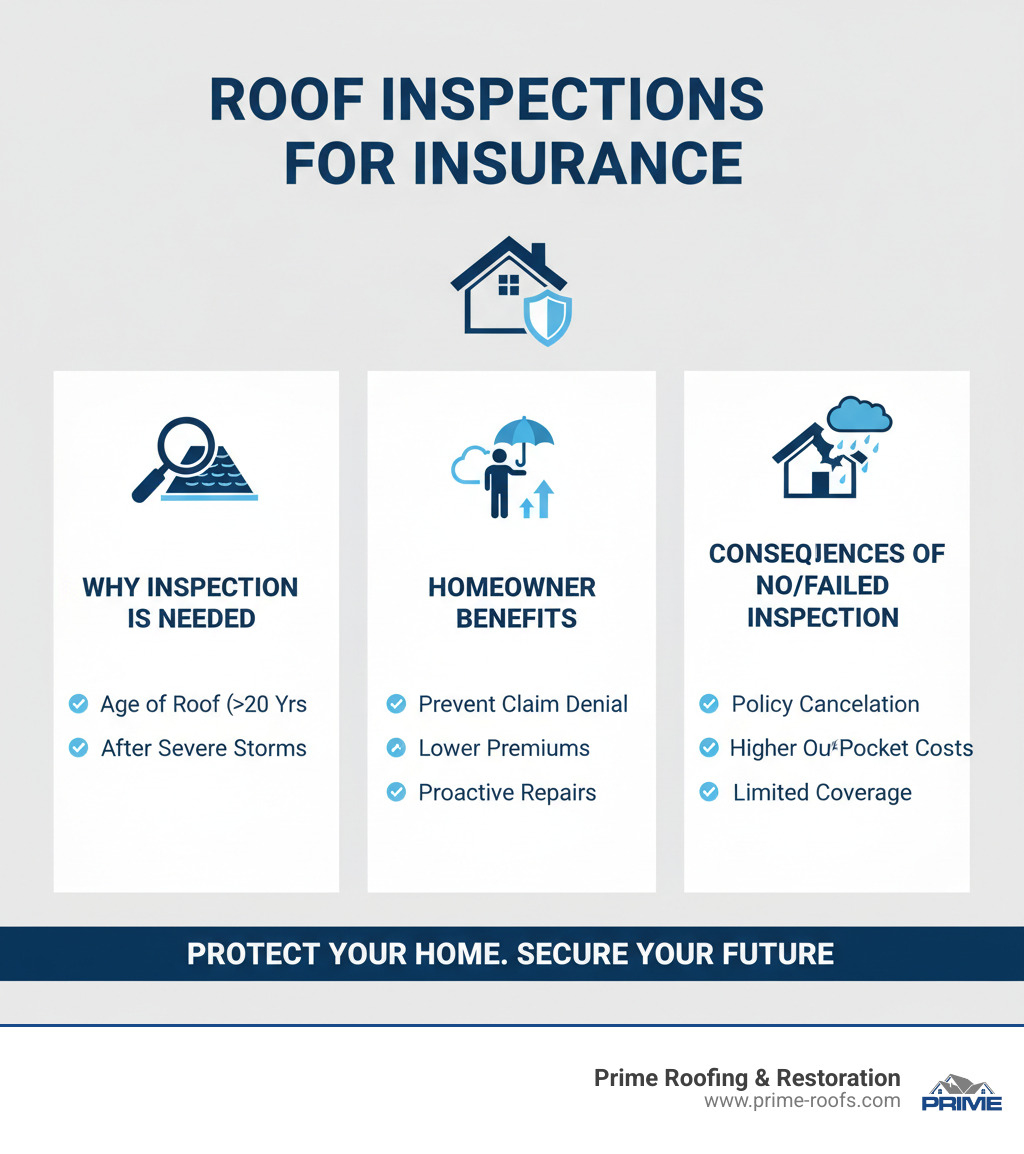
The Triggers for an Insurance Inspection
Several specific events and conditions can prompt your insurance provider to request a formal roof inspection for your home in communities like Alabaster, AL, Orange Beach, or Hoover:
- Roof Age: This is the most common trigger. Most asphalt shingle roofs have a lifespan of 20-25 years. As a roof approaches or exceeds the 15- or 20-year mark, insurers consider it a high-risk liability. Many companies automatically flag roofs over 20 years old for inspection before renewing a policy. For other materials, the timeline varies: architectural shingles may last 30 years, while metal or tile roofs can last 50 years or more, but insurers will still want proof of their condition.
- Recent Storms: After a significant weather event, such as a major hailstorm, hurricane, or tornado outbreak, insurers may mandate inspections across an entire affected zip code to assess widespread damage and validate the legitimacy of incoming claims. This helps them differentiate new storm damage from pre-existing issues.
- Policy Renewal: Insurers periodically review their portfolio of risks. An inspection might be required at your policy renewal, especially for older homes or if the property is in a region with increasing weather-related claims. This re-evaluation ensures the premium accurately reflects the current risk.
- Buying an Older Home: When you purchase an older home and apply for a new insurance policy, the insurer will almost certainly require a comprehensive roof inspection. They will not issue a new policy without first verifying the condition of the roof, as they don’t want to inherit problems from the previous owner.
- Filing a Claim: An inspection by an insurance adjuster is a mandatory, non-negotiable step when you file a claim for roof damage. The adjuster’s goal is to verify the cause, scope, and cost of the damage to determine the payout.
- History of Claims: If you have filed multiple claims in the past (even for non-roof issues), your provider may see you as a higher-risk client. This can trigger a more thorough review of your property’s overall condition, with the roof being the primary focus.
The Financial Impact of Your Roof’s Condition
The state of your roof has a direct and often substantial effect on your homeowner’s insurance costs and the quality of your coverage:
- Higher Premiums: A roof showing significant wear, granule loss, or minor damage signals a higher probability of future failure. To offset this increased risk, insurers will charge higher premiums.
- Policy Cancellation or Non-Renewal: If an inspection deems a roof to be in very poor condition (e.g., widespread damage, active leaks, or exceeding its lifespan), an insurer may cancel your policy with a 30-day notice or, more commonly, issue a notice of non-renewal. This can leave you scrambling to find coverage, which is extremely difficult with a failing roof.
- Coverage Exclusions or Limitations: In some cases, an insurer might agree to renew your policy but with significant changes. They may exclude the roof from coverage entirely, meaning any future roof damage is your financial responsibility. Alternatively, they may change your coverage from Replacement Cost Value (RCV) to Actual Cash Value (ACV), which only pays for the roof’s depreciated value, leaving you to cover the majority of a replacement cost.
- Difficulty Securing New Coverage: If you are dropped by your insurer or are shopping for a new policy with a roof in poor condition, you will find it very difficult and expensive to get insured. Many standard carriers will refuse to write the policy, forcing you into higher-cost, lower-quality surplus line markets.
The Anatomy of a Roof Inspection for Insurance
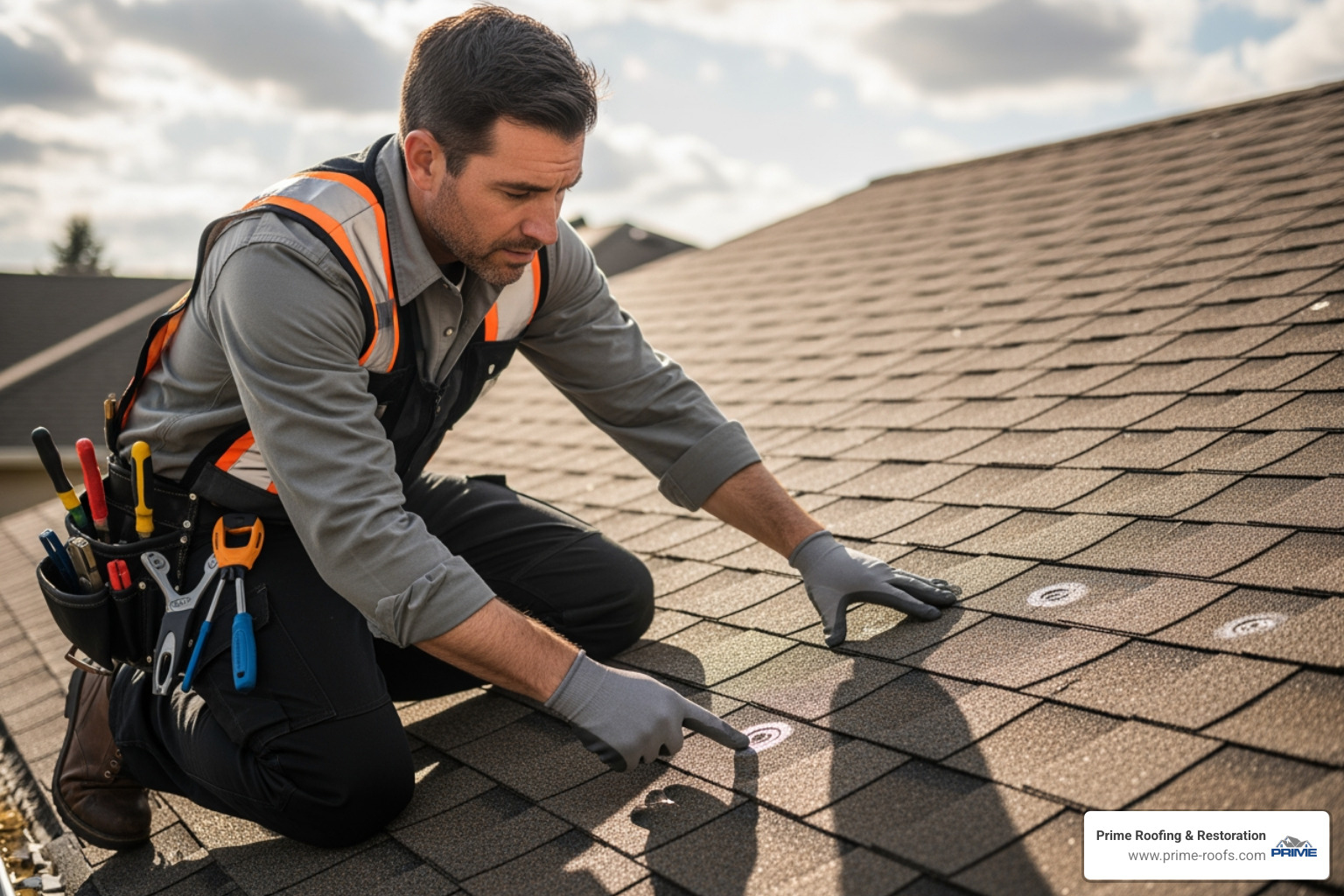
A roof inspection for insurance is a meticulous, systematic evaluation of your entire roofing system, from the structural supports to the outermost layer. Its primary goal is to identify any existing defects, vulnerabilities, or potential issues that could lead to future insurance claims. This comprehensive deep dive assesses the roof’s structural integrity, the condition of its materials, and its estimated remaining lifespan to provide the insurer with a clear, quantifiable picture of their risk. At Prime Roofing & Restoration, we provide a detailed, photo-documented report that not only protects your home but also gives clear, undeniable answers to your insurer, empowering you to understand your roof’s condition and protect your most valuable asset.
The Inspector’s Checklist: What They Look For
When a qualified inspector from a firm in a place like Alabaster, AL, assesses your roof, they follow a rigorous checklist designed to miss nothing. Here’s a detailed breakdown of what they focus on during a roof inspection for insurance:
- Structural Integrity: This is the foundation of the inspection. They look for signs of structural failure like sagging rooflines (which may indicate failing rafters or decking), uneven roof planes, and rot or water damage to the fascia boards and soffits. They also inspect the chimney for cracks in the masonry or cap and check the attic for proper ventilation, as blocked vents can lead to moisture buildup and premature aging.
- Material Condition: The focus here is on the visible weathering and damage to the roofing materials themselves.
- Asphalt Shingles: Inspectors look for missing, cracked, or torn shingles. They also check for curling (edges lifting), buckling (wrinkling), and blistering. A key indicator is significant granule loss, where the protective top layer of the shingle has worn away, exposing the underlying asphalt to UV degradation.
- Metal Components: This includes flashing, valleys, and metal roof panels. The primary concern is rust, corrosion, or denting from hail. They also check for loose or failing fasteners.
- Organic Growth: The presence of moss, algae, or lichen is a red flag. These organisms trap moisture against the roof surface, which accelerates deterioration and can lead to rot.
- Seals and Gaskets: They examine the rubber boots (gaskets) around vent pipes and other penetrations. Over time, these can become cracked, brittle, and worn, creating a direct path for water intrusion.
- Flashing and Seals: Flashing—the metal strips that seal joints—is a common point of failure. Inspectors meticulously check the flashing around chimneys, vents, skylights, dormer walls, and in roof valleys where two planes meet. Damaged, loose, or improperly sealed flashing is a leading cause of roof leaks.
- Gutter System: A functional gutter system is crucial for roof health. The inspector will check for clogs from leaves and debris, sagging or detached gutters, and damage that prevents water from being channeled effectively away from the home’s foundation.
- Interior Signs (The Attic): A thorough inspection always includes a trip into the attic. Here, the inspector looks for the most definitive signs of a leak: water stains on the underside of the roof decking, damp or compressed insulation, and any visible signs of mold or mildew growth on the wooden structures.
Professional inspectors also document “collateral damage” on the ground level, such as dents in gutter guards, AC units, window screens, or mailboxes. This helps build a comprehensive case to support a storm damage claim by proving the intensity of the event. You can view a sample inspection checklist from a major insurer to appreciate the level of detail required.
How Storm Damage is Documented
Proper, thorough documentation is the single most important factor in a successful insurance claim. Our experienced roofing contractors are experts at capturing every piece of evidence needed to prove your case:
- High-Resolution Photographic Evidence: We take hundreds of clear, well-lit photos of all damage. For hail, we photograph specific impact marks on shingles, vents, flashing, and other surfaces, often with a reference object for scale.
- Chalk Markings and Test Squares: To make subtle damage like hail strikes more visible in photographs for the adjuster, we may circle the impacts with chalk. We also frequently mark out a 10’x10′ “test square” on each slope of the roof and count the number of confirmed hail hits within it. This is the industry-standard method adjusters use to determine if a full replacement is warranted.
- Comprehensive Collateral Damage Assessment: We meticulously document damage to other parts of your property, including gutters, siding, fences, decks, and AC units. This helps prove the storm’s intensity and its undeniable impact on your roof, countering any claims of pre-existing wear and tear.
- Detailed Written Report: Our final report provides a complete narrative of the findings. It explains the type, location, and severity of the damage, and connects it directly to a specific weather event. This professional documentation is your most powerful tool, proving the damage is from a recent, insurable event, not long-term neglect. Knowing how to spot these signs yourself is also helpful; you can learn how to spot roof hail damage to be better prepared for the process.
Proactive vs. Reactive: The Benefits of Scheduling Your Own Inspection
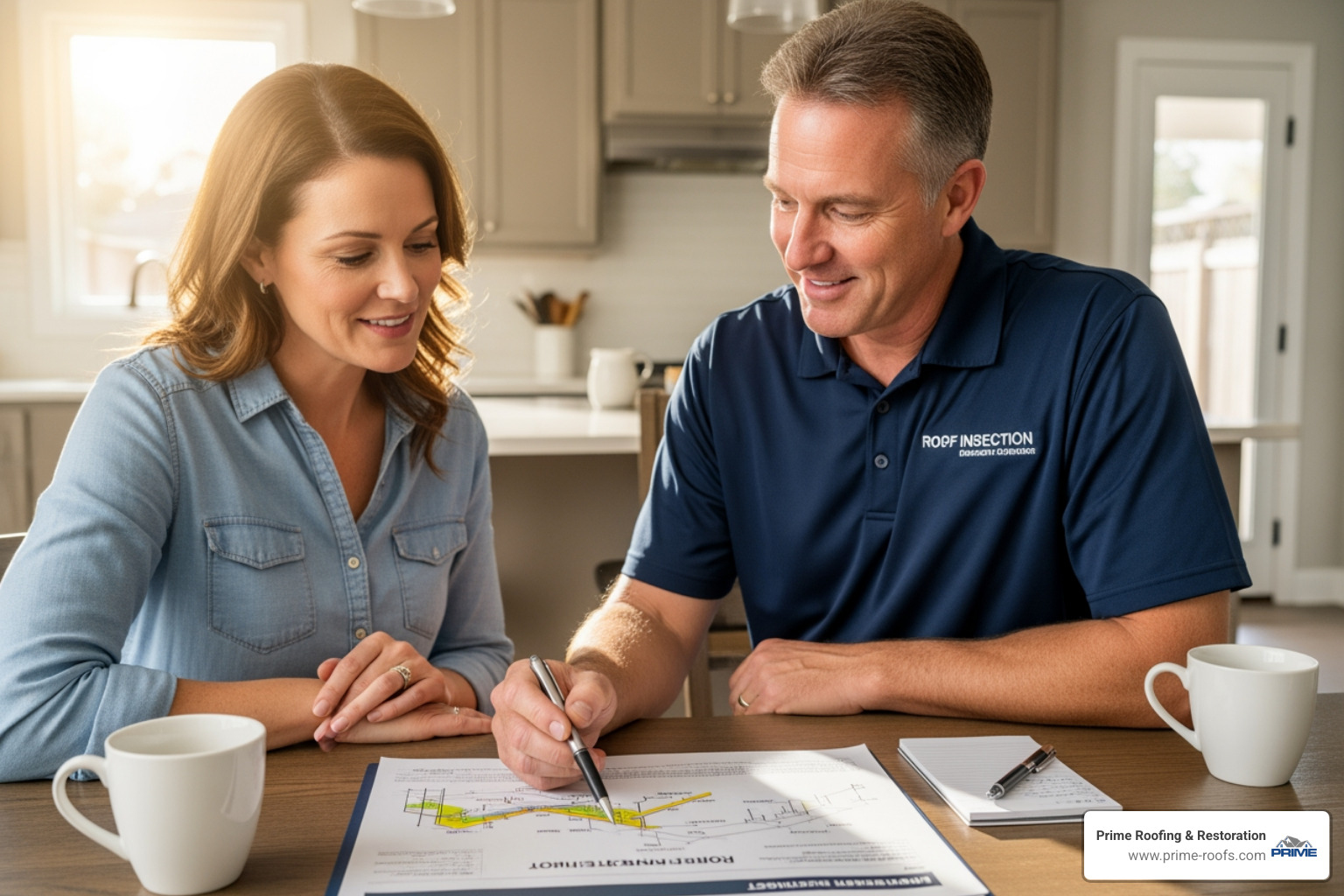
Waiting for your insurance company to flag a problem with your roof immediately puts you in a defensive, reactive position. Scheduling your own roof inspection for insurance before your insurer demands one puts you in complete control of the situation. This proactive approach arms you with an unbiased, expert assessment and provides significant leverage in any future negotiations or claims processes, ultimately saving you from immense stress, time, and money.
Gaining the Upper Hand in the Claims Process
By commissioning your own inspection from a trusted local roofer, you gain several powerful advantages:
- Obtain a Truly Independent Assessment: A roofer works for you, not the insurance company. Their inspection report is focused on protecting your best interests and ensuring the long-term health of your roof. An insurance adjuster’s primary role, in contrast, is to protect the insurance company’s financial interests by minimizing payouts.
- Establish a Pre-Storm Condition Baseline: This is perhaps the most critical benefit. A professionally documented inspection report, complete with time-stamped photos, serves as undeniable proof of your roof’s good condition before a storm. This single document can instantly neutralize an adjuster’s attempts to argue that damage was pre-existing or due to wear and tear.
- Prevent Claim Denials and Complications: A proactive inspection allows you to identify and fix minor issues—like unsealed nail pops, cracked pipe boots, or debris in valleys—that an adjuster might otherwise use to deny a legitimate storm damage claim based on a “lack of maintenance” or “improper upkeep” clause in your policy. A small repair today can prevent a full claim denial tomorrow.
- Make Informed Financial Decisions: Your roofer will provide a detailed estimate for any necessary repairs. This allows you to weigh the cost of repairs against your insurance deductible and decide if filing a claim is the smartest financial move. If the repair cost is close to your deductible, it may be wiser to pay out-of-pocket to avoid a potential premium increase.
- Prepare for the Adjuster’s Visit: When the adjuster arrives, you won’t be starting from scratch. You will be armed with a detailed report and photographic evidence from your own expert. You can walk the adjuster through the findings, ensuring their evaluation is thorough, fair, and that no damage is overlooked.
For a complete overview of how a proactive inspection can empower you as a homeowner, read our Free Roof Inspection Ultimate Guide.
Roof Inspection vs. Roof Certification: Understanding the Difference
While the terms are often used interchangeably by homeowners, “roof inspection” and “roof certification” serve two distinct and important purposes, especially in the context of insurance.
-
A Roof Inspection is a diagnostic tool. It is a point-in-time assessment designed to identify current problems, defects, storm damage, and areas of concern. The outcome of an inspection is a detailed report listing all deficiencies and providing recommendations for repairs or replacement. You would typically get an inspection after a storm, before buying a home, or as part of a routine maintenance plan.
-
A Roof Certification is a professional guarantee or warranty. It is a formal document, issued by a qualified roofing contractor, stating that the roof is currently free of defects and is expected to remain serviceable for a specified period (typically 1-5 years). Insurers often require a certification for older roofs (e.g., over 15-20 years old) as a condition for issuing or renewing a policy. It formally attests to the roof’s insurability and transfers a portion of the short-term risk from the insurer to the roofer who issued the certificate. According to the National Roofing Contractors Association (NRCA), any certification should be based on a thorough inspection and clear standards.
In short, an inspection tells you what’s wrong with your roof right now, while a certification is a roofer’s professional opinion predicting how much functional life the roof has left. A certification is always preceded by a thorough inspection (and any necessary repairs), but its primary purpose is to satisfy an underwriter’s requirements for long-term risk assessment.
Navigating the Aftermath: From Inspection Report to Insurance Claim
The inspection report is a critical first step, but it’s just the beginning of the journey. Your next actions—whether making mandated repairs, filing a complex claim, or contesting an unfair denial—require a clear and careful strategy. Having guided hundreds of Alabama homeowners through this exact process, we understand how to navigate the bureaucracy and advocate for the best possible outcome for you.
What Happens if Your Roof Fails an Insurance Inspection?
A failed roof inspection for insurance is a serious notice that requires immediate attention, but it’s not a catastrophe if handled correctly. Here are the common outcomes and what they mean for you:
- Repair Mandate: This is the most frequent result. Your insurer will provide a list of specific, required repairs and a firm deadline (often 30-90 days) to complete them to maintain your coverage. You will be required to submit proof of completion, such as a paid invoice from a licensed contractor.
- Notice of Non-Renewal: If the required repairs are not completed by the deadline, or if the inspection reveals the roof is beyond reasonable repair (e.g., at the end of its service life), your insurer will likely send a notice of non-renewal. This means they will not renew your policy when its current term expires, giving you a grace period to either replace the roof or find a new insurance provider.
- Immediate Cancellation: In rare cases of extreme neglect or hazardous conditions that pose an imminent risk, an insurer might issue a policy cancellation, which can be effective in as little as 10-30 days. This is a dire situation that requires immediate action.
- Higher Premiums or Reduced Coverage: Even if you make the required repairs, the insurer may now classify your property as higher risk, leading to an increase in your annual premiums. Alternatively, they may change your policy to an Actual Cash Value (ACV) schedule for the roof, significantly reducing your coverage for any future claims.
- Coverage Exclusions: An insurer might agree to continue your policy but add an endorsement that specifically excludes the roof from coverage. This leaves you fully exposed and financially responsible for any future roof-related damage until you replace it and have it re-inspected.
It’s crucial to address these issues promptly and professionally. We help homeowners develop practical, cost-effective repair solutions that satisfy insurance requirements and protect their homes. For more on your options, see our Damaged Roof Repair Guide 2025.
The Step-by-Step Process for Filing a Roof Damage Claim
Following a proven, strategic process can dramatically improve your chances of a fair and full settlement. Here is the most effective strategy we recommend to every homeowner:
- Contact a Trusted Roofer First: Before you even think about calling your insurance company, get a professional inspection from a reputable company like Prime Roofing & Restoration at (205) 901-0401. This provides you with your own expert assessment, crucial documentation, and invaluable leverage for the entire process.
- Review Your Policy and Deductible: Locate your insurance policy documents and understand your coverage. Do you have Replacement Cost Value (RCV) or Actual Cash Value (ACV)? What is your deductible (e.g., $1,000, or 1-2% of your home’s value)? This information will help you and your roofer determine if a claim is financially prudent.
- File the Claim: With your roofer’s assessment in hand, contact your insurance company to formally open a claim. Provide them with the date of loss (the date the storm occurred) and a general description of the damage. You will be assigned a claim number.
- Schedule the Adjuster Meeting: The insurance company will assign an adjuster to inspect your property. Coordinate a time for this meeting and immediately inform your roofer.
- Ensure Your Roofer is Present for the Adjuster’s Inspection: This is the most critical step. Your roofer should meet the adjuster at your property. They can walk the roof together, point out all the documented damage the adjuster might otherwise miss, speak the same technical language, and advocate on your behalf to ensure the scope of damage is assessed fairly and accurately.
- Review the Adjuster’s Report and Settlement Offer: After the inspection, the adjuster will produce a report and an estimate for the repairs. Compare this document line-by-line with your roofer’s estimate. If there are discrepancies (and there often are), your roofer can file a “supplement” with the insurance company, providing evidence and arguments for the additional items or costs needed to properly repair your roof.
For a more detailed walkthrough of this complex process, check out our Insurance Claims Assistance Complete Guide.
How to Prepare for a Roof Inspection to Ensure a Favorable Outcome
Taking a few simple steps before an inspector arrives shows you’re a responsible homeowner and can contribute to a smoother, more favorable assessment.
- Gather All Maintenance Records: Create a file with all receipts, invoices, and reports from previous repairs, cleanings, or inspections. This documentation is powerful proof of proactive care and can instantly counter any claims of neglect.
- Trim Overhanging Tree Branches: Branches that are touching or hanging low over the roof can cause damage by scraping shingles and dropping debris. Trimming them back prevents this and provides the inspector with clear, safe access to all roof surfaces.
- Clean Gutters and Downspouts: Clogged gutters can cause water to back up under the shingles, leading to rot. Clean gutters signal a well-maintained home and prevent water backup issues from being misdiagnosed as a roof leak or neglect.
- Ensure Safe and Clear Access: Clear any obstacles from the perimeter of your home. Unlock gates and ensure there is a clear path to your attic access panel. This allows the inspector to work safely, efficiently, and thoroughly.
Frequently Asked Questions About Roof Inspections and Insurance
Navigating the intersection of roofing and insurance can be confusing. Here are clear, straightforward answers to some of the most common questions we hear from homeowners.
What types of roof damage are typically covered by homeowners insurance?
Homeowners insurance is designed to cover sudden and accidental damage, often referred to as “perils” or “Acts of God.” This includes damage from specific, identifiable events like wind, hail, fire, lightning, and falling trees or debris. These are events that are unforeseen, unpredictable, and beyond your control.
Conversely, insurance does not cover damage resulting from lack of maintenance, general wear and tear, faulty installation, or old age. For example, a leak caused by shingles that are 25 years old and have simply worn out is considered a maintenance issue, not an insurable event. Similarly, damage from clogged gutters or unsealed nail pops falls under homeowner neglect. The key distinction an insurer makes is between an unexpected event and preventable, gradual deterioration. This is why proactive maintenance and regular inspections are critical for ensuring your coverage is there when you need it.
How often should I get my roof inspected?
For optimal roof health and longevity, roofing professionals recommend a professional roof inspection twice a year, ideally in the spring and fall. These biannual checkups help catch minor issues like lifted shingles or cracked pipe boots before they evolve into major, costly problems.
In addition to routine checks, you should always schedule an inspection immediately after a major weather event, such as a hailstorm, hurricane, or high-wind event, even if you don’t see obvious damage from the ground. For insurance purposes, having a documented professional inspection every 1-2 years is an extremely smart practice, especially for roofs over 10-15 years old. This creates a clear, time-stamped record of your roof’s condition, which becomes invaluable evidence for proving that any new damage was caused by a recent storm, not by age or neglect.
What’s the difference between Actual Cash Value (ACV) and Replacement Cost Value (RCV) coverage?
Understanding this distinction is critical, as it can mean a difference of tens of thousands of dollars in a claim settlement. It determines how your insurer will pay for your new roof.
-
Actual Cash Value (ACV) pays for your roof’s value at the moment it was damaged. It is calculated by taking the replacement cost and subtracting depreciation for age and wear. For example, let’s say a new roof costs $20,000 and has a 20-year lifespan. If your 15-year-old roof is destroyed, it has depreciated by 75%. An ACV policy would only pay $5,000 ($20,000 – 75% depreciation), leaving you to cover the remaining $15,000 out of pocket.
-
Replacement Cost Value (RCV) is far more comprehensive. It pays the full cost to replace your damaged roof with new, similar-quality materials, minus your deductible. In the example above, an RCV policy would pay the full $20,000 (less your deductible). Often, the payment is split: the insurer first pays the ACV, and then releases the remaining amount (the depreciation) after you provide an invoice proving the work has been completed.
We always recommend reviewing your policy to confirm which coverage you have. If you have an ACV policy, especially on an aging roof, it is a wise investment to contact your agent about upgrading to RCV for greater financial protection.
Can my insurance company force me to use their preferred contractor?
No. While your insurance company may provide a list of “preferred” or “network” contractors, you are under no obligation to use them. In Alabama and most other states, you have the legal right to choose your own licensed and insured contractor. It is often in your best interest to select a trusted local roofer who will advocate for you, rather than a contractor who has a primary business relationship with the insurance company.
What if my insurance only pays to replace part of my roof? What about matching?
This is a common issue. If a storm damages only one slope of your roof, the insurer may only offer to pay for that single slope. This can lead to a mismatched appearance, as new shingles will not match the color of the older, weathered shingles. Whether or not the insurer is obligated to pay for a full replacement for aesthetic consistency depends on your specific policy language and state laws. Some policies have “matching” endorsements. A good roofer can help you navigate this by checking for local building codes or manufacturer specifications that may require a full replacement for proper installation, thereby compelling the insurer to cover the entire roof.
Ensure Your Roof is Covered with a Professional Inspection
A roof inspection for insurance is far more than a simple formality; it’s a critical process that stands as the first line of defense for your home, your family, and your financial well-being. As we’ve covered, your roof’s condition directly and powerfully impacts your insurance premiums, the quality of your coverage, and your ability to file a successful claim when disaster strikes. By shifting from a reactive to a proactive mindset, you can take command of the process with confidence, armed with the knowledge and documentation needed to protect the integrity of your home’s most important asset.
Don’t wait for a letter from your insurer or a leak in your ceiling to reveal a problem. A proactive inspection from a trusted professional gives you control, peace of mind, and the essential baseline evidence needed to handle any situation, from navigating a complex storm damage claim in Gulf Shores to satisfying underwriting requirements for a policy renewal in Alabaster.
The licensed, insured, and experienced experts at Prime Roofing & Restoration provide comprehensive Roof Inspection Services designed to help you document damage, navigate the claims process, and protect your home. We are a local Alabama company dedicated to serving our communities. We’re available 24/7 because we know that storms and emergencies don’t keep business hours. Call us anytime at (205) 901-0401 to schedule your free, no-obligation inspection today and take control of your roof’s future.
Contact Us
Prime Roofing & Restoration
-
Address:
123 Main Street
Alabaster, AL 35007 -
Phone:
(205) 901-0401 -
Hours:
Monday – Friday: 8:00 AM – 6:00 PM
Saturday: 9:00 AM – 1:00 PM
24/7 Emergency Services Available