
When Natural Light Dims: Understanding Commercial Skylight Replacement
Commercial skylight replacement is a critical, yet often overlooked, aspect of strategic building maintenance. Skylights are integral components of your building’s envelope—the physical barrier between the conditioned interior and the unconditioned exterior. When they perform optimally, they provide valuable natural light and can enhance ventilation. However, when they begin to fail, they can compromise your building’s structural integrity, energy efficiency, and the safety of its occupants. With a typical lifespan of 15 to 20 years, skylights often age in tandem with your roof. Factors such as extreme weather exposure, building settlement, and the quality of the initial installation can accelerate this aging process. Proactively replacing them is not just a repair; it’s a crucial investment in your property’s long-term performance that can prevent catastrophic damage and substantial emergency repair costs. As a leading provider of roofing and exterior restoration services, Prime Roofing & Restoration offers expert, integrated solutions for every component of your building’s protective shell.
Key indicators that a replacement is necessary include persistent fogging between glass panes, visible cracks or crazing in the dome, recurring water leaks, and a noticeable increase in energy consumption. Delaying replacement transforms these warning signs into significant liabilities. Upgrading to a modern, high-performance skylight, however, offers immediate and measurable benefits. These advantages extend far beyond simply stopping a leak. You can expect vastly improved energy efficiency through advanced glazing technologies, enhanced daylighting that is proven to boost employee productivity and morale, and the complete elimination of leak-related risks. A professional installation is paramount to realizing these benefits, ensuring the new unit is seamlessly integrated with your existing commercial roofing system for decades of watertight, worry-free performance, all accomplished with minimal disruption to your daily business operations.
Is It Time for an Upgrade? Key Signs Your Commercial Skylight Needs Replacing
Commercial skylights are engineered for durability, but even the best-built units have a finite service life. Most are designed to last between 15 and 20 years, meaning they often reach the end of their lifespan at the same time as the roof they are installed on. Recognizing the warning signs of skylight failure early is one of the most effective preventative maintenance actions a building owner can take, potentially saving thousands in future structural repairs and preventing catastrophic roof damage. At Prime Roofing & Restoration, our extensive field experience has shown that ignoring these red flags not only compromises the building’s integrity but also creates significant safety and financial risks.
Telltale Signs of Skylight Failure
Spotting a failing skylight requires a vigilant eye and knowing precisely what to look for. These are the most common and critical indicators that it’s time to schedule a professional commercial skylight replacement:
- Water Leaks and Interior Stains: This is the most urgent and obvious sign. Brown or yellow stains on ceilings, walls, or even drips on the floor below the skylight are definitive proof that water is getting in. The cause could be a failed seal, deteriorated flashing, or a crack in the glazing itself. While a minor leak might seem like a simple repair job, persistent water intrusion, especially in an older unit, almost always signals a systemic failure that requires a full replacement to properly resolve.
- Cracked, Crazed, or Discolored Glazing: Physical damage to the skylight’s lens is a major red flag. Hairline cracks can quickly expand, compromising weather resistance and structural integrity. On older acrylic or polycarbonate domes, a yellow, hazy, or cloudy appearance indicates that UV radiation has broken down the material, making it brittle and less effective at transmitting light. This degradation is irreversible and a clear sign the unit is past its prime.
- Fogging or Condensation Between Glass Panes: If your skylight has double-pane or triple-pane glass, any moisture, fog, or mineral deposits trapped between the layers is a definitive sign that the hermetic seal has failed. This failure allows the insulating argon or krypton gas to escape and moisture-laden air to enter, completely negating the unit’s thermal protection and energy efficiency. The skylight is no longer an insulated window, but a thermal hole in your roof.
- Inoperable Venting Skylights: For units designed to open and close, any operational failure is a serious concern. A skylight that is stuck open is a major security risk and an open invitation for water damage during the next rainstorm. One that won’t open at all has lost its ventilation function. The cause can range from a burned-out motor in an electric unit to stripped gears in a manual one, often indicating the unit has reached the end of its mechanical life.
- Noticeable Drafts and Energy Loss: If you can feel a distinct temperature difference—hotter in summer, colder in winter—when standing under your skylight, its insulating properties have severely degraded. These drafts are a symptom of failing seals and poor thermal performance, forcing your HVAC system to work overtime to maintain a comfortable indoor temperature, which directly translates to higher monthly energy bills.
- Frame Damage or Corrosion: The skylight’s frame is its structural backbone. Inspect it for signs of rust on metal frames, rot on wood frames, or warping and cracking on vinyl frames. Any compromise in the frame can break the watertight seal with the roof, leading to leaks and putting the entire system’s stability at risk. Corrosion can also weaken the frame to the point of structural failure.
The Escalating Risks of Delaying Replacement
Postponing a necessary commercial skylight replacement is a gamble that rarely pays off. It allows small, manageable problems to escalate into expensive, business-disrupting disasters. Persistent leaks will saturate roof decking and insulation, leading to widespread wood rot, structural decay, and the need for a much larger, more expensive roof replacement project. This water intrusion can also destroy valuable inventory, ruin sensitive electronic equipment, and create dangerous slip-and-fall hazards for employees and customers. Furthermore, the constant presence of moisture creates the perfect breeding ground for toxic mold and mildew, which can cause serious health problems and require costly remediation. From a financial standpoint, a failing skylight acts as a constant energy drain, forcing your HVAC system to run excessively and inflating your utility costs month after month. Timely replacement is a proactive measure that protects your assets, ensures a safe environment, and ultimately saves you a significant amount of money.
The ROI of Replacement: Unpacking the Benefits of New Commercial Skylights
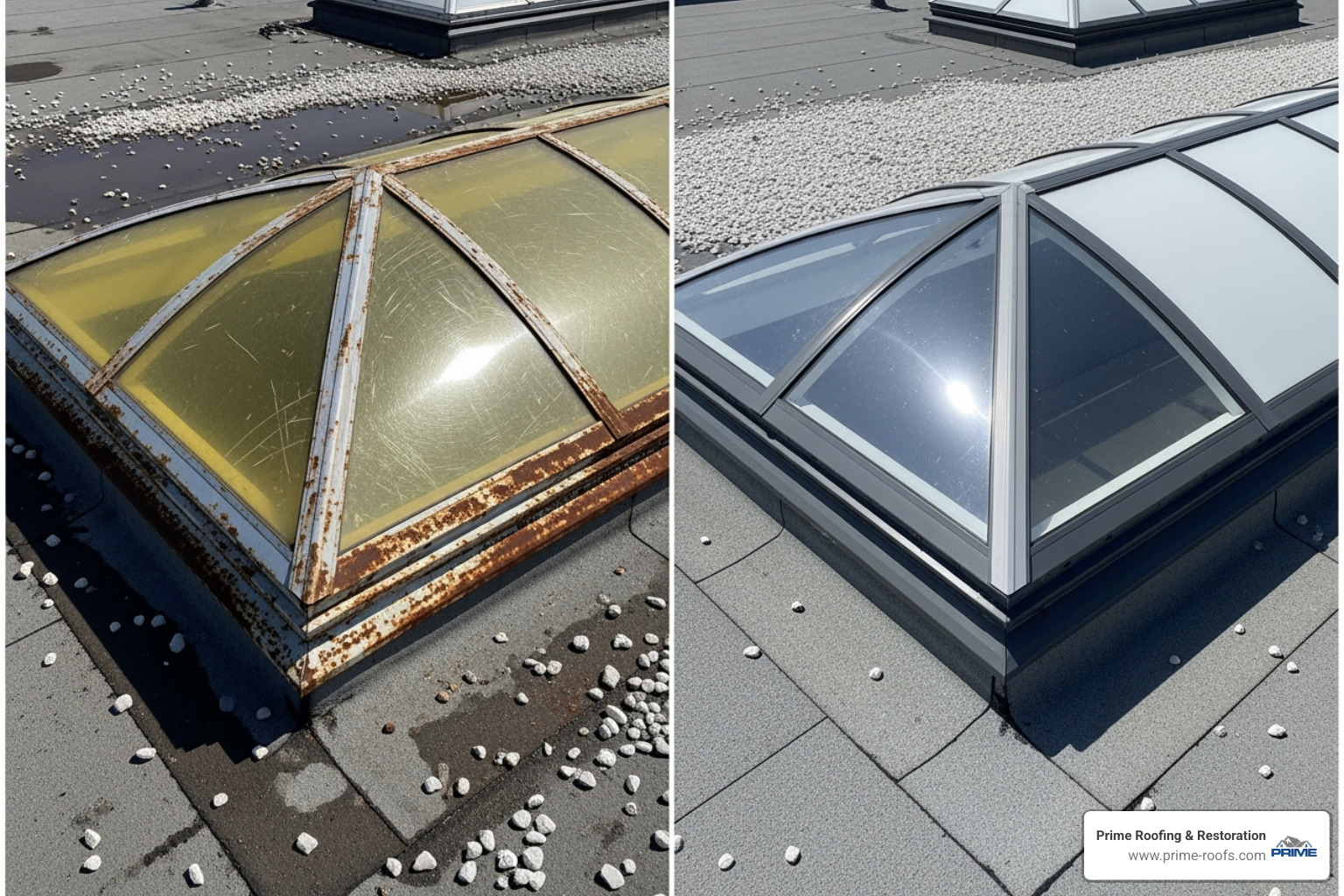
Replacing an old, inefficient, or failing skylight is one of the smartest investments a commercial property owner can make. Far from being a mere maintenance expense, a modern skylight upgrade delivers a powerful and measurable return on investment (ROI) that positively impacts your monthly operating budget and overall bottom line. The technological advancements in fenestration over the past decade mean that today’s skylights offer performance levels that were previously unattainable, turning a necessary repair into a strategic, value-adding upgrade for your facility.
Improved Energy Efficiency and Substantial Cost Savings
One of the most compelling reasons for commercial skylight replacement is the dramatic improvement in energy efficiency. Depending on the building’s location, size, and the type of unit selected, modern skylights can cut annual lighting and HVAC costs by a remarkable 20 to 40 percent. New units are designed to maximize useful daylight, flooding interior spaces with high-quality natural light. This significantly reduces the need for artificial lighting, a major consumer of electricity in most commercial buildings. Furthermore, advanced glazing with spectrally selective coatings acts as a sophisticated thermal barrier. These coatings are engineered to block solar heat gain in the summer while allowing visible light to pass through, and to prevent radiant heat loss in the winter. This dual action dramatically lowers the load on your HVAC system year-round. Today’s high-performance skylights, especially ENERGY STAR® certified products, feature double or triple glazing, inert gas fills (like argon or krypton), and low-emissivity (Low-E) coatings that create a superior insulation barrier against the elements. These features are rated by the National Fenestration Rating Council (NFRC) to provide clear performance metrics.
| Feature | Old Skylight (Pre-2000) | Modern Energy-Efficient Skylight | Annual Energy Savings (Estimated) |
|---|---|---|---|
| Glazing Type | Single-pane acrylic or basic double-pane glass | Double/Triple-pane, Low-E, Argon-filled | Significant (20-40% reduction in combined costs) |
| Insulation (U-Value) | High (e.g., >1.0) – Poor Insulation | Low (e.g., <0.40) – Excellent Insulation | Varies by climate and size |
| Heat Gain (SHGC) | High (e.g., >0.60) – Excessive Heat | Low (e.g., <0.30) – Controlled Heat | Up to 30% reduction in cooling costs |
| Visible Transmittance (VT) | Good, but often hazy/yellowed | Excellent, clear, and color-neutral | Reduced artificial lighting costs by 50-80% |
| Air Leakage | High (Common) | Very Low (<0.3 cfm/ft²) | Prevents drafts, saves heating & cooling |
The Power of Daylighting in Commercial Spaces
Beyond direct energy savings, the introduction of abundant, high-quality natural light—a practice known as “daylighting”—can fundamentally transform a commercial environment. An extensive body of research has demonstrated the profound positive effects of daylight on human performance and well-being. Studies by organizations like the Heschong Mahone Group have shown that workers in naturally lit office spaces are more productive, make fewer errors, and report higher levels of job satisfaction and wellness. In retail environments, natural light renders product colors more accurately and creates a more appealing shopping experience, encouraging customers to stay longer and spend more. In educational settings, it’s been linked to improved student test scores. The aesthetic improvement alone can make a building feel more modern, spacious, and open, impressing clients and boosting employee morale. The powerful combination of energy savings and productivity gains means the return on investment for commercial skylight replacement is often realized within just three to five years.
Your Guide to Modern Skylight Options and Materials
Choosing the right skylight for your commercial property involves a careful balance of performance requirements, aesthetic goals, and budget constraints. The market today offers a diverse and sophisticated range of solutions designed to fit any type of commercial building, from vast industrial warehouses and distribution centers to sleek modern offices and retail spaces. Understanding your options is the first step toward making an informed decision for your commercial skylight replacement project.
Types of Commercial Skylights
- Fixed Skylights: These are non-opening, fully sealed units. As the most economical and common choice, their primary function is to maximize daylighting in a given space. They have no moving parts, which minimizes maintenance and potential points of failure. Best For: Warehouses, manufacturing facilities, lobbies, atriums, and any large space where ventilation is already managed by a central HVAC system.
- Venting Skylights: Also known as operable skylights, these units can be opened to provide natural ventilation and fresh air circulation. They are available in manual (hand-crank), electric (wall switch or remote-controlled), and solar-powered models. Modern smart versions can be integrated with building automation systems and often include rain sensors that automatically close the unit at the first sign of precipitation. Best For: Offices, commercial kitchens, gyms, conference rooms, and any area that benefits from passive cooling and moisture control.
- Tubular Skylights: Often called sun tunnels or light tubes, these innovative systems are designed to bring natural light into interior spaces where a traditional skylight isn’t feasible. They use a small, highly efficient dome on the roof to capture sunlight, which is then channeled through a highly reflective tube down into the space below, ending in a diffuser that spreads the light evenly. Best For: Interior hallways, windowless offices, restrooms, closets, and core building areas far from exterior walls.
- Custom and Architectural Skylights: For projects that demand a unique aesthetic or have specific structural requirements, custom skylights offer limitless design possibilities. Options include dramatic pyramid shapes, elegant barrel vaults, continuous ridge lights along a roof’s peak, and large-scale modular systems that can create an entire glass roof. These are engineered to become stunning architectural features. Best For: High-end retail centers, corporate headquarters, hotel lobbies, museums, and atriums.
Glazing and Frame Materials
The long-term performance, durability, and energy efficiency of a skylight are largely determined by its core materials. Modern advancements in glazing and framing offer significant advantages over the materials used in older units.
- Glazing Options: The “glass” of the skylight is its most critical component. Tempered or laminated glass is the premium standard, offering superior clarity, scratch resistance, and longevity. For applications requiring high impact resistance, such as in hurricane zones or areas with heavy hail, polycarbonate is a lightweight and virtually unbreakable alternative. Acrylic is another plastic option, often used in dome skylights for its cost-effectiveness, though it is more prone to scratching and UV degradation over time. Impact-resistant glazing that meets Miami-Dade or Texas Department of Insurance standards is essential in high-wind regions.
- Advanced Coatings: The most significant technological leap in glazing is the development of Low-E (low-emissivity) coatings. These are transparent, microscopically thin layers of metal oxide applied to the glass surface. They are spectrally selective, meaning they block specific wavelengths of energy. They reflect long-wave infrared energy (heat) back to its source, keeping heat out in the summer and in during the winter, while allowing visible light to pass through. This dramatically reduces cooling and heating costs.
- Frame Materials: Aluminum is a popular choice for commercial frames due to its strength, durability, and corrosion resistance, but it must include a “thermal break”—a piece of less conductive material—to prevent energy loss. Vinyl and rigid PVC frames are excellent insulators, require minimal maintenance, and are very cost-effective. Fiberglass frames offer the best of all worlds: the strength of aluminum with the superior insulation of vinyl, plus minimal expansion and contraction with temperature changes.
The Commercial Skylight Replacement Process: From Inspection to Installation
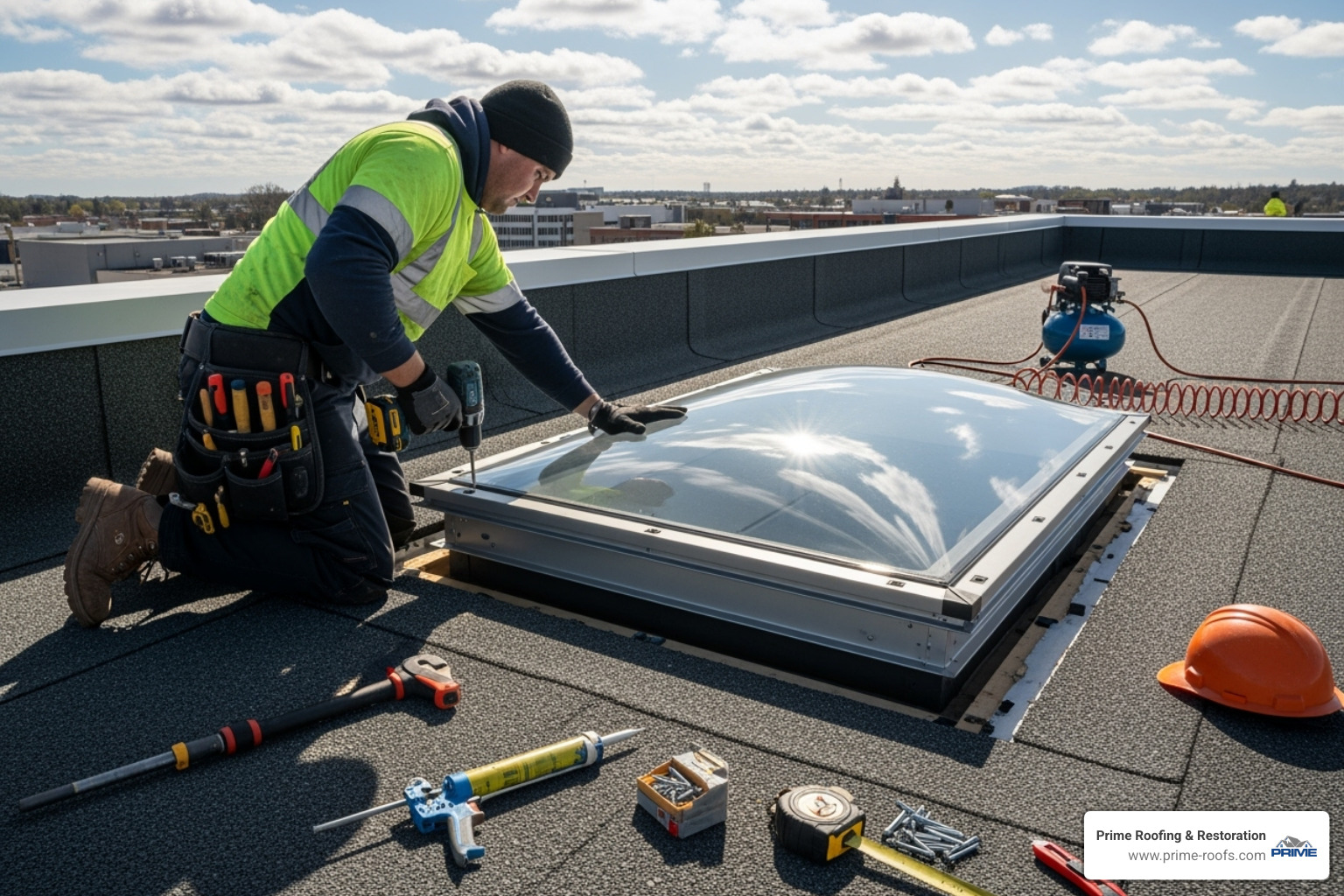
A professional commercial skylight replacement is a systematic, multi-step process designed to ensure your new unit is installed correctly, integrates perfectly with your specific roofing system, and provides decades of leak-free service. The entire procedure is meticulously planned to minimize disruption to your business operations, with a standard replacement often completed in just a few hours to a single day. At Prime Roofing & Restoration, our certified and experienced team follows a proven methodology to make the process smooth, safe, and efficient from start to finish.
Step-by-Step Replacement Guide
- Comprehensive Inspection and Diagnosis: The process begins not with removal, but with a thorough assessment. Our technician will inspect the existing skylight, its curb, the surrounding flashing, and the adjacent roof area. We use tools like moisture meters and thermal imaging cameras to identify the root cause of any failure and detect hidden water damage in the roof deck or insulation.
- Precise Measurement and Product Selection: We take exact measurements of the existing unit and curb. We then consult with you to understand your goals for daylighting, ventilation, and energy performance. Based on this consultation and your budget, we help you select the ideal skylight type, glazing package, and frame materials for your specific application.
- Thorough Site Preparation: Safety is our top priority. Before any work begins, our team implements comprehensive safety protocols, including OSHA-compliant fall protection for our crew. We also protect your property by laying down tarps and barriers on the interior to catch any dust or debris and covering any sensitive equipment below the work area.
- Careful Removal of the Old Unit: The old, failing skylight is carefully dismantled and removed. Critically, all of the old flashing, sealants, and roofing materials immediately surrounding the skylight are also stripped away. This is essential to create a clean, solid, and properly prepared surface for the new installation.
- Curb Inspection and Preparation: The curb—the raised wooden or metal frame that the skylight sits on—is the foundation of the entire system. We meticulously inspect it for any signs of water damage, rot, or structural weakness. If the curb is compromised, it must be repaired or completely rebuilt to ensure a solid, level base for the new skylight. This step is non-negotiable for a long-lasting installation.
- New Skylight Installation: The new skylight unit is carefully hoisted into position and set onto the prepared curb. It is then fastened securely according to the manufacturer’s precise specifications to ensure it can withstand wind uplift and other environmental stresses.
- Expert Weatherproofing and Flashing Integration: This is the most critical step for preventing future leaks. New flashing is expertly installed around the curb. The technique varies depending on the roof type. For TPO or EPDM roofs, this involves heat-welding or using specialized primers and tapes to create a monolithic, waterproof seal between the new flashing and the existing roof membrane. This process requires specialized tools and certified expertise.
- Interior Finishing and Final Cleanup: Once the exterior work is complete and fully sealed, we move inside to restore any interior finishes that may have been disturbed. Finally, our team conducts a thorough cleanup of the entire work area, both inside and out, leaving your property as clean as we found it.
Special Considerations for Commercial Flat Roofs
Replacing skylights on low-slope or flat commercial roofs requires a higher level of expertise than on sloped residential roofs. Most commercial properties correctly use curb-mounted skylights. The curb’s function is to elevate the skylight above the roof’s surface, preventing water from pooling against its edges—a phenomenon known as “ponding water.” Building codes often mandate a minimum curb height. Integrating the new skylight’s flashing with modern single-ply roofing membranes like TPO, PVC, or EPDM is a technical process that requires specific welding temperatures or adhesive chemistries to create a permanent, watertight bond. Ensuring proper drainage away from the curb, sometimes by installing water diverters or “crickets,” is also critical to prevent leaks and protect the roof membrane from premature failure.
Ensuring a Flawless Installation and Long-Term Performance
The ultimate success and longevity of your new commercial skylight depend on two equally important factors: the quality of the initial installation and a commitment to basic, routine maintenance. While modern skylights are designed to be durable and low-maintenance, the installation process is where their performance is either guaranteed or compromised. Partnering with a certified, experienced professional roofing contractor is the single most important decision you can make to protect your investment and ensure decades of reliable, leak-free performance.
Why Professional Commercial Skylight Replacement is Non-Negotiable
In an effort to save money, some building owners might be tempted to hire a general handyman or an unqualified, low-bid contractor. This is a critical mistake that almost inevitably leads to recurring leaks, premature failure, voided manufacturer warranties, and ultimately, much higher costs in the long run. Professional installation is absolutely essential for several key reasons:
- Mastery of Watertight Sealing: A professional roofer understands the complex science of water management on a commercial roof. They have mastered the specific techniques required to integrate flashing with different roofing systems—from heat-welding TPO to applying multi-course sealants on modified bitumen—to create an impenetrable, monolithic barrier against water intrusion.
- Strict Adherence to Building Codes: Professionals are knowledgeable about and stay current with local and national building codes, including the International Building Code (IBC) and the International Energy Conservation Code (IECC). They ensure your project is fully compliant with regulations regarding structural loads, energy efficiency, and safety, preventing failed inspections and potential legal issues.
- Rigorous Safety Protocols: Working on commercial roofs, especially at height, poses significant risks. Trained and insured professional teams adhere to strict OSHA safety standards, utilizing proper fall protection equipment, secure ladder-access protocols, and site-specific safety plans to protect their workers, your employees, and your property.
- Warranty Protection: Virtually all skylight manufacturers require their products to be installed by certified or qualified professionals to keep the product warranty valid. An improper installation by an uncertified installer will immediately void your warranty, leaving you with no recourse if the product fails prematurely.
- Correct Material and Tool Usage: A professional knows that material compatibility is key. They use only high-quality, manufacturer-approved sealants, fasteners, and flashing materials designed specifically for commercial skylight replacement and your particular roof type, ensuring maximum durability and system integrity.
Our comprehensive expertise in all aspects of your commercial roofing system guarantees that your new skylight is not just an addition, but a seamless and durable integration.
Post-Replacement Maintenance Checklist
While modern skylights require minimal upkeep, a simple, proactive maintenance routine can significantly extend their lifespan and ensure they continue to perform at their peak.
- Semi-Annual Inspections (Spring and Fall): At least twice a year, visually inspect the skylight from both the interior and exterior. Look for any signs of new cracks, discoloration, or seal failures. Check the surrounding flashing to ensure it remains fully adhered and sealed.
- Clear Debris: Regularly inspect the roof area around the skylight and clear away any accumulated leaves, branches, dirt, or other debris. This is crucial for preventing blockages that can impede proper water drainage and lead to ponding water.
- Clean the Glazing: Periodically clean the skylight’s glazing (both inside and out, if accessible) with a soft cloth, water, and a mild, non-abrasive soap. This removes grime and film buildup, maximizing light transmission and maintaining a clear view.
- Inspect Seals and Gaskets: During your routine roof inspections, pay close attention to the visible seals and gaskets around the skylight lens and frame. Look for any signs of drying, cracking, or separation that could indicate a potential future leak.
- Ensure Drainage Paths are Clear: Verify that the roof’s drainage system, including scuppers and drains, is functioning correctly. Proper overall roof drainage is essential to prevent water from backing up and challenging the skylight’s seals.
Frequently Asked Questions about Commercial Skylight Replacement
Making the decision to replace a commercial skylight often comes with many questions. Here are answers to some of the most common inquiries we receive from building owners and facility managers.
How much does commercial skylight replacement cost?
The cost of a commercial skylight replacement can vary widely based on several key factors. The primary drivers are the unit’s size, type (a fixed unit is less expensive than a motorized venting one), and glazing options (standard insulated glass vs. high-performance polycarbonate or glass with advanced Low-E coatings and impact ratings). Installation complexity is another major factor. A straightforward, one-for-one replacement on an easily accessible flat roof will cost significantly less than a project that requires extensive curb rebuilding, crane access for a high roof, or custom flashing for a complex metal roof system. To get an accurate and reliable price, it is essential to schedule a professional on-site inspection and receive a detailed written estimate.
Can my leaking skylight be repaired instead of replaced?
Whether a repair is a viable option depends heavily on the skylight’s age, the nature of the leak, and the overall condition of the unit. A minor leak from a localized sealant failure on a relatively new skylight (less than 7-10 years old) can sometimes be effectively repaired. However, replacement is almost always the more cost-effective and reliable long-term solution if the skylight is over 15 years old, the glazing is cracked or foggy (indicating a failed seal), the frame is rusted or warped, or if it has been repaired multiple times before. Repeatedly spending money to patch an aging, failing unit is often more expensive over time than replacing it once with a modern, warrantied system.
How long does it take to replace a commercial skylight?
For a standard-sized unit in a typical commercial setting, a professional, well-organized team can often complete a full commercial skylight replacement in just a few hours to a single workday. The majority of the work is confined to the rooftop, which means there is minimal disruption to your business operations on the interior. More complex installations, such as those involving multiple units, custom fabrication, or significant curb reconstruction, may extend the timeline. Adverse weather can also cause delays. Your contractor should always provide you with a clear, detailed project schedule before any work begins.
What is the difference between a curb-mounted and a deck-mounted skylight?
This is a crucial distinction. Curb-mounted skylights sit on a raised frame (the curb) that is built on top of the roof deck. This is the standard and required method for low-slope or flat commercial roofs because it lifts the skylight’s seals and seams above the level of potential standing water. Deck-mounted skylights have a lower profile and are installed directly onto the roof deck. These are designed exclusively for steeply sloped roofs (typically residential) where water sheds quickly and does not pose a pooling risk.
Will replacing my skylights disrupt my business?
Minimizing operational disruption is a top priority for any professional commercial roofing contractor. The replacement process is carefully planned to be as efficient and non-intrusive as possible. Work areas below the skylight are protected, and the actual replacement is often completed quickly. For sensitive environments like restaurants or retail stores, work can often be scheduled outside of normal business hours (early mornings, evenings, or weekends) to ensure zero impact on your customers and staff.
Are there skylight options that can withstand hurricanes or heavy snow loads?
Absolutely. Skylight manufacturers offer a range of products specifically engineered for extreme weather conditions. For coastal areas prone to hurricanes, you can specify impact-rated skylights that meet stringent Miami-Dade County or Texas Department of Insurance (TDI) testing protocols for large missile impact. For regions with heavy snowfall, skylights are designed and tested to withstand specific structural snow loads, which are dictated by local building codes. It is critical to select a product that is rated for your specific geographic location and climate challenges.
Secure Your Investment with a Professional Skylight Upgrade
Investing in a professional commercial skylight replacement is a forward-thinking, strategic decision for the health and future of your building. By learning to recognize the critical signs of failure and understanding the immense benefits of modern skylight technology—from substantial energy savings and improved safety to enhanced employee well-being and productivity—you can protect your valuable property and significantly improve its market value for decades to come.
New, high-performance skylights do more than just fix a problem; they transform a commercial space. The immediate improvement in energy efficiency directly slashes utility bills, delivering a tangible return on investment. Simultaneously, the superior quality of diffused daylighting creates a more inviting, vibrant, and productive environment for employees, customers, and tenants alike. At Prime Roofing & Restoration, our team of highly trained and certified experts is dedicated to ensuring your project is handled with the precision, care, and meticulous attention to detail that your investment deserves.
The key to a lasting, leak-free result that delivers all these benefits lies in the quality of the installation. Our licensed and insured professionals are masters of their craft, creating flawlessly integrated, watertight seals that comply with all building codes and manufacturer specifications. We pride ourselves on completing most replacements with minimal to no disruption to your business operations. If your property is in the Alabaster, AL area, our local team is ready to help you find the perfect daylighting solution for your needs.
Ready to bring new light, new life, and new efficiency into your commercial space? Contact us today for a comprehensive consultation and a free, no-obligation estimate.
Contact Prime Roofing & Restoration
Address:
Prime Roofing & Restoration
123 Main Street
Alabaster, AL 35007
Phone:
(205) 555-1234
Online:
Contact Us Today