
Why Storm Damage Home Repair Demands Immediate Attention
Storm damage home repair is the process of restoring your home after severe weather events like hurricanes, tornadoes, hail, or high winds cause structural harm. For homeowners, navigating this process requires a trusted partner, and at Prime Roofing & Restoration, we specialize in end-to-end solutions. This typically involves roof repairs, water damage remediation, and securing your property to prevent further loss. According to the National Centers for Environmental Information, weather and climate disasters in the U.S. caused over $92 billion in damages in a single year, making prompt and proper repairs critical for protecting your investment.
Quick Storm Damage Home Repair Checklist:
- Ensure safety first – Wait for official clearance, check for hazards like downed power lines or gas leaks
- Document all damage – Take photos and videos from multiple angles before cleanup
- Contact your insurance immediately – Most policies require prompt notification
- Prevent further damage – Tarp damaged roofs and board broken windows
- Hire a licensed, local contractor – Verify credentials and avoid “storm chasers”
- Understand your coverage – Know if your policy is RCV or ACV and what’s excluded
- Keep detailed records – Save all receipts for repairs, lodging, and communications
When a storm sweeps through Alabama, it can turn your safe haven into a disaster area overnight. From missing shingles and cracked siding to water-logged ceilings and structural damage, the aftermath leaves homeowners facing tough decisions about repairs, insurance claims, and contractor selection. The challenge isn’t just fixing what’s broken—it’s navigating the complex process while preventing additional damage and avoiding costly mistakes.
As Bill Spencer, owner of Prime Roofing & Restoration with over five years of hands-on experience serving Central Alabama, I’ve guided hundreds of homeowners through every stage of recovery with our storm damage repair services. This comprehensive guide walks you through the essential steps to protect your home, maximize your insurance claim, and rebuild stronger than before.
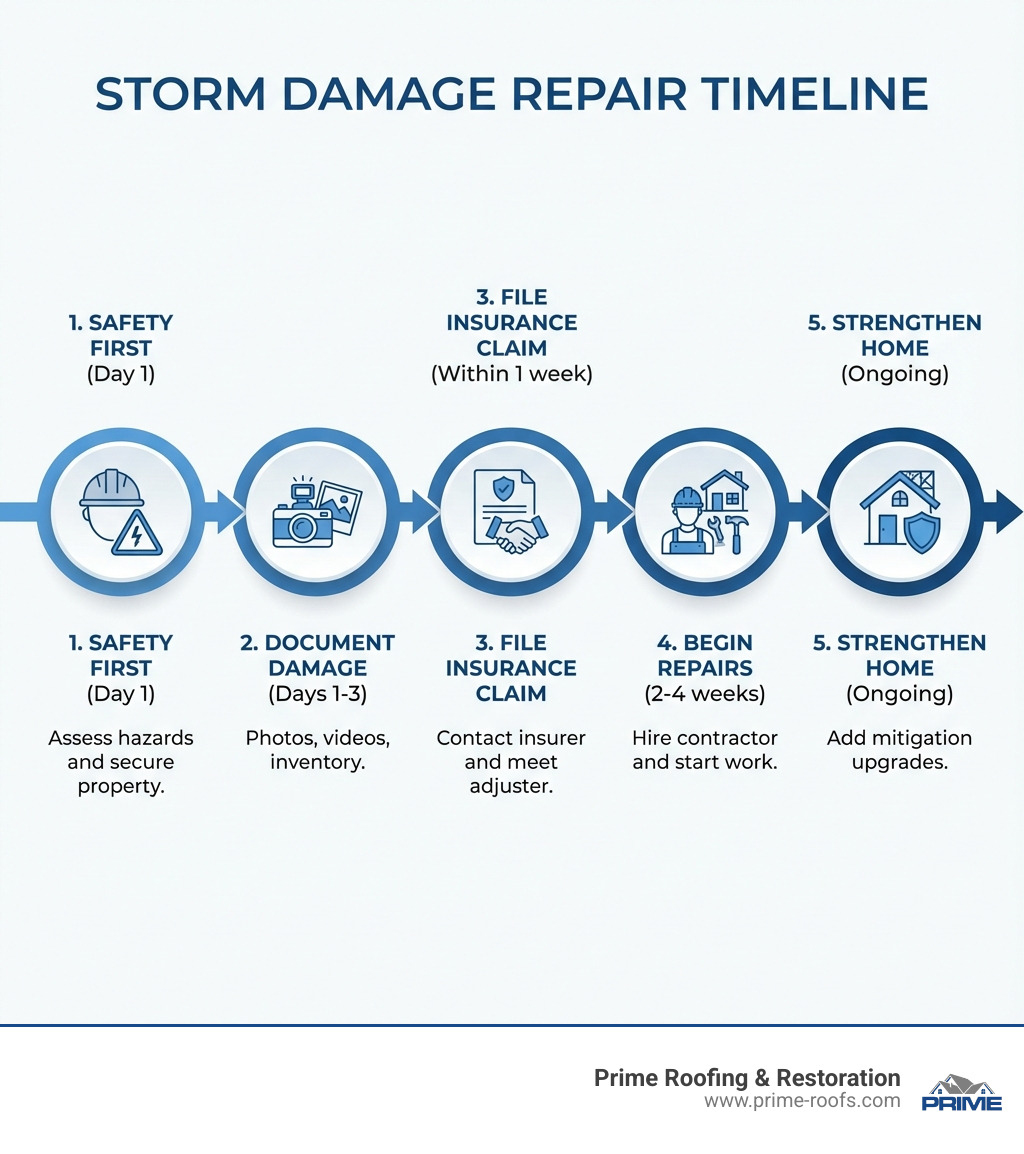
Know your Storm damage home repair terms:
Step 1: Prioritize Safety and Prevent Further Damage
Safety is the top priority after any storm. Once the immediate threat has passed and everyone is accounted for, take steps to secure your property and prevent additional losses.
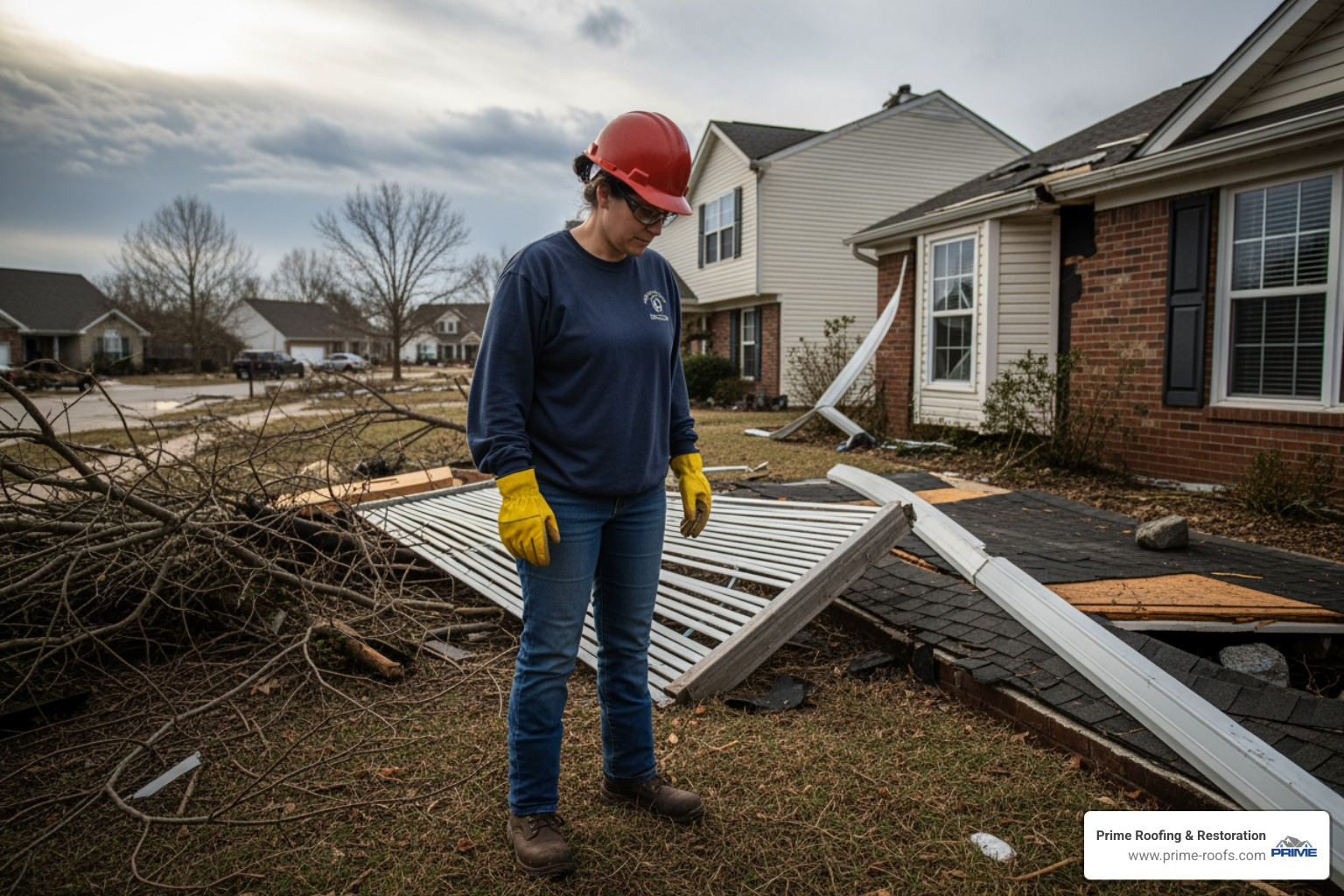
What are the immediate safety precautions to take after a storm?
The very first step after a storm is to ensure your family’s safety and your own. We always recommend waiting for official clearance from local authorities before returning to your property, as dangers like lingering flooding, downed power lines, or even secondary weather systems can persist even after the main storm passes.
Once clearance is given, approach your property with extreme caution. Immediate safety checks include:
- Check for hazards like downed power lines or gas leaks: Assume all downed power lines are live and dangerous. If you smell gas, evacuate immediately and call emergency services.
- Wear protective gear: Always wear sturdy boots, thick gloves, and long clothing. A helmet and eye protection are also highly recommended, especially if you’re dealing with debris.
- Avoid standing water: Standing water can hide electrical hazards, sharp debris, or even contain contaminants. If there’s standing water inside your home, avoid using electricity until a professional has assessed the risk.
- Use flashlights instead of candles: This prevents accidental fires in potentially compromised structures.
- Practice generator safety: If using a generator, always keep it outdoors and away from windows to prevent carbon monoxide poisoning.
For more detailed guidance on post-tornado safety and recovery, you can refer to FEMA’s guide on post-tornado safety.
How can I prevent further damage to my home?
Once immediate safety is addressed, our next priority is to prevent additional damage to your home, which can significantly reduce repair costs and insurance claim disputes. This is called emergency mitigation.
- Emergency tarping for your roof: If your roof has missing shingles, holes, or significant damage, it’s crucial to cover it with a tarp as quickly as possible. This prevents rain from entering your attic and home, which can lead to extensive water damage, mold growth, and compromised structural integrity. Many roofing companies, including Prime Roofing & Restoration, offer 24/7 emergency services, including emergency tarping. For more information, see our Emergency Tarping Complete Guide.
- Boarding windows: Broken windows or doors should be boarded up to prevent further water intrusion, debris entry, and unauthorized access.
- Shutting off utilities: If your home has significant water damage or structural issues, it’s wise to shut off the main water valve and electricity to prevent further damage from burst pipes or electrical shorts. If you suspect a gas leak, shut off the gas immediately.
- Move undamaged belongings: If feasible and safe, move any undamaged belongings to a dry, secure location to protect them from potential future leaks or water damage.
These temporary measures are vital for safeguarding your property until professional repairs can begin.
Step 2: Document Everything and Steer Your Insurance Claim
Thorough documentation is critical for a successful insurance claim. Creating a detailed record of your home’s condition immediately after the storm ensures you have the evidence needed for your insurer.
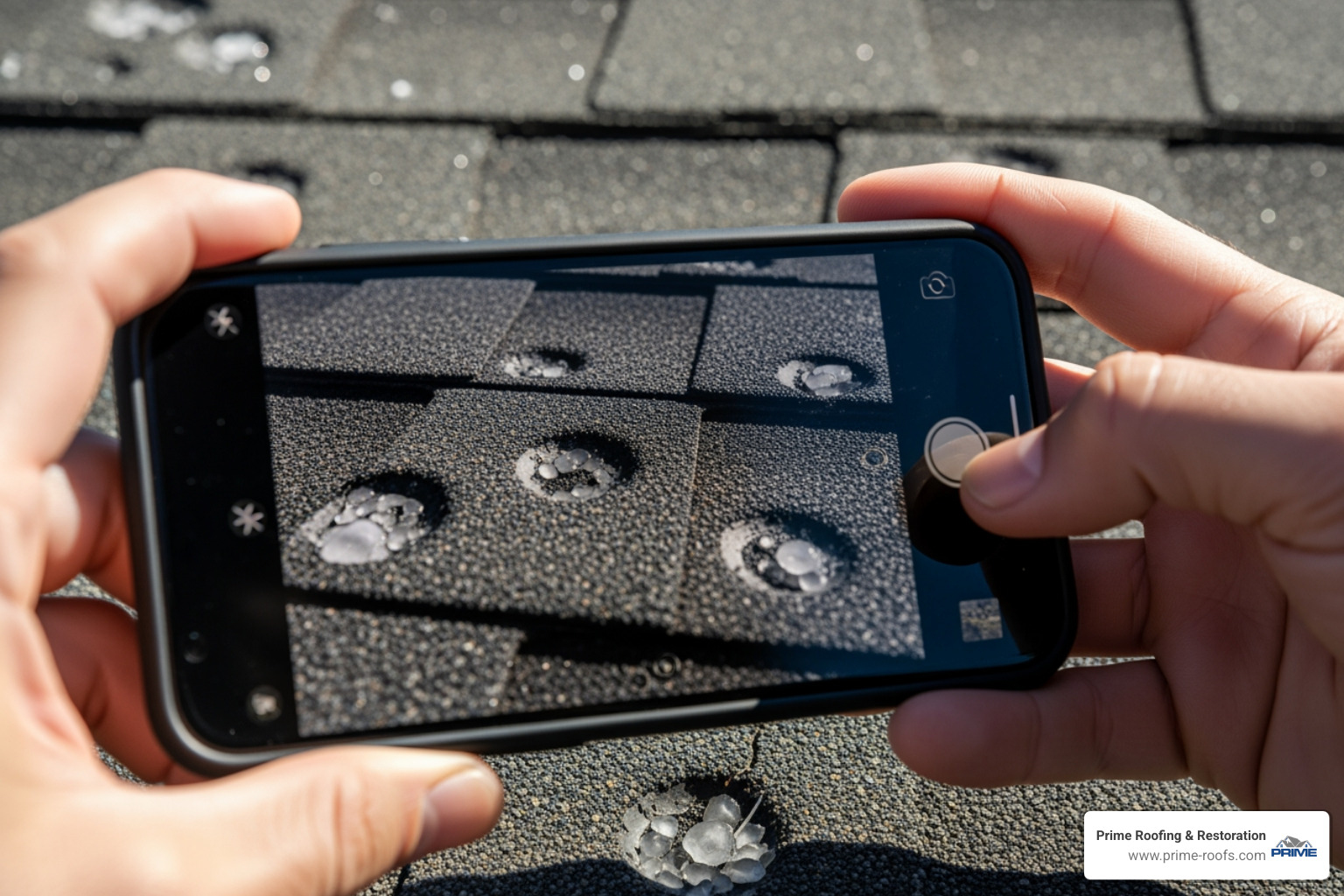
How should homeowners document storm damage for insurance claims?
Meticulous documentation is your best friend when dealing with insurance claims. It provides concrete evidence of the damage, helps prevent disputes, and can speed up your claim process.
- Take comprehensive photos from multiple angles: Use your smartphone or a camera to capture both wide shots that show the overall context of the damage and close-ups that highlight specific issues like missing shingles, cracks, or punctures. Take photos of all affected areas, inside and out.
- Record a narrated video walkthrough: Walk through your entire property, narrating what you see. Point out specific damages, mention the date, and describe the extent of the impact. This provides a dynamic record that can be very persuasive.
- Create a detailed inventory of all damaged items: List every damaged item, including appliances, furniture, electronics, and personal belongings. For each item, note its age, condition before the storm, and estimated value. If possible, include receipts or appraisals. Our Insurance Claims Assistance Complete Guide offers further tips.
- Keep all receipts: Save receipts for any temporary repairs (like tarps, plywood), lodging if your home is uninhabitable, food, and other storm-related expenses. Many of these may be reimbursable under your policy’s Additional Living Expenses (ALE) coverage.
Do not discard any damaged items before an insurance adjuster has had the opportunity to review the scene. This thorough approach ensures nothing is missed and supports your claim for full compensation.
How do insurance policies typically cover storm damage?
Understanding your insurance policy is crucial. Most standard homeowner policies cover damage from wind, hail, and wind-driven rain. This means if a storm’s high winds tear off your shingles, or hail dents your siding, your policy should cover the repair or replacement costs, minus your deductible.
However, a critical distinction is flood damage. Flood damage, caused by rising water from the ground up (e.g., storm surge, overflowing rivers), is generally excluded from standard homeowner policies and requires a separate policy through the National Flood Insurance Program (NFIP). It’s important to know this difference because if rain enters your home through a wind-damaged roof, it’s typically covered as wind damage. If it enters because of rising floodwaters, it’s a flood claim.
Another key aspect is whether your policy is a Replacement Cost Value (RCV) or Actual Cash Value (ACV) policy:
- RCV covers the cost to repair or replace damaged property without deducting for depreciation, meaning you get the full cost of a new item.
- ACV covers the depreciated cost, meaning you’ll receive less than the cost of a new item, accounting for wear and tear.
Understanding your policy type is crucial for knowing your potential payout. We recommend reviewing your policy documents carefully and contacting your insurer directly for clarification on any terms you don’t understand.
What is the role of an insurance adjuster and other resources?
An insurance adjuster is a professional hired by your insurance company to assess the damage to your property and determine the amount of money your insurer will pay for repairs. There are a few types:
- Company adjusters work directly for your insurance company.
- Independent adjusters are contracted by insurance companies to handle claims, especially after large disasters.
- Public adjusters are licensed professionals you can hire to represent your interests. They work for you, not the insurance company, and typically charge a percentage of your settlement. They can be particularly helpful if your claim is complex or you disagree with the insurer’s offer.
Preparing for the adjuster’s visit:
- Have all your documentation (photos, videos, inventory, receipts) organized and ready.
- Be prepared to walk them through the damage and point out everything you’ve documented.
- Consider having your contractor present during the inspection. A reputable contractor can provide expert insights and ensure the adjuster doesn’t miss anything.
Federal Aid: For major disasters, federal aid may be available through FEMA. This can include grants for home repair or replacement. For Fiscal Year 2025, the maximum amount FEMA can provide for home repair or replacement is $43,600. That FEMA inspectors do not make decisions about your eligibility or discuss money; they only assess the damage. Always be wary of scammers posing as adjusters asking for confidential information like your Social Security number or bank account numbers. You can find more information on how to identify legitimate adjusters at agents.floodsmart.gov/whos-knocking.
For a comprehensive understanding of the claims process, we highly recommend reviewing the NAIC’s Post-Disaster Claims Guide.
Step 3: The Ultimate Guide to Storm Damage Home Repair
Once your property is secure and your insurance claim is underway, focus shifts to repairs. Assess the full scope of work, determine whether to repair or replace, and select a reputable contractor.
What are the most common types of storm damage to homes?
Storms, particularly in our region of Alabama, can inflict a wide array of damage on homes. The most frequent issues we see include:
- Roof damage: This is often the first and most critical area affected. Hail can cause widespread bruising, granule loss, or even punctures on shingles, compromising their protective layer. High winds can lift, tear, or completely remove shingles, leaving your roof decking exposed. For more on this, check our article on Wind Damage to Roof Shingles.
- Siding damage: Wind-driven rain and hail can crack, dent, or detach siding panels, exposing your home’s exterior to moisture.
- Broken windows and doors: Flying debris can shatter windows or compromise the integrity of doors, leading to direct water intrusion and security issues.
- Water intrusion: Beyond roof and window damage, heavy rains can lead to leaks around chimneys, skylights, or through compromised flashing, causing interior water stains, warped flooring, and the potential for mold growth.
- Structural damage: Severe storms, especially tornadoes, can cause significant structural damage to walls, foundations, or the overall frame of your home. Signs include shifted foundations, cracked walls, or uneven floors.
- Gutter damage: Gutters and downspouts can be bent, torn off, or clogged with debris, preventing proper water drainage and potentially leading to foundation issues.
A professional roof inspection is always the best way to identify all issues, including hidden damage that might not be visible from the ground. Our experts are trained to spot subtle signs of damage that could lead to bigger problems down the road.
What are the key considerations when hiring a contractor for storm damage home repair?
Choosing the right contractor is paramount for a successful and stress-free repair process. This decision can impact the quality of your repairs, your insurance claim, and your peace of mind. Here’s what we advise:
- Choose a local, licensed, and insured contractor: Always verify that the contractor is licensed to operate in Alabama and carries appropriate insurance (liability and workers’ compensation). Local contractors are more likely to be familiar with regional building codes and are readily available for follow-up.
- Avoid “storm chasers”: Be wary of contractors who appear immediately after a storm, especially if they are from out of state and pressure you for quick decisions or large upfront payments. These “storm chasers” often do shoddy work and then disappear, leaving homeowners with unfinished projects and no recourse.
- Look for proven storm restoration experience: Ensure the contractor has a solid track record in storm damage repair, specifically for the types of damage your home has sustained.
- Get a detailed, written contract: Before any work begins, demand a comprehensive contract that outlines the scope of work, materials to be used, timelines, payment schedule, and warranty information.
- Check reviews and ask for references: Look for online reviews and ask the contractor for references from previous storm damage clients. This is especially important in your local community, such as in Alabaster, AL, where local reputation speaks volumes.
- Work with your contractor on the insurance claim: A good contractor will help you understand the insurance process and can even be present during the adjuster’s visit to ensure all damage is properly assessed.
We pride ourselves on being a trusted local partner for storm damage repair services, offering transparent communication and quality workmanship. You can learn more about how we work and why choosing a local, reputable contractor is important on sites like Contractor Connection.
What factors influence the costs of storm damage home repair?
The costs associated with storm damage home repair can vary widely, depending on several key factors:
- Extent and type of damage: A few missing shingles will cost significantly less to repair than a collapsed roof or a flooded basement requiring extensive water remediation.
- Material quality: The type of materials chosen for repair or replacement (e.g., standard asphalt shingles vs. metal roofing) will impact the overall cost.
- Labor rates: Labor rates for storm damage repairs typically range from $50 to $150 per hour, depending on the trade (roofers, carpenters, electricians) and your location. Emergency or after-hours repairs can increase labor costs by 20% to 50%.
- Additional services: Often, storm damage necessitates additional services beyond the primary repair. These can include:
- Debris removal: Hauling away fallen trees, broken glass, and other storm debris.
- Emergency tarping or temporary weatherproofing: To prevent further damage while awaiting permanent repairs.
- Mold remediation: If water intrusion has led to mold growth, which can start within 24-48 hours of water exposure. For more on mold, see this blog post.
- Permit fees: Many significant repairs require local building permits.
- Temporary housing: If your home is uninhabitable during repairs.
These additional services can increase your total bill by $500 to $5,000, depending on the scope and urgency. Always obtain a detailed estimate from a qualified professional for accurate budgeting. Our team can provide a comprehensive assessment as part of our storm damage repair services to help you understand potential costs.
Step 4: Rebuilding Stronger to Prepare for Future Storms
After repairs, invest in mitigation upgrades to make your home more resilient. These improvements can reduce future storm damage and may lower your insurance premiums.
How can homeowners prepare their homes for future storms?
After experiencing storm damage, many homeowners look for ways to fortify their homes against future events. This proactive approach, often called “wind mitigation” or “hurricane hardening,” can significantly reduce future damage and may even qualify you for insurance premium discounts.
- Install impact-resistant windows and doors or hurricane shutters: These protect vulnerable openings from flying debris during high winds.
- Reinforce roof-to-wall connections with hurricane straps: These metal connectors create a continuous load path from your roof down to your foundation, preventing your roof from lifting off in high winds. Studies have shown that hurricane ties had a 92% success rate during Hurricane Andrew.
- Upgrade to high-wind-rated roofing materials: Consider using shingles rated for 90+ mph winds, installed with a minimum of six nails per shingle for improved uplift resistance. For homes in Alabama, durable metal roofing is also an excellent option, offering superior resistance to wind and hail. You can learn more about the Benefits of Metal Roofing for Alabama Homes.
- Ensure gutters and downspouts direct water away from your foundation: Properly functioning gutters prevent water from pooling around your home, which can lead to foundation issues and basement flooding.
- Seal roof penetrations and add a secondary water barrier: Sealing joints with self-adhered tape and applying an ice and water shield over the entire roof deck can significantly reduce water intrusion even if shingles are lost.
- Trim trees and shrubs: Remove dead or weak branches that could fall on your home during a storm.
- Have an emergency kit and evacuation plan: While not a home repair, preparing your family with an emergency kit and a clear evacuation plan is a vital step in overall storm preparedness.
Implementing these measures not only protects your property but also contributes to your family’s safety. In Florida, for example, Statute 627.0629 requires insurance companies to offer “discounts, credits or other rate differentials” for homes with wind mitigation features, a practice that can also benefit homeowners in other storm-prone regions like Alabama. Regular roof maintenance also plays a crucial role in ensuring your home’s first line of defense remains strong.
Frequently Asked Questions about Storm Damage Repair
Will my insurance pay for a full roof replacement if only part of it is damaged?
This depends heavily on your specific insurance policy and the laws in your state. Many policies include a “matching clause” or require “like kind and quality” replacements. If your existing shingles are no longer manufactured or if the color/style cannot be reasonably matched, a full roof replacement may be justified to ensure a uniform appearance and structural integrity. Insurance companies understand that repairing only a section of a roof with mismatched materials can devalue your home and potentially lead to future issues. However, if a reasonable match is available, they may only cover the damaged section. It’s always best to consult with your roofing contractor and your insurance adjuster to understand your options.
What is the difference between damage from flooding versus wind-driven rain?
This distinction is crucial for insurance claims. Flood damage is caused by rising water that enters your home from the ground up, typically due to storm surge, overflowing rivers, or heavy rainfall that overwhelms drainage systems. This type of damage is generally not covered by standard homeowner’s insurance and requires a separate flood insurance policy, often through the National Flood Insurance Program (NFIP).
Wind-driven rain damage, on the other hand, occurs when rain enters your home through an opening created by wind damage (e.g., a hole in the roof from missing shingles, a broken window). In this scenario, the rain damage is considered a direct result of the windstorm, and thus, it is typically covered by a standard homeowner’s policy. If rain enters through a leaky roof that was not damaged by wind, it might not be covered. FEMA offers a guide to tell the difference.
How long do I have to file a storm damage claim?
Most insurance policies require you to report damage “promptly” or “as soon as reasonably possible.” This means you should notify your insurance company as soon as you find the damage, typically within a few days or weeks of the storm event. While some policies might specify a timeframe (e.g., 30 or 60 days), it’s always best to initiate the claim process immediately.
Statutes of limitations for filing insurance claims vary by state, ranging from one to several years. For instance, some states might allow up to two years from the date of loss. However, waiting too long can complicate your claim, as it can be harder to prove the damage was storm-related, or additional damage (like mold) might have occurred due to delayed repairs, which could be denied coverage. To avoid complications and ensure the best outcome, begin the process immediately after securing your property and documenting the damage.
Your Partner in Storm Recovery
Recovering from storm damage home repair is a complex process, but with the right steps, you can restore your home and peace of mind. By prioritizing safety, documenting thoroughly, understanding your insurance, and hiring a qualified professional, you can steer recovery with confidence. For homeowners in Alabaster and surrounding Alabama communities, Prime Roofing & Restoration is your trusted partner. We offer complete storm damage home repair services—from inspection to final repairs. Contact us today for a free assessment and to learn how we can help with your 24/7 emergency support needs.