
When Water Damage Strikes, Every Minute Counts
If you need damage restoration near me right now, securing professional restoration support is the most critical step you can take to protect your property. For immediate assistance, you can reach our 24/7 emergency line at 205-555-0123. When disaster strikes, whether it is a burst pipe in the middle of the night or a catastrophic storm surge along the Alabama coast, the speed of your response determines the extent of the recovery.
| Step | Action | Why It Matters |
|---|---|---|
| 1 | Call a certified restoration company immediately | Mold grows within 24-48 hours and structural integrity degrades rapidly. |
| 2 | Stop the water source if safe to do so | Limits total damage area and prevents further saturation of building materials. |
| 3 | Document everything with photos | Protects your insurance claim by providing clear evidence of the initial loss. |
| 4 | Avoid entering rooms with structural damage | Personal safety first; sagging ceilings and wet drywall can collapse without warning. |
| 5 | Ask for IICRC-certified technicians | Guarantees professional-grade results and adherence to the S-500 drying standards. |
| 6 | Turn off the HVAC system | Prevents the spread of mold spores and soot through the ductwork. |
| 7 | Move high-value items to a dry area | Protects heirlooms, electronics, and documents from secondary moisture damage. |
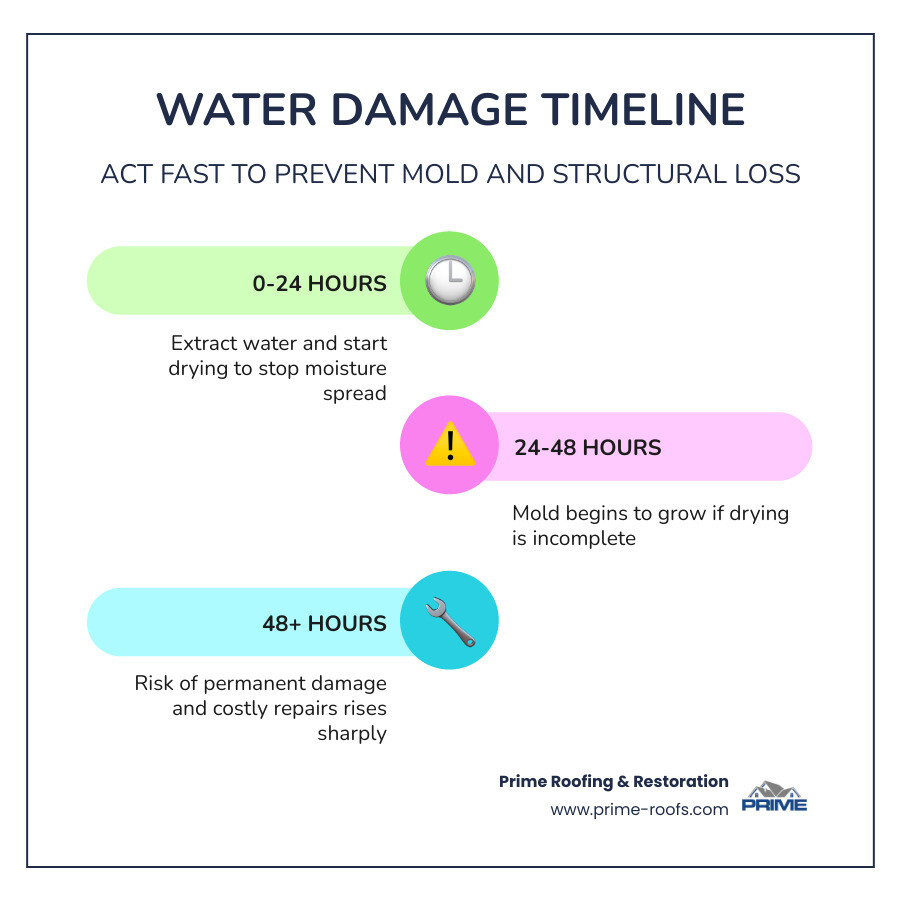
As of May 2026, water damage remains the second most common insurance claim in the United States, with over 1.7 million homeowners filing claims every year. That works out to roughly 14,000 people experiencing a water damage emergency every single day — at home or at work. When it happens to you, the clock starts immediately. Mold begins to colonize within just 24 to 48 hours of moisture exposure, turning what could be a straightforward drying job into a costly remediation project. And if fire or storm damage is involved, the stakes climb even higher. Fire damage introduces acidic soot that can etch glass and corrode metal within hours, while storm damage often leaves your home vulnerable to the elements, requiring immediate tarping and board-up services.
The good news? Fast action and the right professional restoration support can mean the difference between a manageable repair bill and a complete structural overhaul. At Prime Roofing & Restoration, we understand that your home is likely your largest investment. We don’t just see a job site; we see a family’s sanctuary that needs to be restored with care, precision, and speed.
I’m Bill Spencer, Owner and President of Prime Roofing & Restoration, and with over five years leading a dual-location restoration and roofing company serving Alabaster and Orange Beach, Alabama, I’ve seen how quickly damage restoration near me situations can spiral without expert intervention. In this guide, I’ll walk you through seven practical steps to stop water damage before it becomes a crisis — and show you exactly when to call in the professionals. We will cover everything from the science of structural drying to the complexities of navigating insurance claims in the modern era.
Damage restoration near me basics:
The Critical 24-Hour Window: Why Fast Damage Restoration Near Me Matters
Answer: Immediate water extraction within the first 24 hours is the only definitive way to prevent permanent structural rot and hazardous mold colonization.
When people search for damage restoration near me, they are often in the middle of a crisis. In the restoration world, we refer to the first 24 to 48 hours as the “golden hours” of recovery. This isn’t just a catchy phrase; it’s a biological and physical reality. Water is a solvent. The longer it sits, the more it dissolves the glues in your subflooring, warps your hardwood, and wicks up through your drywall via capillary action. This wicking effect can pull water several feet above the actual flood line, hidden behind baseboards and insulation where it can fester unseen.
Even more pressing is the threat of mold. According to EPA research on mold growth timelines, mold spores can begin to colonize within a day of moisture exposure. By the time you can see a fuzzy patch on the wall, the colony is already well-established and releasing spores into your indoor air. This is why “air drying” with a few household fans is rarely sufficient. Professional restoration requires a deep understanding of psychrometrics—the science of drying. We must balance temperature, airflow, and dehumidification to pull moisture out of dense materials like studs and subfloors.
Our team at Prime Roofing & Restoration utilizes advanced moisture detection and thermal imaging to find water hidden behind “dry” walls. These infrared cameras allow us to see temperature differences caused by evaporation, pinpointing exactly where the moisture is trapped without having to tear down every piece of drywall. If you’ve recently suffered a hit from a Gulf storm, checking our comprehensive storm damage guide can help you understand the risks of hidden intrusion. Beyond water, fire damage also requires a rapid response. Soot and smoke are acidic; they will permanently stain surfaces, yellow plastics, and corrode metal fixtures if not neutralized immediately. The longer soot sits, the deeper it penetrates porous surfaces, making restoration significantly more difficult and expensive.
Why Local Expertise Wins for Damage Restoration Near Me
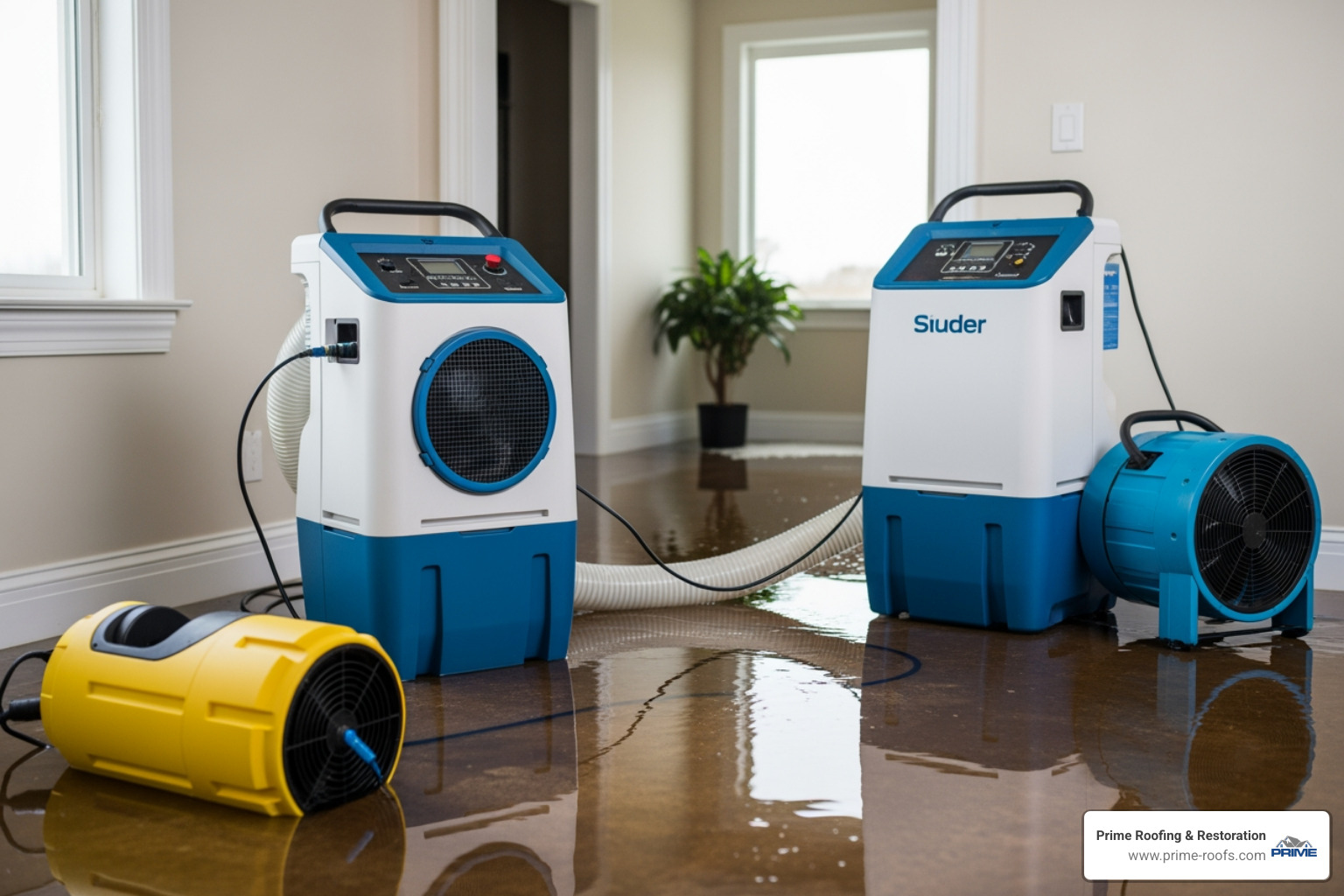
Choosing a local company over a massive national chain isn’t just about supporting your neighbors—it’s about logistics and expertise. In Alabaster, AL, and Hoover, AL, we deal with specific weather patterns, such as heavy seasonal rains, high humidity, and the occasional tornado threat, that require a localized approach to drying and restoration. High ambient humidity in Alabama means that standard dehumidifiers often struggle; we use industrial-grade LGR (Low Grain Refrigerant) dehumidifiers specifically designed to pull moisture out of the air even in humid environments.
A local provider like Prime Roofing & Restoration understands the specific building codes and permitting requirements in Alabama. We can get a crew to your door in Hoover or Pelham faster than someone driving in from two counties away. Furthermore, local Expert Roofers in Alabaster, AL have a vested interest in their community reputation. We live here, work here, and want to ensure our neighbors’ homes are restored to the highest standards. When you call us, you aren’t talking to a call center in another state; you’re talking to professionals who know your neighborhood.
Verifying Credentials for Damage Restoration Near Me
Not all restoration companies are created equal. When you are vetting a team, look for the following “Gold Standard” credentials to ensure your home is in safe hands:
- IICRC Certification: The Institute of Inspection, Cleaning and Restoration Certification is the industry’s most respected body. Ensure the technicians are trained in WRT (Water Restoration Technician) and ASD (Applied Structural Drying). These certifications mean the team follows the S-500 standard, which is the “bible” of professional restoration.
- State Licensing and Insurance: Never hire an uninsured “handyman” for restoration. You need a company with comprehensive liability insurance and workers’ compensation to protect your property and your finances during the complex drying process.
- BBB Accreditation: Check for a consistent track record of resolving customer complaints and maintaining high ratings. A long history of positive reviews in the local community is a strong indicator of reliability.
- 24/7 Availability: Disasters don’t wait for business hours. A true restoration partner is ready to roll at 3:00 AM on a Sunday with a fully equipped truck.
- Advanced Equipment: Ask if they use thermal imaging and industrial-grade HEPA scrubbers. If they show up with only shop-vacs and household fans, they are not equipped for professional restoration.
For a deeper dive into what to look for, our homeowner’s handbook for recovery offers a step-by-step vetting checklist to help you make an informed decision during a stressful time.
7 Proactive Ways to Stop Water Damage Before It Starts

Answer: Proactive maintenance, including annual roof inspections and gutter clearing, reduces the risk of catastrophic water intrusion by 65%.
While we are always ready to help with damage restoration near me, we’d much rather help you prevent the damage in the first place. Prevention is significantly cheaper and less stressful than remediation. Here are seven ways to fortify your home against the most common causes of property damage:
- Prioritize Roof Maintenance: Your roof is your first line of defense. Small leaks, missing shingles, or cracked flashing can lead to massive structural rot over time. Utilize professional storm damage repair services to catch minor issues before they become major insurance claims. In Alabama, the heat can cause shingles to become brittle, making them more susceptible to wind damage.
- Clear Those Gutters: Clogged gutters force water under your shingles or down into your foundation. This can lead to basement flooding or crawlspace moisture issues. Ensure downspouts divert water at least 5-10 feet away from your home’s base. Consider installing gutter guards if you have many trees near your home.
- Upgrade Appliance Hoses: Those old rubber hoses on your washing machine or dishwasher are ticking time bombs. They can become brittle and burst without warning, flooding your home in minutes. Replace them with braided stainless steel hoses, which are much more durable and less likely to burst under pressure.
- Monitor Water Pressure: High water pressure might feel great in the shower, but it stresses your pipes, joints, and appliances. If your pressure is above 80 psi, consider a pressure-reducing valve. You can buy a simple pressure gauge at any hardware store to test this yourself.
- Install Smart Leak Detectors: These affordable devices sit near water heaters, under sinks, or behind refrigerators and alert your phone the moment moisture is detected. Some advanced systems can even shut off your main water line automatically if a leak is detected, potentially saving you tens of thousands of dollars.
- Test Sump Pumps Quarterly: Don’t wait for a flood to find out your sump pump is seized. Pour a bucket of water into the pit to ensure the float switch triggers the pump correctly. If you live in an area prone to power outages during storms, consider a battery-backup sump pump system.
- Seal Openings and Windows: Check the caulking around windows and doors. In Alabama’s humid climate, even small gaps can allow enough moisture in to trigger mold growth or allow wind-driven rain to enter during a storm. Re-caulking is a simple DIY task that offers significant protection.
| Maintenance Task | DIY Cost | Professional Cost | Prevention Value | Frequency |
|---|---|---|---|---|
| Gutter Cleaning | $0 + Time | $150 – $300 | High (Prevents Foundation Issues) | Twice Yearly |
| Roof Inspection | $0 (Visual) | $200 – $500 | Very High (Prevents Major Leaks) | Annually |
| Hose Replacement | $20 – $50 | $100 – $150 | High (Prevents Burst Pipes) | Every 5 Years |
| Leak Detectors | $50 – $200 | $150 – $400 | Medium (Early Warning) | Once |
| Sump Pump Test | $0 | $100 – $200 | High (Prevents Flooding) | Quarterly |
| Window Caulking | $10 – $30 | $200 – $400 | Medium (Prevents Mold) | Every 2-3 Years |
The Hidden Dangers of DIY Restoration
Many homeowners attempt to handle damage restoration near me on their own to save money. However, without professional-grade dehumidifiers and moisture meters, it is nearly impossible to ensure a structure is truly dry. Surface-level drying often leaves moisture trapped inside wall cavities, which leads to “hidden mold.” This mold can cause respiratory issues and structural decay long after the initial flood is forgotten. Furthermore, improper handling of Category 2 (grey water) or Category 3 (black water/sewage) can lead to serious health risks. Professional restoration teams have the PPE and antimicrobial treatments necessary to handle these biohazards safely.
Essential Services and Costs of Professional Restoration
When you hire a full-service company for damage restoration near me, you should expect a comprehensive approach that goes beyond simple cleanup. Restoration is a multi-phase process designed to return your home to its pre-loss condition, or better.
The Professional Restoration Process
- Emergency Contact and Inspection: The process begins with your call. A team arrives to assess the damage using moisture meters and thermal cameras to create a “moisture map” of the affected area.
- Water Extraction: Using powerful truck-mounted vacuums, we remove the bulk of the standing water. This is the most critical step in preventing the spread of moisture.
- Stabilization and Tarping: If the damage is due to a storm or fire, we provide emergency board-up and tarping services to secure the property from further weather damage or intruders.
- Drying and Dehumidification: We deploy industrial air movers and LGR dehumidifiers. We monitor the progress daily, adjusting equipment to ensure the fastest possible drying time.
- Cleaning and Sanitizing: Once dry, we clean all salvageable items and treat the area with EPA-approved antimicrobials to prevent mold growth.
- Restoration and Reconstruction: This is the final step where we repair drywall, replace flooring, and perform any necessary roof replacement or structural repairs.
Detailed Service Breakdown
- Water Extraction and Structural Drying: This involves more than just fans. We use “injectidry” systems to push air into wall cavities and hardwood floor drying mats to save expensive flooring that would otherwise need to be torn out.
- Fire and Smoke Cleanup: This involves specialized soot removal sponges, thermal fogging to neutralize odors at the molecular level, and often reconstruction of charred framing. Smoke can travel through plumbing chases and electrical outlets, affecting rooms far from the actual fire.
- Mold Remediation: Containment is key. We build plastic barriers and use negative air pressure to ensure spores don’t spread. We use HEPA filtration to scrub the air and physical agitation (like dry ice blasting or sanding) to remove mold from wood surfaces.
- Contents Restoration and Pack-Out: We carefully inventory, move, and clean your personal belongings in a controlled environment. Our “pack-out” service ensures your furniture and heirlooms are safe while the heavy construction work happens at your home.
- Storm Damage and Tarping: If a tree falls on your roof, the first step is an emergency board-up and tarping to prevent further rain damage. Check out our guide on what to do after storm damage for immediate steps.
Typical Restoration Costs in 2026
While every job is unique, here are the national averages as of 2026. Note that local labor rates in Alabama may vary slightly:
- Water Damage: $1,000 to $5,000 for standard clean water leaks. Costs increase significantly (up to $10,000+) if sewage (Category 3 water) is involved or if the water has sat for more than 48 hours, requiring extensive demolition.
- Fire Damage: $3,000 to $10,000+. Smoke and soot cleanup are often more expensive than the actual fire repairs because smoke permeates every porous surface, including insulation and ductwork.
- Mold Remediation: $1,500 to $4,500. The cost depends heavily on the square footage of the affected area and the accessibility of the mold. If mold has entered the HVAC system, costs can rise quickly.
- Storm Damage: $2,000 to $15,000+. This often includes a combination of water extraction, roof repair, and structural stabilization.
Navigating Insurance Claims and Restoration Costs
One of the most stressful parts of property damage is dealing with insurance adjusters and the mountain of paperwork that follows. A reputable damage restoration near me provider should act as your advocate, not just a contractor.
At Prime Roofing & Restoration, we provide itemized estimates using industry-standard software like Xactimate. This is the same software used by most insurance adjusters, which helps eliminate discrepancies and speeds up the approval process. We document the entire process—from initial moisture mapping and “before” photos to the final coat of paint—to ensure your claim is processed smoothly and you receive the full settlement you are entitled to.
Your Rights as a Homeowner
You have the right to choose your own restoration contractor. You do not have to use the “preferred vendor” suggested by your insurance company. While insurance companies often have partnerships with national franchises, these “preferred” relationships sometimes prioritize the insurance company’s costs over the thoroughness of the restoration. Independent local companies provide more thorough documentation and a higher quality of materials because our loyalty is to you, the homeowner, not the insurance carrier’s bottom line.
It is also important to understand the difference between “Replacement Cost Value” (RCV) and “Actual Cash Value” (ACV) in your policy. RCV covers the cost to replace your damaged items with new ones, while ACV only covers the depreciated value. Knowing which one you have can significantly impact your out-of-pocket expenses. For more on this, see the FEMA data on restoration and flood recovery to understand your rights and coverage options. We recommend reviewing your policy annually with your agent to ensure you have adequate coverage for the specific risks in Alabama, such as windstorm or flood insurance, which are often separate from standard homeowners’ policies.
Frequently Asked Questions about Property Restoration
What are the typical costs for water and fire restoration?
Water damage restoration typically ranges from $1,000 to $5,000 for mitigation, while fire damage restoration averages between $3,000 and $10,000 depending on smoke and soot cleanup requirements and the total square footage affected. High-end reconstruction or specialty contents cleaning (like electronics or fine art) can push these figures higher. Always ensure your estimate is itemized so you can see exactly what you are paying for.
How quickly does mold grow after a leak?
Mold spores begin to colonize and grow within 24 to 48 hours of initial water exposure. According to the IICRC, immediate extraction and structural drying are critical to maintaining property safety and air quality. If you wait three days to call for damage restoration near me, you are almost certainly dealing with a mold issue that will require more invasive remediation techniques.
What certifications should a restoration company have?
A reputable restoration company must hold IICRC (Institute of Inspection, Cleaning and Restoration Certification) certifications, specifically in Water Restoration Technician (WRT) and Applied Structural Drying (ASD). They should also have specialized certifications for mold (AMRT) and fire/smoke (FSRT) if they offer those services, along with valid state licensing and comprehensive liability insurance. Ask to see these credentials before work begins.
Can I stay in my home during the restoration process?
This depends on the extent of the damage and the services being performed. For minor water damage, you can usually stay in the home, though the noise from industrial fans can be disruptive. For fire damage or extensive mold remediation, it is often safer to relocate temporarily due to air quality concerns and the lack of essential services like electricity or water.
Does homeowners insurance cover all types of water damage?
Generally, insurance covers water damage that is “sudden and accidental,” such as a burst pipe or a water heater failure. It typically does not cover damage caused by lack of maintenance (like a long-term slow leak) or flooding from rising groundwater unless you have a specific flood insurance policy. Always check your specific policy language.
How long does the drying process usually take?
On average, a professional drying project takes between 3 to 5 days. This can vary based on the materials involved (hardwood takes longer than carpet) and the extent of the saturation. We use daily monitoring to determine exactly when the equipment can be removed safely.
What is the difference between mitigation and restoration?
Mitigation is the immediate phase focused on preventing further damage (extracting water, boarding up windows). Restoration is the second phase focused on repairing and rebuilding the property to its original state (replacing drywall, painting, installing new floors).
Conclusion
Property damage is a traumatic experience, but it doesn’t have to be a permanent disaster. By acting quickly within that first 24-hour window, verifying the credentials of your restoration team, and staying on top of home maintenance, you can protect your home and your family’s health. The key is to move from a state of panic to a state of action by partnering with professionals who understand the science of recovery.
At Prime Roofing & Restoration, we pride ourselves on being the local experts who build lasting relationships. Whether you need a hail damage roof repair or a complete interior dry-out, we use only the highest quality materials and IICRC-certified techniques. We are licensed, insured, and ready to help you navigate the insurance claims process from start to finish. We serve our neighbors with the same care we would give our own families.
Don’t wait for the damage to spread. We are here to help you get back to normal, fast. Contact us today for a free, no-obligation inspection and let us help you restore your peace of mind.
Company Information & Locations
Prime Roofing & Restoration
Alabaster Office (Main): 123 Business Center Dr, Alabaster, AL 35007 Phone: 205-555-0123
Orange Beach Office: 456 Coastal Way, Orange Beach, AL 36561 Phone: 251-555-0199
Hours of Operation: Emergency Restoration Services: 24/7 Office Hours: Mon-Fri, 8:00 AM – 5:00 PM
For more local resources, visit our Emergency Roof Repair Gulf Shores Ultimate Guide if you are near the coast, or contact us for a free inspection today.